Survival Gear is the most unused product until a natural disaster happens, then it’s the most desired products, but usually too late to help those that really need the help.

We sell around the World, and pride ourselves on offering a level of customer service that we would want to see ourselves if we were shopping online.
Our product ranges change regularly, so we hope that you come back to our sites to see some of the fantastic offers that we regularly have.

Get In Touch

Survival Gear Review: Emerson Karambit Fixed Blade Knife

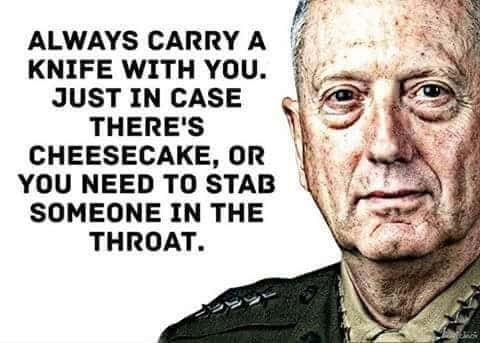
I don’t always carry a handgun. The reasons vary. If I’m not carrying, I still like to have something that will give me an advantage. I carry a folding knife for utility work (what if there’s cheesecake?), but needed something with a little extra pizazz, just in case.

By J. Bridger, contributing author to SHTFblog and Survival Cache

A small fixed blade knife fits the bill; it’s light, meaning I am more likely to carry it regularly. It takes up almost no space, so it doesn’t affect my mobility. The only downsides are the goofy knife laws. I can carry a katana and a Desert Eagle into Walmart, but a 3” fixed blade IWB is illegal? Whatever. The nerds who passed that law must hate cheesecake.

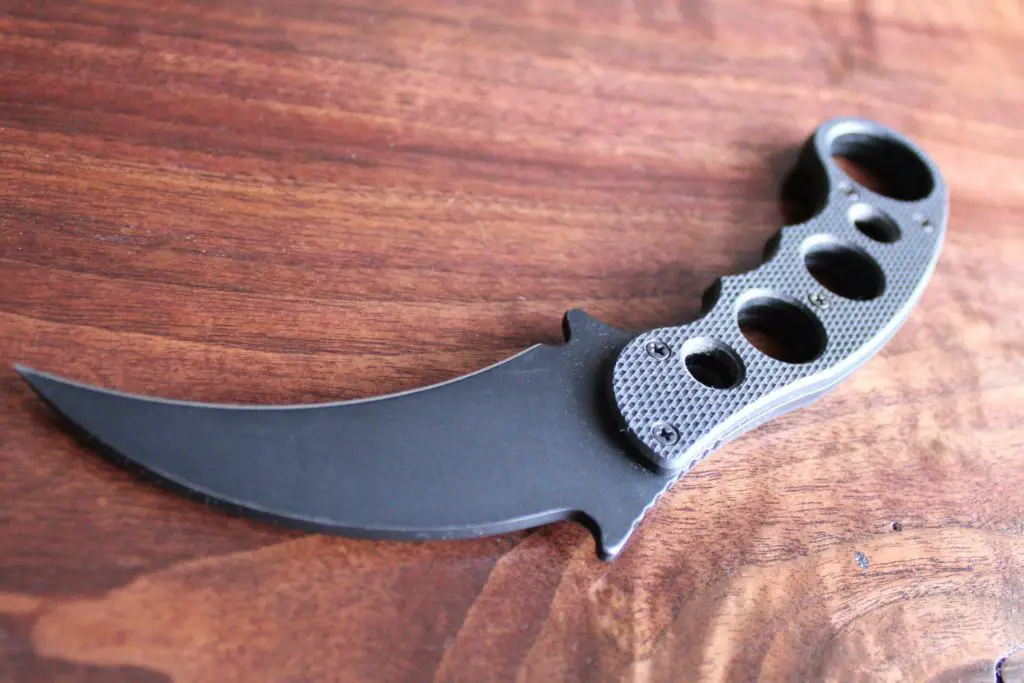
The Emerson Karambit is a solid contender for the perfect self-defense fixed blade. The only downside depends on your philosophy of use. The curved blade isn’t designed for bush craft or utility. Since I don’t intend to use it that way, it’s a non-issue. For those of you who prefer an EDC fixed blade to fill those roles, this knife may not be for you. I’m not here to debate the efficacy of fixed blades for self-defense. You think it’s a good idea or you don’t, fine with me! I contend it is better than nothing.

The knife is full tang and made of 154 CM. 154 CM is a high carbon steel with Molybdenum in the mix. It’s American made and has a hardness of 57.59 RC (reported by Emerson). It has good corrosion resistance (it is stainless, after all) and holds an edge well. It is a tough steel well suited for hard use. It comes in stonewashed or black Cerakote (like the one you see here).

Related: Neck Knives For The Masses

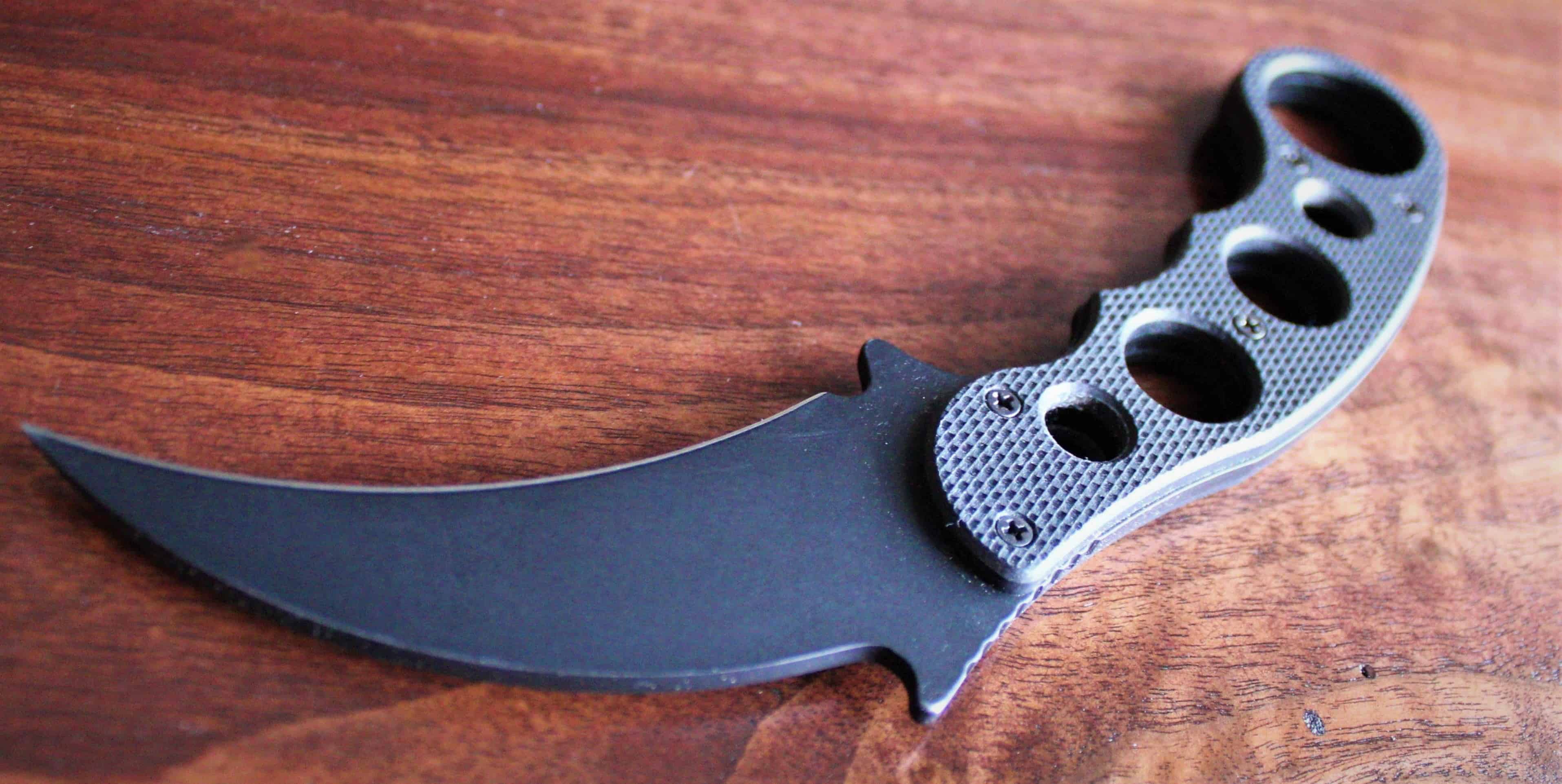
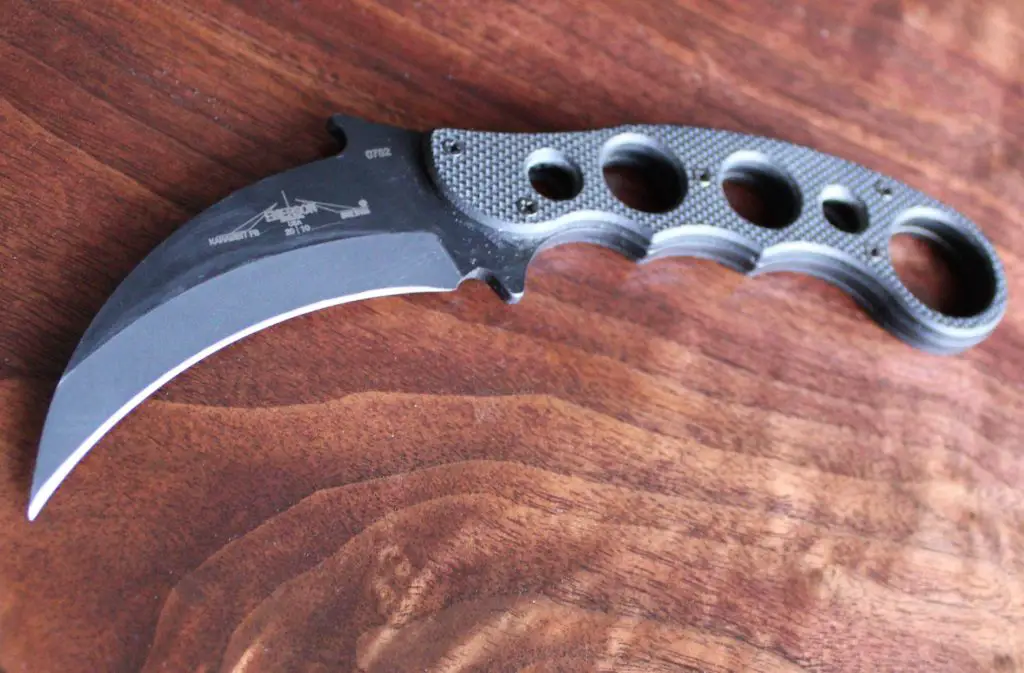
The handles are textured black G-10 epoxy. Five screws secure   them to the steel. They are thin (but comfortable) and offer good grip. There are 4 holes bored from the handle, two small and two medium size. These must have been done to balance the knife, because it handles well. One feature I think is important in a self defense knife like this is the finger ring. Holding this knife with the index finger through the ring gives you a positive grip and reduces the chance it will be dropped. Every time I hold this knife, I have an overwhelming urge to spin it. So far, I have resisted. (If I do ever spin it, look for an article about sutures). There are 3 finger grooves in the handle. It is designed for your index finger to reside in the ring, and your middle finger to fill the first groove. The final groove terminates seamlessly into the finger guard on the blade side. The guard at the back of the blade is reminiscent of Emerson’s wave feature. The back of the handle is smooth and narrows slightly where your pinky resides. The handle is curved slightly. Its evident that Emerson spent the time necessary to design an ergonomic and minimalist grip on this knife. Everything you need, nothing you don’t.

The blade thickness is 0.125” or 1/8th of an inch. I think this was a good choice. Any thinner would be too thin, and any thicker would be unnecessary. It boasts the classic Emerson chisel grind and is razor sharp. It is curved like a talon and has some smooth jimping right where you’d expect it to be. The point is very pointy. The blade length is 3.2 inches. What else can I say? It’s a razor sharp and well-made karambit. I haven’t needed to sharpen it, but it may take practice. This blade shape isn’t one I have any experience with.

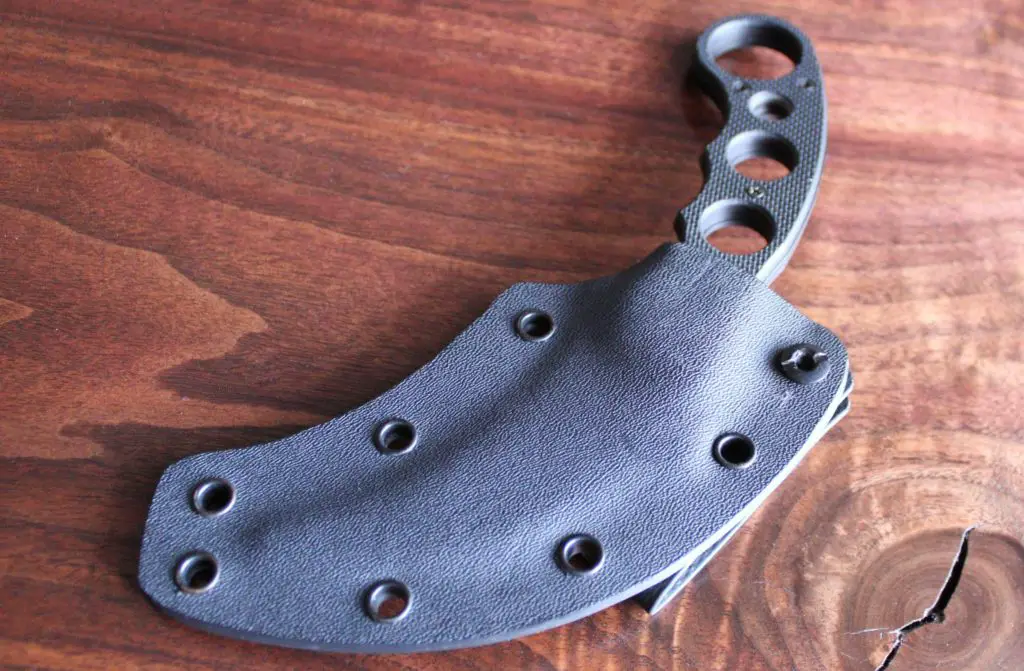
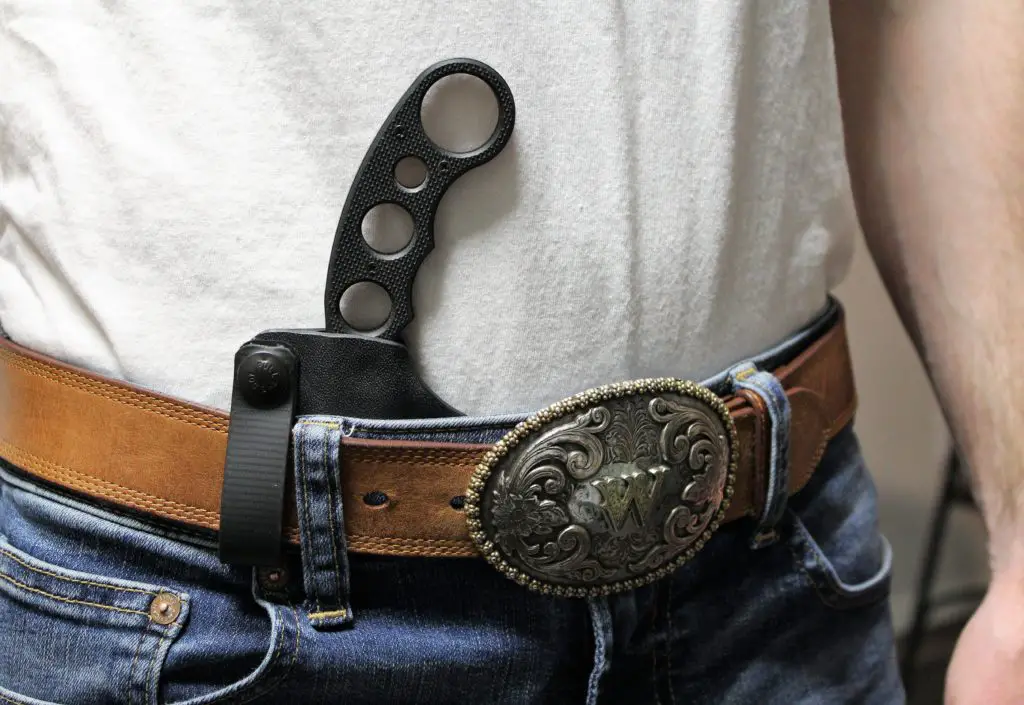
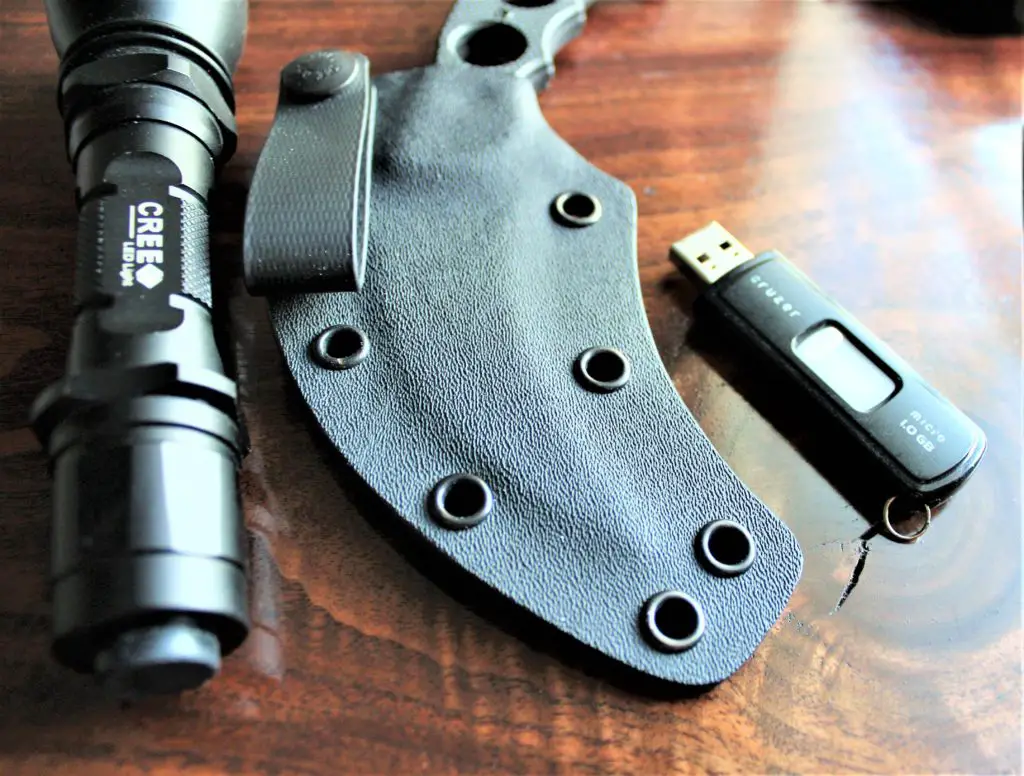
The sheath is made of kydex and holds the knife securely. No rattle here! There are 3 eyelets on the blade side, and 5 on the other. It came with a Tek-Lok system. Some people love it, but it’s not for me. For a long time, I just ran paracord through the eyelets, which allowed me to carry it OWB with a super low profile. There are no sharp edges. I recently traded in my trusty paracord belt loops for a soft loop from Tulster. I love this thing. It was $10 with shipping and easy to put on. Now I can securely carry my knife IWB.

Also read: Tops BOB Knife Review

Carrying the karambit is a breeze. The thickness of the grip panels contributes to its ease of carry. Its light and I often forget it’s there. I like to carry it near my midline, so it’s accessible with both hands if need be. I usually carry it at about 1:30 or 2 o’clock, near my appendix. I can bend over or kick my leg up with no restriction in movement. The end of the handle is smooth, so it shouldn’t hurt you. If it had a glass breaker or something on it, bending over would jab you.

I love how simple this knife is. There’s no flashy bullshit here. It’s exactly what I would expect from Emerson: High quality, well thought out, and well made. The only thing I think may improve this knife is an edge on the back of the blade, just an inch or two. Now that I think about it, having a single blade probably makes a difference legally. Double edged “daggers” seem to have more restrictive laws. Oh well. They must hate cheesecake.

Emerson Fixed Blade Karambit Specs:

OAL: 7.6 in

Blade Length: 3.2 in, Chisel Grind

Blade Thickness: 0.125 in (1/8”)

Weight: 6.5 oz (With Sheath and Tek-Lok)

Steel: 154 CM

Price: $250

Disclaimer: Knife laws vary by state! Please research and be aware of your local laws!

The post Survival Gear Review: Emerson Karambit Fixed Blade Knife appeared first on Survival Cache.

How To Hunt Game Using Long Range Rifle Scopes

Written by Wild Bill on The Prepper Journal.

Editor’s Note: I know, Summer is hardly begun, some kids still have a long Summer breaks in front of them while some return to school this week; but the time to start preparing for the upcoming hunting season is upon us so this article from James Smith at PointOptics.com is timely in the overall scheme of things.

Nothing beats the feeling of stalking a game animal successfully. It’s the pay-off for rising before dawn, hitting the trail, and using the best equipment for the job. The devil is in the details when it comes to choosing the right rifle, scope, and ammunition. And when it comes to long range riflescopes, it is a crucial step in the stalking, sighting-in, and shooting process.

This is a comprehensive guide on how to hunt game using a long range rifle scope. It includes a breakdown of the five features you should look for in the long range rifle scope you use, and the best ways to hunt game with this equipment.

Features to Look for When Choosing a Scope for Your Hunting Rifle

When it comes down to selecting the perfect long range riflescope for hunting game, the process can get complicated. The many available options just end up muddying the waters sometimes. To help you get a better picture, there are five features to look for that will make this process much easier for you.

Magnification: Choosing the magnification capacity of your long range scope is half personal preference and half scientific algorithm. The most straightforward method of considering which magnification type is best for your hunting requirements is to work out the 1 x magnification per 100 feet (30,5 meters) of shooting distance.

For example, if you were sighting-in at 300 feet/91.5 meters, you would select the 3 x magnification setting on your scope. By using this scope selection technique, you will never be looking at a target that appears more than 35 yards/32 meters away. This viewpoint is a comfortable distance for the eyesight and brain to process.

Most game hunters sight-in at around 100 yards to 300 yards/ 274 meters in distance. It is for this reason that 3 x 9 power riflescopes are the most popular choice for most hunters. It’s the ideal range where most hunters like to take aim.

Ballistic Reticles: This long range scope feature is a relative newcomer to the hunting rifle scene. It provides additional crosshairs or aiming points in the available field of view. Once you have zeroed in your rifle sight picture, you can use the ballistic reticle feature on your scope for better aiming precision.

Ballistic reticles for hunting comes most typically in two formats: Minute Of Angle format (MOA) and mil-dot format. If you have a mil reticle, you will need to have mil-dot adjustments on your scope. Correspondingly, if you have a MOA reticle, you will need to have MOA adjustments on the scope. In that way, the adjustments you make with your elevation and windage turrets will coincide with the sub-tensions in the reticle. But more about that later.

Parallax Adjustment: A parallax is the position of the reticle on your target in relationship to your eye. The PA is a popular feature on bigger, higher magnification scopes because it allows you to dial out the parallax at a specific range so that what you see is what you get. It goes from zero all the way to infinity. If you have a 3 x 9 power scope, you probably don’t need this high-tech addition. However, if you have a 4 x 12 or 4 x 16 power scope, getting a parallax adjustment is a good idea.

First or Front Focal Plane Reticle: You used to find first focal plane reticles only in European manufactured riflescopes, but they have started to become more popular in other countries, and for a good reason. A first focal plane reticle allows you to adjust the magnification on your rifle scope, but the additional aiming points you have in the reticle will still be feeding you the correct trajectory compensation information.

A second focal plane reticle is different. The hash marks only typically match the trajectory when the scope is set at its maximum magnification capacity.

Fast Focus Eyepiece: One of the main benefits of this equipment is its user-friendly integration. It is yet another bit of European technology that is spreading across the Atlantic. It allows you to fine tune your interface with the rifle scope in real time. This saves on sighting and adjusting when shooting over long distances.

There are many things to consider when choosing a rifle scope, the size of the scope, the size of the game, and the shooting distance. But these are the five scope features that you need to have basic knowledge about.

The Anatomy of a Rifle Scope

Because riflescopes are fairly costly pieces of equipment, it makes sense to buy one suitable for your long range hunting rifle and the terrain over which you will be sighting in. It also depends on the company you keep when hunting outdoors as a group. If everyone on the team considers less than 100 yards/91 meters as fair game shooting distance, and you want to go after the more challenging targets, then you should change your hunting group, not your equipment.

The scope you choose should be at least 12 x top magnification, and 16 x is preferable. Higher magnification of 6 x 24 is possible, but finding a target at close range will be more difficult, especially if it is moving. The larger the magnification, the better the optics must be. It’s no good being able to zoom in when you can’t see a clear target in low light conditions.

When you mount the scope, it needs to be with the greatest possible integrity. Any movement in the tube or loosening of the mounting screws will turn your trip into a “one that got away,” saga. It is for this reason that a standard mil-dot or MOA reticle in front focal plane position is recommended.

Once you establish the perfect sight-in distance for each of the mil-dots descending from the center, the calculation won’t change. Even if the scope is set to 8, 22, or 16 x, the first mil-dot will be set at the correct distance. The same thing applies to windage turret calculations. When you have a front focal plane mil-dot, any windage (horizontal) adjustments are the same whether the scope variable is positioned at 10 or 16 x.

Your scope should hold up to the recoil of your rifle caliber as well. Taking this into account when choosing a long range rifle scope may limit your options, sadly, but it’s a vital component to getting the job done.

Mil-Dot vs. MOA for Game Hunting

Do your research before deciding on which system to use.

  • Stick to the measuring system with which you are most familiar
  • If you are more comfortable with metric, mil-dot may be the best choice, although the “mil” is not an abbreviation of millimeters
  • If you are shooting over shorter ranges, many hunters holdover using a reticle altogether
  • Long range riflescope accuracy should consider precision, calculation ability, and equipment cost

If this calculating is ruining your hunting experience, simply carry a dope card with you at all times. Once you are more familiar with your mils, you can give over using the dots and make super-fast shots without it.

Sighting-In

Proper shot placement for long range hunting is a very important factor. It’s not as simple as sighting-in your rifle so that the cross-hairs are dead-on at 300 yards/274 meters and pulling the trigger. That means the first mil-dot (see diagram) down would be dead-on at around 500 yards/457 meters.

The best way to illustrate this is by using a trophy object standing at a distance of approximately 300 feet away at a steeply inclined uphill angle as an example. When the rifle scope is zeroed at 300 yards, it is actually almost 4 inches/10 cm too high because of the shortening of the trajectory angle. The bullet’s pathway is 4 inches above the aim point, even though the game target was at 300 yards. The best calculation is to zero the target per 100 yards. The first mil-dot should be down dead-on at around 400 yards/366 meters and the second at 550 yards/503 meters. These adjustments will ensure that the bullet path will never be above your point of aim.

Depending on what caliber and bullet weight you’re using, most riflescopes will use this basic sight-in and trajectory. The bullet has a slight left to right arc at long range. If the windage turret is set at zero per 100 yards, this can veer as much as 7 inches/17 cm off target. Counter this by setting the windage at 550 yards on a calm day. The bullet will still be 1.5 inches/3.8 cm to the left of the target when shooting at 100 to 400 yards, but it will be dead to rights at 550 yards.

Remember, the more practice you get in making these decisions, the faster they will become second nature to you on the field. And that brings us to the crucial part of long range game hunting:

Taking the Shot

Before you take any shot over 200 yards/182 meters, make a few calculations in your head using the WAR acronym: wind, angle, and range.

Wind deflection calculations: Use a handheld wind speed calculator if mental arithmetic is not your forte. It will help you formulate the wind speed, angle of the wind, and how it will affect your trajectory. There are also some useful computer software programs to help you grasp the required compensations.

Angle: Straight down being zero, and level straight out being 90 degrees, if your target is approximately 65 degrees, your angle x range multiplier will be 0.8. The more hunting experience you have, the easier it will become to gauge the angle degree. A good handheld rangefinder will calculate and angle x range multiplier of 0.7 for a 45 degree target.

When to Take Another Shot

If you are using a spotter to let you know when you’ve made a marginal hit on the target, base your next shot on the information you receive from your spotter. If the first shot was a complete miss, but the trophy target is still unaware, make the necessary adjustments and try again. If the target is on the move, withhold shooting again until the target is stationary once more.

If you begin game hunting with an experienced crew, they can guide you to all the best places to sight-in. Someone can use the spotter, and point out any beneficial observations. Remember that once your spotting scope is deployed, you will be locked into that position for a while.

A few other hunting essentials are water or energy drinks, PB&J sandwiches (they don’t turn in the heat), granola bars, and jerky. Don’t forget to wear weather-appropriate clothing, and cover up with insect repellent if it’s bug season.

The only thing left to say is Happy Hunting!

Glossary of Long Range Rifle Scope Terms:

  • 1-inch tube: The erector tube of the rifle scope, most come in 1 inch diameter
  • AO: Adjustable objective. A type of parallax correction feature
  • Ballistic reticle: Incorporates many factors for correct point of aim
  • Ballistic turret: A feature of high-end riflescopes. Allows for more than one predetermined turret setting distance
  • BDC: Bullet Drop Compensation. The relationship between the fired bullet, target, and gravity
  • Clicks: the number of rotations of the turret adjustments
  • Duplex reticle: The most common style of available reticle with cross-hairs reaching the field of view edge
  • Elevation: The vertical cross-hair of the reticle
  • Fast Focus Eyepiece: Sighting and focusing technology from Europe that allows for a sharp, crisp image
  • Fixed Power: The magnification is fixed without varying high to low power settings
  • Holdover: Calculation using BDC technology
  • Light Transmission: The amount of light that’s collected by the objective bell and transmitted to the eyepiece
  • LR: Long range
  • Original Zero: The distance for which you have sighted your scope.
  • RS: Rifle Scope
  • Turrets: Used interchangeably to describe the knobs and dials that protrude from the scope
  • Windage: The horizontal cross-hair of the reticle.

Be Safe out there and be sure to check out The Prepper Journal Store and follow The Prepper Journal on Facebook!

The post How To Hunt Game Using Long Range Rifle Scopes appeared first on The Prepper Journal.

What Is The Best Caliber For Self Defense Shooting?

self defense shooting

Bullet selection is vital when it comes to self defense shooting

Few topics can light up a range-side or gun store discussion like handgun caliber. Most every long-time handgun owner feels strongly about one caliber or another being the best. When speaking of self defense use, the term “stopping power” almost always enters the discussion. Is there a best caliber for self defense shooting? This article looks at both professional opinion and conventional thinking to answer that question.

Lets talk primarily about the differences between two common choices for a self defense handgun. The 9mm Luger and 45, whether it be the ACP, Long Colt, or any other sub-category of 45.


What Is the Goal of Defensive Shooting?

To defeat a common myth from the start, self defense shooting does not have killing as its purpose. The sole purpose of a lawful self defense shooting is to stop the attack. Despite what movies and TV would lead us to believe, only one in six people who sustain gunshot wounds die. Also counter to typical media portrayals, a single round fired from any caliber handgun has less than a 25 percent likelihood of stopping an attack. Odds go up substantially—to about 63 percent—with two shots.


Bullet Selection

It’s important to distinguish defensive ammo—including hollow point, jacketed hollow point, and newer variants (HP)—from target ammo, typically with full metal jacket (FMJ) bullets. FMJ is made to penetrate in as straight a line as its speed and mass will permit. HP is made to expand in size, after impact with solid tissue, and sometimes fragment into smaller projectiles. The wider the expansion, the more dramatic the fragmentation under ideal conditions. I’m referring to a center mass shot on a typical 12-14-inch thick critter, whether two-legged or four. Miss slightly, and that round may sail through muscle and exit the other side, not even slowing down the subject.

Performance of the smaller calibers like 9mm and .380 ACP HP has come a long way in recent years. Loads considered insufficient for penetration of clothing and fat are better dialed-in for self defense shooting. Lots of shooters like 45 for the confidence-producing big hole it makes. But in some cases, this slower-moving projectile (typically around 850 feet per second as compared to in excess of 1,000 fps or more from 9mm), can produce less penetration and fragmentation.

Handheld solar generator offers dependable backup power in times of need. 

It could be said that HP is a responsible selection of ammunition for the self defense handgun as compared to FMJ. The HP expends its energy on the first thing it meets. This bullet is less likely to sustain velocity and cause damage beyond the intended target.

A good strategy is to check out your ammo manufacturer’s website. Ballistic data can often be found on YouTube videos where some producers have gone to the trouble to re-create FBI protocol gel block tests.


What Matters More Than Caliber?

A handgun is a relatively weak weapon against a mammal like the typical human being. Permanently etched in my own memory are two grown men whom I met with in the emergency department in connection with my work, both of whom had been shot in the skull—one with 40 S&W and one with 9mm. Both had wounds that started on the side of the head and, rather than penetrating, the bullet had followed the curve of the skull until it got around the side, behind the ear, and simply went on its way. Both individuals had nothing more than minor scalp wounds.

Anyone who’s studied defensive shooting much knows that it is only a round through the brainstem or upper spinal cord that guarantees an instant stop. In all other cases, including an eventually round right through the heart, the continuation of the attack depends on the determination of the attacker.

Shot placement, followed by a sufficient number of rounds to deflate the assailant’s determination or physical capability, is far more important than caliber.


Decide What’s Right for You

I prefer to discretely carry something that offers more rounds in the gun, as well as an extra magazine. For me, navigating daily life, that means 380 or 9mm. While I admit there is greater “oomph” in the 40 and 45 loads, the former of which I carried for years and still do on occasion, it is my present and usual choice to carry something that holds more ammunition and is instantly accessible in my waistband.

When you’ve learned how your selected rounds perform in terms of expansion, penetration, compare that to your likely defense scenario.  Perhaps you live in a region where people wear heavy layers of clothing most of the year. Consequently, the .380 may not have sufficient penetration to be effective. Comfort will play a factor, as well. If you can fit your favorite 45 into a concealment rig, have at it. Many people can’t make that work. Choose something you’re confident about in terms of performance, as well as something that is wearable.

What is your favorite caliber for self-defense? Share your advice in the section below:

The post What Is The Best Caliber For Self Defense Shooting? appeared first on Off The Grid News.

7 Best Survival Machetes On The Market Today – 2019

Survival MacheteIf you’re looking for help finding the best survival machete FOR YOU, you’re in the right place.

Because there’s no way around it: all survival gear should be multifunctional.

For example, anything in my pack that isn’t serving at least two purposes is a candidate for replacement.

Why? Because in a survival situation, pack space, and weight are at a premium.

So the lighter I can make my bug out bag, the faster I can move and the further I can travel.

Also, the more compact I can make it, the more maneuverable I can be in a fight or flight situation.

One of the more recent additions to my pack is a true multitask tool – A Survival Machete!

The machete is the original survival multitool!

Now, the word “machete” tends to conjure up images of bad movies. Scenes where a group of castaways slowly follow a jungle slasher. And jungle slashing is what machetes are known for. But it’s not all this survival tool can do. There are many more uses for this versatile piece of gear.

And we’ll get into those “survival uses” soon, but first, let me show what exactly what survival machete topics I’ll be covering today:

As A Way To Introduce You To Skilled Survival, We’re Giving Away Our Ultimate Survival Gear Checklist. Click Here To Get Your FREE Copy Of It.

What Is A Machete

WHAT IS A MACHETE?


machete is a broad blade used either as an implement like an axe, or in combat like a short sword. The blade is typically 12.8 to 17.7 inches long and usually under 0.12 inches thick. – Wikipedia

Some form of machete shows up in nearly every culture around the world. They come in a wide variety of shapes and construction methods.

Many of these have specific names. There’s the Nepalese “kukri”, the Malaysian “parang”, the Philippine “bolo”, etc.

In some locations, the machete is still a common part of rural cultures. Places were very young children learn how to properly use and care for their own machete.

So when I say “machete”, I’m referring to a wide range of long flat blades with grips at the end for swinging the blade.

In this article, I’ll refer to all variations simply as “machetes”. But many blade shapes perform similar tasks and can be somewhat interchangeable.

If you looking for specific differences between different machete names – watch this excellent overview video:

man removes the bark from a tree

MOST COMMON MACHETE USES


For a tool to be so widespread around the world, it has to be well-designed for the task at hand.

With the machete, these tasks include:

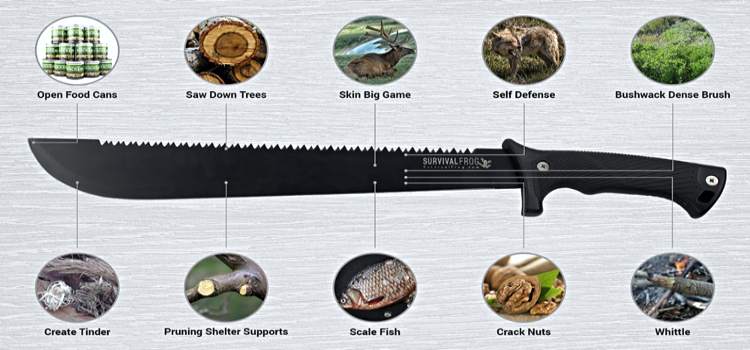
  • Self-Defense
  • Harvesting Produce
  • Skin Big Game
  • Open A Can
  • Bushwhack Dense Brush
  • Prune Shelter Supports
  • Saw Down Trees
  • Create Tinder
  • Shaving Bark
  • Whittle Wood
  • Scale Fish / Fillet Fish
  • Crack Nuts
  • and more!

Few tools have the ability to chop down a small tree just as quickly as it can scare off intruders. But the machete can – and that’s what I call “insane versatility.”


But to have such versatility requires important features. So let’s go over the key features to look for in your next survival machete.

As A Way To Introduce You To Skilled Survival, We’re Giving Away Our Ultimate Survival Gear Checklist. Click Here To Get Your FREE Copy Of It.
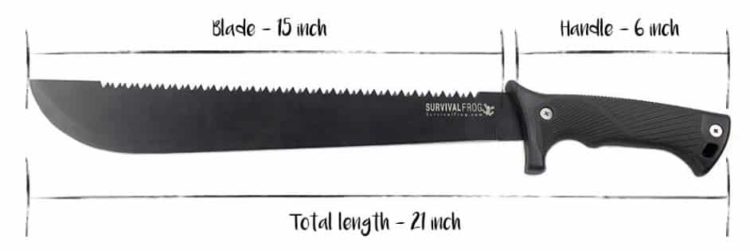
Survival Frog Survival Machete

IMPORTANT MACHETE FEATURES


Most machetes feature a short, heavy blade. It’s generally sharpened on one side and left blunt or serrated on the opposite side.

And for most, you can wield it with a single hand.

Most blades fall between 14″ and 24″ long. Though some applications (such as pruning trees) call for a longer, lighter blade.

Type Of Blade Steel

High-carbon steel blades that are tempered into a spring-like steel are traditionally best for machetes.

This results in a very strong but flexible blade. One that handles shock better and is more resistant to breaking or chipping.

The downside to this type of steel is that it can be more prone to rust and doesn’t hold an edge as long.

The rust can be managed by frequent cleaning and wiping the blade with oil. And a coarser bevel on the blade resist dings and dulling.

There are also stainless steel machete blades on the market today.

And while these blades are far more resistant to rust, they tend to be more brittle and can break with heavy abuse.

Plus, normally stainless steel can be difficult to properly sharpen.

So, for your next survival machete, it’s best to avoid stainless steel. With that said, there is an exception. There are a few stainless steel blades that use a new type of stainless steel – 3CR13 Stainless Steel.

This stainless steel has both the rust-resistant properties but also is easy to sharpen and has impressive durability.

The bottom line is:

A dull blade is worthless since it won’t cut. And a weak blade cannot be trusted. Why? Because it’ll break when you need it most. So the type of steel matters!

Full Tang Construction

Machetes are often used in hacking and chopping tasks, so you want yours to be extremely durable.

They’re frequently built full tang.

This means the metal of the blade extends through the handle. And the grips are usually attached by a rivet through the blade.

Full-tang construction is far more durable and partial tang. Because the blade can not come free of the handle during rough use.

Multi-Functional Design

Several modern machete styles feature a saw-bladed back. This gives the user the ability to make finer cuts or saw through material too thick to chop.

These saws generally don’t have much tooth-set. So they don’t cut and clear sawdust as well as a dedicated sawblade. But they provide an extra function in one package which is worth it.

Another frequent feature of modern machetes is a solid steel pommel, the end cap on the bottom of the handle.

This solid steel cap provides a makeshift hammer without damaging the handle.

Don’t Forget About The Sheath

You also want your machete to come with a quality sheath. Without a sheath, these blades are dangerous to carry.

The blades are both long and sharp so they can accidentally bump your legs, arms (or if it’s on the outside of your pack) others.

Make sure the sheath is thick, fits the blade well, and has a way to secure the blade in the sheath. You don’t want the sheath slipping off during a scramble!

7 BEST MACHETES FOR SURVIVAL


When choosing a machete, remember to look for the critical features of a quality model.

  • Full tang construction
  • Medium or high carbon steel (or 3CR13 stainless)
  • Comfortable grip
  • Well balanced swing
  • Good, easy to use sheath

There are hundreds of machete models on most internet marketplaces. That’s both good and bad.

More options are good because there are lots of designs, sizes and price points for everyone. But also bad, because it’s overwhelming to try and analyze them all.

And that’s where we come in. Here at Skilled Survival, we focus on the very best gear for survival. So we only highlight and feature what we consider the very best at different price points.

So let’s get started!

1 – The Essential Tact Machete
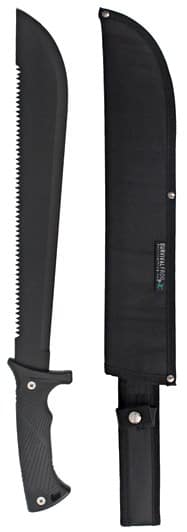
The Essential Tact Survival MacheteThe Essential Tact Machete is one of the strongest, sharpest, and easiest to use machetes ever made at such an insanely low price point…

So what’s the catch? It’s a stainless steel blade. Recall what I said early, “to avoid most stainless steel blades”…

This blade is that exception – it’s made out of 3CR13 Stainless Steel. This hybrid stainless steel provides a perfect balance of durability, corrosive resistance, and edge holding ability.

One often overlooked feature in a machete is its coating. The Essential Tact’s entire blade (plus the handle) is coated in a matte black finish.

This finish is ideal for survival since it doesn’t reflect light.

Giving this machete the ability to keep you hidden during a dark escape or stalking situation.

Now at this price point, you’d probably guess it’s not full tang. But you’d be wrong!

The Essential Tact Machete is a full tang machete (with a small hole punched through at the base for a lanyard).

This guarantees that no amount of rough handling will harm it.

And speaking of handles, this handle provides both extreme comfort and grip.
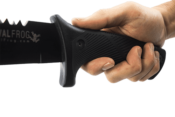
It’s coated in an ultra-rugged, non-slip rubber finish. So no matter how wet or sweaty your hands are The Essential Tact Machete won’t slip.

Also the lining the inside of the rubber coating is a plush layer of polypropylene. This helps to provide extra cushioning. Helping to eliminate the bone-jarring hand shocks you’d experience otherwise.

Not to forget safety, the Essential Tact Machete has a deep, ridged thumb rise. Plus, an oversized finger guard to keep your hands safe from the blade edge – even during the most violent swings.

One of the features that make this machete a “true survival blade” is the tool added to the back of the blade. Instead of leaving it as a dull edge, they turned into a serrated saw blade.

Again, for me, it’s all about multiple uses in one tool. This is a survival machete/survival saw combo in one.
Sure, there are more expensive machetes out there. But they can’t hold a candle to the Essential Tact if you’re looking for a SURVIVAL machete at a value price point.

Check Out Today’s Price


2 – Woodman’s Pal 2.0 – Multi-Use Axe Machete with Sheath

The Woodman’s Pal Machete has been around for decades. It was used by the US Army since WW2!

And it’s received upgrades from 70+ years of testing in the harshest combat conditions.

You can use the current version as a machete, a shovel, an ax, and a knife.

The full tang construction features hard ash wood handles and a black finished blade.

All the cutting edges are hand sharpened before shipping. So the Woodman’s Pal Machete arrives ready to go to work.

They also come with a full-grain leather sheath to protect the edges while not in use and to make carrying easy.

Each order includes reprints of the original US Army manuals. This covers both use and sharpening of the machete, even fighting with a machete!

They’re also made in the USA by skilled craftsmen in Lancaster County, Pennsylvania.

Of course, all that craftsmanship comes at a price, with this blade topping the price list.

Check Out Today’s Price


3 – Fiskars 29 Inch Machete Axe

This 18-inch blade is ideal for clearing, chopping, cutting any vegetation in the wilderness or around your home.

This Fiskars Machete has an axe-like blade that provides enough power for splitting wood.

The curved blade also offers the ability to easily remove suckers and vines from trees.

It’s an excellent everyday machete that includes a good sheath and a lifetime warranty.

Check Out Today’s Price


4 – CRKT Chanceinhell 18″ Carbon Steel Machete

Columbia River Knife & Tool is a reputable manufacturer. One that makes an entire line of extremely high-quality knives and multi-tools.

This 18″ blade machete works well for heavy for hacking through thick vegetation.

It features a drop-point blade shape, with a center of mass closer to to the point than the handle.

This balance makes it efficient for chopping, but tiring if you’re spending the whole day doing so.

The handle is a little smaller than most but makes up for it with good finger grips to keep your hands from slipping.

Check Out Today’s Price


5 – BareBones Woodsman Japanese NATA Tool
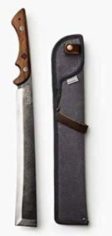
BareBones Woodsman Japanese NATA ToolOne of the more distinct blade shapes on our list is The BareBones NATA Machete. It’s a traditional Japanese garden and utility tool.

The straight edge and sharpened chisel point give you lots of blade options. It’s great for both chopping and hollowing out materials.

The BareBones Woodsman is easier to sharpen than many of the curved blades.

But it only has 12 inches of sharpened blade length. So this machete straddles the line between a true machete and a large survival knife.

It’s not the best choice for heavy brush cutting and chopping through thick branches.

Check Out Today’s Price


6 – Ka-Bar 2-1249-9 Kukri

Another unique blade is The Ka-Bar Kukri Machete. It’s based on the traditional Nepalese kukri blade.

It has an unmistakable forward-hooked blade, similar in shape to a boomerang.

The hooked blade puts the center of mass towards the tip of the blade and in front of the handle.

It’s only sporting an 11.5″ blade. Making it an EXTREMELY efficient tool for chopping through branches and vines.

As you chop, these materials settle into the crook of the blade. This brings all the swing force onto one focal point and not allowing it to slip off the target.

It’s also a very effective combat tool.

Check Out Today’s Price


7 – Condor Duku Machete
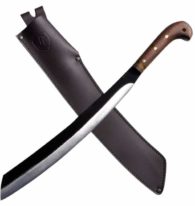
Condor Tool & Knife Duki MacheteFinally, The Condor Duku Machete is yet another distinctive blade shape.

More sweeping and far narrower than most other machetes. The Duku blade is ideal for slashing cuts instead of chopping.

This design helps in cutting through lighter vegetation. Making slicing for harvesting and processing produce a breeze.

The high-carbon steel blade is easy to sharpen and stands up well to repeated blows.

It’s very easy to swing the blade as well. With the narrow profile and center of mass near the tip making it easy to maneuver for precision cuts.

But it’s also heavy, so it can get cumbersome to swing all day.

Check Out Today’s Price

SURVIVAL MACHETE WRAP UP


Sure, I get it, the machete seems like a simple tool. It’s just a large flat blade with a handle.

But as you now know, there’s a lot more to consider. They can be incredibly versatile tools – especially once you learn the proper techniques.

It can take on the role of a survival knife, a survival ax, a self-defense weapon, a survival shovel

In some cultures, it’s the only tool one needs to settle the jungle and start a village!

I’ve found it incredibly useful during recent camping trips. That’s why it’s earned a permanent place on my survival gear list.

As A Way To Introduce You To Skilled Survival, We’re Giving Away Our Ultimate Survival Gear Checklist. Click Here To Get Your FREE Copy Of It.

Jason K.

P.s. Do you know where the closest nuclear bunker is from your home?

There are a lot of natural nuclear shelters in the US that are absolutely free. And one of them is near your home.

Click on the image above to find out where you need to take shelter.

The post 7 Best Survival Machetes On The Market Today – 2019 appeared first on Skilled Survival.

Women In The United States Are Having Fewer Babies Than Ever Before In History

According to the National Center for Health Statistics, the fertility rate in the United States has never been lower than it is right now.  Unlike some of our other problems, this is not an immediate crisis because we definitely have plenty of people.  The population of the U.S. is currently well over 300 million, and more immigrants keep pouring in with each passing day.  So we are in no danger of running out of people, but the fact that Americans are choosing to have so few babies is yet another symptom of the social decay that is eating away at our nation like cancer.  From a very early age, young Americans are being trained not to value marriage, parenthood and the traditional family unit.  As a result, we are on an extremely self-destructive path, and there is no way that we are going to have a positive future as a country unless we change course.

The fertility rate in the U.S. has been in decline for many years, and just when you thought that it couldn’t possibly go any lower, it did

The general fertility rate in the United States continued to decline last year, according to a new report from the US Centers for Disease Control and Prevention’s National Center for Health Statistics.

“The 2018 general fertility rate fell to another all-time low for the United States,” the researchers wrote in the report, published Wednesday.

In fact, a separate report that was put out by the National Center for Health Statistics in January revealed that our fertility rate has now fallen below replacement level

In 2017, the total fertility rate for the United States continued to dip below what’s needed for the population to replace itself, according to a separate report published by the National Center for Health Statistics in January.

In other words, not factoring in immigration, our population would actually start shrinking if our fertility rate continued to stay at the current level.

So why is this happening?

Certainly our poisonous environment is a major contributing factor.  Sperm counts are way down all over the western world, and that could soon become a massive problem.  We are literally poisoning our reproductive systems by what we eat, by what we drink and by the air that we breathe, and our phones are perhaps the biggest danger of all.  And now that 5G is being rolled out, many experts are sounding the alarm louder than ever.  For much more on this, please see this article.

In addition, dramatic cultural changes have completely altered the way that Americans view parenthood.

Once upon a time, getting married and having lots of children was considered to be an integral part of the American Dream.  But now our young people are being encouraged to put off marriage and parenthood, and they are constantly being told that “getting an education” and pursuing a “career” are far more important.

At the same time, the single life is continually being glamorized in popular music, on television and in the movies.  Marriage is often portrayed as “the end of freedom”, and the idea that having children “can ruin your life” is relentlessly promoted.

As a result, the marriage rate in the U.S. has never been lower, the fertility rate in the U.S. is at an all-time low, and Americans are getting married for the first time later in life than ever.

Have all these dramatic changes made us happier?

No way.

In fact, one recent survey discovered that Americans “are among the most stressed populations in the world”

Americans are among the most stressed populations in the world – on par with many countries in the developing world, according to a new survey on global well-being.

Some 55 percent of Americans reported feeling ‘a lot’ of stress within the past 24 hours, according to the Gallup poll of roughly 150,000 people around the globe – including more than 1,000 U.S. adults.

That puts Americans well above the global average of 39 percent.

And as I have discussed previously, “deaths of despair” in the U.S. are now higher than they have ever been before…

According to a shocking new report from the Commonwealth Fund, the suicide rate in the United States is the highest that it has ever been before. Sadly, the same thing can be said about the death rates from drug overdoses and alcohol. All three death rates are at an all-time record high, and yet our society is still fairly stable at the moment. So if we are seeing this many “deaths of despair” right now, what in the world are things going to look like when our society really begins to start crumbling? Today, Americans have literally thousands of different ways to entertain themselves, and yet we have never been unhappier. One out of every six Americans is taking psychiatric drugs, we are currently dealing with “the worst drug crisis in American history”, and people are killing themselves in record numbers. Nobody likes to be told that they are a failure, but it certainly appears that our nation has been on an extremely self-destructive path for a very long time.

Could it be possible that being an extremely narcissistic, selfish, self-centered and self-obsessed society is not the way to go?

Of course some women actually believe that they are staying childless for noble reasons.  For example, it has become quite trendy for young women to say that they are never going to have children in order to fight climate change.  The following comes from a BuzzFeed contributor named Ash Sanders

When I first made the decision not to have a baby, in 2008, I did it because I couldn’t imagine bringing another human into a world already so overheated and overcrowded. I didn’t know anyone like me at the time. But in the intervening decade, the world’s climate change problem has escalated to a crisis, and people across the world are grappling with the question of whether to have children in such uncertain times. In February, Rep. Alexandria Ocasio-Cortez broke Instagram when she so much as raised the question. A few weeks later, Utah Sen. Mike Lee, on the opposite end of the spectrum, argued on the Senate floor that the solution to climate change is to “fall in love, get married, and have some kids.” Meanwhile, in the UK, environmental activist Blythe Pepino launched BirthStrike, a social media–focused movement that questions having children in the face of ecological crisis.

These women have become so brainwashed that they are actually willing to give up one of the greatest joys in life just so that they can show everyone around them how “dedicated” they are to the cause.

As I discussed in my most recent book, bad beliefs lead to bad decisions.  When you put garbage in, you are going to get garbage out, and we can see the evidence of that all around us.

Without strong family units, no society is going to survive for long.

Right now America is living on borrowed time, and we desperately need to return to the values that this nation was originally founded upon.

Get Prepared NowAbout the author: Michael Snyder is a nationally-syndicated writer, media personality and political activist. He is the author of four books including Get Prepared Now, The Beginning Of The End and Living A Life That Really Matters. His articles are originally published on The Economic Collapse Blog, End Of The American Dream and The Most Important News. From there, his articles are republished on dozens of other prominent websites. If you would like to republish his articles, please feel free to do so. The more people that see this information the better, and we need to wake more people up while there is still time.