Survival Gear is the most unused product until a natural disaster happens, then it’s the most desired products, but usually too late to help those that really need the help.

We sell around the World, and pride ourselves on offering a level of customer service that we would want to see ourselves if we were shopping online.
Our product ranges change regularly, so we hope that you come back to our sites to see some of the fantastic offers that we regularly have.

Get In Touch

How to Know When to Bug Out

Are You Ready for SHTF?

A year or so ago, I became interested in preparing for a disaster, so I went to the Internet to see what other folks are doing to prepare. I was surprised to learn the number of people who have been preparing for quite some time, and also at the level of their preparations; purchasing remote properties, building up a personal arsenal, and buying and storing food stocks for their families.

I figured I needed to ‘get on board’ and start my own preparations. I had a lot to do and a lot to consider; food stocks, weapons and ammunition, off-the-grid living,communications, tools, skills, bug out bag, get home bag, maps, cash, precious metals, and much more. Whew!

I am a planning-type person, and I don’t usually do anything without careful consideration and a solid plan. I like to think through what I will do, what I might need in the way of tools, parts, etc., and what my desired results are before I begin a project. Like all my projects, whether they be a family vacation, changing the brakes on my car, or preparing for a disaster, I feel a need to plan.

I decided to work on my preparedness tasks in parallel. As I was building up my food stocks, I also built up my weapons and ammo stock, and continued to read and learn about preparedness and survival. When I began to tackle a bug out plan, I found the task quite difficult as I thought through the three elements of how I tackle projects:

  1. What is the task or tasks involved?
  2. What items and tools will I need?
  3. What are my desired results?

Right away, I knew the answer to question three. In a bug out situation, I desired to stay alive and have the best quality of life possible for the situation. Answering questions one and two were not so easy. The planning gene in my head caused me to think about what actually is involved with pre and post “bugging out” in order to answer the first two questions. As I thought about making my plan, a sound solution to bugging out became quite murky.

There are many websites, blogs, and videos available via the Internet that provide information, ideas, and examples of bug out situations, bug out equipment, and bug out strategies, and I eagerly studied as much as a I could. I initially thought bugging out was a mighty fine idea when the SHTF. After careful consideration, though, I have concluded that bugging out should be my last resort, my “plan Z”, and only after I’ve tried every possible way to avoid it. I offer these bug out cons for your consideration:

The Plan

Everyone should have a plan and equipment for bugging out for those extreme situations when your back is to the wall, or marauding gangs are torching every house on your street. If you must bug out, have a pre-planned destination, and you must get there before your supplies run out. Essential to your bug out plan is to clearly define the condition(s) that would trigger your “got to bug out” alarm.

Remember, though, you’ll be quitting your job, abandoning your house, and your bills will pile up in your overflowing mailbox and remain unpaid. When a crisis occurs, you will not have time to make a successful bug out plan, so you must make your plan now. Anyone can make a plan, but it takes careful thought and consideration to make a successful plan.

Quality Of Life

The notion of bugging out is quite simple; grab your stuff and go. However, after bugging out and arriving “somewhere”, then what? What will you do and what will be your quality of life? When you are at home, all your equipment, food stocks, weapons, and gear are basically within easy reach.

If you have prepared and planned well, you can stay indoors for quite some time and enjoy a high quality of life. You can continue to sleep in your bed, have a bathroom down the hall, and even keep up with current events and what’s happening in your neighborhood.

The act of bugging out brings on its own set of potentially dangerous problems that you will have to deal with and suffer through “on the fly.” In all of my Internet travels, I have yet to see a bug out bag that was stocked and equipped as well my home. Bug out bags usually provide basic survival-type equipment and rations for up to 7 days.

The prospect that my situation would become that much more precarious after my rations ran out is none too appealing. Can I really depend upon hunting, fishing, and berry scavenging?

Land Mines

You are much safer in your own home in most situations. With adequate planning and supplies, you can hunker down and survive through chemical and even biological gas clouds. You can still call the police who might be able to assist you. You and your neighbors might band together to improve your collective security. Think long and hard before you engage in bugging out.

On your way to your pre-determined bug out destination, you need to avoid being ambushed, injured, robbed, or worse. You will not know who is friend or foe, and you must remain as inconspicuous and “normal” as possible.

I think it is unwise to assume you can and will homestead in the forest, hunting and fishing like Daniel Boone until “someone” gives an “all clear” and you can return home. You will not be the only person in the forest, and any food that is available will quickly be hunted or scared away. Your forest will soon be overrun with survivalist who claim hunting territories, and battles will ensue. Gangs will form and if you’re a loner, you will not survive.

Under such conditions, it would be nearly impossible for you to rest or sleep. You’d have to be on your guard 24/7. You couldn’t leave your camp to hunt or fish for fear of coming back to nothing, or a pack of squatters who have taken over your camp and everything you depend upon.

If you knew or sensed that others were in your forest, having a camp fire would be a bad idea because it would give away your location. How would you stay warm, or cook your kill? What if someone off in the distance sees smoke and calls 911 to report a forest fire? What about the winter cold or the summer mosquitos?

What would you do? Remember, you took only your bug out bag which did not have a sleeping bag or multi-season clothing. Sure, you have your big bowie-knife, your .22 rifle, and your length of para cord, but what about those other hundred items you need now that are back home?

Remote Hideaway

If you are one of the fortunate individuals who has some land in a remote location that you have already set up to be your bugged out location, great! The difficult task for you is to know when to bug out and before the crisis or disaster occurs. Timing will be critical. Bugging out after the crisis only increases your chances that you’ll be stuck in gridlock traffic, apprehended, robbed, or again, even worse.

Predicting when and where a disaster or crisis will occur is anyone’s guess. If you guess wrong, then you would have bugged out for nothing, and increased your chances of coming home to a looted and ransacked house.

Abort! Abort!

If you decide to return home, your immediate task would be to navigate your way through or around newly formed gangs and other non-friendlies you might encounter. If you bugged out with your get home bag, it is safe to say that any food you had in your get home bag would have already been eaten a long time ago.

You might arrive home only to find that your house has been looted, and all the food, gear, weapons, and supplies you didn’t take with you when you bugged out are gone. Your windows are broken, your electronics have disappeared, and you quickly discover thieves stole all the copper wires and pipes in your house, along with your refrigerator.

We all know that thieves are not a considerate lot. Since they took your copper pipes and left the water turned on, your house is now flooded, and your water bill is over $1,000. To add insult to injury, every thread of clothing, shoes, tools, and anything of any value that you had is now gone. Was it bugging out or going home that was the wrong decision?

Conclusion

I am unable to convince myself that I, after being so dependent upon grocery stores, utilities on demand, and sound shelter for decades, could just set up camp in the forest for an unknown length of time with only a bug out bag. You know, I am not the MacGyver type.

What do you think? Is “bugging out” a better plan than “bugging in”?

Courtesy of The Survivalist Blog.

Gear Review – Osprey Talon 11 Pack

I recently went on a day hike in the desert and brought my Camelbak M.U.L.E. I’ve had this pack for at least ten years, maybe more. It’s been a good companion, holding 100 oz in the bladder and a few other items. Before my hike I had wanted to pack a rain jacket but didn’t have the room. Climbing over rocks later on, I got hot but didn’t have the space to stow my fleece. Then it rained on me. It was evident I needed something with more storage space that was still light. I wanted something that was good quality but not covered in MOLLE webbing. I love bags, so any excuse to get a new one is good enough for me!

By J. Bridger, contributing author to SHTFblog and Survival Cache

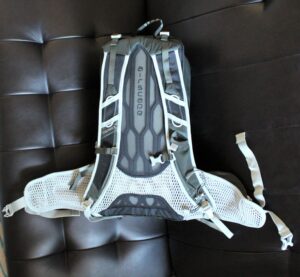
Enter the Osprey Talon 11. If you’re looking for a day hike pack, an everyday carry bag, or an innocuous pack for a grab-and-go bag, this is a good contender. It’s lightweight, comes in two sizes, has enough capacity to carry your essentials, and has a great suspension system. It will carry whatever you put in it comfortably. It has good back ventilation, a sternum strap, and a hip belt. Let’s take a closer look!

I mentioned the Osprey Talon 11 comes in two sizes: you have Small/Medium and Medium/Large. Confused? Me too. Moving on. It comes in several colors: Black, red, bright green, blue, and yerba green. I chose yerba green, which is similar to a dark olive drab. An added bonus is Osprey’s All Mighty Guarantee. I appreciate good customer service, and steer clear of companies that don’t share that sentiment. If your pack needs repaired, they’ll fix it, doesn’t matter how or when. Simple!

 Capacity

The S/M has 9 liters of storage and the M/L has 11 liters. It’s on the small side for a day pack. If it were any smaller, I’d want a bigger one. The Osprey Talon 11 has one main pocket, and a separate pouch for a water bladder (sold separately). It can accommodate a 3-liter bladder (though keep in mind this will limit how much you can fit in the main pocket). My 3L Hydrapak takes up a substantial part of the pack’s capacity. That’s okay, I bought this pack mainly to carry water. I can cram 3 full size bath towels into it, if that gives you any idea of its capacity. It can hold my day hike loadout with a little room to spare: 3L Hydrapak, down jacket, rain jacket, beanie, headlamp, Spyderco PM2, bic lighter, water tablets, Chapstick, handkerchief, compass and map, and 6” Emergency Trauma Dressing.

Features

The Osprey Talon 11 pack is loaded with features, almost too many. I don’t like having loops hanging off the pack to snag. Luckily, I was able to remove some of them without damaging the pack. I can reattach them later if I decide I want to; I really appreciated this feature. Inside the main pocket is a mesh pocket with a clip for your keys. I can nearly fit my spread-out hand inside; it’s a good size. On the front flap, there is a top pocket that is a little larger than the inside pocket. If your pack is stuffed full, these will really only accommodate flat items. On either side of the pack are two elastic pouches. These are too small for a 1L Nalgene but will hold one of the smaller, thin walled 17-ounce water bottles perfectly. There is a cinch strap on each side that you can place over the side pouch or tuck inside.

The hydration compartment has a buckle to hang your bladder. You can get into this pouch without opening the main compartment. A small handle is sewn on top of the Osprey Talon 11. On the front of the bag is a neat device you can use to attach a helmet. This would be great for biking, kayaking, or outdoor climbing. I was able to untie this and remove it without permanently damaging anything. There is a generous amount of shock cord underneath, which I like. It’s a great place to hang wet socks to dry. The compartment buckles at the top, allowing you to stuff something larger inside, like a shirt. Below this are two slots for a bike light.

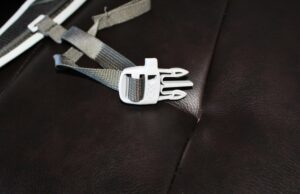
The sternum strap has a built-in whistle that works surprisingly well. This is a great addition that shows how much thought was put into the Talon. If you’re lost, you can blow the whistle instead of yelling (it’s louder and saves energy). The hip belt is one of my favorite features of this pack; they are made of breathable material and have a generously sized pocket on each side. They can be a little difficult to get into when you’re wearing the pack, but it’s far from impossible to access. These hip belt pockets are perfect for holding a compass, Chapstick, and Cliff bar. The hip belt is easy to tighten and loosen; Osprey really did an awesome job here.

The shoulder straps are comfortable and have lots of adjustment. There are two usable elastic loops on each strap, perfect for hydration tube routing. On the left strap, there is a long skinny elastic pouch sized just right for a pocket knife or a Surefire G2 Nitrolon-sized flashlight. It’s too narrow for a cell phone, and I wouldn’t want to cram my Wiley-X’s in there. Also, on the left shoulder strap of the Osprey Talon 11 pack is a short piece of shock cord to secure your hiking poles, with the help of a loop hanging off the bottom left side of the pack. I won’t use this feature, so I easily removed both to keep things simple. Lastly, on the right side of the pack is an ice axe attachment. I also won’t be needing this, so I tucked the loop up under the front flap and removed the shock cord. 

 Osprey Talon 11 Uses

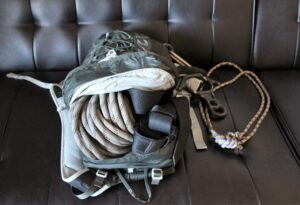
This bag is well thought out and could easily fill many different roles. I intend to use it as a day hike pack, but it could also be used as a range bag, everyday carry bag, laptop bag, canyoneering or small climbing bag (It holds a 45-meter static line, harness, and has a helmet attachment point), or a go bag. It’s also small enough to be a carry-on personal item for a weekend flight. The Osprey Talon 11 is lightweight, well built, and has an awesome warranty. You really can’t go wrong with this one!


Specs:

Weight: 1lb 6oz (22 oz)

Capacity: Medium/Large = 11 Liters. Small/Medium = 9 liters.

Features: hip belt, sternum strap, helmet attachment, hiking pole attachment, ice axe attachment, hydration compartment.

Cost: $100

 Pros:

Hip belt and pockets

Ventilated back

Lightweight

Osprey’s All Mighty Guarantee

Packed with features

 Cons:

Doesn’t come with a bladder


Get Me Home Bag

Written by Wild Bill on The Prepper Journal.

Editor’s Note: This came in at a fortuitous time, as it relates to an end-of-year deal I’m trying to put together. Guest contributor Jonas Grumby writes about the “Get Me Home Bag,” which he says is different from the bug-out bag. What say you? Is he onto something?

The Prepper Journal has many entries that discuss bugging out or hunkering down. This will not be another one. Not exactly, anyway. Let’s imagine you have a emergency plan that involves leaving or staying put. In a perfect world, we are at home with the entire family when the balloon goes up.

But we don’t live in a perfect world. 

What is your zombie plan?

We have jobs where we commute an average of 7 to 16 miles with a 27-minute  drive time. Natural disasters such as hurricanes give enough time to leave, but earthquakes, tornadoes, and flash floods give little, if any, warning. Let’s not forget that civil unrest, such as the 1992 Los Angeles Riots and the Ferguson Riots, can flare up and spread very quickly.

What are your plans should this regional emergency occur while you are at work? Driving home might be the fastest option, but what if it isn’t? What if traffic, road damage or ‘I forgot to get gas during lunch’ prevent it? You’ll have to walk.

But can you? Aside from the physical element of hiking home, do you have the supplies needed to walk the 3, 6, or 10 miles (or further)? If you don’t have a Bug Out Bag (BOB) in your vehicle already, you should think about creating a Get Me Home Bag (GMHB).

Photo by Axel Holen on Unsplash

The get me home bag

Here are some things to consider having in your office or vehicle at all times:

  • Footwear – for people working in an office setting, this is a big factor. Dress shoes or heels may look nice in the boardroom, but walking home in them will be a nightmare. Do you have any place to store a pair of sturdy sneakers or lightweight hiking boots and a couple of pairs of socks?
  • Hydration – For people like me who live in Phoenix, this can be a life-or-death issue. Having to walk home in June could literally kill you during normal times. Imagine trying it during an emergency. If you can get water from your office or other safe location (water bottles?), then you’re off to a good start. You’ll have clean water as well as extra water holders for the journey home. If you don’t, having a 1L water container like a Nalgenebottle will be important.
  • Flashlight – While most phones have flashlights, they’re really only good for a very short distance and they drain your emergency communication device. Some flashlights can run on lithium batteries (higher power but short lifespan) or AA-batteries (less powerful, long lasting and easy to find anywhere). Current generation of LED make these very powerful, even on alkaline batteries. I carry a small flashlight with me all the time, much to the amusement of some coworkers.
  • Cellphone – Everyone has a cellphone, but do you always have it with you? Are you always charging it, or do you wait until you get in the car for your trip home? You’ll need a way to charge it.
  • Portable Power Pack – Cellphones no longer have the 3-5 day battery that some older units did. If you’re away from a regular power source (or the power is down), a small portable power pack will keep your phone going for a long time.
  • Knife and Multi-tool – Most multi-tools have an integrated blade, so you might even be able to ditch the folding knife. That said, I prefer a separate knife I can always carry, like the flashlight.
  • Maps – Work commutes can get to the point where it’s like being on autopilot. But is that route the best one? The most direct route might not be viable on foot, especially if you have to go through any sketchy areas. A map can help you plan which ways to take, and which to avoid.
  • Food, safety and comfort – For a 6-16 mile walk home, you may not need food. But if it happens at the end of the workday, you’re likely to be hungry. If you have to hole up for the night, you’ll be glad you have something to eat. 
    • Having some snacks or something to eat can be a good morale boost as well as fuel for the journey. You don’t have to have a full MRE, but they’re convenient and keep well. Trail mix, nuts or other calorie-dense foods should suffice.
    • Most employers have policies against self-defense tools on property, but you can always leave something like that in your vehicle. Some states like Arizona even have laws permitting employees having firearms in their vehicles while at work. Check you local laws and company policy for details.
    • Don’t forget some toilet paper, some first aid (band aids and moleskin) and something to protect against sun and dust (a shemagh works well for these) and a pair of gloves to protect your hands.

The get me home bag

I’m lucky…I work less than 7 miles from home. Pictured below is the kit I have assembled. It’s easily stored in a small drawer at work, or my laptop backpack, which doubles as my get home bag. I happen to have a decent supply of MREs, but I could make my kit smaller by substituting some trail mix and energy bars.

My get home bag

These items can easily be integrated into a larger bug-out bag you may already have, or even be redundant to your BOB. Remember, two is one and one is none when it comes to life-critical supplies. The most expensive thing in that kit was the MSR water filter. 

Not pictured are the shoes and extra socks I kept in my desk drawer, nor is my first aid kit (aside from the Israeli pressure bandage)…because it needs to be restocked. I had forgotten I’d used some supplies at work awhile back, and never replenished them.

Writing this wound up being a teaching moment, and a reminder to review your supplies on a regular basis. It’s easy to ‘set it and forget it’, then realize when it’s too late that you’re missing something. 

Lesson learned.

The post Get Me Home Bag appeared first on The Prepper Journal.

Will Climate Change Attract More People to Prepping?

Climate change is all over the news. Let’s take a look at what this might mean for preppers and the prepping market as a whole, but first…

Is Climate Change Real?

Climate change is a political subject, and in today’s political climate, that means it’s a polarizing subject. Those on the right say it isn’t happening. Those on the left say the sky is falling. There isn’t much common ground.

By Rangerman, contributing author to SHTFblog and Survival Cache

Farmer examining corn plants in field during a drough

Self-identifying as the political middle, I generally try to avoid political subjects these days. Those on the left call me conservative while those on the right call me liberal. Where I stand really depends on the issue, however. As for climate change, I believe the science. It’s real. It’s happening.

That puts me in a precarious position. I write to preppers, and preppers are an overwhelming conservative audience. It’s not uncommon, if I write something about climate change, to hear people call me names, tell me I’ve been duped, and just stop following me altogether. But one thing you quickly learn after throwing yourself out there online, is that you can’t please everyone. People will call you names no matter the position you take. You need thick skin.

I have seen the conversation change over time, however. Fewer people are outright denying that climate change is happening. People are transitioning from “it’s not real” to “it’s real, but it’s not man-made.” Alternatively, they are going from “it’s not real” to “it’s happened before, and there’s nothing we can do about it.”

But this post isn’t about whether climate change is real or not. I’m not going to cite the evidence that climate change is real, or that humans are the major cause of global warming. This post assumes that climate change is happening.

Climate Change will Draw More People to Prepping

I’ve been in the prepping business long enough to see the ebbs and flows of the market. I was on the early side of it, when “prepper” was still associated with the fringe “survivalist” folks – loners in the woods sitting on stockpiles of guns and ammo. Since then, “prepper” has become a household term with prepping becoming far more mainstream than it has ever been to the point freeze dried food can be purchased in everyday places like Costco. Reasonable people are preppers. In fact, once you look at the many reasons to prepare, “reason” follows that you must prep!

The same as 9/11, the government’s poor response to Katrina, and the Great Recession, global warming will draw another wave of people to prepping. It may be the biggest draw ever. This may be a different crowd than your typical recession prepper, civil unrest prepper, etc., but the climate change prepper will grow in numbers. You can see this already through events like climate change preparedness forums. These preppers will be younger, as today’s youth will face more of the consequences of global warming.

Climate Change Preppers Will Prep in Both Similar and Different Ways

Similar Ways of Prepping for Climate Change

What will prepping for climate change look like? In many ways, not that much different from prepping for anything else. A big part of prepping is preparing for natural disasters. Natural disasters and climate change go hand-in-hand. According to NASA, some of the effects of climate change on the United States will be:

  • Rising Temperatures – This will not be uniform across the country or over time.
  • Frost-free Growing Seasons Will Lengthen – Food-wise, this could be seen as a good thing, but read on.
  • More Droughts and Heat Waves – Just when you think the growing season will extend, heat waves and droughts will stress food security.
  • Hurricanes Will Become Stronger and More Intense – Storm intensity and rainfall from hurricanes will increase will require greater preparation for hurricanes.
  • Sea Levels Will Rise – Expect greater storm surges and higher tides. Don’t forget that warming oceans also impacts fishing.

Also read: Killer Climate

As preppers, we should already be aware of the necessary basics for prepping. If you’re new to prepping, you can start by reading FEMA’s Are You Ready? book… but many preppers have pretty strong feelings about FEMA and their Katrina response. Still, the book covers the basics. If you’re following sites like SHTFblog and SurvivalCache, however, you’re already ahead of the game.

The basics, of course, include everything from having an emergency plan, having food and water stored, making a bug out bag, to the more mundane subjects of having financial protection for your house, apartment, etc. These are not new ideas for most preppers, but in what ways will climate change require new means of prepping?

Different Ways of Prepping for Climate Change

The same as prepping for a recession requires different methods than prepping for civil unrest, prepping for climate change will require different methods as well. While climate change will require preparing for more hurricanes in certain areas, there are longer-term issues that will need to be addressed. Here are a few:

  • Environmental Migration – There are already indications that climate change is driving mass migration around the globe. While the United States may not face the type of migration problems that people in Bangladesh, Africa, Central America, and Australia might face, the people in these places will have to go somewhere when drought and famine strike. Their migration will cause political and economic challenges around the globe. How can you prepare for that as an individual? I don’t know.
  • Food Shortages – Erratic weather will wreak havoc on agriculture. Farmers will experience drought, then abnormally heavy rainfall, then drought, then hail, etc. Food prices will swing up and down. The household impact will be felt at the grocery store checkout.
    • Gardening – Preparing for this could, and should, include growing more food at home. That could mean anything from an herb garden off your deck to a full-size family survival garden. Gardening, and doing it well, requires knowledge and experience. You can’t just go and plant a garden expecting results. Good soil often takes years to produce. Knowing how to prevent pests and crop disease also takes experience. That’s not even covering seed saving.
    • Preserving Food – If you’re growing your own food, you will eventually graduate to producing food that will take you through winter. That means not only growing more but preserving it. Buy a copy of the USDA Complete Guide to Home Canning and learn how to can. Maybe you will build a root cellar and/or dry storage.
    • Stocking Up – Remember that what hits farms will also hit you, so your garden could be subject to the same erratic weather. Stocking up on non-perishables is a basic tenet of prepping. For climate change, you will want to do more of that. Take advantage of sales. Stock a pantry and rotate stock. When there are shortages and prices are high, you can use the stock you already have.
  • Finances – Having your financial house in order makes sense on every level, and it also applies here. Energy may cost more. Homeowner’s insurance may cost more. Food may cost more. And, depending on where you live, you may also be face with…
  • Moving – Some people are already experiencing the urge to flee (think people in California who are under a near-constant threat of wildfires). People living along the coast may also be finding an urge to move inland. More and more people will be wondering where to escape climate change in the United States. Real estate prices will decline in some places, rise in others. If you are not wedded to a particular area, or your kids/grandkids are wondering where to live, getting ahead of the population move may be wise.

Why Climate Change Preppers Should be Welcomed

h2o survival storageWhether you believe climate change is happening or not, whether you think it’s man-made or not, climate change preppers should be welcomed into the prepping community. Even if they don’t align with the typical prepper’s political beliefs, the more people that are prepared the better – regardless of their reasons!

Think of this practically, even if you have distaste for those with dramatically different political beliefs. If your neighbor is prepared, and your neighbor’s neighbor, that means greater security for you WTSHTF. Every prepared person means one less hungry person looking for what you might have. How can that be a bad thing?

And remember! When the apocalypse hits, when disease is rampant, politics will all get tossed aside when people band together for mutual survival. That bleeding-heart liberal down the street might be covering second watch when the neighborhood defenses go up against the hordes of zombies.


10 Best Survival Food Kits (Tested) That Will Make You Resilient To Emergencies

Best Survival Food Kits

Note: Today I’m only going to recommend survival food kits from companies that I’ve personally reviewed, taste-tested, and purchased with my own money. – “Just In Case” Jack

I believe every adult should own several survival food kits.

Why? Because having a survival meals on hand for when times get tough is just plain smart.

FEMA recommends at least three days’ worth of food for emergencies.

But I consider 3 days “an absolute bare minimum”. It should ONLY be a starting point…

In order to be resilient to life’s inevitable shocks, and uncertainties you must arm yourself with more than just “the bare minimum”.

How? By researching.

Spending time reading articles, like this one, to find the best survival food kits for YOU.

It sounds simple, but here’s the problem. There are thousands of emergency food kits on the market today. The market is flooded with them.

It seems like all food companies are marketing and selling emergency food kits nowadays. But not all kits are worth your hard-earned money.

Some are great, some or ok, but many are not worth a damn…

And that’s why I wrote this survival food article. To help you invest in some of the best survival food kits without all the hassle. To give you guidance and confidence to ensure you get a great deal on your next survival food kit purchase.

So today I’ll be sharing everything I know about survival food kits, specifically.

Note: If you already know what a survival food kit is and why you should get one – feel free to click any link above to skip ahead… 

As A Way To Introduce You To Skilled Survival, We’re Giving Away Our Family First Food Planning Guide. Click Here To Get Your FREE Copy Of It.

EXACTLY WHAT IS A SURVIVAL FOOD KIT ANYWAYS?


In the broadest terms, a survival food kit is simply a collection of non-perishable foods to help you survive an emergency.

But that’s just the tip of the iceberg.

Survival food kits come in all different sizes, preparation methods, and price points. They also come in all sorts of different container options – from bags to buckets.

Now once you start digging into the details, there are many emergency food kit options to consider. So, let’s start breaking all these options down in a helpful way.

Freezed Dried Mixed VegetablesWHAT TO LOOK FOR IN A QUALITY SURVIVAL FOOD KIT (plus things to avoid)


First off, not all survival food kits are created equal. Much of the quality of a survival food kit is in the way the food is prepared AND how it’s sealed.

Preparation Options

The best survival food kits are prepared using a technique called freeze-drying.

Freeze-drying is a process by which nearly ALL the moisture is removed from the food. It’s done by the way of using low temperature and sublimation.

Freeze-dried foods are ideal for survival food kits. Why? Because less moisture equates to extremely long shelf life. We’re talking about the shelf life of multiple decades.

Plus, the process of freeze-drying allows the food to better retain its original texture.

This allows you to store the food dry but by adding it back into some boiling water the food reconstitutes. The dried food will absorb the water and comes back to a similar taste and texture as the original food.

What About Dehydration?

Dehydration is another food preservation option. But dehydration won’t remove nearly as much water AND the food won’t reconstitute as well.

So while dehydration is OK, it’s not the best.

What About MRE’s?

MRE’s meals are food items packed and sealed in mylar bags to extend the shelf life of the food inside. And sure, MRE’s have a longer shelf life than fresh foods but not nearly as long as freeze-dried foods.

For a comparison, MRE’s typically have a stable shelf life of anywhere from 1 – 5 years. But, freeze-dried foods are shelf-stable for up to 30 years!

Sealing & Storage Options

Once you have some food prepared, there are several food storage options available.

Mylar Bags

Mylar bags are a staple in emergency food storage.

They were originally known as BoPEt film. This film was invented by Dupont in the mid-1950s and quickly used by NASA ever since – that’s why they are also sometimes called “space blankets“.

They’re basically a thin bag made of special foil that is “unbreathable”. That means once sealed, tiny air molecules cannot pass through it.

This has one major advantage – keeping moisture and oxygen OUT.

You see, food won’t spoil is it’s kept in an environment in which organic material (mold) cannot grow. Organic materials need a few ingredients to begin growth, 2 of them being moisture and oxygen.

Without moisture and oxygen – mold cannot do its thing.

So, with a mylar bag, you’re putting in super dry freeze-dried foods and sealing it up. No moisture can pass through the mylar bag walls, keeping harmful moisture out – until your ready to eat it.

But here’s the deal, you can also toss an oxygen absorber or two into the bag with the food. These little packets will absorb any oxygen within the bag. Leaving the inside of the bag without enough oxygen for mold to grow.

But mylar bags by themselves are NOT enough.

Why? Because determined vermin can chew through these bags. And that’s where thick food grade buckets or tubs come into play.

Thick Plastic Food Grade Buckets / Tubs

To protect your survival food from vermin you need to put the mylar bags of food into buckets.

Bucket storage can also provide a few other benefits.

First, the food becomes stackable. Without buckets or tubs, you’ll have to store the survival food kit bags on open shelving. But they can take up a ton of useable space.

Instead, with hard plastic buckets or tubs, you can stack them from floor to ceiling. This saves a ton of space in your pantry or basement.

Another benefit of plastic buckets is that most of them have a robust carry handle.

Now, most people don’t plan to move their survival food kits often. But remember they last decades. So, who knows what may happen over the next few years – let alone decades?

You might move to a new house, or you might want to move the buckets to a different location within your home. And if you’re forced to bug out with a vehicle, a bucket with a handle makes this process much easier.

Affordability / Price

Of course, with most things in life, you get what you pay for…

But with survival kits, careful shopping can pay off big time. For example, there are often bulk discounts to be had. And sometimes you can get a “free” sample kit to try a certain brand out.

But you must be careful. It’s easy to focus on only the price but there’s a lot of misinformation within the survival meals space.

Everyone is jockeying to be the “best deal” or the “best food” or they add extra incentives to get you to buy.

And sometimes, these deals and incentives are perfectly fine. But make sure you’re confident you’re not getting duped. Price is a very important variable but not the ONLY one.

The bottom line is IF you understand what you’re getting, you can choose the RIGHT survival food kit for YOU. And it may just become one of the best investments you’ll ever make…

As A Way To Introduce You To Skilled Survival, We’re Giving Away Our Family First Food Planning Guide. Click Here To Get Your FREE Copy Of It.

dirty poor hands outWHY A SURVIVAL FOOD KITS MAY END UP BEING THE BEST INVESTMENT YOU EVER MAKE


Here’s the deal, the future is uncertain AND history is full of horrific disasters…

Whether a disaster is due to severe weather, or countries deciding it’s a good idea to destroy each other…

Regardless of the event – it’s a fact, the future is uncertain.

That’s why survival kits are so important. They’re something resilient people embrace and take seriously. They’re something the fragile masses tend to ignore, or worst, assume bad things will never happen to them.

And the more survival food kits you own the more resilient you become. Why? Because while 72 hours is better than nothing – disasters don’t follow such protocols.

72 hours will work for MOST emergencies BUT not all…

Recent history is full of massive famines that lasted much longer than “72 hours”:

  • Great Famine – Ireland (1845 – 1853) – 1.5 million dead
  • Vietnamese Famine of 1945 – 2 million dead
  • North Korean Famine (1994 – 1998) – 3 million dead
  • Russian Famine of 1921 – 5 million dead
  • Bengal Famine of 1943 – 7 million dead
  • Bengal Famine of 1770 – 10 million dead
  • Soviet Famine (1932 – 1933) – 10 million dead
  • Chalisa Famine of 1783 – 11 million dead
  • Chinese Famine of 1907 – 25 million dead
  • Great Chinese Famine (1932 – 1933) – 43 million dead

I don’t know about you, but I’m not willing to roll the dice on starvation. It’s a horrific way to die!

And sure, the odds are unlikely any of us experience a starvation level disaster in our lifetimes. But even at low odds, it’s not impossible.

How much are you willing to bet that your right? Your life?

It’s crazy to me that people are willing to spend thousands of dollars on home insurance and car insurance. But avoid stepping up to buy something more important “food insurance”.

When you buy car insurance, you’re taking the side of the bet that says, “I’m betting I’ll have an accident in the next 6 months”. Your insurance company is taking the other side of the bet “that you WON’T have an accident in the next 6 months.”

And the insurance company is usually right – that’s how they make money. But even tho they are usually right, you’re still not willing to take that gamble.

Because if you lose, it could mean some serious financial hardship…

But with starvation – it’s not a financial hardship we’re talking about – it’s a slow, horrible, painful DEATH!

That fact changes EVERYTHING.

It makes it so you must do everything in your power to protect yourself from even tiny odds. Because while the odds are small, they are not impossible, and the downside is much too great.

People “think” they’re good at calculating the odds of things (we’re not). But we’re even worse at seeing the REAL amount of downside from black swan type events.

There are smallish bad events (like a car wreck, or hail damage, etc.). But then there are life-shattering bad events (like mass starvation).

When the downside is starvation, it trumps the “odds” every time.

And here’s the deal. Putting money down on “food insurance” a.k.a. survival meals are a one-time investment. One that will last most of an adult’s entire lifetime (30 years).

As opposed to car insurance which is an investment you must pay regularly (monthly or yearly).

So, in contrast, you can spend a one-time investment on survival food and get a lifetime of starvation protection! Sign me up!

And if it pays out? It’ll be the BEST investment I’ll ever make, and it won’t be even close.

If a stock you buy goes up 10% per year for 30 years, it’s a fantastic investment, right? You have more money to spend on more “stuff” you don’t really need. Woo-hoo!

But, IF your “one-time survival food kit investment” pays off, YOU get to avoid STARVATION!!

So which investment has a better payoff?

This is why I don’t understand why EVERYONE doesn’t invest in some survival food kits.

BEST SURVIVAL FOOD KITS ON THE MARKET TODAY (from 72 hours survival food kits to 1 year)


Now you know what to look for in a quality survival food kit. And I sure hope you’re now properly motivated as well.

So let’s shift our focus on the best ones to buy.

Because the number of choices is overwhelming, making it a difficult selection process to narrow down. But that’s what I’m here for. I’m going to share with you what I believe are the BEST survival food kits on the market today.

Note: I’m going to share only survival food kit brands that I’ve personally reviewed, taste-tested, and invested with.

VALLEY FOOD STORAGE

Valley Food Storage is the first survival food company I bought food from several years ago. And I’ve been very pleased with their products.

Go here if you want to check out my taste test.

They have a wide range of kit sizes. Everything from a small 72-hour survival food kit to 1-year survival food kits.

They even have a monthly subscription plan available as well. That way, you can build your survival food in monthly increments.

All their kits (except for the 72 hours survival meal kit) comes in hard plastic stackable buckets. So, they exceed all quality marks and are a great company I highly recommend.

You can’t go wrong with Valley Food Storage as your survival food kit company of choice. Here are a few of their most popular kits by the length of supply:


72 Hour Survival Food Kit

If you’re just looking to get started, then you’ll want to check out Valley Food Storage’s 72 Hour Survival Food Kit.

It’s an ideal starter survival food kit at an affordable price and it will provide nourishment for most short term emergencies.

They use thick mylar bags with wide seals at the top. This helps to ensure the bag remains closed to moisture and oxygen until you’re ready to consume.

Check Out Today’s Price

VFS 1 Month

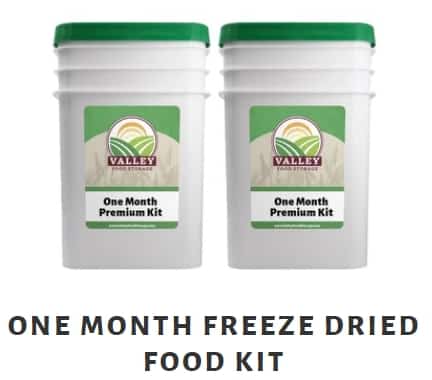
1 Month Freeze-Dried Food Kit 

This one-month food kit includes the same quality mylar pouches that are in the 72-hour kit. But there’s one major difference: buckets.

The food pouches are sealed inside two hard plastic, stackable buckets.

These buckets help to ensure the food remains dry, provides excellent protection from vermin, and allows you to stack the buckets.

Check Out Today’s Price


VFS 3 Month

3 Month Freeze-Dried Food Kit

Now we’re starting to enter into some serious resiliency to a food crisis.

This 3 Month Kit will provide enough calories to keep someone well-fed for about 3 months. Again, this kit uses excellent mylar pouches and buckets.

And these use the same high-quality ingredients as all Valley Food Storage freeze-dried survival meals.

Check Out Today’s Price

VFS 6 Month

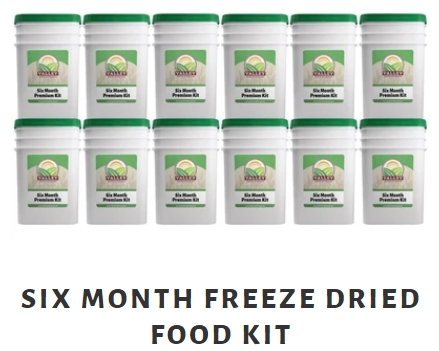
6 Month Freeze Dried Food Kit

6 months’ worth of food sure seems like a lot, And for most emergencies, it is.

But if you’re someone who takes resiliency serious, then it may be worth it to you to store this much.

Again, the same quality pouches, food, and buckets – just a whole lot more of them.

Check Out Today’s Price


VFS 1 Year

1 Year Freeze-Dried Food Kit

Of course, if you’re extremely motivated you increase your level of resiliency by stocking a year’s worth of freeze-dried food.

A year’s worth of food is my own personal target and yes, it’s overkill 99% of the time. But if I get unlucky I’m gonna be sure glad I made this investment!

Check Out Today’s Price


VFS SubscriptionFreeze Dried Food Kit Subscription Plan

This offering is unique.

This is the only company I’ve seen offer an emergency food monthly subscription plan.

Because a large one-time investment can be a challenge for some people. But by spreading out the costs monthly most people can build a nice stash of survival food kits over a few month’s time.

Check Out Today’s Deal


LEGACY FOOD STORAGE

Legacy Food Storage Bulk Survival Food KitLegacy Food Storage is another quality survival food company. One I’ve personally reviewed and tested.

They also use a combination of freeze-dried food, mylar bags, and food buckets. This helps ensure their food kits stay shelf-stable for decades to come.

Their survival food kits start out at 60 servings all the way up to 4320 servings.

You can’t go wrong with Legacy Food Storage when it comes to quality food and price. They claim to offer the “lowest cost per lbs” of food and free shipping as well.

Here are a few of their most popular kits by “total number of servings”:

60 Servings / 120 Servings360 Servings / 720 Servings / 1440 Servings2880 Servings / 4320 Servings

They also have a few gluten-free survival food kits as well:

120 Servings / 240 Servings / 360 Servings

MOUNTAIN HOUSE

Mountain House Food KitMountain House freeze-dried food pouches are popular in the backpacking scene. Why? Because freeze-dried food weighs a whole lot less than fresh foods – and they keep better!

This is another survival food brand I’ve bought from in the past and have reviewed.

Most survival food kits have a 25-year guarantee but Mountain House has upped their “taste guarantee” to 30 years! That’s the longest guarantee I’ve ever come across in the survival food kit space.

Mountain House offers survival food kits in pouches and buckets. But my one gripe is they don’t sell large quantities in buckets – so if you want to stock up, you’ll just need to buy more single buckets.

The bottom line is: Mountain House is not the cheapest but they are one of the best. You can buy survival food from them with confidence; they’re a fine choice.

Here are the survival food kits they have available with buckets:

HOW TO BUILD A SURVIVAL FOOD KIT YOURSELF


Now, you may be thinking…. hey, maybe I can do this myself.

And you’d be right; you ABSOLUTELY can.

But if you want to make your own freeze-dried foods, you’ll have to invest in a home freeze dryer machine. But freeze dryers are pretty expensive. They cost way more than your typical countertop appliance (like a food dehydrator).

A small freeze dryer will cost you at least $1600 or more. Which for some people, that’s no big deal, but for many, that’s a huge hurdle.

Now, you could use the freeze dryer to start your own small survival food kit shop. Or you could get a few friends to “share” the cost. Both of those options can help you make your own survival food kits.

But you’d still need to buy mylar bags, silica gel desiccants or oxygen absorbers, and food-grade buckets.

So, at the end of the day, most people find it a better deal to buy their freeze-dried food from a reputable company.

Your other DIY option is to NOT freeze-dry your survival food kits. Instead, focusing on storing dehydrated foods. And this can work OK IF you plan to rotate the “survival food” over time.

If you consume what you make and replace it often, you can create a rotating stockpile of survival food. But again, this adds another layer of hassle, complexity, and organizational skills.

So, if you’re up for it, you should absolutely DIY your survival food stockpile. But, either way, it’s going to be an investment in TIME or MONEY – you get to choose.

As A Way To Introduce You To Skilled Survival, We’re Giving Away Our Family First Food Planning Guide. Click Here To Get Your FREE Copy Of It.

FINAL THOUGHTS


Every year, you buy insurance and HOPE you never have to use it. And we are generally OK with this setup.

Well, the same goes for food insurance. You buy it and HOPE and PRAY you never need to use it!

And at the end of 30 years, if the food is still sitting there on the shelf, you get to eat it and enjoy it. Because nowadays freeze-dried survival meals taste great.

So, no matter what, an investment in survival food kits will never be a waste!

And one final thing to remember – there are no do-overs in survival. Woulda, coulda, shoulda won’t fill you or your families bellies in times of crisis.

Remember: Prepare, Adapt, and Overcome,
“Just In Case” Jack

P.s. Do you know where the closest nuclear bunker is from your home?

There are a lot of natural nuclear shelters in the US that are absolutely free. And one of them is near your home.

Click on the image above to find out where you need to take shelter.

The post 10 Best Survival Food Kits (Tested) That Will Make You Resilient To Emergencies appeared first on Skilled Survival.

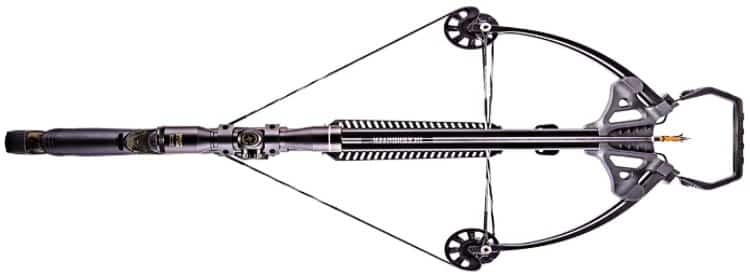
13 Best Crossbows That Will Make You A Deadly Silent Shooter

Best CrossbowLooking for the best crossbow? Well, you’ve come to the right place.

Here you’ll find honest and unbiased crossbow reviews. We cover only the best selling and top-rated crossbows available on the market today.

Our reviews and guides will help you make an informed decision. So you can feel confident about which crossbow is the best for your needs.

Whether you want a crossbow for leisure, hunting, or sports, this guide will help you find the right one.

Because these weapons come in a variety of shapes, sizes, pulling mechanisms.

And most importantly, they all have different calibers and shooting speeds.

So today I’m going to share everything I know about crossbows, specifically:

Note: Feel free to skip ahead by clicking any link above, especially if you’re in a hurry to read our crossbow reviews below.

As A Way To Introduce You To Skilled Survival, We’re Giving Away Our Ultimate Survival Gear Checklist. Click Here To Get Your FREE Copy Of It.

Crossbow In Side ViewREASONS WHY YOU SHOULD GET A CROSSBOW


The crossbow excels as both a self-defense weapon and a hunting weapon.

But as survival site, we tend to look at things with an eye towards “worst-case” SHTF type scenarios.

That’s why I like this video from Canadian Prepper. He does a nice job laying out all the survival justifications for owning a crossbow:


KEY FEATURES FOUND IN A QUALITY CROSSBOW


When it comes time to choose a crossbow, there are lots of competing models and claims.

It can be a daunting task to wade through all the options and decide which fits your needs best.

To help narrow the field, you should consider the following features:

Arrow Speed

In the world of crossbows (and survival bows), speed is king. Faster arrow speeds translate to more powerful shots and penetrating power.

A compound crossbow can deliver these high speeds much easier than a recurve model. But don’t forget to consider the size and strength of the crossbow bolts.

The heavier the bolt the more momentum it will have to carry through a target.

A high-powered compound crossbow can snap a light, poorly constructed bolt. So make sure you buy ones rated to the task.

“Overall Weight”

As with anything you’re carrying around the woods, weight matters.

A lightweight crossbow may be easier to carry, but it won’t damp out the vibrations caused when you fire a bolt.

On the other hand, a heavyweight crossbow may feel like a boat anchor, but shoot smooth as silk.

So, it’s best to think about the type of hunting or shooting you plan to do.

Whether you stalk prey on foot or waiting in a blind or both. It’s best to think about how you intend to use your crossbow before you “pull the trigger” on a purchase.

“Draw Weight”

“Draw weight” is NOT the same as “overall weight.” “Overall weight” refers to how much weight you’ll be carrying.

While “Draw weight” is a measure of the force needed to pull the string back into position.

A higher draw weight means it’s harder to prep the crossbow for shooting. But the higher draw weight results in higher arrow speeds.

That’s why many crossbows offer cocking mechanisms, to help offset the difficulty of intense draw weights.

Crossbows with draw=assist mechanisms are popular, especially for those who are older or disabled.

Crossbow Noise

Compared to rifles and shotguns, just about any crossbow is relatively quiet. But you may be looking for something extremely quiet and stealthy.

Perhaps you want a model to avoid spooking game or to help conceal your presence.

A recurve crossbow with parallel limbs is the quietest.

This type of crossbow has fewer moving parts, and the forces are more balanced. This translates into fewer parts in motion to create noise in the first place.

Also, you can add stabilizers and string silencers to help reduce the “twang” of any bowstring.

Build Quality

A crossbow – especially a compound model – is a mechanical work of art.

The materials, the precision, and assembly all contribute to the reliability, accuracy, and power of the device.

If the manufacturer skimps on any of these, your experience as a user suffers.

Manufacturer / Brand Name

As with anything else, there is something to be said for long-lasting brand names.

A name is not the last word in quality. But a brand with a loyal following is most likely built on a quality product.

The same goes for outstanding customer support.

Local Knowledge

Stop by your local archery ranges and shops. Ask around for the best recommendations from other shooters and professionals.

Take the time to shoot any models you’re considering buying. Get help fitting and setting up your crossbow after purchase.

You’ll learn a lot more about how to fine-tune things and get some great shooting tips in the process.

Compound Bow Top ViewTHE DIFFERENT TYPES OF CROSSBOWS YOU CAN CHOOSE


The crossbow has come a long way since Leonardo da Vinci drew prototypes in his notebooks.

There are designs for a variety of uses, and at all levels of technology.

Pistol-Grip Crossbows

One-handed, pistol-grip crossbows are a niche market.

These are mostly for target shooting. Though perhaps you could hunt small game like rabbits with one with some practice.

But few will be able to take down larger game like deer.

Recurve Crossbows

A recurve crossbow is the most uncomplicated design.

Whether made of wood or modern materials, they have few moving parts. Making them inherently lighter and more durable.

Many recurve designs can be serviced in the field if a string breaks or is knocked out of alignment.

They are also usually a lower cost than more technologically advanced compound models. They are quieter when fired as well since they don’t have as many moving parts.

The most significant disadvantages are the massive draw weights and slower arrow speeds.

Compound Crossbows

The main difference between a compound crossbow and a recurve crossbow is noticeable at first sight.

There are multiple pulleys and cams on the ends of each limb of a compound bow. In addition to several wraps of cable around them as well.

This sophisticated design allows the bow to “let-off” the draw weight once you reach a certain point. This makes it far easier to cock the firing mechanism and still get fast arrow speeds.

Plus, the limbs of a compound bow are often much shorter than a recurve model. This allows for a more compact design with better maneuverability.

They often have much higher arrow speeds; thus, the resulting Kinetic Energy of the bolts is much higher. However, they do have some significant drawbacks.

First off, they’re louder, heavier, and more of a challenge to maintain.

In fact, a broken string can be dangerous as it unwinds through the cams and can not be serviced in the field.

Reverse Draw Crossbows

Reverse draw crossbows are primarily compound designs with the bow mechanism reversed.

This results in a better-balanced weapon. This means its more comfortable and maneuverable than it’s design predecessor.

Plus, they fire faster arrow speeds than most compound models and at reduced noise levels.

Here’s a nice introduction video on the different crossbow technologies. This video only scratches the surface but if you’re new to the world of crossbows, it’s a must-watch:

HOW MUCH DRAW WEIGHT DO YOU NEED?


The first question most people ask is, “How much draw weight is enough?”

To be honest, it depends on what you want to do with your crossbow. Modern crossbows are built for one of two purposes: target shooting and hunting.

1- Target Shooting

Lower draw weight and lighter arrows are perfectly acceptable. In fact, lower draw weights and reduced recoil will often be more accurate for shooting.

Ever notice that all the Olympic sharpshooters are using .22cal rifles? Same reason.

2 -Hunting

Accurate shooting is always essential, but so is knock-down power if your hunting.

As you hunt larger and larger game, the amount of energy required to take down the animal increases. An arrow must be able to penetrate the skin, muscle, and even bone to hit vital organs.

This is measured as the kinetic energy (KE) of the weapon. This is calculated using arrow speed and mass.

Higher speeds and higher mass result in a greater KE. This means you can either shoot a heavy arrow slower or a lighter arrow faster to achieve the same KE.

In the past several decades, the trend has been towards lighter, faster arrows. That’s because they fire further and reach the target faster. Often before the animal hears or realizes it got shot.

Most crossbow manufacturers design their hunting models around medium to large-sized game.

In North America, that means most hunting short of the absolute biggest game such as moose and bear.

With that said, an arrow speed of over 300 fps can efficiently dispatch a whitetail deer. If you’re hunting larger game, faster speeds (and heavier broadheads) would be necessary.

Here’s a helpful video that provides even more detail about crossbows, setup, and kinetic energy:


13 BEST CROSSBOWS ON THE MARKET TODAY


Like choosing any other piece of survival gear, you can spend as much or as little as you want on a crossbow. And like most things in life, you’ll get what you pay for.

If you have a large bankroll, go for a top of the line model. You can expect high performance and unmatched quality.

On the other hand, if you’re trying to stretch every dollar, you need to look out for deals and be ready to do your homework.

We’ve done some searching and found great options at every price point. Starting with some lower budget models that can get you into the sport:

1 – Barnett Jackal Package (315 fps)

The Barnett Jackal is a great entry-level model. This package contains a quiver, three bolts, and a sight.

If you’d like to hunt with it someday, you’ll just need to add some bolts with broadheads, and you’re ready to go.

The Barnett Jackal is lightweight and comes with a “dry fire” prevention safety feature. This helps to prevent damage from firing it without a bolt loaded.

Pros

  • Affordable
  • Solid design and construction
  • The complete package for beginners

Cons

  • Some people report it’s louder than expected
  • Harder to cock than other similar models

Check Out Today’s Price


2 – CenterPoint Tormentor Whisper (350 fps)

The CenterPoint Tormentor Whisper improves on the Barnett Jackal in several areas.

First off, as the name implies, it’s much quieter. This is an important feature and prevents giving away your location.

Secondly, it’s much faster – which translates into more Kinetic Energy and knock-down power.

It has a suitable cocking mechanism and robust safety features.

Unfortunately, the arrow retention spring appears to be a weak design point. So be careful when loading your arrows.

Pros

  • Quiet
  • Good safety features
  • Fast!

Cons

  • Users have reported some durability issues

Check Out Today’s Price


3 – Southern Crossbow Risen XT 350 (350 fps)

Southern Crossbow is a relatively small company. But they’re making crossbows with unique features many people like.

Combined with their low cost, they are a good option for a beginner.

In particular, people like the familiarity of the AR-15 style stock. This can make for a smooth transition from shouldering and aiming a firearm.

They also have an acceptable amount of power, which translates to reasonably fast arrow speeds.

Pros

  • Affordable
  • Comfortable AR-15 stock

Cons

  • Bolts were low quality
  • Heavier than average

Check Out Today’s Price


Now let’s move up a bit in the price range. Next, are some quality crossbows at a medium price:

4 – Wicked Ridge Invader G3 (330 fps)

The Invader G3 is a very sturdy crossbow that should provide years of service.

It comes nearly pre-assembled on arrival, so you can head out to the range or the woods almost immediately.

It also features a well-designed cocking mechanism and dependable safety features.

Unlike some competitors, it’s a reasonably lightweight design with a compact limb system.

Pros

  • Effective cocking mechanism
  • Lightweight and maneuverable

Cons

  • The scope may not hold zero for extended storage
  • Somewhat noisy, especially the cocking mechanism

Check Out Today’s Price


5 – Barnett Whitetail Hunter II (350 fps)

The Barnett Whitetail Hunter II is another excellent, lightweight hunting crossbow. This crossbow has an advanced trigger mechanism and safety vs. others in this price range.

It’s small enough to not be bulky in a blind or treestand, but still boasts a respectable 350 fps.

The package also includes a modest scope, quiver, and bolts. This makes for a complete setup for an affordable price.

Pros

  • Advanced trigger mechanism
  • Lightweight
  • Includes several excellent safety features

Cons

  • Arrow track seems imprecise, causing grouping issues
  • The scope is not the best, resulting in drift – many people have opted to replace

Check Out Today’s Price


6 – Barnett Whitetail Pro STR (400 fps)

The Barnett Whitetail Pro STR is nearing the “expensive” mark. But you’d think it cost more than this, with all the features included.

The string dampers help to keep it quiet, while the illuminated scope can help at the edge of shooting hours.

Like similar crossbow packages, it comes with a quiver and bolts. But the bolts included seem to be higher quality than comparable starter sets.

Pros

  • Fast arrow speeds
  • Included string dampers help quiet string noise

Cons

  • Several reports of dry fires, which can damage the bow

Check Out Today’s Price


7 – Excalibur Matrix Grizzly SMF (300 fps)

This is a trusted brand by many for its durability and ease of maintenance. The Excalibur Matri Grizzly is the first recurve design on our list.

As expected, it’ s also a lightweight option at under 6lbs.

This crossbow is also friendly for those who want to DIY maintenance. Regular tasks such as replacing bowstrings are straightforward to perform.

However, the relatively low arrow speeds make this more a small to a medium-sized game weapon. But it excels at that role and will provide for years to come!

Pros

  • Good quality construction and accessories
  • Lightweight
  • Field serviceable

Cons

  • Louder than expected – so it would help to add string dampers

Check Out Today’s Price


If you’re willing to pay up for higher-end technology, these following crossbows take you up a level in quality:

8 – TenPoint Titan SS (340 fps)

Ten Point Titan SSTenPoint is quickly developing a solid reputation with the pros. They make high-quality crossbows at a variety of price points.

The Titan SS is a dependable workhorse for small to medium-sized game. It’s lightweight, compact, and easy to carry and shoot.

The 340 fps arrow speeds are fast enough for nimble deer. AND small enough to swing in the brush to follow a rabbit or grouse.

Pros

  • Lightweight and compact
  • High-quality build

Cons

  • Not suitable for game larger than whitetail deer

Check Out Today’s Price


9 – Bear Archery Fisix FFL (375 fps)

I grew up with Fred Bear stories and visits to the Bear Archery store.

When I think of that name, traditional bows pop to mind. But it turns out that Bear Archery is producing some advanced reverse draw crossbows as well!

The Fisix FFL is a great example, with a tiny 11″ width at full draw and a well-balanced profile, making it easy to swing.

This crossbow is extremely solid! But that comes at a price – in this case, a weight of almost 10lbs!

You won’t want to carry the Fisix for a full day of stalking. But it’s hard to beat the accuracy that stability provides.

This is an ideal setup for a large blind or treestand hunting!

Pros

  • Incredibly accurate
  • Solid and durable Bear construction

Cons

  • Nearly 10lbs!

Check Out Today’s Price


10 – Excalibur Matrix Bulldog (400 fps)

Here’s another fine recurve design from Excalibur. The Bulldog includes some significant upgrades from their starter models.

Notably, the high 400 fps arrow speeds are great for those interested in larger game. Because this crossbow generates far more kinetic energy than lower speed models.

The recurve design allows for easy maintenance and lightweight construction.

At just over 6lbs, it’s an easy load to carry around in the woods.

Bonus details such as the illuminated scope and integrated cocking rope make for a complete crossbow package.

Pros

  • 400 fps speeds make it suitable for large game
  • Quiver and quality bolts included

Cons

  • Wide recurve design might not be maneuverable in brush or treestands

Check Out Today’s Price


Finally, if you absolutely have to have the best, here are some top of the line crossbows with ALL the features:

11 – TenPoint NitroX (385 fps)

Ten Point CrossbowThe TenPoint NitroX lists a respectable arrow speed of 385 fps. But there are many reports of speeds well above 400 fps from this model.

With the right arrow combination, even 440 fps!

Obviously, that kind of speed creates the power to take down big game.

This is a rugged, reverse draw design, making it a technical work of art that’s hard to beat.

Pros

  • Arrow speeds of more than 400 fps are possible
  • Very well balanced due to reverse draw
  • Extremely accurate due to vibration reduction

Cons

  • Cost

Check Out Today’s Price


12 – Ravin R9 Package (390 fps)

At this higher price range, all the bows will tick the boxes for speed, quality, and reliability.

The Ravin R9 does so with a revolutionary design. That’s why it can boast as one of the smallest crossbows on the market, at under 7″ wide at full draw.

If you want to hunt in dense brush, a small blind, or narrow treestand, this is the crossbow that has your name on it.

It swings easily, fits anywhere, and can hit a target so fast it’s nearly impossible to spook them.

There’s a reason the R9 is DOMINATING the market these days. Now, if only it were less expensive…

Pros

  • Tiny profile, only 7″ wide
  • Blazing speed

Cons

  • $uper high price

Check Out Today’s Price


13 – Scorpyd Aculeus (460 fps)

Yes, the Scorpyd Aculeus is one hell of an expensive crossbow.

It’s also one of the fastest designs on the market today. It comes in at an absolutely staggering speed of 460 fps.

So fast, in fact, that you’re limited on what arrows can handle the forces created when you pull the trigger.

All that speed is paired with incredible accuracy. This is due to its high-precision construction and detailed engineering.

This makes for an unbeatable crossbow for nearly any situation.

Pros

  • Incredible speed
  • Accuracy

Cons

  • Audible click when removing safety
  • Limited arrow choices
  • $uper expensive

Check Out Today’s Price


CROSSBOW LEGALITY QUESTIONS AND ANSWERS


One of the most common questions about crossbows is whether they’re legal to own and use.

Unfortunately, I can’t give you legal advice. That’s why you should look up local regulations for where you live, before finalizing a crossbow purchase.

Depending on where you live, it may be treated more like a firearm than a bow, while some states only allow crossbows for hunting with disability permits.

The North American Crossbow Federation provides helpful information by state for crossbow hunting.

As A Way To Introduce You To Skilled Survival, We’re Giving Away Our Ultimate Survival Gear Checklist. Click Here To Get Your FREE Copy Of It.

FINAL THOUGHTS


A crossbow can be a great hunting tool. It combines the quiet approach of archery with an easier aiming and firing of a firearm.

You don’t run out of ammo (as long as you recover your arrows), and with proper care and maintenance, they can last for years.

There are so many models on the market that there’s certainly one that fits your budget and needs.

It’s worth considering a crossbow for your next hunting season!

Jason K.

P.s. Do you know where the closest nuclear bunker is from your home?

There are a lot of natural nuclear shelters in the US that are absolutely free. And one of them is near your home.

Click on the image above to find out where you need to take shelter.


The post 13 Best Crossbows That Will Make You A Deadly Silent Shooter appeared first on Skilled Survival.
Survival Gear Review: Windham Weaponry R16FTT-9MM Carbine

Wikipedia has the following to say about a concept called “Confirmation Bias”: “the tendency to search for, interpret, favor, and recall information in a way that confirms one’s preexisting beliefs or hypotheses. It is a type of cognitive bias and a systematic error of inductive reasoning. People display this bias when they gather or remember information selectively, or when they interpret it in a biased way. The effect is stronger for desired outcomes, emotionally charged issues, and for deeply entrenched beliefs.” Basically, when one is looking for results or an answer, one tends to view drawn conclusions or perform research in a manner that supports a conscious or subconscious pre-existing bias. 
By Drew, contributing author to Survival Cache and SHTFblog

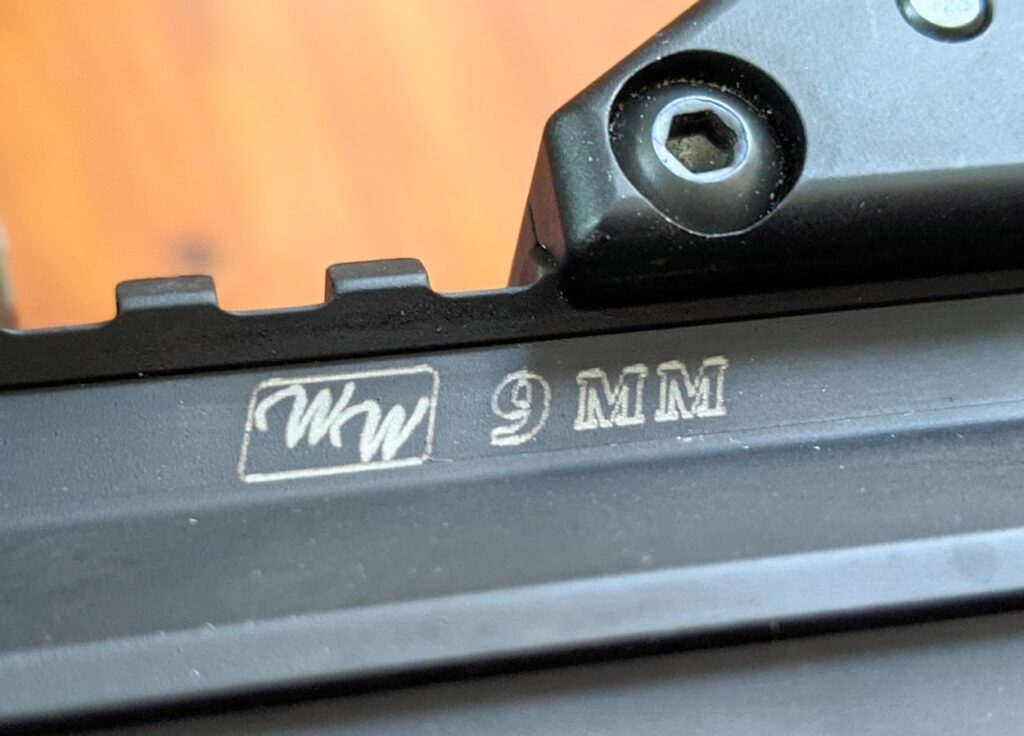
I’ll fully admit to initially having been under the influences of a full-blown confirmation bias when I first laid my eyes on the Windham Weaponry R16FTT-9MM carbine. My first impression upon seeing Windham Weaponry’s new carbine was probably similar to how might you feel handling any other Armalite-pattern rifle for the first time: “Yup, it’s another AR.” And that’s what I thought this platform would be; yet another AR. I knew there were some interesting features, but overall, I thought the 9mm carbine would fit into the same manilla envelope that other ARs do, because I had a preconceived notion of what this little black rifle was all about. And I was pleasantly surprised to find that actually running this carbine through its paces steered me away from looking for data to support the conclusion I thought I already knew.

Pistol Caliber Magnificence

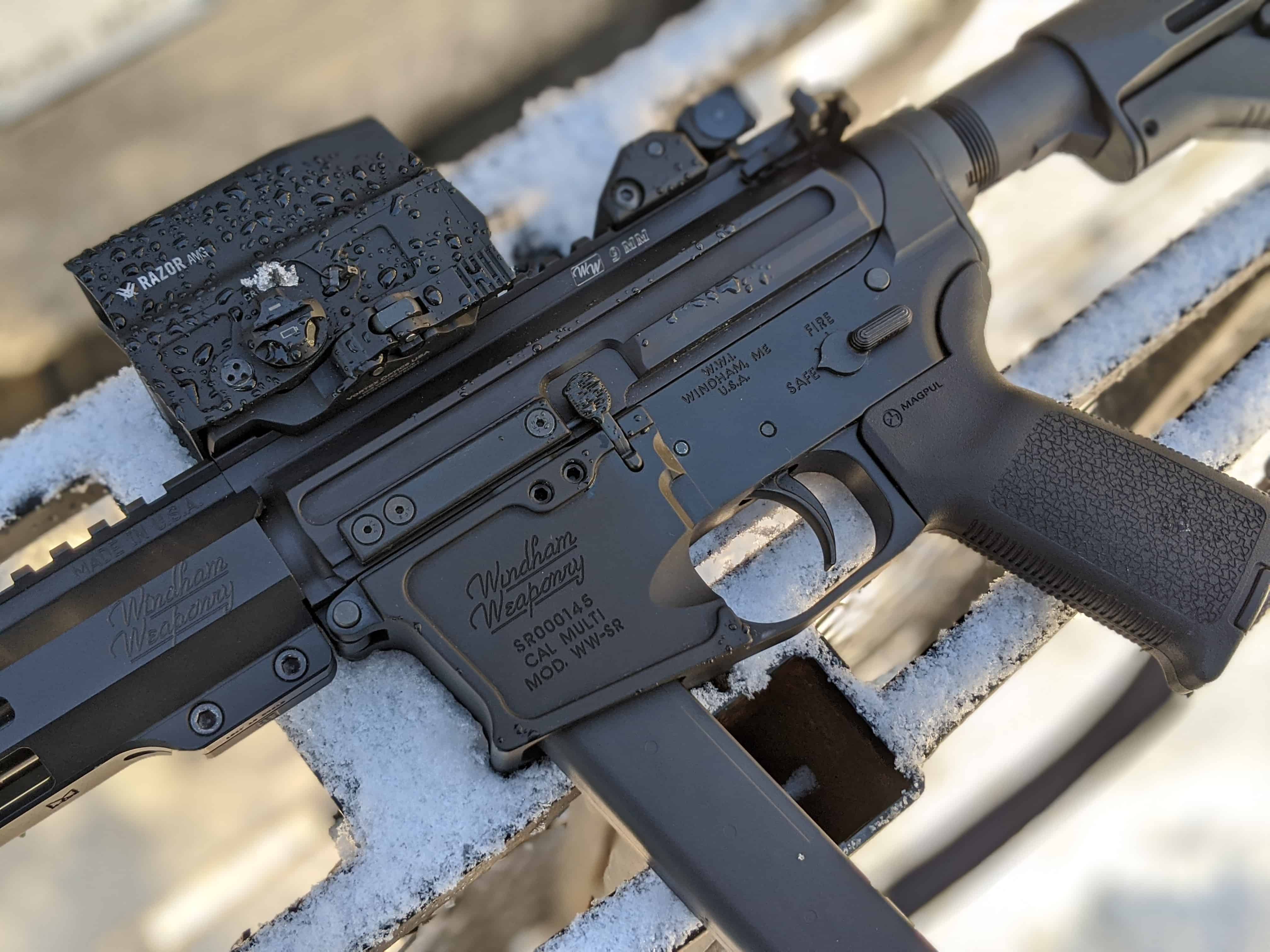
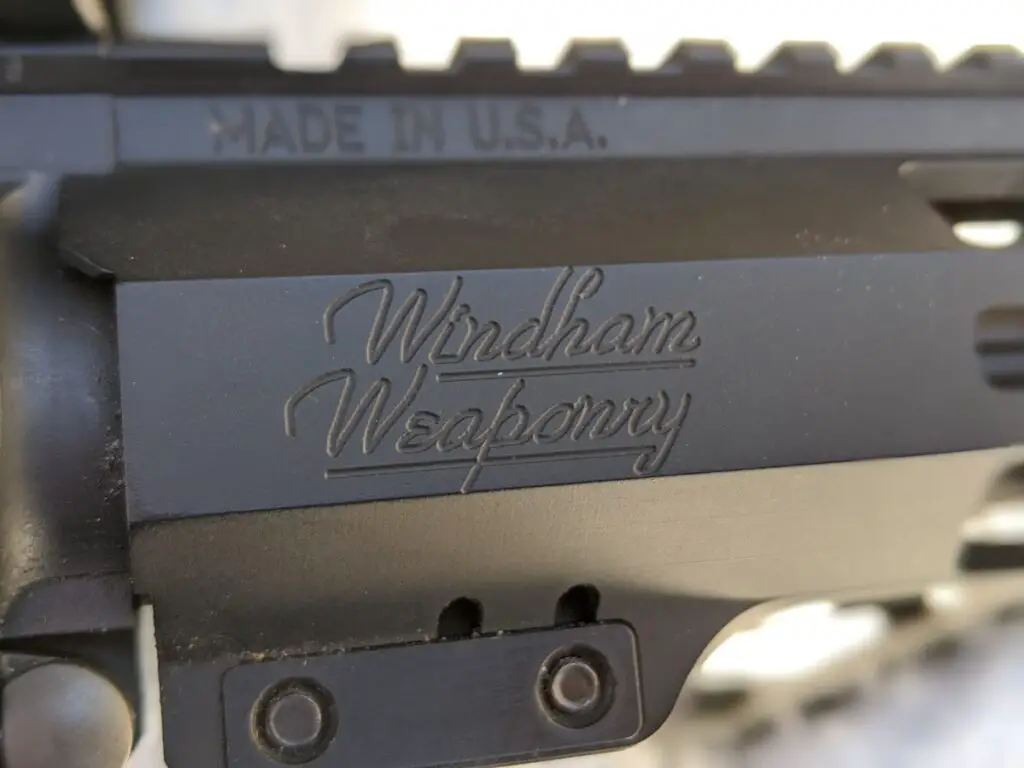
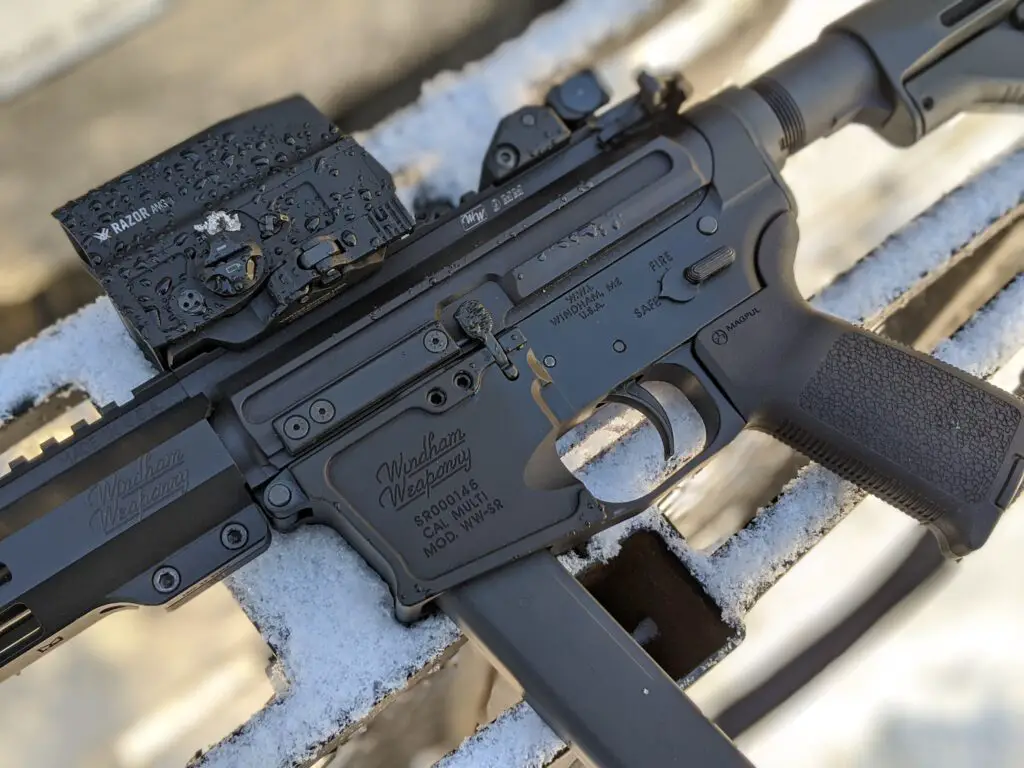
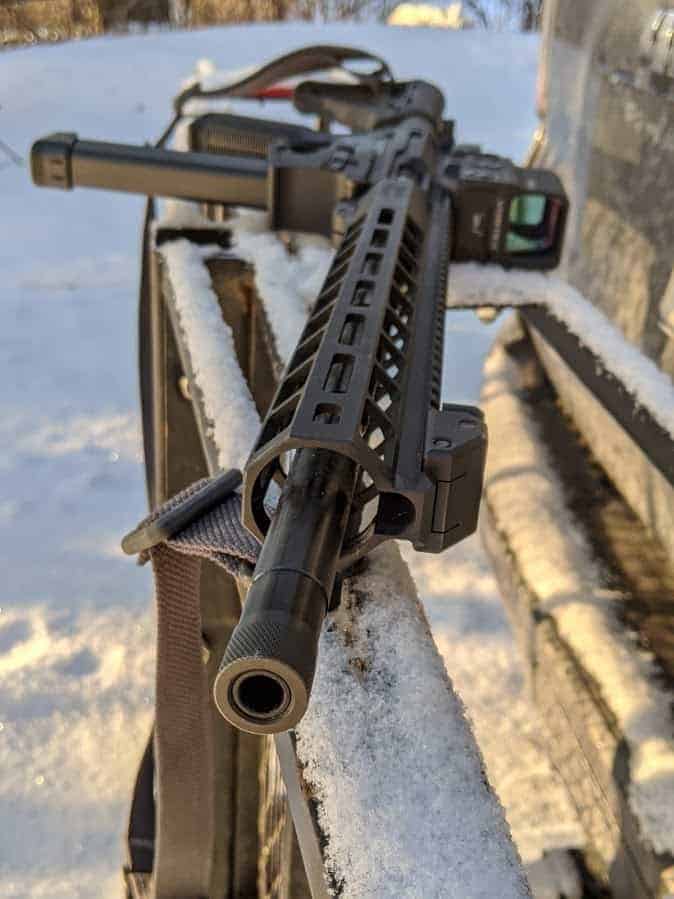
The Windham Weaponry R16FTT-9MM is a stellar piece of gear – well thought out but not over-designed to the point of lunacy. The whole package is approximately the same size as your standard M4 carbine, being about 6 ¾ lbs empty with no accessories, and just shy of 31” long with the stock collapsed all the way in. A 16 inch long medium-weight barrel (with no flash hider or brake) incorporates a 9mm-standard 1:10 rifling twist to stabilize heavier bullets for subsonic loads without compromising light-bullet accuracy. All the standard AR goodies are included: a free-floating anodized aluminum handguard, a 2” removable rail section for mounting accessories, and a full-length Picatinny rail that runs continuously from the back of the receiver all the way to the forwardmost point of the handguard. The A2-style pistol grip and 6-position telescoping CAR-style cuttstock are molded plastic, while the aluminum receivers are hard anodized in a pleasing, flawless matte black. The controls are all where they should be and operate the same as any AR would. The provided trigger is the expected Mil-Spec standard setup, and is compatible with all aftermarket AR-15 fire control systems. Nothing groundbreaking here, but no departures from the norm either – a huge benefit for training if you already run an AR-15.
When you break the receivers apart, however, you start noticing the changes that make this Windham Weaponry rifle unique. First off, the ejector is fixed into the lower receiver via two beefy allen screws, and juts upwards from just behind the magazine well – much different (and far simpler) than the plunger ejector that lives inside standard AR-15 bolts. 
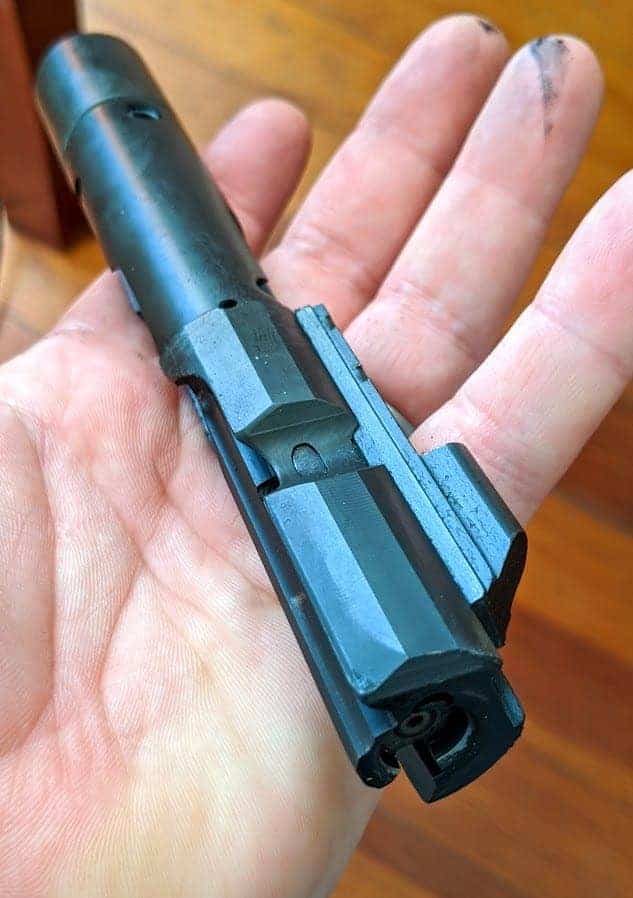
And speaking of bolts, popping the R16FTT-9MM’s bolt out of its upper receiver raceway will reveal the big surprise: this gun runs as a straight blowback. That’s right: no gas tubes, no gas ports or blocks, no gas keys to loosen and leak. No separate rotating bolt for a Multi-piece BCG. The gasses from the round going off in the chamber push the bolt backwards and start the process of the carbine’s semi-automatic cycling; the rifle’s springs and physics perform the rest of the work. The straight closed-bolt blowback system has been around for over a century now and is well-developed and dependable – and it’s a great, reliable choice for the operation of this little carbine. Less moving parts than HK’s roller-delayed system, no weird dissimilar metals friction like a Thompson’s Blish Lock. No wildly unpredicatable accuracy from firing from an open bolt. No fuss, all simple, reliable goodness. It should even work well as a suppressed rig, too; no worrying if your gas port is correctly sized or properly gassed.

Glock Perfection in an AR package

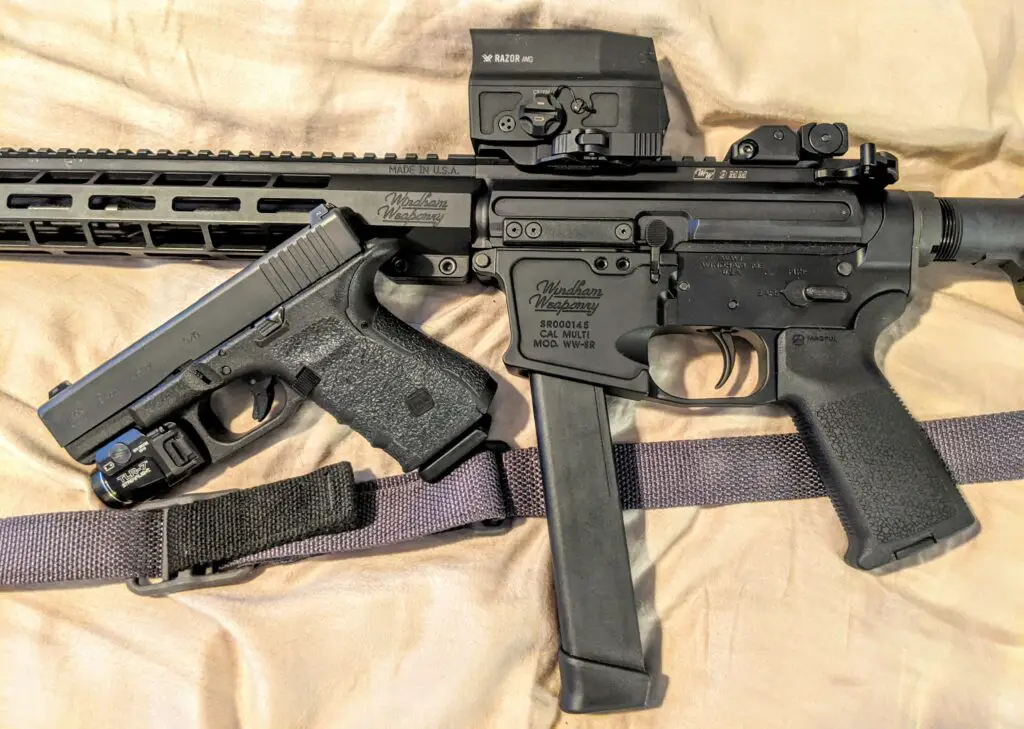
The real crowd-pleasing aspect of the Windham Weaponry 9mm carbine is its ability to source its high-velocity meals from 9mm Glock magazines. That’s right, proud Glock 17, 18, 19, 26, 34, et.al., owners can now run a high-quality AR platform carbine that feeds from magazines that are already on-hand. For SHTF planning, the utility is obvious – both your long gun and your sidearm can utilize the exact same magazines, easing your logistics strain as you pile up stacks of double-stack Glock magazines. 
Also read: Magpul PMAG27 Glock Magazine

Making magazine acquisition even easier is the fact that Magpul now offers high-quality, inexpensive 9mm Glock magazines; as a matter of fact, our subject carbine shipped with a Magpul 17-round magazine straight from Windham Weaponry. 

Since the carbine landed in my lap, I’ve been buying up a decidedly inconsistent mixture of polymer mags; 15-round Glock 19 and 17-round Glock 17 magazines, 33-round Glock “Giggle Sticks”, along with a complement of 15, 17, and 21-round Magpul GL-9 magazines. Every single one of them locks into the magwell securely and feeds the little 9mm rounds like greased snot through the blowback action of the Windham Weaponry 9mm Carbine.

The 9mm Glock magazine compatibility is a Godsend to those wanting to design a single-caliber centerfire pistol/carbine plan; instead of trying to source the clunky Colt stick mags, SIG Sauer’s proprietary $60-each MPX magazines, or even pricier HK MP5 magazines, you can walk into any Cabela’s or reasonably well-stocked gun store and find rugged, proven magazines on the rack for dirt money; my last purchase was a Magpul 17-round magazine for $15.99 at Cabelas. I even found used Magpul 15-round mags at a local gun shop for $10 each. Though I don’t know why someone would discard anything that has “Magpul” moulded into it, I snatched them up with glee and they function with aplomb. I bought the 33-round Glock-made mags for $25 each on sale from Brownell’s.

Icing on the polymer cake: while there are several manufacturers who make 9mm AR lowers – a few of whom manufacture with Glock magazine capability – whittling down this category further is the need for a 9mm AR lower that runs on Glock mags, AND ALSO locks the bolt back when the mag runs dry. The Windham Weaponry 9mm carbine checks all the above boxes with a flawless bolt hold-open feature. A rifle that’s theoretically designed for battle or competition (or maybe really intense hunting?) should absolutely lock the bolt back when the mag runs dry. Major kudos to Windham Weaponry for making sure the rifle operates as we expect an AR-platform rifle should.

Suppressor Ready

Since pistol caliber carbines are immensely popular no doubt due in part for their ability to be effectively suppressed, Windham Weaponry provided the 9mm Carbine without a muzzle device – just a knurled thread protector at the danger end of the barrel. Unscrew the thread protector to expose the muzzle device threads. Windham Weaponry’s page for this particular model says these threads are ½” x 28 threads per inch – however I did note a company newsletter that stated all 9mm models are produced with ½” x 36 thread pitch. The moral of this story: if you’re looking to install a suppressor on your Windham Weaponry 9mm, be sure to double check the thread pitch. 
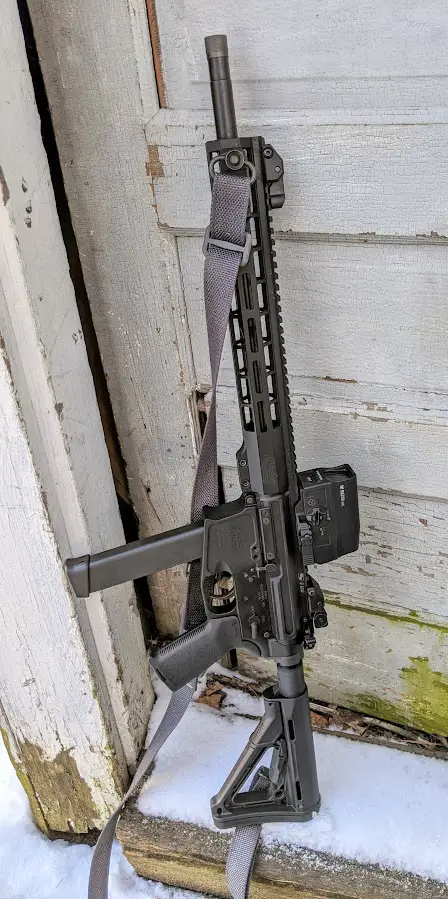
I visited my buddy with the SIG Sauer MPX-C that I reviewed a couple years ago so I could do a 9mm carbine comparison and take advantage of the SilencerCo Octane 9HD that he obtained for the SIG. However, the muzzle thread pitches are entirely different between the two guns, so I sadly wasn’t able to play with the Windham Weaponry 9mm suppressed. And with the thread adapter for an Octane 9 being about $90, I’ll have to save the suppressed report (pun intended) for a later date. But the ability is there, so a tax form is in my future, I predict. I mean, it only makes sense, right? Right.

Not Bad Out Of the Box, But…

Windham Weaponry kits out the 9mm Carbine with a complement of standard AR accoutrements that are perfectly functional, but I personally feel a touch dated in this ergonomically enhanced and developed firearms worldview. The standard provided collapsible buttstock is a mildly-enhanced throwback to Colt’s Vietnam-induced CAR-15/XM177 design of the 1960s, and the A2 style pistol grip is unchanged since the introduction of the M16A2 variant from the early 1980s. The black nylon sling is really just a strap with zero quick adjustability when installed between the provided QD rail mount and the telescoping buttstock.
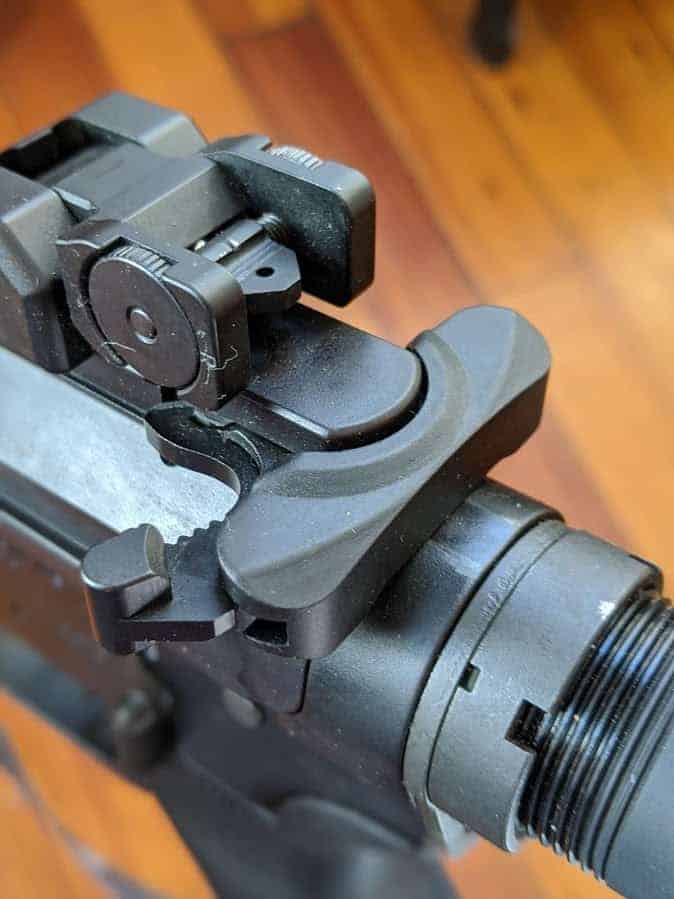
Some may argue that these designs are perfectly adequate and functional, and they are absolutely right. However, after having my cheek pinched in some buttstock-receiver extension junctions a couple times, and wrestling with trying to retrofit a proper two-point sling on the buttstock, I just bit the bullet and purchased a black Magpul CTR buttstock and MOE pistol grip. These two simple additions added a touch of storage and a healthy serving of increased utility with the ability to properly mount a Blue Force Gear Vickers two-point sling on QD mounts fore and aft. This setup proved its worth on a carbine course and during numerous drills at the sandpit. Don’t get me wrong: Windham Weaponry provides a serviceable setup out of the box – and props to them for providing a complete package – but for a few extra bucks (MOE Grip – $20, CTR Stock – $60, Blue Force Gear Sling $55) you get a pistol-caliber wonder carbine that wants for nothing in the ergonomics and utility department.

Heads up though: when I yanked the original buttstock off the 9mm carbine to find that the stock receiver is of the Commercial variety, not the Mil-Spec configuration. I checked with Windham Weaponry, and they confirmed that most of their rifles go out the door with Commercial extensions, since the .03” narrower diameter allows the use of both Commercial and Mil-Spec stocks. Just be forewarned – it may be easier to find additional colors and configurations in the Mil-Spec sizes (as the industry as mostly standardized the use of Mil-Spec components), but they will rattle and wiggle just a tiny bit when used on Commercial tubes. Fully functional, just a bit annoying, if that sort of thing bothers you. Just an FYI.

The only other change I made was to swap out the stock style charging handle for a BCM Gunfighter Mod 4 piece with a left-side extension. More on the important “why?” of that modification here in a second – and it ain’t just for increased handle leverage.

You’ll also need to source sights and/or an optic to run this carbine properly. I had some kicking around, thankfully – but a set of decent BUIS will be probably around $60-70 to start – and optics can range from Wal-Mart $39 cheapies to red dots and ACOGs that will make you take an unsteady knee when you pull out the wallet. The Windham Weaponry 9mm AR carbine’s picatinny rail will gladly give any of them a solid home.

Yeah, But How Does It Shoot?

Ahh, here’s the question I’m sure most of you are dying to know the answer to. As soon as this little beast was in my sweaty palms, I grabbed a couple boxes of ammo and headed to the sandpit to get the 9mm Carbine dialed in and ready for some real-world testing. A Vortex AMG UH-1 holographic sight was mounted on the rail along with some folding sights. I planned on dialing the rifle in for 100 yards – from previous experience with the SIG Sauer MPX I knew that was about as far away as a 9mm is happy to go.  The provided Magpul 17-round magazine was loaded up with some Winchester 124-grain FMJ ammo, and within three shots had the rifle on target at 25 yards. I went to a kneeling position, and trying for a decent group, proceeded to plunk four rounds touching with no problems whatsoever. A good start.

Related: Survival Gear Review: SIG Sauer MPX-C

A few steps back to 50 yards confirmed that I was still on paper, and an adjustment to bring the bullet impact about an inch high at 50 yards worked well. A five-shot group from the kneeling position at 50 yards measured about 1 ½” or so. I then stood, and proceeded to handily perforate a 1-liter soda bottle shot for shot at the 100-yard marker. The gun was a shooter for sure – better than I expected. 

When I was testing handloads and some other factory ammunition through the Windham Weaponry 9mm carbine, I found that resulting group size varied wildly by bullet type and weight, but all of the loads produced usable accuracy – especially when you consider that a stubby 9mm bullet ain’t exactly a ballistic wonder. I settled on a handload that played nice in the W-W carbine and my Glock 19; the load pushed a 124-grain Hornady FMJ bullet at about 1,250 fps – and grouped in the 4” range at 100 yards. I think the carbine could have done a bit better with a proper magnified optic, but the Vortex’s holographic reticle was incredibly fast and positive to work with – and 100-yard 4” groups from a 9mm carbine was A-OK with me. High-end defensive ammo did shoot markedly better, with Remington Golden Saber 124-grain +P loads in particular providing excellent accuracy.

The R16FTT-9MM proved to be boringly reliable. It gobbled up every nasty lead bulleted handload I made, every hollow point defense load I offered it, and every steel-cased crap Wolf load I dropped the hammer on. To this day, with probably close to 3,000 rounds through the rifle, I have yet to experience a malfunction with the gun – though I make sure to clean and lube the rifle often due to the blowback action’s rapid carbon buildup.

Running the 9mm Carbine in the Real World

I recently took a carbine course through SRT Concepts here in Maine (outstanding company for training, check them out if you’re in the New England Area). I checked with Peter Joyce, the instructor, ahead of time, and asked if I could run two guns at the course so I could compare a pistol caliber carbine against my normal 5.56mm AR. He liked the idea and welcomed me to run both rifles, as long as I was fully communicative with the instructors about swapping guns and following enhanced safety procedures while walking to and from the firing line with different rifles.

The carbine course was stellar, and a real eye-opener with the function, performance, and perception differences between the two calibers. On the base level, the two guns were approximately the same – my 5.56 AR even has a Windham Weaponry heavy barrel! – with collapsible Magpul stocks, 16” barrels, and identical sling setups. Optics were different, as my 5.56 rifle sports a Leupold Mk AR 1.5x-4 on a Burris PEPR mount, while I elected to run the 9mm carbine with the non-magnified Vortex AMG UH-1 holographic sight in keeping with the close-in philosophy the pistol-caliber platform promotes.

Related: Survival Gear Review: Windham Weaponry R18FSFSM-308

Both rifles performed flawlessly, with either carbine proving to be ridiculously accurate and perfectly capable of providing easy hits under all circumstances and shooting positions. At the 75 yard mark and beyond, I did find that the 9mm definitely didn’t have the outright practical accuracy and flat trajectory that the 5.56 afforded, but hits inside the “kill” box were simple at all ranges to 100 yards with the 9mm. A “running man” drill with 90 9mm rounds at all distances from powder-burn range to 100 yards, and launching bullets from a variety of positions including prone, offhand, weak-side transition, and from behind cover with the rifle laying sideways and the buttstock mounted over the shoulder turned up a perfect score with no rounds striking outside the scoring boxes. I used a mix of Winchester “White Box” 124-grain FMJ rounds and 124-grain FMJ handloads throughout the course with no failures to function. Recoil was positively negligible and the rifle was a breeze to fire quickly and accurately. 
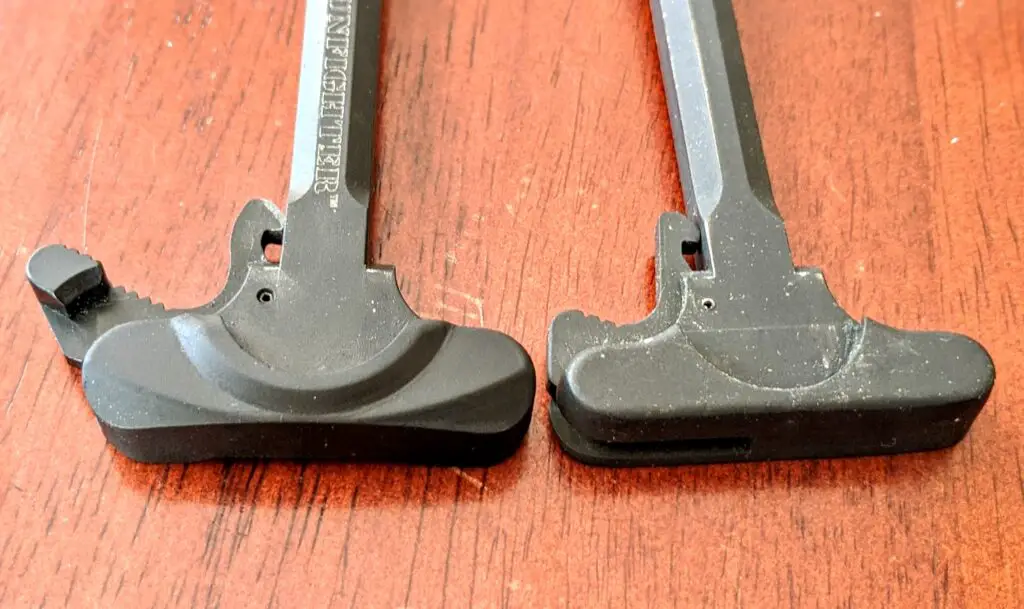
The guys on the line either side of me appreciated the 9mm carbine greatly. My 5.56 AR wears a Seekins Precision muzzle brake that is hugely effective at taming muzzle rise, but blasts concussively every time the rifle goes off. (I was told by my instructor that the muzzle blast was flapping my neighbor’s shirt around!)  The 9mm carbine was launching 124-grain bullets at about 1,250 feet per second, making the rifle seem almost suppressed in comparison!. Reportedly the 9mm AR was much more comfortable to stand near while I was shooting. Even with no muzzle device, there were no issues with muzzle rise or blast. This is a major consideration for anyone possibly running this gun indoors – whether it be a warrant-serving police officer, or a homeowner defending his family.

The 9mm carbine’s quick handling characteristics were a joy on the range, and the safety was positive and crisp – a welcome characteristic indeed, especially when working near other shooters with plenty of distraction. Knowing through haptic feedback – a nice positive “click” – that the safety was fully engaged or fully disengaged when I operated it was a Godsend.

(Very  Minor) Trouble in Paradise 

Issues? Yeah, a couple – but these were not really the gun’s fault, just struggles that manifested themselves via the differences in magazine design. You see, due to the feeding angle of Glock magazines imparted by Gaston Glock’s grip design, the Windham Weaponry’s magazines rake backwards slightly in the magazine well and require a different insertion angle when reloading from the shoulder. Where a standard 5.56mm magazine inserts straight up into the magazine well, the 9mm magazines require you to cant your wrist forward and slant the top of the magazine slightly forward when inserting. I also had a bit of luck inserting a magazine sort of like an AK, with the top of the magazine facing my head and then rocking it upwards and into the magwell. However, this technique didn’t work as well with tactical reloads when you had to juggle two magazines with one hand. 

The other issue I found was that though magazines generally dropped free when the release was pushed, the smaller, lighter 17 and 15 round pistol mags very occasionally had enough polymer-to-aluminum friction to hang up and require a yank or a shake while performing a reload from the shoulder. Not the end of the world, but another step to work through when you need the gun topped off in a hurry. I did find that this hang-up phenomenon occurred mostly when the rifle had been in a position where the magazine had some lateral pressure on it, usually from leaning against a barricade or cover. 

Training and repetition will help you through both of these issues decisively, but I found that swapping back and forth between the 9mm and 5.56 platforms had me confused when it came time for fast reloads. Keep that in mind if you like having lots of different rifles.

BCM charging handle (left) vs. stock. Note the built-up half-circle area on the BCM.

The other problem I’d found (actually before I took the course) centered around the 9mm carbine’s blowback operating system. Every time the rifle went off, the gun cycled and hot gasses from the expended cartridge made their way back through the charging handle keyway, and blew directly on my eyes. I never noticed the problem while wearing eye protection, like I do 99.9% of the time – but the one time I didn’t use eye pro, the hot gasses expelling backwards rushed into my eyes like a rowdy heat gun directed on my face. It was uncomfortable to say the least – and while dry eyes aren’t fun, unburnt powder, case debris, or other carbon residue could travel with the gasses – possibly disabling your eye. Lesson one: always use eye protection. Lesson two: ditch the stock charging handle and source a replacement unit that has a built-up “wall” of material on the top of the part – this mitigates the gasses nicely. The BCM charging handle I dropped in the carbine (standard AR charging handles work just fine!) enhanced the gun’s manual of arms with increased leverage for operating the bolt from the shoulder, and it deflected hot gasses nicely. 

Of all the swapped parts I changed out on the Windham Weaponry 9mm carbine, I would consider the charging handle swap the most important – a huge safety upgrade for your face and peepers. When the SHTF or that home invader kicks the door open at 2am, think you’ll be wearing safety glasses? Even odds that you won’t be. Keep that in mind.

Brass Tacks

The pistol caliber carbine efficacy debate is a subject for a future article (one I’m looking forward to indeed); we’re going to assume that your plans dictate that the 9mm caliber is what you want, and you’re looking to take advantage of the Windham Weaponry R16FTT-9MM’s ability to utilize Glock magazines. And why shouldn’t you? For Survival Cache’s target audience – Preppers and Survivalists – the Windham Weaponry 9mm carbine provides you with a hugely effective tool to maximize your minimalist ideals and requirements. No longer do you need to keep multiple magazine types, ammunition calibers, and other logistical and maintenance accoutrements to supply your firearms needs; the Glock-mag-fed 9mm carbine fixes this issue for you. Run one caliber through one type of magazines for both your long guns and sidearm. The low recoil, close-in effectiveness, and lightweight, quick handling would make this a stellar choice as a training rifle of primary arm for smaller-framed shooters, women, and supervised, appropriately-aged children as well.
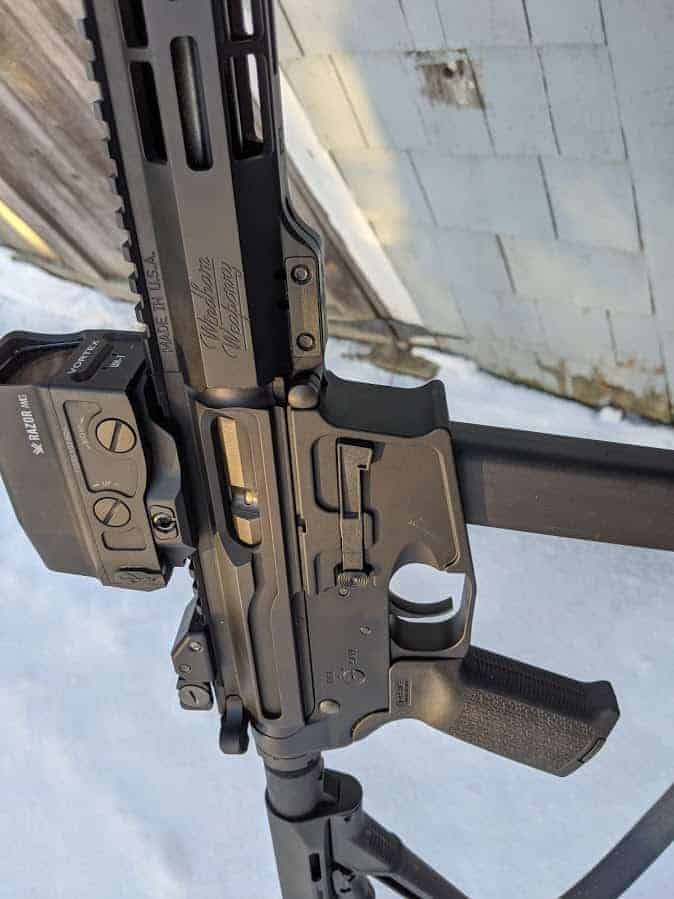
I’ve written before about Windham Weaponry’s outstanding commitment to quality and innovation – and this R16FTT-9MM is a perfect manifestation of both of these ideals. This carbine is beautifully manufactured to a design that is exactly what a 9mm AR should be. I know I griped a tad about the accessories Windham Weaponry chose to include with the package, but the very plain and simple fact is that this carbine is 100% serviceable and ready to go out of the box once you throw a sighting system on. It’s also a great starting platform to build a suppressed carbine, or even an SBR. The street price of $900-950 for the Windham Weaponry R16FTT-9MM carbine may seem a bit steep when lesser companies offer a package with ostensibly the same features, but this is a classic example of getting what you pay for. The quality, design, reliability, fit, and finish are light-years ahead of other companies’ offerings, and – perhaps most importantly – Windham Weaponry’s transferable warranty and customer service are outstanding in their field…which I cannot say about other companies with, well, budget-minded products. 

If you think this 9mm carbine is “Just another AR”, get past your own confirmation bias and try one out. You’ll realize for yourself that an AR in 9mm is an absolute platform enhancement when combined with a sidearm that uses the same feeding system. Pistol caliber carbines paired with a compatible pistol are hot right now – shooters and preppers are recognizing the versatility, effectiveness, and minimalist leanings of the concept. And there’s no better combo (in my humble opinion) than a Glock 19 and a Windham Weaponry R16FTT-9MM carbine. Grab one of each (or more, that’s cool too), stock up on cheap, reliable magazines and some cases of ammo, and proudly possess the best pairing of shooting tools on the market – they’re ready when you are, no matter what hits the fan. 

The post Survival Gear Review: Windham Weaponry R16FTT-9MM Carbine appeared first on Survival Cache.

3 Important Aquatic Survival Skills

When you think of survivalist, you’re probably thinking of igniting fires, building shelters, and hiking miles of wilderness. Though survivalists do these things, many people don’t think about the aquatic survival skills people need to know in order to survive places like rivers, oceans, and other larger bodies of water.

As a survivalist, you will need to be comfortable with the idea of being around water if you want to explore the world to the fullest. Not only that, but learning basic aquatic survival skills may save your life on vacations or allow you to explore your abilities as a survivalist in the water.

1. Swimming

All survivalists should know how to swim. Though there are a variety of swimming techniques to use, the most common form is freestyle, where you alternate kicking your legs and alternating extending your arms forward. Using your arms, you push yourself through the water using your legs as a natural propeller. However, knowing how to swim isn’t the only thing you need to know. You also need to be cognizant of your swimming ability and endurance so you don’t overdo it and put yourself in harmful situation.

2. Treading Water

There are a variety of techniques you can choose from when learning how to tread water. Some important things to keep in mind, however, is that you will need to use both arms and legs while keeping your head above water.

One technique you can try is moving your arms horizontally while spinning your legs as if you were on a bike: in a vertically circular motion. Another technique is to use flutter kicks (point your toes downward and then kick your legs back and forth in short bursts) while using your arms to keep balance. No matter what treading technique you try, you will run out of energy, so be sure to practice consistently and frequently.

If you cannot tread water anymore, then you may lie on your back in the water and float to regain your strength. You can attempt to backstroke to safety if you’re within an ideal range, but the main focus should be on you getting your strength back so you can stay afloat!

3. Getting out of Currents

If you get stuck in a river or ocean current, this isn’t the end of the world. If you are stuck in an ocean current and are getting pulled out to sea, do not panic. Take slow deep breaths and then begin to swim parallel to the shore. You will waste energy trying to fight against the current to swim back to shore. Though it may take a while, you will eventually feel the current stop pulling on you and then you can swim to shore. If you can, try and call for help, but not if you think you’re going to inhale water doing it!

Similarly to being stuck in an ocean current, do not fight against a current. Swim at in a diagonal line to shore; don’t swim upstream or perpendicular to the current. If, worst case scenario, you are going downstream and can’t fight it, turn your body so your feet are facing the way you are going. Doing this will prevent your head from hitting something and causing you injury or unconsciousness.

Always Prepare

If you are going to be around or going into any body of water, be prepared to bring a flotation device with you. This prevents you from having to expend precious energy in staying afloat in a dangerous situation. Along with having floatation devices, be sure to continue practicing swimming– never know when it could save your life one day.

Who Are The Globalists And What Do They Want?

This article was originally published by Brandon Smith at Alt-Market.

I get the question often, though one would think it’s obvious – Who are these “globalists” we refer to so much in the liberty movement?

Sometimes the request comes from honest people who only want to learn more. Sometimes it comes from disinformation agents attempting to mire discussion on the issue with assertions that the globalists “don’t exist.” The answer to the question can be simple and complex at the same time. In order to understand who the globalists are, we first have to understand what they want.

We talk a lot about the “globalists” because frankly, their agenda has become more open than ever in the past ten years.  There was a time not long ago when the idea of the existence of “globalists” was widely considered “conspiracy theory”. There was a time when organizations like the Bilderberg Group did not officially exist and the mainstream media rarely ever reported on them. There was a time when the agenda for one world economy and a one-world government was highly secretive and mentioned only in whispers in the mainstream. And, anyone who tried to expose this information to the public was called a “tinfoil hat-wearing lunatic”.

Today, the mainstream media writes puff-pieces about the Bilderberg Group and even jokes about their secrecy. When members of Donald Trump’s cabinet, Mike Pompeo and Jared Kushner, attended Bilderberg in 2019, the mainstream media was wallpapered with the news.

When the World Government Summit meets each year in Dubai, attended by many of the same people that attend Bilderberg as well as shady mainstream icons and gatekeepers like Elon Musk and Neil deGrasse Tyson, they don’t hide their discussions or their goals, they post them on YouTube.

I remember when talking about the US dollar being dethroned and replaced with a new one-world currency system and a cashless society controlled by the IMF was treated as bizarre theory. Now it’s openly called for by numerous leaders in the financial industry and in economic governance. The claim that these things are “conspiracy theory” no longer holds up anymore. In reality, the people who made such accusations a few years ago now look like idiots as the establishment floods the media with information and propaganda promoting everything the liberty movement has been warning about.

The argument on whether or not a globalist agenda “exists” is OVER. The liberty movement and the alternative media won that debate, and through our efforts, we have even forced the establishment into admitting the existence of some of their plans for a completely centralized global system managed by them. Now, the argument has changed. The mainstream doesn’t really deny anymore that the globalists exist; they talk about whether or not the globalist agenda is a good thing or a bad thing.

First, I would point out the sheer level of deception and disinformation used by the globalists over the past several decades.  This deception is designed to maneuver the public towards accepting a one-world economy and eventually one-world governance. If you have to lie consistently to people about your ideology in order to get them to support it, then there must be something very wrong with your ideology.

Second, the establishment may be going public with their plans for globalization, but they aren’t being honest about the consequences for the average person. And, there are many misconceptions out there, even in the liberty movement, about what exactly these people want. So, we need to construct a list of globalist desires vs globalist lies in order to define who we are dealing with. These are the beliefs and arguments of your run-of-the-mill globalist:

Centralization

A globalist believes everything must be centralized, from finance to money to social access to production to the government. They argue that centralization makes the system “more fair” for everyone, but in reality, they desire a system in which they have total control over every aspect of life. Globalists, more than anything, want to dominate and micro-manage every detail of civilization and socially engineer humanity in the image they prefer.

One World Currency System And Cashless Society

As an extension of centralization, globalists want a single currency system for the world. Not only this, but they want it digitized and easy to track. Meaning, a cashless society in which every act of trade by every person can be watched and scrutinized. If trade is no longer private, preparation for rebellion becomes rather difficult. When all resources can be managed and restricted to a high degree at the local level, rebellion would become unthinkable because the system becomes the parent and provider and the source of life.  A one-world currency and the cashless system would be the bedrock of one-world governance. You cannot have one without the other.

One World Government

Globalists want to erase all national borders and sovereignty and create a single elite bureaucracy, a one-world empire in which they are the “philosopher kings” as described in Plato’s Republic.

As Richard N. Gardner, former deputy assistant Secretary of State for International Organizations under Kennedy and Johnson, and a member of the Trilateral Commission wrote in the April 1974 issue of the Council on Foreign Relation’s (CFR) journal Foreign Affairs (pg. 558) in an article titled ‘The Hard Road To World Order’:

In short, the ‘house of world order’ will have to be built from the bottom up rather than from the top down. It will look like a great ‘booming, buzzing confusion,’ to use William James’ famous description of reality, but an end-run around national sovereignty, eroding it piece by piece, will accomplish much more than the old-fashioned frontal assault.”

This system would be highly inbred, though they may continue to give the masses the illusion of public participation and “democracy” for a time. Ultimately, the globalists desire a faceless and unaccountable round table government, a seat of power which acts as an institution with limited liability, much like a corporation and run in the same sociopathic manner without legitimate public oversight. In the globalist world, there will be no redress of grievances.

Sustainability As Religion

Globalists often use the word “sustainability” in their white papers and agendas, from Agenda 21 to Agenda 2030. Environmentalism is the facade they employ to guilt the population into supporting global governance, among other things. As I noted in my recent article ‘Why Is The Elitist Establishment So Obsessed With Meat’, fake environmentalism and fraudulent global warming “science” is being exploited by globalists to demand control over everything from how much electricity you can use in your home, to how many children you can have, to how much our society is allowed to manufacture or produce, to what you are allowed to eat.

The so-called carbon pollution threat, perhaps the biggest scam in history, is a key component of the globalist agenda. As the globalist organization The Club Of Rome, a sub-institution attached to the United Nations, stated in their book ‘The First Global Revolution’:

In searching for a common enemy against whom we can unite, we came up with the idea that pollution, the threat of global warming, water shortages, famine and the like, would fit the bill. In their totality and their interactions, these phenomena do constitute a common threat which must be confronted by everyone together. But in designating these dangers as the enemy, we fall into the trap, which we have already warned readers about, namely mistaking symptoms for causes. All these dangers are caused by human intervention in natural processes. and it is only through changed attitudes and behavior that they can be overcome. The real enemy then is humanity itself.”

In other words, by presenting human beings as a species as the great danger, the globalists hope to convince humanity to sublimate itself before the mother earth goddess and beg to be kept in line. And, as the self-designated “guardians” of the Earth, the elites become the high priests of the new religion of sustainability. They and they alone would determine who is a loyal servant and who is a heretic. Carbon pollution becomes the new “original sin”; everyone is a sinner against the Earth, for everyone breaths and uses resources, and we must all do our part to appease the Earth by sacrificing as much as possible, even ourselves.

The elites don’t believe in this farce, they created it.  The sustainability cult is merely a weapon to be used to dominate mass psychology and make the populace more malleable.

Population Control

Globalists come from an ideological background that worships eugenics – the belief that genetics must be controlled and regulated, and those people they deem to be undesirables must be sterilized or exterminated.

The modern eugenics movement was launched by the Rockefeller Foundation in the early 1900s in America and was treated a legitimate scientific endeavor for decades. Eugenics was taught in schools and even celebrated at the World’s Fair. States like California that adopted eugenics legislation forcefully sterilized tens of thousands of people and denied thousands of marriage certificates based on genetics. The system was transferred to Germany in the 1930s where it gained world renown for its inherent brutality.

This ideology holds that 4% or less of the population is genetically worthy of leadership, and the elites conveniently assert that they represent part of that genetic purity.

After WWII the public developed a distaste for the idea of eugenics and population control, but under the guise of environmentalism, the agenda is making a comeback, as population reduction in the name of “saving the Earth” is in the mainstream media once again.  The Question then arises – Who gets to decide who lives and who dies?  Who gets to decide who is never born?  And, how will they come to their decisions?  No doubt a modern form of eugenics will be presented as the “science” used to “fairly” determine the content of the population if the elites get their way.

Narcissistic Sociopathy

It is interesting that the globalists used to present the 4% leadership argument in their eugenics publications, because 4% of the population is also consistent with the number of people who have inherent sociopathy or narcissistic sociopathy, either in latent or full-blown form, with 1% of people identified as full-blown psychopaths and the rest as latent.  Coincidence?

The behavior of the globalists is consistent with the common diagnosis of full-blown narcopaths, a condition that is believed to be inborn and incurable. Narcopaths (psychopaths) are devoid of empathy and are often self-obsessed. They suffer from delusions of grandeur and see themselves as “gods” among men. They believe other lowly people are tools to be used for their pleasure or to further their ascendance to godhood.  They lie incessantly as a survival mechanism and are good at determining what people want to hear.  Narcopaths feel no compassion towards those they harm or murder, yet crave attention and adoration from the same people they see as inferior. More than anything, they seek the power to micro-manage the lives of everyone around them and to feed off those people like a parasite feeds off a host victim.

Luciferianism

It is often argued by skeptics that psychopaths cannot organize cohesively, because such organizations would self destruct.  These people simply don’t know what they’re talking about.  Psychopaths throughout history organize ALL THE TIME, from tyrannical governments to organized crime and religious cults.  The globalists have their own binding ideologies and methods for organization.  One method is to ensure benefits to those who serve the group (as well as punishments for those who stray).  Predators often work together as long as there is ample prey.  Another method is the use of religious or ideological superiority; making adherents feel like they are part of an exclusive and chosen few destined for greatness.

This is a highly complicated issue that requires its own essay to examine in full. I believe I did this effectively in my article ‘Luciferians: A Secular Look At A Destructive Globalist Belief System’. Needless to say, this agenda is NOT one that globalists are willing to admit to openly very often, but I have outlined extensive evidence that Luciferianism is indeed the underlying globalist cult religion. It is essentially an ideology that promotes moral relativism, the worship of the self and the attainment of godhood by any means necessary – which fits perfectly with globalism and globalist behavior.

It is also the only ideological institution adopted by the UN, through the UN’s relationship with Lucis Trust, also originally called Lucifer Publishing Company. Lucis Trust still has a private library within the UN building today.

So, now that we know the various agendas and identifiers of globalists, we can now ask “Who are the globalists?” The answer is – ANYONE who promotes the above agendas, related arguments, or any corporate or political leader who works directly with them.  This includes presidents that claim to be anti-globalist while also filling their cabinets with people from globalist organizations.

To make a list of names is simple; merely study the membership rosters of globalists organizations like the Bilderberg Group, the Council On Foreign Relations, the Trilateral Commission, Tavistock Institute, the IMF, the BIS, World Bank, the UN, etc. You will find a broad range of people from every nation and every ethnicity ALL sharing one goal – A world in which the future for every other person is dictated by them for all time; a world in which freedom is a memory and individual choice is a commodity only they have the right to enjoy.

Survival of the Richest: How the World’s Financial Elite are Preparing for Armageddon

Written by Wild Bill on The Prepper Journal.

As we normal folks prepare for emergencies, disasters and the like, I was curious as to how one might approach this should “money be no object.” I myself have never had that problem, when cost was an afterthought, not a concern. But there are those that are born to or succeed to a point where this is their reality and in such Daniel Williams brought the following to my attention.

I for one found it fascinating, not just for the content and presentation but for the reality that if the EOTWAWKI, SHTF happens some of the “Golden Horde” is going to be its own little fiefdom, replete with private armies and weapons you only see in the movies. Another consideration to take into account as we all try to survive.

If it demonstrates anything it clearly shows that being rich and successful does not mean you are not just as flawed as us little people.

Since The New Yorker unveiled the doomsday survivalist strategies of the super-rich in 2017, the planet’s most monied men and women have proceeded to amp things up.

And you can’t fault the scope of their ambition as they look to inter-planetary escape, de facto states and even immortality to evade the collapse of our planet and the revolt of its stinking, heathen masses.

As such, the content team at Loanable have created an infographic which shows the freshest, weirdest and most popular ways the master’s of the universe will side-step doom should a catastrophe topple the natural order.

Mars Biospheres

Do you believe this better for mankind than to become extinct?

It is possible this dilemma will come to pass. Because what if Musk musters only a few thousand survivalists to colonize the red planet? It will be their duty to spread life on Mars.

Musk’s recent pledge to bring Pizza Hut to his biospheres also extends to some of The Hut’s industry rivals, so his Spaceship X survivalists will see out their days with a heady mix of fast food inside a giant greenhouse with an anti-gravity chamber on hand. Should the world end, some will perhaps consider that an upgrade on our current form of civilization.

Laser Eye Surgery

To prepare for post-nuclear melt down and martial law being unable to contain the baying mobs, then first things first. You absolutely, positively, need to pre-emptively correct the plus 1.2 vision in your left eye, right?

Because this is what Steve Huffman would have us believe.

And if you can’t get round to laser eye surgery before the world goes to hell, then you must face down the existential threats by stockpiling contact lens solution instead.

And who am I to deride Huffman and his survivalist priorities? This man who is the brilliant, billionaire, founder of the “front page of the internet” as against a glib content creator, sitting in pajamas in a tiny basement flat, with pieces of peppermint immovably lodged in between his teeth?

Private Armies

The private standing army is the essential end-of-the world accessory for the financial overlord. And what really matters is how big your force of mercenary soldiers is compared to the next man’s.

In this spirit, a number of American survivalist billionaires recently met in secret in Switzerland – with the size of their squadrons top of the agenda. After all, what’s the point in accruing billions of dollars if you don’t have a system in place to protect it from the antsy hoi polloi when the world is in peril?

But if food and water and law and order are in short supply, and hyper-inflation kicks in as it typically does during extreme crisis, then subordinating one’s troops becomes a real issue.

And whereas in the past, the very rich could trade Givenchy, Chapaud and furs for loyalty, today’s fiscally elite survivalists are largely austere, righteous and lacking in ostentatious possessions (other than, ironically, their anti-armageddon accouterments) This means they’ll be faced with the futile task of trading stock in solar powered hectares in Arizona for the fading loyalty of their soldiers.

Food Mountains

Instead of posing the tired question of what would be your last meal before you die, we can instead ask what’s the best meal to have when the planet dies?

And on this front, survivalist food kits are a multi-billion dollar business. They are also a great leveler: rich and poor alike will typically be reliant on the same, boring types of emergency food: cereals, tinned fruit and vegetable and freeze-dried produce.

Many of the survivalist food kits, though, do offer charming, unexpected flourishes such as the hand wipes provided by leading emergency food kit manufacturer, Gear Hungry. After all, it’s bad enough having the world end before your very eyes without also having to deal with pesky, sticky fingers from your mini-pack raisin and sultana mix.

Survival Condo Projects

Luxury living inside a former nuclear bunker is a special pitch for special times. This form of subterranean existence is perfect for the super rich survivalist who isn’t grandiose or romantic enough to set their sites on living in space.

The full luxury, doomsday units in Wichita Falls, Texas can be yours from around $3 million USD and they will allow 75 people to outlive the real world for up to 5 years.

There is also a special, organic hydroponic and aquaculture facility which is THE place to get your hands on luxury survivalist produce. This means that when the general public run out of food and start eating each other’s radio- active flesh, you can dine on carefully cultivated matsutake mushrooms, saffron and albino sturgeon procured from the Sterlet fish being farmed in the sea water tanks.

The Wichita Falls condo units also offer a further, rich blend of banal and apocalyptic features. So you can enjoy “Nuclear, Biological, and Chemical air filtration” alongside the “Washer and dryer in each unit”. And as well as the “Command & Control Center” you will find “Full kitchens with High-end stainless appliances” lest you endure a nuclear fall out with the added indignity of not having a sashimi-grade cutting knife.

The Doomsday Clock

The time of the clock (which gauges how close the world is to catastrophe) is governed by The Board of Atomic Scientists whose numbers include a dozen Nobel prize winners and experts in various fields.

As well as the present day, the only other occasion the Doomsday Clock was as far gone as 11:58 pm was in 1953 – after the Soviet Union and the U.S had developed and tested “H-Bombs”.

So it doesn’t look good for us then.

It might, perhaps, be said, though, that The Board of Atomic Scientists a doom- laden lot. The earliest time they have ever recorded was 11:43 pm in 1991, after a pact between Russia and the U.S to reduce nuclear arms.

Which means we’ve never been more than a figurative 17 minutes from the end of the world. And this begs the question of what insane level of utopia we’d have to attain to make it, say, 08:27 am?

New Zealand

Many New Zealand media outlets reacted with anger to vast parts of their beautiful country being sold to over a dozen Silicon Valley billionaires. Presumably, it was more irritating still, though, when James Cameron started buying up land there.

All of the above contributed to a change in the law in 2018, restricting non-citizens’ right to buy property in New Zealand. This can be side-stepped, however, by acquiring permanent residency if $7.5m USD is invested in the country year-on year after an initial outlay.

This forms part of a bigger picture of “passport collecting” amongst dozens of the world’s richest survivalists. Because as well as allowing them to find political and economic safe havens, multi-citizenship is the ultimate keeping-it-classy-the hell with-you status symbol; the non-gauche equivalent of the mega-yacht.

Inside the mind of Ray Kurzweil

Eternal life achieved through a downloaded conscience is of long-running intrigue to survivalists, science fiction writers and raging narcissists alike. So let us ponder, then, what it means to exist without bodily movement or sensation for infinity…

…Those billions of years you’d have alone with your biggest regrets. The trillions of years spent with no means of generating new memories. Or perhaps you’d lose your mind and your memories altogether; for there can be no absolute guarantee against that.

So maybe, then, you’d be terrified, trapped and confused ad infinitum. In which case you’d think someone would flip the switch and put out of your misery. Unless you get overlooked in the data base, lost in the system. Forever conscious.

Enjoy it, Ray.

There you have it, perhaps “out there on some points” eye-opening on others. Knowledge is power, and your power is to process it and keep the parts that add value to your life.

Be Safe out there and be sure to check out The Prepper Journal Store and follow The Prepper Journal on Facebook!

The post Survival of the Richest: How the World’s Financial Elite are Preparing for Armageddon appeared first on The Prepper Journal.