Survival Gear is the most unused product until a natural disaster happens, then it’s the most desired products, but usually too late to help those that really need the help.

We sell around the World, and pride ourselves on offering a level of customer service that we would want to see ourselves if we were shopping online.
Our product ranges change regularly, so we hope that you come back to our sites to see some of the fantastic offers that we regularly have.

Get In Touch

This Is What Economic Collapse Looks Like

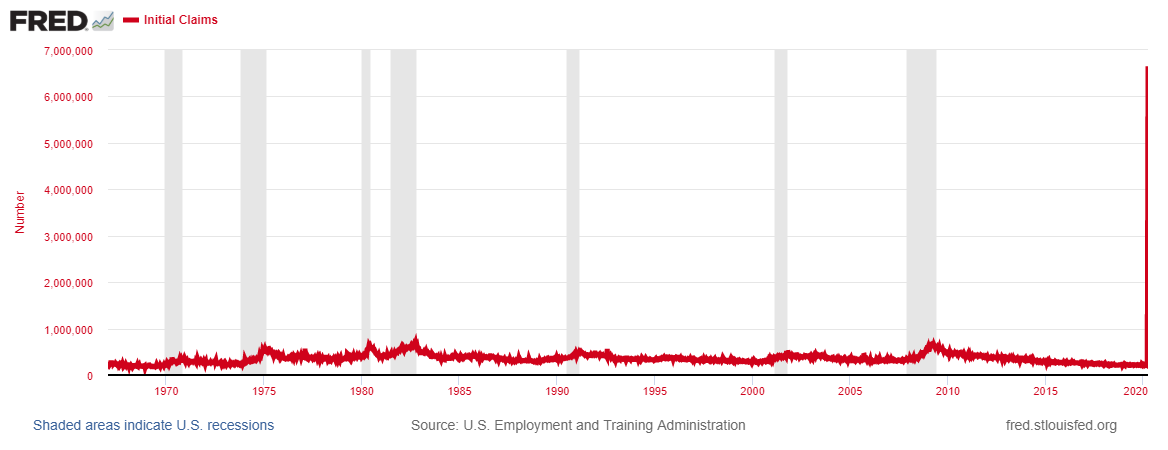
Approximately ten million Americans have filed new claims for unemployment benefits over the past two weeks.  To put that in perspective, the all-time record for a single week before this coronavirus pandemic hit was just 695,000.  So needless to say, 6.6 million claims in a single week puts us in uncharted territory.  Just check out this chart.  We have never seen a week like this before, and we may never see a week quite this bad again.  Of course millions more jobs will be lost in the months ahead as this pandemic stretches on, but it is hard to imagine another spike like we just had.  When you add the last two weeks together, somewhere around 10 million Americans have filed new unemployment claims during that time period…

The torrent of Americans filing for unemployment insurance skyrocketed last week as more than 6.6 million new claims were filed, the Labor Department reported Thursday. That brings to 10 million the total Americans who filed over the past two weeks.

Economists surveyed by Dow Jones had expected 3.1 million for last week, one week after 3.3 million filings in the first wave of what has been a record-shattering swelling of the jobless ranks. The previous week’s total was revised higher by 24,000.

As I have documented repeatedly in my articles, survey after survey has shown that most Americans were living paycheck to paycheck even during the “good times”.

Now that those paychecks aren’t coming in anymore for millions of Americans, a lot of bills aren’t going to get paid.

Just like we witnessed in 2008, mortgage defaults are about to skyrocket, and Wall Street is bracing for the worst

Borrowers who lost income from the coronavirus, which is already a skyrocketing number as the 10 million new jobless claims in the past two weeks attests, can ask to skip payments for as many as 180 days at a time on federally backed mortgages, and avoid penalties and a hit to their credit scores. But as Bloomberg notes, it’s not a payment holiday and eventually homeowners they’ll have to make it all up.

According to estimates by Moody’s Analytics chief economist Mark Zandi, as many as 30% of Americans with home loans – about 15 million households – could stop paying if the U.S. economy remains closed through the summer or beyond.

As I noted yesterday, the St. Louis Fed expects the unemployment rate to eventually hit 32 percent.  That won’t happen immediately, but if we do get there it will be worse than anything that we witnessed during the Great Depression of the 1930s.

Because of all the shutdowns that have been instituted nationwide, economic activity has already dropped to levels that we have never seen before in our entire history.

Personally, I was absolutely astounded when the latest box office numbers were released

The Domestic Box office (movie theaters) brought in a whopping $5,179 for the week of Mar 20-26. Down 100% from $204,193,406 the same week a year ago… These numbers are just incredible.

And even once all the “shelter-in-place” orders have finally been lifted, a substantial portion of the population will not want to go to movie theaters anymore due to fear of catching the virus.

Many movie theaters that have closed down will simply never open up again.

Another thing that has really surprised me is how rapidly many Americans have run out of food.  A Daily Mail article that documented a line of vehicles a half mile long at a church in Orlando that was giving out food received a lot of attention today…

Today, the hundreds of families flocking to a church parking lot across town from Orlando’s iconic resorts and theme parks are here for a starkly different reason: survival.

‘In the amusement parks, the purpose or the outcome is about having joy or a thrill,’ says mom-of-three Glenda Hernandez, winding down her window to speak with a DailyMail.com reporter.

‘This is about having a child’s belly full for the night or the next couple of nights on whatever they give us.’

How is it possible that so many families are out of food already?

And apparently charities and food banks all over the country are seeing similar surges in demand.  Here are just a few examples that were shared by the Guardian

  • In Amherst, home to the University of Massachusetts’ largest campus, the pantry distributed 849% more food in March compared with the previous year. The second-largest increase in western Massachusetts was 748% at the Pittsfield Salvation Army pantry.
  • The Grace Klein community food pantry in Jefferson county, which has the largest number of confirmed Covid-19 cases in Alabama, provided 5,076 individuals with food boxes last week – a 90% increase on the previous week.
  • In southern Arizona, demand has doubled, with pantries supplying groceries to 4,000 households every day – double the number supplied in March 2019. “We saw an increase during the federal government shutdown but nothing as rapid, massive or overwhelming as this,” said Michael McDonald, CEO of the Community Food Bank of South Arizona.

If things are this bad already, how much worse will the suffering be a month or two down the road?

Meanwhile, U.S. farmers are facing problems of their own.

Because of all the shutdowns, it has been difficult for farmers to get enough workers into their fields.  The following comes from CNN

April and May are critical planting and harvesting times for many US farmers. They need skilled laborers to work their fields, and a reliable supply chain to deliver their goods. And they don’t have any time to waste.

If farmers can’t find enough workers or if their farming practices are disrupted because of the pandemic, Americans could have less or pricier food this summer. And because international farmers and their supply chains face similar problems, we could receive fewer food imports, potentially limiting supply and driving up prices.

Of course the main thing that is going to drive up prices is the fact that the system is being absolutely flooded with new money.  Many Americans have applauded the recent moves by the Federal Reserve, and just about everyone seems thrilled that big government checks are coming, but they won’t be so thrilled when a loaf of bread costs five dollars and a gallon of milk costs ten dollars.

As the virus spreads, many are concerned that it will sweep through low wage communities particularly hard, and that is a huge problem because low wage workers are absolutely vital all along the food chain

By law, food manufacturers must prevent anyone who is sick or has a communicable disease from handling, processing or preparing food for human consumption. But much of the food supply chain is staffed by low-wage workers, many of them undocumented immigrants with limited ties to health services.

So what are we going to do if there are not enough healthy workers to get our food from the farms to our dinner tables?

Already, confirmed cases are starting to pop up at quite a few food production facilities

The first case of a worker at a major U.S. meat producer testing positive for the virus was reported last week at poultry giant Sanderson Farms Inc. Since then, infections have cropped up everywhere from JBS SA plants in Iowa to Harmony Beef in Alberta.

While scattered factories have closed temporarily or cut output, generally companies are keeping plants running when workers get sick. Rather than shutting entire plants, they’ve focused on identifying areas where infected people have had direct contact.

Fear of the coronavirus is going to paralyze even “essential” industries such as food production.

We are now being told that authorities hope that cases peak in April and that this crisis will hopefully be behind us by June.  Let us pray that is true, but what most Americans don’t realize is that this pandemic is just the beginning.

Even before any of us ever heard of “COVID-19”, our world was already descending into madness, but now this pandemic has certainly accelerated things.

Millions of Americans have already lost their jobs, and the days ahead are going to be exceedingly challenging.

This is what an economic collapse looks like, and it is just getting started.

About the Author: I am a voice crying out for change in a society that generally seems content to stay asleep. My name is Michael Snyder and I am the publisher of The Economic Collapse BlogEnd Of The American Dream and The Most Important News, and the articles that I publish on those sites are republished on dozens of other prominent websites all over the globe. I have written four books that are available on Amazon.com including The Beginning Of The EndGet Prepared Now, and Living A Life That Really Matters. (#CommissionsEarned) By purchasing those books you help to support my work. I always freely and happily allow others to republish my articles on their own websites, but due to government regulations I need those that republish my articles to include this “About the Author” section with each article. In order to comply with those government regulations, I need to tell you that the controversial opinions in this article are mine alone and do not necessarily reflect the views of the websites where my work is republished. The material contained in this article is for general information purposes only, and readers should consult licensed professionals before making any legal, business, financial or health decisions. Those responding to this article by making comments are solely responsible for their viewpoints, and those viewpoints do not necessarily represent the viewpoints of Michael Snyder or the operators of the websites where my work is republished. I encourage you to follow me on social media on Facebook and Twitter, and any way that you can share these articles with others is a great help.  During these very challenging times, people will need hope more than ever before, and it is our goal to share the gospel of Jesus Christ with all many people as we possibly can.

The post This Is What Economic Collapse Looks Like appeared first on The Economic Collapse.

DIY Bidet: How to Make Your Own Bidet When Toilet Paper Is No More

It figures that the first thing to go in a SHTF situation is the toilet paper. With COVID-19 snaking its way across America—and news stations breathlessly reporting on empty shelves—TP is at the top of most shoppers’ lists. If you’re limiting your grocery runs to reduce the likelihood of exposure, you run the real risk of missing out on this basic staple. You can go to off-the-beaten-path stores, but they might not have it either. So what do you do if your monthly shopping expedition comes after the village hoarder has ransacked the hygiene aisle? For that, we turn to one of the bougiest of concepts: The bidet. Well, a DIY bidet.

Creating a DIY Bidet

No, I’m not talking about that sink next to toilets in Europe, or one of those multi-button motion-sensor, heated-seat porcelain thrones that you see in luxury penthouses. (Although if you DO have one of those installed in your home already, excellent foresight.) No, what I’m talking about is the backcountry bidet—a simple solution to all your No. 2 needs.

The classic backcountry bidet is a type of squeeze bottle with a long, bent-neck nozzle (such as the BioBidet). However, if you don’t have one of these lying around, it’s easy enough to jerry rig a DIY version. These range from the VERY low-tech (a cup of warm water and your left hand) to more complex prototypes that require a trip to the hardware store (yeah …). But an easier version uses common household materials.

Make Your Bidet

Step 1) Find your bottle. A quick search of my fridge and backpacking pantry resulted in a variety of options. Select your bottle for “squeezability”—Gatorades are probably not the best choice here)—and size. You’ll just have to use your judgement when it comes to size. If you have smaller hands and are relatively, er, efficient, you’d want to select a smaller bottle than someone with quarterback-sized mitts. Some trial and error may be involved.

Step 2) Mark your bottle in a way that is impossible to miss. Duct tape, stickers, whatever you have at hand. The last thing you want is to mistake this bottle for a regular water bottle in the middle of the night.

Step 3) Grab a drill and drill bit; something in the 1/8 to 7/32 range works best. Test to see if your hole is already the correct size. If not, remove the cap, place it on a firm surface, and get drilling.

Step 4) Fill your bottle with water and screw the top back on.

Using Your Bidet

Step 1) After you’ve done the deed (taking your time—a pandemic is no time for a hernia), grab your bottle.

Step 2) Reach underneath and spray front to back (especially important for women and girls). Depending on the size of the bottle you selected, you may need to elevate your carriage some off the throne to get the right angle. Be mindful of the back of the toilet; this was designed for outdoor use, after all. Try to keep your hand out of the way of any splashback, but don’t worry too much about it. We’ve all had lots of practice with the proper technique for washing hands these days.

Step 3) Depending on how much you are trying to conserve toilet paper, you can either grab a square or two of TP to dry off, or let things air out au naturel.

Programming note: Do NOT get fancy and start thinking that you can conserve your home water supply by using urine in your DIY bidet. The uric acid will give you diaper rash.

Can You Live Off-Grid in A Van or Motorhome?

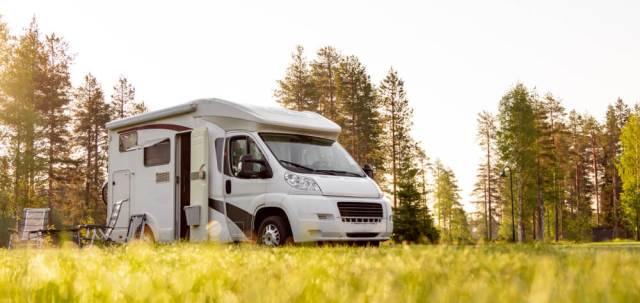
Van life is a very popular trend among young individuals seeking freedom, a simple life, and exploration. Off-grid living is a popular trend in the same vein that it incorporates the goals of freedom and simple living. Is van life and off-grid living mutually exclusive? Can you live the van life as a prepper and enjoy the aspects of off-grid living? For some budget conscious individuals, they may just be looking to live this style of life while building or saving for a more permanent home. For preppers, as during the COVID-19 pandemic, motorhomes can also be for self-isolation.

Related: Selecting a Campground as a Bug Out Location

Most of us have romantic notions about off-grid living. Sure, growing food and sourcing water would be hard, laborious work. But it would be honest work. Even better, it would all be an exercise in independence. There would be no bureaucrats, no middle-men; no corporate influence — just you, your loved ones, and the raw materials of the Earth.

It is in this sense that we think of off-grid living as a life “how it should be.” A natural life. The good life. The romanticism goes on.

But in today’s increasingly interconnected and globalized world, how realistic is the off-grid lifestyle? Is it even legal in so-called liberal democracies? And if it could be achieved, would it ultimately be desirable, and worth the effort?

These are the questions this article is looking to explore.

off-grid small home
Off-grid living seems idyllic, even the “right” way to live.

Off-grid living seems idyllic, even the ‘right’ way to live. 

Freedom and Defining Off-Grid

In order to explore how possible off-grid living is, we first need to define what people mean when they talk about it. Some definitions are more strict than others. For example, some people take off-grid living to be:

  • Living independently of the public power grid.
  • Living free of all public utilities, including water.
  • Completely avoiding all public infrastructure, such as roads.
  • Being completely independent of all walks of life, including food-shopping and healthcare.

For most people, the romanticism associated with off-grid living can be
found at the most extreme end of this scale — but few would seriously want to
put their health at risk in the event of an emergency. 

Most people — and as we shall soon see — tend to think of the first step
as sufficient enough. After all “grid” is a synonym for electrical grid. This
is literally where the expression comes from. 

Living Off-Grid in a Van or Motorhome — Is it Possible?

To attempt the off-grid lifestyle in a motorhome is to automatically be dependent on the road network. This way of life is appealing to many, because it opens up whole new areas of the world to settle down in, relax and explore. It also makes you more answerable to governmental legislation, which more often than not interrupts any romantic notions of “freedom” and “independence.”

For example, in the UK, it is not possible to just find someplace out in
the countryside, settle down and start cultivating the land. Not without
permission. You can settle down somewhere for 28-days, but after that
the local authorities will demand you move on (unless you successfully apply
for planning permission). 

But here are some things you can do:

  • You could look for a residential site or holiday site for motorhomes that is welcome all year round. Although some sites have legal requirements for you to leave the site for a period of 48-hours every three months or so. But that’s not really a problem, and could give you the chance to do some exploring.
  • You could live off-grid on someone else’s land with their permission. This is known as ancillary accommodation. And “someone else’s land” can refer to anything, from pastures and meadowland, to a large garden and even somebody’s driveway.

And that’s about it! You could opt for a full nomadic lifestyle, with no fixed address — but you would soon run into problems, and this would make the off-grid lifestyle nearly impossible. As without ancillary accommodation, you would have to keep moving about.

Living ‘off-grid’ in a motorhome is appealing to many, for extra independence. 

motorhome
Living “off-grid” in a motorhome is appealing to many, for extra independence.

Off-Grid Living or Full-Time Touring?

If we are willing to bend the rules of what constitutes off-grid living,
then full-time touring is an option. This is actually really popular, because
it provides motorhome-owners with all of the perks of travelling and
independence, and none of the downsides. 

For example, someone who is touring full-time could still visit the shops to get food. And (a neat trick that a friend told me) could join a 24-hour gym for the sole purpose of a hot shower. People living the van life often join a YMCA to enjoy the “use any YMCA gym” benefit that membership comes with. It would entirely be possible to be off-grid in terms of power usage, but on the darkest and coldest winter nights, hook-ups would still be an option at most sites.

Full-time tourists can even take advantage of motorhome sites with no
power grid. These sites are unpopular even on bank holidays and in the height
of summer, and will provide plenty of spaces to sit back, relax and enjoy what
life has to offer. 

Off-Grid Energy in a Motorhome

For the purposes of the rest of this article, we are going to assume you
want to be somewhat self-sufficient; as close to the romanticism of off-grid
living as possible. In that case, you will need to know what to do for
power. 

  • Solar panels — The most important source of power will come from the sun. Technological improvements over the years have driven the cost of solar panels right down, and a good one will last over a decade if looked after properly. Mounted-roof panels are ideal because you can pivot them to follow the sun, and after nightfall, fold them away and store them inside to prevent theft.

    A 100-watt panel wired into two 110-amp leisure panels should serve your energy needs in a motorhome well, though you might have to sacrifice some — in my opinion easily doable — electronics. Such as: TV (watch on a laptop instead); toasters, coffee makers, French press, and so on (you can find more practical ways to make coffee and toast). A 200-watt panel is also suitable.

  • Propane Gas — The second most important type of power source is gas. In the summer, gas works to keep our refrigerators cool. In the winter, we burn gas for warmth. Without mentioning specific brands, a refillable gas system should cater well for your gas needs — with a backup cylinder in reserve. Shop around and find the best cost-for-cost cylinders. Two cylinders should last about three weeks. You can even buy 100lb steel propane tanks for more semi-permanent residence!
  • Generators — Generators are noisy and smelly, so they are best used as a backup, when the solar panel cannot generate enough power. If you are power-smart, a 500-watt one might be enough to manage on. Higher energy consumers might opt for a two-kilowatt generator. Invest in a good brand and you should get a decade of use out of it. Honda makes a super quiet 1000-watt generator with an inverter and a 3000-watt version. They’re more costly than others, but the benefits could outweigh the costs. You also have the added benefit of Honda quality.
  • A car engine — If you don’t have a generator and just need a little backup in case everything goes out, then the engine of a car or other motorhome may be just the trick. All engines like these have alternators and can provide sufficient charge in half-an-hour or so. 

Somewhat surprisingly, power-sufficiency is probably the easiest part of
the off-grid lifestyle. Though be warned: it can get expensive. But if you can
afford it, it should well be within your grasp to manage. 

Food and Water Self-Sufficiency in a Motorhome — Can it be Done?

The answer to the water part of this question can be dealt with quite quickly: no. Even some of the most die-hard off-grid enthusiasts still have to resort to a public utilities source for their water. Most lakes and rivers are, unfortunately, polluted or riddled with vomit-inducing microorganisms. A travel Berkey gravity-fed water filter can help, or something like the Katadyn small group water filter, but those only go so far – and they assume a ready supply of water. 

You could consult a geographical map, find an area with a
naturally high water table, and try digging a well. But such an endeavor will
cost a lot of money, require apparatus to pump the water out, by no means be a
guaranteed success and (you guessed it) will rattle the attention of the local
authorities. 

Self-sufficient food and water is much harder to manage than electricity and gas. 

off-grid motorhome
Self-sufficient food and water is much harder to manage than electricity and gas.

For food, the answer is: definitely sometimes. You can grow a surprisingly large amount of food in a relatively small place; raised-beds are a perfect example of this. You can then supplement whatever you grow with more edible fruits and plants grown in containers. Even a raised-bed around 24-inches wide should be sufficient for a couple of people (read Square Foot Gardening to see how). You can raid local supermarkets for food-waste and cardboard to re-purpose as compost, too. But that’s a lot of work!

Related – How to Build a Concrete Block Raised Bed Garden

The problem is, for such self-sufficiency to be possible, you will have
to ground your motorhome for months at a time. Growing food this way also
requires meticulous and strategic care — akin to becoming something like a
low-level biologist — and you will have to deal with pests, plant-disease, and
bad weather on top of all that. Self-sufficient food crops have also been
linked to bad breath and digestive problems.

At the very least, it would be possible to be somewhat self-sufficient
some of the time. This goes for people who live in a fixed abode as well, and
not just for motorhome enthusiasts. The general consensus from the people
who’ve tried it seems to be: it is far better to grow some food for the
sense of accomplishment, but not to depend on it. 

Thoughts and Conclusions

In short, the answer to the question: “Can you safely live off-grid in a
van or motorhome?” depends on your interpretation of what the word“off-grid”
actually means, and if one is allowed to bend that definition. As we have
explored, simply driving around and using the roads is by some interpretations
off-limits for anyone who truly desires to be independent from the
network. 

You can certainly live in a motorhome independent of a national power grid. With careful management of your solar panels and gas canisters — this is actually one of the least problematic areas of off-grid living. And it is certainly achievable and has some advantages.

But sourcing food and water is very difficult. At best, and at some expense and risk, and strategic thinking, you may be able to be food and water self-sufficient some of the time. It will be hard work, but it will be honest labor. And in the periods where one can live truly off the Earth, there are few greater senses of accomplishment.


This Author

Neil Wright is a copywriter and researcher. He has an interest in travel, science and the natural world, and has written extensively about off-grid living in the UK on his motorhome website. 

The post Can You Live Off-Grid in A Van or Motorhome? appeared first on SHTF blog – Modern Survival.

Internal Documents: Monsanto Knew For YEARS Their Products Damaged Farms

According to internal documents, Monsanto and Germany’s BASF knew their products would destroy farms in the United States. The firms disregarded the risks even while they planned on how to profit off farmers who would buy Monsanto’s new seeds just to avoid the damages caused by their products.

The documents (some of them date back more than a decade) have been uncovered during a recent successful $265 million lawsuit brought against both firms by a Missouri farmer. The internal documents were seen and released by the Guardian. They also revealed how Monsanto opposed some third-party product testing, in order to curtail the generation of data that might have worried regulators. In some of the internal BASF emails, employees were even joking about sharing voodoo science and hoping to stay “out of jail.”

“The documents are the worst that I’ve ever seen for any case that I’ve worked on,” said lawyer Angie Splittgerber, a former tobacco industry defense attorney who works with farmers who are suing Monsanto and BASF. “So many of them put things in writing that were just horrifying.”

Unfortunately, this isn’t the first time Monsanto has been caught trying to hide the damages that are done with their products.

BUSTED! Monsanto Caught Writing Their Own Independent Safety Reviews

Monsanto Declares a Sneaky Social Media War Against Protesters

Records showed that at private meetings dating back to 2009, agricultural experts warned that the plan to develop a dicamba-tolerant system could have catastrophic consequences. Dicamba herbicide would normally kill crops such as soybean or cotton, but Monsanto altered the genes in these crops to create genetically modified varieties that are resistant to the herbicide. This meant that farmers can spray the weedkiller directly on those soybean or cotton plants to destroy weeds but leave the crops unharmed.

The experts told Monsanto that farmers were likely to spray old volatile versions of dicamba on the new dicamba-tolerant crops. They have warned that even new versions were still likely to be volatile enough to move away from the special cotton and soybean fields on to crops growing on other farms.

What is more important, under the system designed by Monsanto and BASF, only farmers buying Monsanto’s dicamba-tolerant cotton and soybean seeds would be protected from dicamba drift damage. –RT

Monsanto Pays Out $10 Million For Spraying Toxic Chemicals on Hawaiian Crops

According to a report prepared for Monsanto back in 2009 as part of industry consultation, such an off-target movement was expected. The company also expected things such as massive crop loss”, “lawsuits” and “negative press around pesticides.” Monsanto’s own projections estimated that dicamba damage claims from farmers would total more than 10,000 cases, including 1,305 in 2016, 2,765 in 2017 and 3,259 in 2018.

Both Monsanto and BASF defended their products, claiming dicamba is safe “when used correctly,” and marketed it as an important tool for farmers. Industry estimates suggest that several million acres of crops have now been reported damaged by dicamba. More than 100 US farmers are engaged in litigation in federal court alleging Monsanto and BASF collaboration created a “defective” crop system that has damaged orchards, gardens and organic and non-organic farm fields in multiple states.

4 Reasons To Choose Heirloom Seeds For Your Garden