Survival Gear is the most unused product until a natural disaster happens, then it’s the most desired products, but usually too late to help those that really need the help.

We sell around the World, and pride ourselves on offering a level of customer service that we would want to see ourselves if we were shopping online.
Our product ranges change regularly, so we hope that you come back to our sites to see some of the fantastic offers that we regularly have.

Get In Touch

How To Throw A Knife For Deadly Bullseye Accuracy

How To Throw KnivesToday I’ve got something really cool to share…

A Complete Guide To Throwing A Knife With Bullseye Accuracy

Because a skilled knife thrower is an incredible thing to behold.

But like most things in life…the experts “make it look easy.”

Throwing a knife with accuracy takes practice (and some guidance).

But that’s why YOUR hear, so lets get to it…

TOPICS IN THIS GUIDE…    ↓(click to jump)

Survival Gear Checklist eBook Cover -with fire piston on a rock and campfire in the background

Want a free 54 item survival gear checklist?

Click here to instantly download this Complete Checklist PDF. No purchase necessary.

Why You Should Learn This Skill?

First, why would you want to throw a knife in the first place?

Perhaps you want to know the skill as a “last resort” self-defense tactic.

Maybe you’d like to hunt small game silently and discreetly.

Or perhaps you dream of joining a circus to dazzle crowds with your bladed accuracy.

Or maybe you think throwing knives is badass.

Which it is indeed!

↓ The Best Knife Throwing Trick Shots

Learning the skill takes guidance regardless of why you want to throw a knife.

But before we dive in,  I want to warn you – there’s some serious controversy surrounding the usefulness of this skill for self-defense and survival.

↓ Is Knife Throwing Useful?

Many believe if you enter a fight with a knife, you should NEVER throw away your weapon.

Not only are you effectively disarming yourself, but unless you make the perfect throw, you’ll make your assailant angrier (and now you have no weapon).

You also probably just armed your assailant with the weapon you threw at them…

It’s easy to see the logic there, and I agree.

But, like I said:

I’ve seen some amazing knife throwers in my day.

And it’s frightening to behold how accurately and powerfully some can sling a blade.

So it’s a matter of skill and experience.

Check out this video to see how effective and deadly it can be:

↓ Throwing Knives & Tomahawks vs. GEL/RIBS

Sure, you may be a beginner today.

But after a few years of practice, when some chump tries to mug you in a dark alley, you’ll have the confidence and ability to cast a knife and end his criminal days.

Don’t try until you can nail the target every time.

Buying A Set Of Throwing Knives

Now here is where things get tricky.

Because the internet is full of throwing knives for sale, I’m here to tell you that not all are created equal.

In fact, a lot out there are utter garbage.

This is an important section because the knife makes a difference. It needs to be weighted correctly and made of the right type of steel.

For a beginner, this step is easy to mess up – because you don’t know what you are looking for.

But do not worry; that is why this article is here.

1.


SOG Fling Throwing Knives: 3 Pack

This is a standard set of balanced throwing blades.

Their handles are wrapped in nylon cord for grip and weight, just like the old-school throwing knives bound with leather or sinew.

The cord offers a special survival bonus, as it can be removed in a survival emergency and repurposed.

Each SOG Fling knife is 9.5” and has a ballistic nylon sheath for storage.


Check Today’s Price

We earn a small commission if you make a purchase, at no additional cost to you.

↓ SOG Fling Throwing Knives Full Review

2.


BOKER Magnum Bailey Ziel II Throwing Knives

These knives are longer throwing knives, at 13.25”. The stainless steel blades look a bit like scalpels.

And at 14 ounces, they are heavy enough to surgically strike down anything they sink their hefty weight into.

The Magnum blades come with a very nice leather sheath for storage.


Check Today’s Price

We earn a small commission if you make a purchase, at no additional cost to you.

↓ Bailey Zeil Throwing Knives

3.


Cold Steel Perfect Balance Thrower

Cold Steel is known for making excellent professional-grade throwing knives. And this intermediate Cold Steel Pro Balance Sport thrower is no exception to that.

The blade is expertly balanced and crafted with hard spring tempering. 13.25” long and 11.5 ounces, these professional throwing knives are an incredible bang for your buck.

You get nearly the same quality weapon that the pros use for a margin of the price.


Buy Now

We earn a small commission if you make a purchase, at no additional cost to you.

↓ The Perfect Balance Thrower from Cold Steel

4.


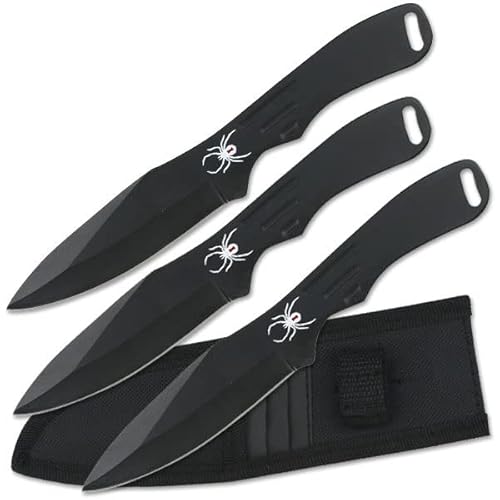
Perfect Point Throwing Knives: Set of 3

Another high-quality budget throwing knife is The Perfect Point RC-179 Series. It’s a well-balanced knife and allows accurate throws every time.

It’s made from black stainless steel construction and has a laser cut-out at the end of the handle that allows a lanyard to be tied to it.

It includes a black nylon sheath for safe transport, and each knife measures 8 inches in overall length.


Check Today’s Price

We earn a small commission if you make a purchase, at no additional cost to you.

↓ Review of Perfect Point Throwing Knives – Set of 3

6.


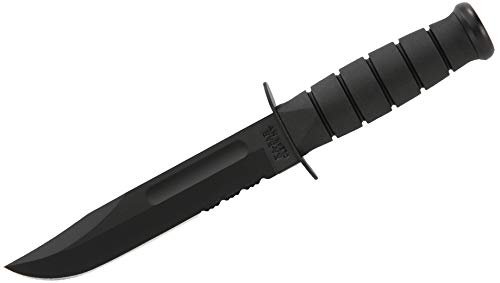
KA-BAR USA Fighting Knife

First off, let me be clear – the KA-BAR is NOT designed specifically to be thrown.

However, if you’re into survival (like we are), you may prefer to learn how to throw your survival knife (since we don’t carry throwing knives in our bug-out bags).


Check Today’s Price

We earn a small commission if you make a purchase, at no additional cost to you.

↓ KA-BAR Knives Don’t Throw?

Bug Out Bag Checklist eBook Cover - a man walking away wearing a military style backpack

Want a free 104 item bug out bag checklist?

Click here to instantly download this Complete Checklist PDF. No purchase necessary.

If you watched the video above, you noticed the Ka-Bar CAN be thrown with success with practice.

And when it hits its target, it’s a devastating blow.

Throwing A Knife Introduction

Sure, you could go into your kitchen, grab a bread knife and start hurling it around the house.

But you’re not going to have much success.

Instead, to practice correctly, get yourself a set of throwing knives and a safe space outside.

That way, you won’t throw toward anyone or anything valuable (i.e., the neighbor’s kids or cars).

In general, there are three types of throwing knives:

  1. Handle Heavy Knives
  2. Blade Heavy Knives
  3. Balanced Knives

How To Hold The Knife

You always want to hold the knife opposite the heavy end so the weighted side gets thrown first.

For example:

If you have a heavy handle knife, you will hold the blade – if you have a heavy blade knife, you will hold the handle.

Balanced blades can be thrown from either end and are the preferred knives amongst professionals.

Place your index, middle, and ring fingers on one side of the end you are holding and your thumb on the other.

Hold the knife gently but firmly.

↓ Time Warp: Knife-Throwing Physics

The Different Throwing Motions

There are many schools of thought on how to throw a knife.

There are many techniques, and none are right or wrong – they’re just different. And some work better than others.

For this article, I will explain a few of the most common ways:

↓ How To Throw A Knife | Axe | Tomahawk ↓

The Professional Technique

No matter how you throw the blade, the first step is always the same: find your “throwing line.”

This is the distance from you to your target – usually about five paces.

This is where most professionals throw from, and as a beginner, you’ll want to start here too.

Simply take a step forward from where you stand on the throwing line.

Keeping the knife horizontal to the target, swing, gently release, and always follow through (just like a good golf swing or baseball pitch).

While this method is perfect for practicing accuracy and getting a good feel for throwing a knife, it does not generate much Oomph.

Survival Gear Checklist eBook Cover -with fire piston on a rock and campfire in the background

Want a free 54 item survival gear checklist?

Click here to instantly download this Complete Checklist PDF. No purchase necessary.

The Power Throw

You need extra steps to get more power out of your throw.

Once you have found your line, take another step backward and one more step at a 45-degree angle.

Stand with your weak shoulder to the target (left shoulder for the right-handed, right shoulder for the left-handed).

Place your back foot one step ahead of your front foot (almost like you’re mid-stride, with the target to your side).

Wind up, take a big step towards your line with your back foot (the one on your dominant side), and throw that knife friggin hard.

Once again: keep the knife horizontal to the target throughout the throw, gently let it go, and follow through.

With all your might, the extra step lets you pitch that knife like a baseball.

Successfully throwing a knife like this generates enough force to peg an animal you’re hunting or punch a hole in an enemy.

Timing the release is the hardest part of throwing.

Knowing when and how to let go of the blade so it spins correctly, flies the right way, and sinks where you want it to is a matter of trial and error.

Practicing is the only way to perfect this skill.

↓Throwing a Knife

The “No Spin” Throw

There is a third way to throw a knife.

It is not typical, but it can be effective.

The no-spin throw sounds exactly as it looks: the thrower launches its knife so that it doesn’t rotate to the target.

Start in the same place you would for the Power Throw (described above) and in almost the same stance.

But hold the knife with your pointer finger supporting the back edge of the knife.

Step outwards with your dominant leg and throw the knifepoint first towards the target, release gently, and follow through.

Watch the video for more details:

↓ No Spin Throwing Tutorial

BONUS! Shuriken and the Art of Shuriken Jutsu

Ninja stars, as they are commonly known, are another throwing knife.

I kept them separate from the other knives.

Why? Because they’re different from regular Western throwing knives (heavy-handled, heavy-bladed, or balanced).

↓ Ninja Stars For Self-Defense?!?! ↓

Shuriken were not typically instruments of assassination, as many people believe.

Most shuriken (most throwing knives, for that matter) cannot be thrown with enough force to stick directly into a person.

Especially if that person is very far away.

Instead, martial artists would use them to cut, slice, or nick their target’s skin.

They were used as distractions, and nuisances during fights, and used to target exposed areas of the body (like the eyes, and hands).

Ninjas were a crafty bunch – they would embed their shuriken into the ground so that enemies would step on them like caltrops.

They would wrap them in a lit fuse and throw them at structures to start fires.

They would wrap them in poisonous cloth, which they lit on fire before throwing, to cover a vast area in toxic smoke.

Heck, they were even used as handheld weapons, for close combat.

Shurikens didn’t have to be perfectly shaped “stars” either – many were made from nails or coins.

Shuriken came in many different shapes and sizes.

Some were circular with sharpened outer edges.

Others were more like pointed-throwing darts (known as Bo Shuriken).

They were perhaps the most effectively used throwing knives of all time.

Throwing a shuriken is very similar to throwing a regular knife.

You only need to make certain that you hold it so that the blade has no chance of cutting your skin when you release it.

The Japanese martial artists who developed the art of throwing shuriken (Shurikenjutsu) created more ways to throw these deadly weapons than you can imagine:

  • overhead
  • underarm
  • sideways
  • rear ways…

Sometimes in battle, they would whip out a shuriken so quickly and with such stealth, that warriors who got cut by them would think they were being attacked by an invisible swordsman.

↓ Learning to Throw Shuriken with no Experience ↓

The Final Word

Yes, a thrown knife can function as an additional self-defense weapon – if you know how to do it.

But it takes lots of practice.

If this is something that interests you, it’s a great hobby.

Much like darts or target shooting, throwing knives is a fun and relaxing way to practice a skill with some practical self-defense applications.

If you’re more into survival than knife-throwing competitions, you should learn how to throw your survival knife.

That way, you won’t weigh down your bug out bag with an unnecessary set of throwing knives.

Why Trust Skilled Survival…

Go here now to review a full breakdown of:

  • Who We Are
  • Our Credentials
  • Our Mission
  • & Product Recommendations…

Here are a few highlights of our teams credentials & certifications:

  • Certified Member of a Mountain Search & Rescue Organization
  • Plant Emergency & Safety Leader for a Major Food Manufacturer
  • Member of the 10TH Mountain Division Hut Association
  • Certifications: Avalanche 1, WFR, CPR
  • Official Gear Tester for Numerous Outdoor Gear Companies
  • Countless Multiday Backpacking trips into Remote Wilderness
  • Bachelor’s Degree In Mechanical Engineering 
  • Bachelor’s Degree In Civil Engineering
  • Bachelor’s Degree In Biomedical Engineering

“It takes 20 years to build a reputation and five minutes to ruin it.” – Warren Buffett

We’re fully aware that trust is NOT something you GET but is EARNED.

And we’ll continue to earn YOUR trust through our forthright and honest approach with each new Blog Post, Guide & Product we create…

Will Brendza

Will Brendza

  • Bachelor of Arts, University of Colorado at Boulder
  • Member of The 10th Mountain Division Hut Association
  • Certifications: Avalanche 1, WFR (expired), CPR (expired)
  • 8+ Years Researching, Writing, About Survival and Preparedness
  • Awards from Society of Professional Journalists
  • Winner of Camp Cold’s “Happy Camper” award in 2020
  • P.s. Do You Live In A ‘Danger Zone’ County?

    Find out now using my Danger Zone County List & Special Report it’s absolutely FREE.
    In minutes you’ll know EXACTLY where you stand and if you should be worried or not..

    The post How To Throw A Knife For Deadly Bullseye Accuracy appeared first on Skilled Survival.

    How To Make A Longbow: Ultimate Tricks Of The Trade

    How To Make A LongbowToday I’ve got something exciting to share…

    A Complete Guide On How To Make A Longbow From Scratch

    Because the longbow was the most innovative invention of its day.

    And whomever first created the bow had no idea they were carving out the future of humanity.

    A weapon equally silent, stealthy, simple, and utterly deadly.

    And you CAN build your own, IF you follow this guide…

    TOPICS IN THIS GUIDE…    ↓(click to jump)
    Survival Gear Checklist eBook Cover -with fire piston on a rock and campfire in the background

    Want a free 54 item survival gear checklist?

    Click here to instantly download this Complete Checklist PDF. No purchase necessary.

    What You Need To Make A Longbow

    Making a bow is no simple endeavor (unless you want to make a green bow from a sapling).

    ↓ How to Make Your First Long Bow from a Sapling

    For more advanced longbows, you’ll want to use some specialty tools.

    Hunter-gatherers and Ute tribesmen did not have fancy drawknives, shellac, or fletching jigs, yet they built wonderfully functional longbows.

    But the fewer tools you choose to use, the harder and more painstaking this project becomes.

    Some of these resources are necessary – those marked with *s. Make sure you have what you need before getting started.

    Time

    Do not kid yourself.

    This project isn’t the kind of project you will be able to knock out some lazy afternoon after a long day at the office.

    It’s a time-consuming, highly involved undertaking.

    Make sure you have the time to invest. Otherwise, your bow will be half-assed and likely useless.

    Wood and materials

    • Tree Trunk/Pole * – This can be ordered at a lumber or hardware store, collected in the woods, or bought online. There are some places where one can acquire this essential piece. Choosing the right type of wood to use can be difficult, but we’ll get to that later.
    • A 2X4 – The wooden block should measure about 40” long (no shorter than 30” ).
    • 2 to 4 – 40 Watt Light Bulbs
    • Several Pieces of Plywood
    • Parachute Chord – Eventually, you’ll string your bow with this, but not for archery purposes.
    • Bowstring * – B-50 bowstring material (or your preference).
    • Shellac *
    • Gorilla Glue (or another type of wood glue).
    • Finish – Choose the color yourself.
    • Satin and clear polyurethane.

    Tools

    One can build a bow with nothing more than a hatchet, but it is significantly easier to use specific tools:

    • Hatchet *
    • Drawknife * – This is probably the most important tool you will use while building your bow, so don’t skimp on this. You can buy a decent one for $45, and the middle-shelf draw knives will be even cheaper.
    • Rasps * (hoof/farriers, Nichelson #49 & 5#50)
    • Cabinet Scraper * – You may not HAVE to use this, but it could be useful.
    • Pocketknife – hopefully, you already own one of these tools. If you don’t: get out there and buy one! Pocket knives are unbelievably versatile tools.
    • Sandpaper * – 80-, 150-, and 220-grit.
    • File * – Chainsaw files will work best because of their small, detailed function.
    • Vice – Most woodworking projects require that you use a vice at some point or another. These are available at several retailers; you should have no problem finding one of these.
    • Sledgehammer *
    • Wedges *

    Prepper Checklist eBook Cover - with gas mask on a SHTF scenery background

    Want a free 78 item prepper checklist?

    Click here to instantly download this Complete Checklist PDF. No purchase necessary.

    survival longbow

    Getting Started: Making Your Longbow

    The more effort you put into the design and construction of your bow, the better the outcome.

    Patience and meticulousness will help to improve the results of your labor exponentially.

    Toys are easy to build, but useful survival tools are often difficult.

    Wood longbows are traditionally fashioned from the core of trees.

    It takes a lot of attention to detail and patience to shave away one growth layer at a time, but it is how you create a flexible and functional bow shaft.

    There are several steps involved in making a longbow, so prepare yourself:

    Picking the Right Type of Wood

    Opinions differ on what is the best wood to make a bow.

    A degree of personal preference is involved in selecting the wood.

    It depends upon your skills as a carpenter, tool experience, size, strength, skill as an archer, and body type.

    Here is a list of different types of wood that are up for the job:

    • Yew – Very popular for centuries throughout Europe, this lightweight wood is good for simple, short-lived bows with a light draw weight. It’s the only non-hardwood suitable for creating bows and is one of the best! Yew is good for beginners because it usually has fewer knots.
    • Elm – Creates short, stout bows with thick limbs. Like Yew, the bows Elm yields are short-lived and have a lighter draw weight than other woods.
    • White Ash – Yields shorter, stouter bows that are less climate-sensitive and last a little longer. It has a moderate draw weight but is prone to compression cracks on the belly of the bow.
    • Hickory
    • Oak (White Oak/Red Oak)
    • Maple
    • Elm (American Elm/ Red Elm)
    ↓ Best wood for making bows? My TOP 5

    Picking the Right Tree

    This step is just as important as selecting the right wood.

    The results will be disastrous if you choose a short, stumpy, knotted section of some timberline defect.

    Here are some criteria to follow when selecting the right tree:

    • 6-8 feet of straight trunk section.
    • The tree’s bark runs vertically without “spiraling.”
    • As few knots, limbs, bumps, or swales as possible (ideally none).

    When you cut the tree and remove your desired section, it is best to coat the wood with shellac or wax to prevent any cracking and avoid rot when brought inside.

    ↓ Bow Woods. How I Identify Tress for my Longbows

    Splitting off Staves

    Apparently, you cannot just stain and string an 8-inch diameter log and call it a longbow.

    The wood must be divided into staves first, and an 8” diameter will roughly produce six bow staves (so don’t worry if you mess up on the first one… or two).

    If you have a circular saw and something similar, you can kerf the log to ensure it splits along exactly the right lines.

    With the wedges and hammer, split the log lengthwise until you have some staves that are larger than the intended, finished length – roughly 2-3” in diameter.

    Once again, shellac them when these staves are split to prevent cracking.

    ↓ Osage: Harvesting & Splitting

    Shaving The Staves

    The first part of shaving your staves is to note the growth rings: summer growth rings are fatter and more distinct, and winter growth rings are small denser laminations.

    You will want to select a summer growth ring for the belly of the bow.

    Secure your stave in the vice and begin to draw off layers.

    Shave away wood until you have reached the winter growth ring just above the summer ring you have selected for the belly.

    Pare away this final growth ring with the cabinet scraper, following the growth ring from one end of the stave to the other.

    The more precise you are with this step, the better off you will be down the line, so take care to shave, draw, and pare as carefully as possible.

    Once finished, shellac the stave to prepare it and protect it from cracking during the next step.

    ↓ How to make a longbow – Part 1: Backing an Osage Stave

    Drying And Shaping The Stave

    Pare the stave with a hatchet and drawknife so that it is only slightly larger than the intended product. Shellac the back.

    You can build your drying box out of a few pieces of plywood and a couple of 40-watt light bulbs.

    A drying box is a relatively easy device to build, and it is pretty cheap for what a difference it makes.

    Drying on a shelf in the garage will do, but you probably will not be able to get the wood as close to the desired moisture content.

    Now comes the tough part:

    Testing Your Patience

    The stave should dry for 3-4 weeks at the minimum, and some bow makers even suggest you let the wood dry for an entire year.

    Regardless of how long you let the bow sit when you pull it out, it should be around 15% moisture content (8% is ideal).

    Moisture measuring devices can be purchased at almost any hardware store.

    When the time has finally come to move on with the project, extract your stave from wherever it was drying and very carefully draw the outline of your finished bow onto the stave with a marker.

    On Native American bows, the center 8” is narrower than both the limbs for the handle, and the belly tapers off at the end of the limbs.

    Mark the shape you want to cut out.

    Reduce the stave to your drawn outline using the drawknife and refine the form with a pocketknife to get the final details.

    Lightly sand the edges and tips and smooth out the front and back surfaces.

    Finally, create two deep 45-degree notches for the string on either end of the bow using a chainsaw file.

    ↓ How to make a Longbow – Part 2: Layout & Roughing out

    The Art Of Tillering

    That’s right. It is an ART.

    And it is perhaps one of the most important steps in this project.

    When you look at an unstrung longbow, it is not straight like your staves.

    It is curved slightly.

    Tillering is the method by which you achieve that curve.

    Remove wood from the belly with a file and cabinet scraper until the libs are thin enough to bend.

    Floor Tillering

    Holding one tip in hand and resting the other on the floor securely against your foot.

    At first, bend the bow gently to test the flexibility.

    Begin to shave off small amounts of wood between each bending session, creating more and more arc.

    But be VERY CAREFUL not to crack the stave – otherwise, start starting over.

    As you do this, keep a wary eye open for any flat spots or points of resistance and shave them away.

    The amount of wood you shave off should get increasingly smaller as you get closer to a finished product.

    Inspect regularly along the process for any cracks or imperfections – if anything but small cracks on the back develops, you will have to start from scratch.

    Once the bow is bent enough to string, bust out that hemp or parachute cord and tie it off.

    There should be about seven inches between the bow’s belly and the string on a properly strung bow.

    Tiller Tree

    This is why you need a 2×4.

    Stand the block up on one end and use a file or saw to create angled notches every inch or half an inch along the long side.

    Here is a video of building a tillering tree:

    ↓ Building a Tillering Tree

    Fasten the tiller tree upright against a wall and place the belly of your strung bow on the top.

    Carefully start to draw the string and rest it in the tiller tree’s notches to increase the draw of your bow gradually.

    Leave the string on each level for a few minutes to adjust the wood.

    A typical draw length is about 28 inches, so you should be good to go when your bowstring hits the 28-inch mark on the tiller tree.

    Once again, shave away any flat or compromised points of weakness as you do this.

    The end goal of tillering is to create a perfectly even bend in both limbs.

    Once this has been achieved, take the bow and draw it in front of the mirror.

    Do this repeatedly until you identify which of the two limbs is stiffer.

    The stiffer one should become the bottom of your longbow.

    Use your file to create a small indentation on the handle for the arrow (right or left, depending on which hand you shoot with).

    ↓ How to make a Longbow – Part 3: Tillering

    Finishing Your New Longbow

    Sand the entire bow with 80-, 150-, and 220-grit sandpaper and shellac again for good measure.

    At this point, you can decide if you want to finish your bow or not.

    It is a personal choice, but remember, the darker the color of your weapon, the harder it will be to spot in the brush or woods.

    Seal with three coats of clear gloss polyurethane and one final coat of satin polyurethane.

    Wrap your handle in nylon cord, hemp cord, or leather chord using the “whipping” technique.

    Apply a light coat of clear glue (like Tightbond III) and let it dry.

    Finally, you can string your bow with an actual bowstring, and you are ready to get out there.

    You have a completed, one-of-a-kind handmade hunting longbow – enjoy!

    Prepper Checklist eBook Cover - with gas mask on a SHTF scenery background

    Want a free 78 item prepper checklist?

    Click here to instantly download this Complete Checklist PDF. No purchase necessary.

    The Final Word

    There is nothing quite as satisfying as hunting live game with a longbow you made with your own bare hands.

    It is a very human experience. But more importantly, once mastered, it’s a survival skill that can never be taken away from you.

    Even if you are not into hunting, using a handmade custom bow to practice archery is ideal for survival.

    It is the original long-range weapon and a tool that helped our species proliferate from a few small bands of wandering tribes into the great and comprehensive society we live in today.

    It may also be a weapon that keeps your family safe if society collapses back into ancient times.

    Why Trust Skilled Survival…

    Go here now to review a full breakdown of:

    • Who We Are
    • Our Credentials
    • Our Mission
    • & Product Recommendations…

    Here are a few highlights of our teams credentials & certifications:

    • Certified Member of a Mountain Search & Rescue Organization
    • Plant Emergency & Safety Leader for a Major Food Manufacturer
    • Member of the 10TH Mountain Division Hut Association
    • Certifications: Avalanche 1, WFR, CPR
    • Official Gear Tester for Numerous Outdoor Gear Companies
    • Countless Multiday Backpacking trips into Remote Wilderness
    • Bachelor’s Degree In Mechanical Engineering 
    • Bachelor’s Degree In Civil Engineering
    • Bachelor’s Degree In Biomedical Engineering

    “It takes 20 years to build a reputation and five minutes to ruin it.” – Warren Buffett

    We’re fully aware that trust is NOT something you GET but is EARNED.

    And we’ll continue to earn YOUR trust through our forthright and honest approach with each new Blog Post, Guide & Product we create…

    Will Brendza

    Will Brendza

  • Bachelor of Arts, University of Colorado at Boulder
  • Member of The 10th Mountain Division Hut Association
  • Certifications: Avalanche 1, WFR (expired), CPR (expired)
  • 8+ Years Researching, Writing, About Survival and Preparedness
  • Awards from Society of Professional Journalists
  • Winner of Camp Cold’s “Happy Camper” award in 2020
  • P.s. Do You Live In A ‘Danger Zone’ County?

    Find out now using my Danger Zone County List & Special Report it’s absolutely FREE.
    In minutes you’ll know EXACTLY where you stand and if you should be worried or not..

    The post How To Make A Longbow: Ultimate Tricks Of The Trade appeared first on Skilled Survival.