Survival Gear is the most unused product until a natural disaster happens, then it’s the most desired products, but usually too late to help those that really need the help.

We sell around the World, and pride ourselves on offering a level of customer service that we would want to see ourselves if we were shopping online.
Our product ranges change regularly, so we hope that you come back to our sites to see some of the fantastic offers that we regularly have.

Get In Touch

Mylar Bags vs Vacuum Sealing: Which Method is Best for Long-Term Food Storage?

The Short Answer: Which is Better?

Mylar Bags are the gold standard for your “Deep Cache” (10–25 years) because they provide a total light and oxygen barrier. Vacuum Sealing is the superior choice for your “Active Pantry” (1–3 years) and freezer management.

But there’s a catch: In 2026, simply “bagging it” isn’t enough. To avoid the #1 Preservation Mistake and ensure your gear passes the “Spouse Test” , you must follow specific technical standards like the 15-Mil Rule and the Snap Test

At a Glance: Mylar Bags vs Vacuum Sealing (Winner By Category)

Category Method 2026 Pro Insight
Pantry / Fridge Vacuum Sealing High Spouse Test score; best for high-visibility rotation.
Deep Cache Mylar + OA The industrial barrier prevents microscopic O2 seepage.
Dry Staples Mylar + OA Prevents Pinhole Leaks and hits the 10% Moisture Rule.

Managing household resilience is a part of modern competence. One of the most critical parts of that resilience is your “food insurance.” But there is a massive difference between storing food for a weekend camping trip and building a 25-year reserve. In the debate of Mylar Bags vs. Vacuum Seals, choosing the wrong one could mean opening a bag of spoiled grain exactly when your family needs it most.

RELATED: The Best Emergency Food Storage Kits for a Family of 4 (2026 GUIDE)

Jump to:

What’s the technical difference between Mylar bags and vacuum seals?

To understand why one fails where the other succeeds, we have to look at the Oxygen Transmission Rate (OTR).

  • Vacuum Sealing: Uses polyethylene (plastic) bags. While it feels airtight, plastic is technically “porous” at a microscopic level. Over 1–2 years, oxygen molecules slowly migrate through the plastic, oxidizing your food.

  • Mylar Bags: Mylar is a brand name for BoPET laminated with a foil layer. It is essentially a flexible tin can. The metalized layer offers a near-zero OTR, providing a total barrier against light, moisture, and gas for 20+ years.

Mylar Bags vs Vacuum Seal Comparison Table

Choosing between these two is about the “dollar-per-value” of your security and ensuring your vigilance is rewarded with viable nutrition years down the line.

Method
Mylar Bags

Vacuum Sealing

Name
30 Mylar Bags for Food Storage 1 Gallon – Extra Thick 15 Mil – Long Term & Food Grade – Mylar Bags…

MEGAWISE 2025 Powerful Vacuum Sealer Machine | Compact Design | One-Touch Automatic | Seal in…

Preview
30 Mylar Bags for Food Storage 1 Gallon - Extra Thick 15 Mil - Long Term & Food Grade - Mylar Bags...

MEGAWISE 2025 Powerful Vacuum Sealer Machine | Compact Design | One-Touch Automatic | Seal in...

Primary Goal
Decadal-Level Preservation

Preventing Freezer Burn

Shelf Life
10–25 Years (Professional)

1–3 Years (Average)

Oxygen Barrier
Excellent (0.1% Oxygen level)

Fair (Plastic leaks over time)

Puncture Resistance
High (Industrial grade)

Low (Sharp food can poke holes)

Method
Mylar Bags

Name
30 Mylar Bags for Food Storage 1 Gallon – Extra Thick 15 Mil – Long Term & Food Grade – Mylar Bags…

Preview
30 Mylar Bags for Food Storage 1 Gallon - Extra Thick 15 Mil - Long Term & Food Grade - Mylar Bags...

Primary Goal
Decadal-Level Preservation

Shelf Life
10–25 Years (Professional)

Oxygen Barrier
Excellent (0.1% Oxygen level)

Puncture Resistance
High (Industrial grade)

Method
Vacuum Sealing

Name
MEGAWISE 2025 Powerful Vacuum Sealer Machine | Compact Design | One-Touch Automatic | Seal in…

Preview
MEGAWISE 2025 Powerful Vacuum Sealer Machine | Compact Design | One-Touch Automatic | Seal in...

Primary Goal
Preventing Freezer Burn

Shelf Life
1–3 Years (Average)

Oxygen Barrier
Fair (Plastic leaks over time)

Puncture Resistance
Low (Sharp food can poke holes)

Last update on 2026-03-16 / Affiliate links / Images from Amazon Product Advertising API

Author’s Note on These Selections: We specifically chose the 15-Mil Extra Thick Mylar Bags for this guide. While many brands offer 5-mil or 7-mil, a 15-mil total thickness (7.5 mil per side) is the “puncture-proof” threshold. For the Vacuum Sealer, we prioritized models with high-duty cycles that don’t require a “cooling break” every two bags.

Food Storage Spouse Test & Stealth Preparedness

MYLAR BAGS VS VACUUM SEALS (2) (1)

The “Spouse Test” ensures your preparedness efforts look like standard household organization rather than a doomsday bunker to maintain social harmony while building a 25-year security plan.

  • Active Pantry Integration: Use vacuum sealing to create a 1-year “working” supply. It passes the Spouse Test by doubling as high-end kitchen management, which saves you money on groceries and prevents freezer burn in plain sight.

  • Deep Cache OPSEC: Use Mylar bags for your multi-decade reserves. To maintain stealth, store sealed bags in secondary containment like 5-gallon hardware buckets. These blend into garages or closets as “gardening supplies” or “salt,” keeping your long-term calories hidden from casual observation.

The 2026 Food Insurance Matrix

Preservation is a battle against physics. The data below assumes a baseline storage temperature of 70°F (21°C). Note that for every 10-degree drop in temperature, shelf life effectively doubles.

Food Item Grocery Packaging Vacuum Sealed 15-Mil Mylar + OA Primary Failure Mode
White Rice 1–2 Years 3–5 Years 25–30 Years Oxidation / Yellowing
White Flour 6–12 Months 2 Years 10–15 Years Rancidity (Natural Oils)
Dried Beans 1 Year 2–3 Years 20–25 Years “Hard Seed” (Non-softening)
Pasta 2 Years 5 Years 20–30 Years Pinhole Seal Fractures
Freeze-Dried Meat 1 Year 2 Years 25+ Years Texture Degradation

Critical Safety: The 10% Moisture Rule

Removing oxygen creates an anaerobic environment. In the presence of moisture, this is the primary breeding ground for Clostridium botulinum. Strict adherence to moisture protocols is required.

  • The Technical Standard: Only preserve foods with a moisture content of 10% or lower when using Mylar bags and Oxygen Absorbers.
  • Compliant (Safe): White rice, dry beans, white flour, dehydrated pasta, and freeze-dried proteins.
  • Non-Compliant (Unsafe): Brown rice (high oil content), oily nuts, “chewy” dehydrated fruits, or wet jerky.
The “Snap Test”:
If the food item doesn’t “snap” cleanly when bent (like a dry cracker), that means the moisture content is too high for a 25-year Mylar seal.

Why Vacuum Bags Eventually Fail

Standard vacuum bags are pulled tight against the food. If you are storing dry pinto beans or pasta, those sharp edges act like tiny knives. Over time, the tension and storage pressure cause pinhole leaks in thin plastic.

The 2026 “Pro” Hack: If you want the absolute highest level of security, vacuum seal your food in a standard bag first, then place that bag inside a 15-mil Mylar bag with an Oxygen Absorber. The inner bag prevents punctures while the outer Mylar provides the light and oxygen barrier.

⚠ The #1 Preservation Mistake: Relying on porous materials for long-term security. Standard plastics allow microscopic oxygen seepage within 24 months, causing total nutritional depletion. Achieving a 25-year storage objective requires the industrial-grade environmental barrier of 15-mil Mylar to maintain long-term food viability.

Mylar Bags vs Vacuum Seals: What’s the Final Verdict

MYLAR BAGS VS VACUUM SEALS 2026

  • Use Vacuum Seals for your Active Pantry to rotate through food every few months.
  • Use Mylar Bags for your Long-Term Reserve to create a 25-year “time capsule” of nutrition for your family.

Free Resource: The 2026 Food Storage Checklist

Don’t guess how much you need. Download our updated checklist to calculate exactly how many calories your family needs to survive 3, 6, or 12 months of disruption.

DOWNLOAD THE FREE LONG-TERM STORAGE CHECKLIST HERE

Is Mylar the only real choice for a serious food stash?

FAQ: Mylar Bags vs Vacuum Sealing

Q: Can I use oxygen absorbers in vacuum bags?
A: It is generally not recommended. Standard vacuum bags are porous; the absorber will quickly exhaust itself trying to “fix” the air leaking through the plastic.

Q: Does vacuum sealing prevent botulism?
A: No. In fact, removing oxygen can encourage Clostridium botulinum in moist foods. Only use vacuum/Mylar for dry goods or properly frozen items.

Q: Is Mylar more expensive than vacuum sealing?
A: Initially, yes. However, Mylar is more cost-effective for long-term reserves because it prevents food spoilage and waste over decades.

Q: Can I use oxygen absorbers in vacuum bags?
A: Not recommended. Because vacuum bags are porous, the absorber will “burn out” within months as oxygen leaks through the plastic.

Q: Why don’t you use oxygen absorbers with sugar?
A: Sugar doesn’t spoil. If you add an OA, the sugar will turn into a solid, brick-like block that requires a hammer to break.



Treason? Trump Claims Iran “Is Being Decimated,” And Fake News Is Lying About It

United States ruler, Donald Trump, has claimed that Iran “is being decimated,” while the “fake news” mainstream media outlets lie about it. Trump has threatened the outlets with “treason” over their reporting of the Iran war.

On Sunday, Trump composed and published a long Truth Social post in which he made all kinds of claims about the reporting on the war, and how horribly Iran is being “decimated.”

“The fact is, Iran is being decimated, and the only battles they ‘win’ are those that they create through AI, and are distributed by Corrupt Media Outlets,” Trump wrote.

He also disparaged the mainstream media, accusing them of knowingly colluding with Iran to cast doubt on Washington’s decisive “victory,” accoridng to a report by RT. 

According to the president, Tehran has circulated fabricated footage showing attacks on U.S. military assets, including alleged strikes on refueling aircraft and naval vessels.

Trump described the outlets that published the “fabricated” reports as “Corrupt and Highly Unpatriotic ‘News’ Organizations.” He added that the media is spreading “knowingly FAKE” information, and those who do “should be brought up on Charges for TREASON for the dissemination of false information.”

Trump claimed that some of the images depict non-existent “kamikaze boats” and the USS Abraham Lincoln aircraft carrier burning, which he dismissed as artificial intelligence-generated propaganda intended to portray Iran as militarily successful. He claimed that only one aircraft was damaged and remained out of service since the escalation of the conflict on February 28th.

Along with Israel, the U.S. attacks Iran “preemptively,” which has resulted in retaliatory strikes on U.S. assets in the Middle East.

Reports suggest that more than ten US aircraft have been damaged or destroyed, including several refueling planes damaged in Saudi Arabia, fighter jets reportedly lost to friendly fire, multiple drones, and a refueling aircraft crash in Iraq, along with damage to regional bases.

Pentagon Confirms 3 Deaths, Iran Claims It Killed 200 In Strikes

Nearly One-Third Of The People Living In The U.S. And Canada Believe That The World Will End During Their Lifetimes

We live at a time when millions upon millions of us feel deeply unsettled. The news is filled with constant headlines about war, political chaos, economic problems and major natural disasters. A lot of people feel like humanity’s story is building up to some sort of a crescendo, and they are not optimistic about what that will mean. In fact, a new study conducted by researchers at the University of British Columbia has discovered that nearly one-third of the people living in the United States and Canada actually believe that the world will end within their lifetimes

Almost a third of people living in the USA and Canada believe that the world will end within their lifetime. According to new research, this could affect how they view the challenges facing society, though this very much depends on what kind of apocalypse the individual is envisioning.

I was quite surprised to learn that so many people believe that the end of the world is rapidly approaching, and so were the researchers

“Belief in the end of the world is surprisingly common across North America, and it’s significantly influencing how people interpret and respond to the most pressing threats facing humanity,” said Dr. Matthew I. Billet, the study’s lead author who conducted the research as a PhD candidate in UBC’s psychology department. He is now a postdoctoral scholar at the University of California, Irvine.

The research draws on surveys of more than 3,400 people in the U.S. and Canada. In the U.S. national sample of 1,409 respondents, nearly one‑third said they believe the world will end within their lifetime.

Of course the world is not going to end any time soon.

But as global events spiral out of control, it will certainly feel like “the world is ending” to much of the population.

At this moment, the chaotic war that has erupted in the Middle East is causing emotions to run very high.

It is difficult for me to imagine how freaked out everyone will be if this war escalates even more.

Already, Iran has chosen to escalate matters quite dramatically by regularly using cluster munitions

Hezbollah and Iran launched a coordinated strike strategy Tuesday, a national security expert claimed, as reports emerged that deadly cluster munitions were hitting Israel in synchronized attacks.

The developments unfolded on day 11 of Operations Epic Fury and Roaring Lion, the joint U.S.-Israeli campaign targeting Iran, marking a potential escalation in the widening regional conflict.

“Hezbollah has fully joined the war, and it looks like they are now very well coordinated with Iran,” Kobi Michael, a senior researcher at the Institute for National Security Studies and the Misgav Institute, told Fox News Digital while speaking from his bomb shelter near Tel Aviv.

Over and over again, we have seen cluster munitions rain down in Israeli territory.

The reason why cluster munitions have been banned by more than 120 countries is because they are specifically designed to cause large scale civilian casualties over a large area…

Fox News correspondent Nate Foy also said despite Israel’s strong air defense, half of the missiles are hard to defend against because half of the missiles are cluster munitions.

“The Iranian use of cluster missiles and the idea that they deliberately target civilians and civil facilities must be considered as a use of non-conventional weapons, and the American-Israeli response must be appropriate,” Michael urged.

Banned by more than 120 nations under the 2008 Convention on Cluster Munitions, the weapons are widely condemned for their broad-area, indiscriminate effects that often result in catastrophic civilian harm.

The Iranians have also chosen to escalate matters by deploying naval mines in the Strait of Hormuz

Iran has deployed about a dozen naval mines in the Strait of Hormuz, Reuters reported Wednesday citing two sources familiar with the matter.

One source said the locations of most of the mines were known but declined to say how the United States planned to address them. CNN first reported the mining of the strait on Tuesday.

Even if a way can be found to remove those mines, the Iranians will just continue hitting ships with drones.

In fact, earlier today I discussed the fact that the Iranians just hit three more cargo vessels in a 24 hour period.

Of course the U.S. and Israel have been escalating things too.

Just hours ago, U.S. Central Command issued a warning urging Iranian civilians to stay away from ports along the Strait of Hormuz because the U.S. military is about to start bombing them

On March 11, U.S. Central Command (CENTCOM) is issuing a warning to civilians that the Iranian regime is using civilian ports along the Strait of Hormuz to conduct military operations that threaten international shipping.

This dangerous action risks the lives of innocent people. Civilian ports used for military purposes lose protected status and become legitimate military targets under international law.

CENTCOM urges civilians in Iran to immediately avoid all port facilities where Iranian naval forces are operating. Iranian dockworkers, administrative personnel, and commercial vessel crews should avoid Iranian naval vessels and military equipment.

The regime in Iran is going to be really upset when they begin losing their most important ports.

In addition, there are unconfirmed reports that are claiming that the U.S. has just used the “Mother of All Bombs” against an underground missile storage facility…

As the widening war in West Asia continues to intensify, unconfirmed reports from local Iranian journalists suggest that the United States may have launched one of its most powerful conventional weapons against an underground military facility in central Iran.

The US Air Force aircraft, as reports suggest, hit underground installations near the city of Qods using the GBU-43/B Massive Ordnance Air Blast bomb, also called the “Mother of All Bombs” (MOAB). The purported strike allegedly targeted an underground missile storage complex, which is believed to be associated with Iran’s military infrastructure.

The Iranians have been claiming that they have been holding back their most powerful weapons for later use.

Instead of waiting for Iran to use them, it appears that the U.S. just tried to blow them up

It is important to understand why the MOAB (Mother of All Bombs) may have seen its second operational use in history:

Iran was planning to manufacture around 200 missiles per month, with ambitions to ramp up production to 500. Within three years, such a facility could have produced over 10,000 missiles.

Imagine the devastating potential to terrorize Gulf states, Israel, and parts of Europe—especially as Iran developed longer-range missiles capable of reaching the mainland United States. Now, that key facility has been destroyed (“caput”).

I don’t think that this war is going to end any time soon.

The regime in Iran is still in power, they are still able to hit targets all over the Middle East with missiles and drones, and they are still able to paralyze traffic through the Strait of Hormuz.

And the Iranians have absolutely no intention of giving up, because they intend to impose a very high level of pain on the United States and Israel before this is all over…

Iran believes there can be no end to the conflict until it believes Trump has been shown the economic, political and military cost is so high that it is not worth repeating.

As for Israel, it appears that regime change is still the ultimate goal.

In fact, Israeli Prime Minister Benjamin Netanyahu just told the people of Iran that once conditions are right, they will have a “once in a lifetime opportunity to remove the Ayatollah regime and gain your freedom”…

Israeli Prime Minister Benjamin Netanyahu wrote a message on his office’s official X account on Tuesday night local time, where he addressed the people of Iran, urging them to seize what he calls a “once in a lifetime opportunity to remove the Ayatollah regime and gain your freedom”.

“The Ayatollah [Ali Khamenei] is no more, and I know you don’t want him replaced with another tyrant,” Netanyahu posted.

“So you must act. We are creating the conditions for you to do so. When the time is right, and that time is fast approaching, we will pass the torch to you. Be ready to seize the moment!”

The signal has not been given yet.

But it is coming.

Personally, I am skeptical that unarmed protesters will be able to topple the regime.

I guess that we will see.

And I think that the Iranians still have quite a few surprises up their sleeves, and that could even potentially include attacks on U.S. soil.

According to ABC News, the FBI has warned that Iran “could retaliate for American attacks by launching drones at the West Coast”…

The FBI warned police departments in California in recent days that Iran could retaliate for American attacks by launching drones at the West Coast, according to an alert reviewed by ABC News.

“We recently acquired information that as of early February 2026, Iran allegedly aspired to conduct a surprise attack using unmanned aerial vehicles from an unidentified vessel off the coast of the United State Homeland, specifically against unspecified targets in California, in the event that the US conducted strikes against Iran,” according to the alert distributed at the end of February. “We have no additional information on the timing, method, target, or perpetrators of this alleged attack.”

The warning came just as the Trump administration launched its ongoing assault against the Islamic Republic. Iran has been retaliating with drone strikes against targets throughout the Mideast.

Can you imagine the panic that we would witness if Iranian drones started slamming into tall buildings in California?

It would be madness.

In the end, I do not believe that Iran will win this war.

But I do believe that the Iranians are fully capable of creating a tremendous amount of chaos.

We really are living in apocalyptic times, and much more mayhem is in our future.

Michael’s new book entitled “10 Prophetic Events That Are Coming Next” is available in paperback and for the Kindle on Amazon.com, and you can subscribe to his Substack newsletter at michaeltsnyder.substack.com.

About the Author: Michael Snyder’s new book entitled “10 Prophetic Events That Are Coming Next” is available in paperbackand for the Kindle on Amazon.com.  He has also written nine other books that are available on Amazon.com including “Chaos”“End Times”“7 Year Apocalypse”“Lost Prophecies Of The Future Of America”“The Beginning Of The End”, and “Living A Life That Really Matters”.  When you purchase any of Michael’s books you help to support the work that he is doing.  You can also get his articles by email as soon as he publishes them by subscribing to his Substack newsletter.  Michael has published thousands of articles on The Economic Collapse BlogEnd Of The American Dream and The Most Important News, and he always freely and happily allows others to republish those articles on their own websites.  These are such troubled times, and people need hope.  John 3:16 tells us about the hope that God has given us through Jesus Christ: “For God so loved the world, that he gave his only begotten Son, that whosoever believeth in him should not perish, but have everlasting life.”  If you have not already done so, we strongly urge you to invite Jesus Christ to be your Lord and Savior today.

The post Nearly One-Third Of The People Living In The U.S. And Canada Believe That The World Will End During Their Lifetimes appeared first on End Of The American Dream.

Iran’s New Supreme Leader Is “Obsessed With The End Of Days”, And People On Both Sides Believe We Are Witnessing An End Times War In The Middle East

For a lot of people, this war with Iran is not just another war. Millions of Shiite Muslims all over the world are convinced that this is the war that will result in the rise of the Mahdi. In fact, most of Iran’s key leaders are eagerly watching for the appearance of the Mahdi. So why would they give up if they actually believe that the Mahdi is going to show up at any moment? To them, that wouldn’t make any sense at all. On the other side, there are millions of Christians all over the world that believe that this war with Iran is a fulfillment of Bible prophecy. Of course there is a tremendous amount of debate within Christian circles about which passages of the Bible are actually being fulfilled. But if this war with Iran is a fulfillment of Bible prophecy, we should expect other major events to soon follow.

According to someone that once knew Mojtaba Khamenei very well, Iran’s new supreme leader is “obsessed with the end of days”

It comes as another source, a former study partner of Mojtaba, revealed that the new Supreme Leader is said to be ‘obsessed with the end of days’ and is ‘more dangerous’ than his father.

The man that is making this claim is an exiled Iranian official named Jaber Rajabi.

He says that Mojtaba truly believes that his destiny is to “have a special part” in ushering in the return of the Mahdi…

While studying with Mojtaba at The Qom Seminary – the most highly regarded centre for Islamic scholarship in Iran – Rajabi described him as ‘obsessed with the end of days’ and that he believed ‘he himself will have a special part in hastening humanity down that path’.

According to Twelver Shia – the largest branch of Shia Islam studied by Khamenei at Qom – the 12th Imam, Muhammad al-Mahdi, who is believed to be in hiding, will return at the end of times to establish a period of global justice in which oppression is eradicated.

Islamic apocalyptic traditions describe major conflicts happening before this era, including the Malhama al-Kubra – a great battle sometimes interpreted as a confrontation with Western powers.

If Mojtaba and other Iranian leaders are convinced that this war with the United States and Israel is actually “the Malhama al-Kubra”, why in the world would they ever give up?

From their perspective, that would be unthinkable.

It is so important to see this war from their perspective.

They believe that the U.S. and Israel represent everything that is evil, and they are also waiting for the imminent arrival of the Mahdi.

So there will be no surrender.

In fact, one expert is claiming that the Iranians will never surrender “in a million years”

Citrinowicz said that if the war ended today, he would not consider it a victory for the U.S. “because the regime is not going to capitulate, not in a million years.”

“As long as this regime is there, [there will be] no unconditional surrender,” he said, adding that the regime is not going to give up its missile or nuclear capacity.

He said the new supreme leader could instead “cross the Rubicon towards a nuclear bomb.” According to Citrinowicz, the late ayatollah “was afraid to cross that threshold,” though he pushed to enrich uranium.

According to Twelver theology, a very evil figure must appear on the scene before the arrival of that Mahdi.

That very evil figure is known as “the Dajjal”.

As I discussed in a piece that I published earlier this month, many Shiite leaders have become convinced that Donald Trump is “the Dajjal”.

And Twelver Shiites also believe that the Mahdi is supposed to kill “the Dajjal” once he arrives.

Are you starting to understand why the Iranians view this war completely differently than we do?

Here in the western world, many Christian leaders are starting to link this current war with Iran to Bible prophecy.

In an article that was just put out by the Daily Mail, they quoted Pastor Jeff Cramer of Westminster Calvary in Colorado…

Pastor Jeff Cramer at Westminster Calvary in Colorado said the current moment carries ‘biblical significance’ because ‘Iran is ancient Persia,’ arguing that ‘there are prophetic issues that are with them for sure.’

He pointed to Ezekiel 38, which names Persia among the nations aligned against Israel, and said recent developments in the Middle East have caused some Christians to believe those prophecies could be moving closer.

‘We’re living in the prophetic timeline somewhere close to chapter 37 and the opening of chapter 38,’ Cramer said.

He argued that Israel remains central to biblical prophecy, saying, ‘Israel is always God’s timepiece when it comes to prophecy,’ and suggested modern conflicts involving Iran should be viewed through that lens.

Of course Pastor Cramer has a lot of company.

Right now, so many prominent Christian voices are talking about Bible prophecy.

Interestingly, discussions about the end times are reportedly even happening in the U.S. military

One US solider reported his commander to the troops that the war with Iran was, “[A]ll part of God’s divine plan.” The soldier continues that this commander made numerous references to the Book of Revelation which predicts Armageddon and the Second Coming, saying US President Donald Trump “has been anointed by Jesus to light the signal fire in Iran to cause Armageddon and mark his return to Earth.”

Many are convinced that God is on Donald Trump’s side and that this will ensure victory over Iran.

On the other side, the Shiite Muslims that are running Iran believe that when the Mahdi shows up it will guarantee their victory over the United States and Israel.

I don’t think that this war is going to end any time soon, and many have been warning that we will see terror attacks on U.S. soil.

In fact, there were a couple of terror attacks on U.S. soil on Thursday.

In Michigan, someone drove a truck that was “carrying explosives” into a very large synagogue…

The shooter who drove a truck carrying explosives into a Michigan synagogue with an attached preschool has been killed, officials say.

The truck caught fire after ‘something ignited’ when the gunman smashed into the Temple Israel in West Bloomfield Township on Thursday.

A man armed with a rifle was found dead inside the vehicle, Oakland County Sheriff Mike Bouchard said. Law enforcement sources said his body is ‘badly burned’ but provided no further details.

In addition to “carrying explosives”, authorities are also telling us that there was a “chemical agent” inside the vehicle…

Authorities confirmed that a ‘chemical agent’ was found inside the truck that rammed Temple Israel in Michigan on Thursday morning.

Police sources confirmed to FOX 2’s Jessica Dupnack that the chemical agent, which was not identified, indicated that there was an explosive device inside the shooter’s vehicle.

The shooter, who died on the scene, threw an explosive projectile at the building before opening fire at the house of worship.

This incident could have been really, really bad.

We should be very thankful that there was not a very large explosion and that the chemical agent was not dispersed, because there were 140 students inside the building at the time

Temple Israel released a statement late Thursday afternoon, confirming “everyone is safe.”

“All 140 students in our Susan and Harold Loss Early Childhood Center, our amazing staff, our courageous teachers, and our heroic security personnel are all accounted for and safe,” the statement read.

So who did this?

Well, Bill Melugin of Fox News is reporting that it was a “naturalized citizen from Lebanon”

The suspect in the synagogue shooting is a naturalized citizen from Lebanon, Fox News reporter Bill Melugin reports, citing three law enforcement officials.

Did this “naturalized citizen from Lebanon” have any connection to Hezbollah?

I am sure that we will find out.

The other terror attack that happened today occurred at Old Dominion University in Virginia.

The terrorist gunman killed one person and wounded two others.

The shooter had been previously convicted of providing material support to ISIS in 2016, but he was allowed out of prison under the Biden administration in December 2024

The gunman who killed one person and wounded two others at a Virginia university campus on Thursday had previously been imprisoned for trying to support ISIS, sources told CBS News.

Law enforcement sources identified the gunman in the Old Dominion University shooting in Norfolk as Mohamed Bailor Jalloh, a 36-year-old former Virginia National Guardsman who pleaded guilty in October 2016 to attempting to provide material support to the terror group ISIS. He was sentenced to 11 years in prison and was released early in December 2024, according to his Federal Bureau of Prisons record.

I am sure that there will be many more attacks if this war persists for an extended period of time.

For many Shiite Muslims, this is the big one.

For many Christians, this war has Biblical importance.

Personally, I fully agree that this war is extraordinarily important.

But I also think that things are going to play out differently than most people are anticipating.

We are truly living at one of the most pivotal moments in human history, and I expect global events to get really wild during the months ahead.

Michael’s new book entitled “10 Prophetic Events That Are Coming Next” is available in paperback and for the Kindle on Amazon.com, and you can subscribe to his Substack newsletter at michaeltsnyder.substack.com.

About the Author: Michael Snyder’s new book entitled “10 Prophetic Events That Are Coming Next” is available in paperback and for the Kindle on Amazon.com.  He has also written nine other books that are available on Amazon.com including “Chaos”“End Times”“7 Year Apocalypse”“Lost Prophecies Of The Future Of America”“The Beginning Of The End”, and “Living A Life That Really Matters”.  When you purchase any of Michael’s books you help to support the work that he is doing.  You can also get his articles by email as soon as he publishes them by subscribing to his Substack newsletter.  Michael has published thousands of articles on The Economic Collapse BlogEnd Of The American Dream and The Most Important News, and he always freely and happily allows others to republish those articles on their own websites.  These are such troubled times, and people need hope.  John 3:16 tells us about the hope that God has given us through Jesus Christ: “For God so loved the world, that he gave his only begotten Son, that whosoever believeth in him should not perish, but have everlasting life.”  If you have not already done so, we strongly urge you to invite Jesus Christ to be your Lord and Savior today.

The post Iran’s New Supreme Leader Is “Obsessed With The End Of Days”, And People On Both Sides Believe We Are Witnessing An End Times War In The Middle East appeared first on End Of The American Dream.

FBI Warns California of “Iranian Drone Threat”

The Federal Bureau of Investigation (FBI) has warned the authorities in California that Iran has planned drone raids. These will be launched from an unidentified vessel off the West Coast, according to an alert reviewed by United States media outlets.

Launching a War on Iran Was No Act of Courage

Local officials, however, have cast doubt on the warning, saying it is unverified. California Governor Gavin Newsom has downplayed the alert, saying he is “not aware of any imminent threats at this time,” but “we remain prepared for any emergency in our state,” he wrote on X.

However, he also said that he remains “in constant coordination with security and intelligence officials” on threats to the state, including those tied to the Middle East conflict.

The memo warned that in early February, Iran “allegedly aspired to conduct a surprise attack using unmanned aerial vehicles from an unidentified vessel off the coast of the United States Homeland, specifically against unspecified targets in California.” This attack was supposedly to be a retaliatory plan in case of a US attack against the country, accoridng to a report by RT.

The bulletin added that the federal authorities “have no additional information on the timing, method, target, or perpetrators of this alleged attack.”

Other officials also downplayed the warning, claiming these reports of a possible drone strike were “unverified.”

“All this means is we got this information, and we want to get it out to law enforcement executives to make sure they’re up to speed on it… There is absolutely nothing more to it,” a third CBS source said as reported by RT. 

This alert followed the massive joint U.S.-Israeli strikes on Iran that kicked off on February 28, killing Supreme Leader Ali Khamenei and igniting a regional war. Tehran retaliated with drone and missile strikes targeting Israel and US military bases in the Gulf.

Iran Has Confirmed The Death of Supreme Leader Ayatollah Ali Khamenei

Fuel Prices Surge in U.S.: How to Store Gas Safely at Home

At a Glance: How to Store Gas Safely at Home

  • Safe Storage Hardware: Use NATO-standard metal Jerry cans with airtight gaskets to prevent oxidation and moisture intake.

  • Fuel Chemistry: Stockpile Ethanol-Free (REC-90) gasoline mixed with a professional stabilizer like PRI-G for a 2-year shelf life.

  • Strategic Location: Store fuel in a detached structure (shed or separate garage) at least 50 feet from living quarters and never in a basement or attached garage.

Oil price hikes are a recurring symptom of global instability, often turning fuel from a daily commodity into a strategic vulnerability overnight. In March 2026, this reality hit home as WTI crude prices skyrocketed above $110 per barrel following the US-Israel-Iran conflict and the subsequent blockade of the Strait of Hormuz.

For many, the resulting surge at the pump was a “panic tax” on those who failed to prepare. True security means having a stabilized, 24-month supply bought at yesterday’s prices. Below are the field-tested methods you need to build a long-term usable gas reserve.

Jump to:

3 Fuel Storage Mistakes
What are the best containers for gas storage
How to Stabilize Fuel
Is storing gas at home legal

The 3-Layer Fuel Defense System

Layer Component Purpose
1. The Shell NATO Metal Jerry Can 100% Vapor-proof; prevents oxidation and “breathing.”
2. The Core REC-90 (Ethanol-Free) Eliminates phase separation and internal moisture issues.
3. The Guard PRI-G Stabilizer Chemically maintains fuel shelf-life for 24+ months.


3 Fuel Storage Mistakes That Ruin Most Gas Reserves

Avoid these three critical errors to avoid fire hazards:

  • Mistake 1: Storing gasoline in an attached garage or basement is a catastrophic risk. Vapors are heavier than air; they crawl along the floor toward water heaters and furnace pilot lights. Rule: If it shares a wall with your sleeping quarters, it is the wrong place to store fuel.
  • Mistake 2:Cheap, $15 red plastic jugs are permeable, allowing high-octane vapors to escape while letting oxygen in. This leads to rapid oxidation and “plastic swelling” that ruins seals.
  • Mistake 3: Most people buy standard E10 pump gas. Because ethanol is hygroscopic, which means it pulls water from the humidity in the air. This leads to Phase Separation, where a layer of water-sludge sinks to the bottom, ready to destroy your fuel pump.

Why Does Standard E10 Gasoline Go Bad So Quickly?

Standard E10 gasoline goes bad quickly because the 10% ethanol content is hygroscopic, which means it actively attracts and absorbs moisture from the air. Within 30 to 90 days, this moisture causes a Phase Separation and creates a highly acidic, non-combustible sludge that corrodes fuel lines, clogs carburetors, and prevents the engine from firing.

  • The 30-Day Clock: Unlike pure gasoline, ethanol-blended fuel begins to oxidize almost immediately upon exposure to oxygen, leading to the formation of “gum” and varnish.
  • Hygroscopy Explained: Even in a “sealed” plastic container, temperature fluctuations cause the can to vent. As the can “breathes,” it pulls in humid air, which the ethanol then traps inside the fuel.
  • The “Engine Killer”: Once phase separation occurs, the remaining gasoline on top loses its octane rating, while the watery sludge at the bottom is sucked into your engine, causing permanent hardware damage.

What Are the Best Containers for Gas Storage (Long-Term)?

how to store gas safely at home 11111

The best containers for long-term fuel storage are NATO-standard metal Jerry cans with a fully gasketed, cam-lock lid. Unlike consumer-grade plastic jugs, high-quality metal cans (such as those made by Wavian) are 100% vapor-proof and non-permeable, preventing the evaporation of volatile compounds and the intake of oxygen. For any fuel reserve intended to last 24 months or longer, a Rezistol-lined metal container is a non-negotiable requirement to prevent internal rust and external “breathing.”

  • The Gold Standard (NATO Metal): These cans use a locking pin and a heavy-duty rubber gasket to create a true vacuum seal. This prevents the “breathing” cycle that introduces moisture into the fuel.
  • Plastic Failure: Standard HDPE plastic cans are semi-permeable. Over time, the most combustible elements of the gasoline (the light-end hydrocarbons) leak through the plastic walls, leaving behind a “stale” fuel with a lower octane rating.
  • Vapor Integrity: If you can smell gasoline in your storage area, your container has failed. A professional-grade metal can eliminates the olfactory signature, keeping your fuel stable and your storage site stealthy and safe.

Top 3 Gas Storage Containers 2026

Here are three of the best containers for gas storage:

1.  Wavian Authentic NATO Jerry Can

The Wavian NATO Jerry Can is the gold standard for long-term storage. Its Rezistol internal lining prevents the rust that often ruins standard metal cans over time. It is the only can designed to be 100% vapor-proof, keeping your garage safe and your fuel’s octane rating intact for years.

  • Pros: 100% leak-proof in any position; internally lined to prevent corrosion; manufactured to military specs.
  • Cons: Highest cost; heavy when full (approx. 45 lbs).
  • Specs: 0.9mm Steel; 5.3 Gallon (20L); NATO-spec bayonet closure; EPA/CARB/DOT approved.

2. Eagle 2 Gallon Type I Safety Can

The Eagle 2 Gallon Type I Safety Can is a professional-grade, American-made steel container. It is specifically designed for industrial safety, featuring a seamless construction that removes the risk of leaks at the base.

  • Pros: Auto-venting lid prevents swelling; built-in flame arrester; galvanized steel resists exterior rust.
  • Cons: Round shape is less space-efficient than “slim” Jerry cans; 2-gallon capacity requires more units for a large reserve.
  • Specs: 24-Gauge Galvanized Steel; 2 Gallon; UL/ULC listed and FM approved.

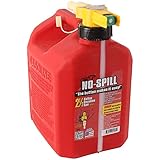
3. No-Spill 1450 Poly Can

For an affordable but high-quality plastic option, the No-Spill 1450 is the most reliable. It is 70% thicker than the cheap jugs at big-box stores and features a patented thumb-button nozzle for precise control.

  • Pros: Most affordable; automatic flow stop prevents overfilling; lightweight and easy to carry.
  • Cons: Plastic is semi-permeable (allows minor “breathing”); not recommended for storage longer than 12 months.
  • Specs: High-Density Polyethylene (HDPE); 5 Gallon; EPA, CARB, and CPSC compliant.

Wavian USA Authentic NATO Jerry Can and Spout System – Rust-Proof, EPA & CARB Compliant, Green…

Eagle 2 Gallon Type I Red Safety Gas Can for Gasoline with Flame Arrester, Self-Closing Lid, and…

NO-SPILL 2-1/2 gal. Gas Can

Wavian USA Authentic NATO Jerry Can and Spout System - Rust-Proof, EPA & CARB Compliant, Green...

Eagle 2 Gallon Type I Red Safety Gas Can for Gasoline with Flame Arrester, Self-Closing Lid, and...

NO-SPILL 2-1/2 gal. Gas Can

Wavian USA Authentic NATO Jerry Can and Spout System – Rust-Proof, EPA & CARB Compliant, Green…

Wavian USA Authentic NATO Jerry Can and Spout System - Rust-Proof, EPA & CARB Compliant, Green...

Eagle 2 Gallon Type I Red Safety Gas Can for Gasoline with Flame Arrester, Self-Closing Lid, and…

Eagle 2 Gallon Type I Red Safety Gas Can for Gasoline with Flame Arrester, Self-Closing Lid, and...

NO-SPILL 2-1/2 gal. Gas Can

NO-SPILL 2-1/2 gal. Gas Can

Last update on 2026-03-11 / Affiliate links / Images from Amazon Product Advertising API

How to Stabilize Fuel for 2+ Years of Shelf Life?

To stabilize fuel for 2+ years of shelf life, you must stop oxidation and phase separation before they begin. The industry standard for long-term storage is to mix a professional-grade thermal stabilizer (like PRI-G) into Ethanol-Free (REC-90) gasoline at the point of purchase. This “at-the-pump” treatment ensures the additive is fully integrated into the fuel’s molecular structure, creating a chemical barrier against the moisture and oxygen that turn standard gasoline into unusable sludge within 90 days.

The Stabilization Rule Most People Miss

You must add your stabilizer to the empty Jerry can before you pull the trigger at the gas station. This ensures the incoming fuel pressure creates a perfect “vortex mix,” distributing the stabilizer evenly throughout the 5-gallon volume.

  • Product Breakdown: While consumer-grade stabilizers (like standard Sta-Bil) are sufficient for overwintering a lawnmower, 24-month storage requires PRI-G. It is a refinery-grade treatment that prevents the formation of “gum” and varnish.
  • The REC-90 Hack: Whenever possible, pay the “ethanol-free premium” for REC-90 gasoline. Since ethanol is the primary cause of moisture absorption, removing it is the single most effective way to guarantee your fuel will ignite during a crisis.

Is Storing Gas at Home Legal?

⚠ SAFETY WARNING: FIRE CODE COMPLIANCE

Improper fuel storage can void your homeowner’s insurance and pose a lethal risk to first responders. Always consult your local Fire Marshal for specific municipal ordinances.

  • NFPA 30 Standards: The National Fire Protection Association generally limits residential storage to 25 gallons in an approved area.
  • The Small Circle Protocol: In urban environments, you must keep your footprint tight. This protocol dictates that you decentralize your stash. Split your storage into two detached, ventilated locations. This reduces the heat signature and ensures a single accident doesn’t consume your entire reserve.

Secure Your Gas Reserve

Fuel is the lifeblood of modern survival. Whether the next disruption is caused by geopolitical conflict, a natural disaster, or a simple economic spike, the difference between a resilient household and a desperate one comes down to three metal cans and a bottle of stabilizer. By following the 3-Layer Protocol, you’re locking in energy security for your family.

FAQ: How to Store Gas Safely 

Q: How long can I store gas at home before it goes bad? A: Untreated E10 gas lasts 30–90 days. Treated Ethanol-Free (REC-90) gas in metal NATO cans can remain viable for 2 to 3 years.

Q: Are metal Jerry cans worth the price? A: Yes. A $15 plastic can will degrade and leak within 2 years. A $80 Wavian NATO can will last a lifetime and preserve fuel that would otherwise spoil.

Q: Can I mix stabilized gas with old gas? A: No. Adding fresh gas to “sour” gas will not fix the old fuel; it will only accelerate the degradation of the new fuel.

Why Iran, Not America, Now Controls the Global Energy Economy

This article was originally published by Mike Adams at Natural News. 

Introduction

I have watched, analyzed, and reported on geopolitical shifts for decades, but what we are witnessing in March 2026 is not just another conflict. It is the final, convulsive act of a dying American empire. On February 28, President Donald Trump, in concert with Israel, launched Operation Epic Fury — a massive air campaign aimed at regime change in Iran [1]. The administration frames this as a decisive, necessary stroke. But from my perspective, this war was lost before the first missile was fired. The outcome guarantees a seismic shift in global power, and it hands the ultimate leverage not to Washington, but to Tehran.

In this article, I will argue that Iran, through a combination of strategic patience, asymmetric military capability, and- most importantly- geographic destiny, now holds the master key to the world’s energy economy. The United States and its allies are not just losing a military campaign; they are surrendering control over the global energy system. The Strait of Hormuz, that narrow artery of commerce, is the fulcrum upon which the fate of nations now balances. And Iran’s hand is firmly on the lever. This is not speculation; it is the hard, emerging reality documented in real-time market collapses, panicked diplomatic overtures, and the frantic, unhinged rhetoric of a trapped American president.

A War Lost at the Starting Line: The Hard Truth About U.S. Failure

The strategic goal of Operation Epic Fury was ostensibly to eliminate Iran’s nuclear program and military reach, with Trump delegating “regime risk to the Iranian people” and urging them to “take over your government” [2]. This was a catastrophic miscalculation rooted in the same hubris that doomed prior American adventures. The U.S. and Israel are decisively losing this conflict, a fact now obvious in Israel’s panicked pleas and Trump’s desperate search for an ‘off-ramp’. The Iranian regime is not only intact but politically empowered, having named a hardline successor, Mojtaba Khamenei, as Supreme Leader even as bombs fell [3].

The fundamental flaw was assuming military might alone could secure victory. Iran’s response has exposed the hollow nature of U.S. power projection: it cannot defend the one thing that matters most, the physical chokepoint of global energy. As one analysis notes, the Iranian strategy is executed with precision reflecting decades of preparation, aiming to overwhelm U.S. bases and pivot toward enforcing a closure of the Strait of Hormuz [4]. The strategic goal — toppling the Iranian regime or severing its military reach — has failed, leaving Iran militarily intact and politically galvanized.

The Strait of Hormuz: The Choke Point That Grants Iran Ultimate Leverage

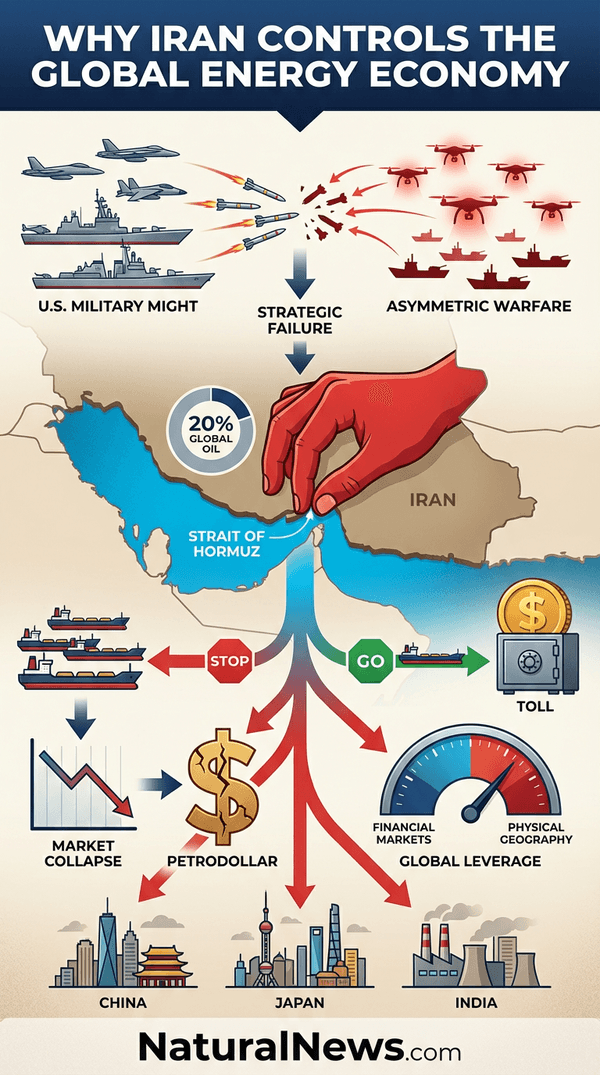
Geography is destiny. Iran’s control of the narrow Strait of Hormuz gives it a physical stranglehold on roughly 20% of global oil and a massive share of liquefied natural gas (LNG) flows [5]. This isn’t an abstract statistic; it’s the lifeblood of industrialized Asia and the fragile post-pandemic global economy. Following the U.S.-Israeli attacks, Iran’s General Sardar Jabbari declared that Tehran will “not let a single drop of oil leave the region” [6]. This isn’t a bluff. It’s a statement of fact backed by the asymmetric capability to make it real.

U.S. naval power, for all its aircraft carriers and high-tech missiles, is rendered impotent against cheap, ubiquitous drones launched from pickup trucks and caves. It cannot provide security for commercial shipping in these confined waters. The U.S. military budget is nearly $1 trillion, while Yemen’s operates on mere millions, yet Yemeni forces have managed to neutralize billions in U.S. warship assets [7]. This scale of asymmetric warfare makes a traditional navy obsolete in securing the Strait. This isn’t about who has more bombs; it’s about who controls the artery. Iran does. This single fact shifts the entire foundation of global power from financial markets to physical geography.

The Terms of Surrender: Iran Dictates, the West Must Listen

In the face of this demonstrated power, Iran has laid out its conditions. These are not requests but demands backed by tangible, economic force: lifting all sanctions, recognizing its nuclear rights, and receiving massive reparations for the aggression against it. These terms are the logical, self-evident price for the West’s failed aggression, a bill now coming due. We have already seen backchannel outreach, with Iran’s Ministry of Intelligence contacting the CIA after the strikes began [8], and Saudi Arabia intensifying direct talks with Tehran in a desperate bid to contain the war [9].

More ominously, and in my view inevitably, Iran can — and will — institute a ‘toll’ for Hormuz passage. This would create a multi-billion-dollar revenue stream to rebuild its nation and stand as a permanent symbol of its new energy hegemony. Qatar’s Energy Minister Saad al-Kaabi has warned that this conflict could “bring down the economies of the world,” stating that if the war continues for weeks, it could shut down all Gulf energy exporters and drive oil to $150 a barrel [10][11]. When the holder of the world’s second-largest gas reserves and third-largest oil reserves [12] controls the valve, it sets the price. The West’s choice is now between humiliating surrender to Iran’s terms and total economic collapse.

Israel’s Collapse and the Limits of U.S. Protection

Israel’s victimhood narrative in this conflict is pure hypocrisy. This is a nation that has ruthlessly targeted civilians for decades now, complaining when the same treatment is meted out to its own. But the story is deeper than rhetoric. The staggering, largely unreported losses — targeted strikes on critical infrastructure, generals, and nuclear scientists — reveal a nation being systematically dismantled [13]. Even the IDF’s announcement of destroying a key Tehran bunker is a tactical footnote against the strategic reality of Israel’s isolation and vulnerability [14].

The U.S. cannot protect Israel from sustained missile and drone barrages, just as it cannot protect the Strait of Hormuz. U.S. air defenses are being depleted and proven useless against mass, low-cost attacks. This isolation is the direct result of the criminal adventurism of Netanyahu and his enablers in Washington, who believed they could wage war with impunity. Israeli opposition leader Yair Lapid’s call to “destroy all of Iran’s oil fields” on Kharg Island is the sound of panic, not strategy [15]. It acknowledges that Iran’s energy infrastructure is a center of gravity, but attacking it would only guarantee the permanent closure of the Strait and global economic ruin.

Trump’s Desperation and the Implosion of the Petrodollar

President Trump’s threatening, unhinged rhetoric — demanding Iran’s “unconditional surrender” [16] — is the sound of a trapped animal, a confession of strategic bankruptcy. His administration launched this war based on allegations “that international inspectors have already debunked” [17], and without any viable exit strategy. More telling is his frantic policy reversal on oil. After years of threatening rivals with tariffs, Trump is now desperately lifting oil sanctions on countries he once punished, begging for barrels to stave off a domestic gasoline price revolt [18]. This proves the U.S. energy weapon is broken.

The real, unspoken crisis is the petrodollar. For decades, the dollar’s privileged status as the currency of energy trade has been the foundation of American financial hegemony [19]. If oil flows only on Iran’s terms, that status faces immediate, existential peril. Iran has already built a multi-billion-dollar parallel economy using state-sponsored Bitcoin mining and stablecoins to bypass the U.S. dollar [20]. If it begins demanding payment for oil or Hormuz passage in currencies other than dollars, or in gold, the dollar’s collapse will accelerate. This is the ultimate checkmate. As Russian President Vladimir Putin warned, oil production dependent on the Strait could come to a complete halt within a month, with around 14 million barrels per day — mostly headed to Asia — at risk [21].

Conclusion: The New Geopolitical Reality and the Folly of Empire

In my view, this conflict has permanently recalibrated global power. Iran, through strategic patience, asymmetric capability, and geographic luck, now holds the master key to the world economy. Trump and Netanyahu didn’t weaken Iran; they handed it the moral and strategic justification to wield its ultimate weapon — the Strait of Hormuz — with devastating effect. The path forward is not more bluster, but a humiliating Western surrender to Iran’s terms. The alternative is economic collapse.

The era of unchallenged U.S. control over global energy is over. This is the bitter fruit of an empire that prioritized militarism over sustainable statecraft, centralized control over resilient decentralization. As we face this new reality, the principles of self-reliance, decentralized finance, and honest money like gold and silver become not just philosophical ideals, but urgent practical necessities. For those seeking uncensored analysis of this accelerating shift, I recommend turning to independent platforms like BrightNews.ai for AI-analyzed news trends and BrightAnswers.ai for deep research free from the narratives of a captured establishment. The future belongs not to centralized empires, but to those who adapt to the new corridors of power.

References

    1. Why Trump Has Already Lost: The Unwinnable War and the Shattered Illusion of American Power – NaturalNews.com. March 5, 2026.
    2. How US/Israeli Iran Strikes Will Penalize Global Prospects – Antiwar.com. Dan Steinbock. March 3, 2026.
    3. Asian governments to cap fuel prices as oil costs jump – BBC. March 9, 2026.
    4. The Middle East is on fire. Will this gulf become another oil haven? – RT. March 5, 2026.
    5. Middle East tensions stir fears of 150 oil spike amid Straits of Hormuz crisis – NaturalNews.com. Willow Tohi. July 10, 2025.
    6. Strait of Hormuz: What happens if Iran shuts the global oil corridor? – BBC. March 3, 2026.
    7. Health Ranger Report – HISTORY of collapsed world – Mike Adams – Brighteon.com. June 18, 2024.
    8. Futures Bounce, Oil Slides After Report Of Iran Backchannel Outreach – ZeroHedge. March 4, 2026.
    9. Saudi Arabia said it is talking with Iran; Gulf states complain about the lack of notice before war – Times of Israel. March 7, 2026.
    10. BREAKING: Qatar warns war on Iran could ‘bring down’ world economies – Middle East Eye. March 6, 2026.
    11. Qatar warns war on Iran could ‘bring down’ world economies – Middle East Eye. March 6, 2026.
    12. Country Analysis Brief: Iran – U.S. Energy Information Administration.
    13. Iran’s resilience challenges U.S.-backed Zionism amid Global South solidarity – NaturalNews.com. Willow Tohi. June 24, 2025.
    14. IDF says it destroyed Khamenei’s bunker, being used by top brass; Trump demands unconditional surrender – Times of Israel. March 7, 2026.
    15. Israeli opposition leader says Israel must destroy all of Iran’s oil fields – Middle East Eye. March 7, 2026.
    16. US Oil Prices Soar 14 Percent as Trump Demands Iran’s ‘Unconditional Surrender’ – NTD. March 6, 2026.
    17. The War on Iran – and Washington’s Missing Exit Strategy – Antiwar.com. Medea Benjamin and Nicolas J. S. Davies. March 10, 2026.
    18. Trump signals potential sanctions relief for Russia: A path to peace or a diplomatic gamble? – NaturalNews.com. Willow Tohi. February 27, 2025.
    19. The Hidden Hand of American Hegemony: Petrodollar Recycling and International Markets – David E Spiro.
    20. Iran crisis puts the regime’s $7.8 billion crypto shadow economy in the spotlight – Activist Post. March 9, 2026.
    21. Gulf oil production could stop in weeks – Putin – RT. March 9, 2026.

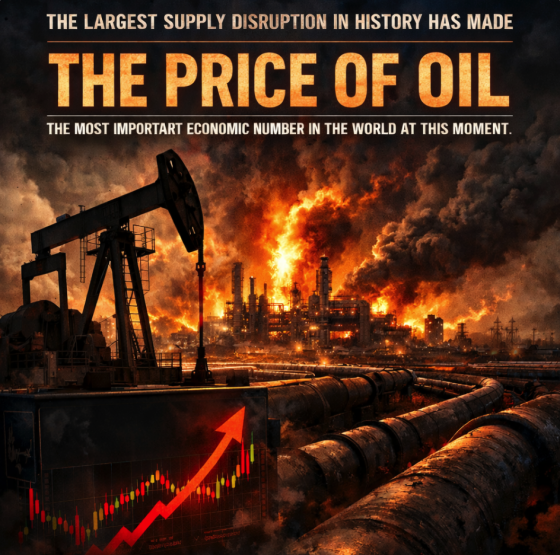
Explainer Infographic:

The Largest Supply Disruption In History Has Made The Price Of Oil The Most Important Economic Number In The World At This Moment

What a wild week it has been already. On Sunday night, I watched as the price of oil hit $116 a barrel. It was insane. Financial markets started to panic all over the world because investors know that if the price of oil stays above $100 a barrel for an extended period of time it will absolutely crush the global economy. Our entire way of life depends upon cheap energy, because virtually every type of human activity in the modern world uses energy. I am using energy as I write this article, and you are using energy as you read this article. After the crazy spike in the price of oil that we witnessed on Sunday night, authorities quickly shifted into damage control mode, and for the moment they have successfully pushed the price of oil back below 90 dollars a barrel. But how long will they be able to keep it there?

According to CNBC, we are currently experiencing the largest oil supply disruption in the history of the world…

The U.S. war against Iran has triggered the largest oil supply disruption in history, more than double the previous record set during the Middle East crisis of the 1950s, according to an analysis by consulting firm Rapidan Energy.

About 20% of the world’s oil supply has been disrupted for nine days now as tanker traffic through the Strait of Hormuz remains at a standstill. Crude prices have surged above $100 per barrel in response.

The biggest disruption before the current war was during the Suez Crisis of 1956 when Britain, France and Israel invaded Egypt’s Sinai Peninsula, the energy consulting firm told clients in a Sunday note. In that crisis, about 10% of the world’s oil supply at the time was disrupted.

Needless to say, there have been other times when the global supply of oil has been disrupted for one reason or another.

During those times, nations with spare capacity have been able to step up and bridge the gap.

But this time around, the nations that possess most of the spare capacity are being directly affected by this war

The big difference between the supply shock of the Iran war and past crises is the world has no spare oil capacity to address the problem, the analysts said. Saudi Arabia and the United Arab Emirates hold the overwhelming majority of swing capacity but they have been cut off from the global oil market by the Hormuz closure, the analysts said.

“The conflict has not only taken offline a historically high share of global supply – it has simultaneously disrupted the primary holders of spare capacity,” the Rapidan analysts said. “The result is a market with no meaningful cushion. There is no swing producer positioned to step in.”

It appears that a lot of pain at the pump is ahead for all of us.

Already, the average price of a gallon of gasoline in the state of California has surpassed the five dollar mark

Prices are currently highest in California, where drivers were paying an average of $5.20 per gallon on Monday morning, and in Washington state, where gas hit $4.63 per gallon.

We haven’t seen anything like this in a long time.

If you can believe it, one gas station in Los Angeles is actually charging more than 8 dollars for a gallon of gasoline…

A lot of people actually thought that the article that I posted yesterday was exaggerating the threat.

I guess not.

The Iranians continue to insist that they will be able to push the price of oil up to $200 a barrel

“If they can afford the price of oil at $200 per barrel, let them keep playing this game.”

The spokesman for a wing of the IRGC, Ebrahim Zolfighari, says the US has opened a new chapter in the war by bombing Iran’s energy infrastructure.

The good news is that for now western authorities have been able to push the price of oil back below $90 a barrel.

Early on Monday, G7 finance ministers suggested that there could soon be a coordinated release of emergency oil reserves

The G7 said it was ready to take “necessary measures” to address the economic impact of the US-Israel war on Iran, after a meeting prompted by soaring oil prices, which rose above $100 (£74) a barrel for the first time since 2022.

Following a remote meeting on Monday, G7 finance ministers said they would closely monitor the situation but stopped short of agreeing to release emergency oil reserves.

“We discussed the current conflict in the Middle East, its impact for regional stability, global economic conditions, and financial markets, and the importance of secure trading routes,” they said in a statement.

When that news broke, it immediately ended the panic.

So that was a good thing.

But the truth is that releasing those oil reserves would only be a temporary measure, and it wouldn’t provide that much relief.

Later on Monday, the price of oil really started plummeting once President Trump said that “the war is very complete”

President Trump told CBS News that he believes the U.S.-Israeli war with Iran is “very far ahead of schedule.”

“I think the war is very complete, pretty much,” he said. “They have no navy, no communications, they’ve got no air force. Their missiles are down to a scatter. Their drones are being blown up all over the place, including their manufacturing of drones. If you look, they have nothing left. There’s nothing left in a military sense.”

Of course the war is not even close to over, but Trump’s statement was able to push the price of oil way down.

And during that same interview, Trump warned that he was considering taking over the Strait of Hormuz

Speaking to CBS News Senior White House Correspondent Weijia Jiang on Monday, U.S. President Donald Trump said that he is considering taking further action to secure the Strait of Hormuz, the critical waterway spanning from Iran to Oman through which a fifth of global oil supplies flow annually.

Trump said that while some ships are moving through the Strait despite the Iranian threat, he said that he is “thinking about taking it over.”

It would take boots on the ground to physically secure the Strait of Hormuz, and Trump knows that.

So what are we to make of his contradictory statements?

The Chinese have also been very alarmed by what has been going on in the Strait of Hormuz, because they get a lot of their oil from the Middle East.

Just hours ago, China warned that it “will take necessary measures to safeguard its own energy security”

“Energy security is of paramount importance to the global economy, and all parties bear responsibility for ensuring stable and uninterrupted energy supplies,” Chinese Foreign Ministry spokesperson Guo Jiakun said Monday when asked whether Beijing would join G7 discussions about a coordinated release of strategic petroleum reserves.

“China will take necessary measures to safeguard its own energy security,” Guo added, referring reporters to the country’s “relevant authorities” for details.

China has repeatedly called for unimpeded tanker access through the strait, citing its importance to global trade, and Chinese officials have been holding talks with Iran about resuming safe oil passage, according to media reports last week. At the same time, Beijing has avoided directly blaming Tehran and has repeatedly condemned the U.S.-Israeli offensive as a violation of international law.

The Chinese are usually very hesitant to take military action.

But once they decide to pull the trigger, they don’t mess around.

Personally, I believe that this crisis is far from over.

And that means that the price of oil could ultimately go much higher.

Former IEA executive Neil Atkinson seems to agree with that assessment.  In fact, he is convinced that “the sky is the limit” as for what this war could mean for the price of oil…

“Though there are oil stocks around the world, the point is that if this closure of the Strait persists, those oil stocks if they are deployed will be depleted and we are going to be in a situation where, with the oil production actually shut in, in Iraq and possibly in Kuwait and maybe even in time in Saudi Arabia, that we are going to be in a crisis the likes of which we have never seen before,” Atkinson told CNBC’s “Squawk Box Europe.”

Asked what this could mean for oil prices, Atkinson replied: “Sorry, we are getting into the realms of educated guesswork here. I mean, there is no precedent for this. The sky is the limit.”

It would be wonderful if this war comes to an end before the end of this month.

That would be a good thing for the entire world.

But if that doesn’t happen, it is going to be exceedingly difficult for western authorities to keep the price of oil down.

At this moment the price of oil is the most important economic number in the world, and if it rises above the $100 mark for an extended period of time the consequences will be disastrous.

Michael’s new book entitled “10 Prophetic Events That Are Coming Next” is available in paperback and for the Kindle on Amazon.com, and you can subscribe to his Substack newsletter at michaeltsnyder.substack.com.

About the Author: Michael Snyder’s new book entitled “10 Prophetic Events That Are Coming Next” is available in paperback and for the Kindle on Amazon.com.  He has also written nine other books that are available on Amazon.com including “Chaos”“End Times”“7 Year Apocalypse”“Lost Prophecies Of The Future Of America”“The Beginning Of The End”, and “Living A Life That Really Matters”.  When you purchase any of Michael’s books you help to support the work that he is doing.  You can also get his articles by email as soon as he publishes them by subscribing to his Substack newsletter.  Michael has published thousands of articles on The Economic Collapse BlogEnd Of The American Dream and The Most Important News, and he always freely and happily allows others to republish those articles on their own websites.  These are such troubled times, and people need hope.  John 3:16 tells us about the hope that God has given us through Jesus Christ: “For God so loved the world, that he gave his only begotten Son, that whosoever believeth in him should not perish, but have everlasting life.”  If you have not already done so, we strongly urge you to invite Jesus Christ to be your Lord and Savior today.

The post The Largest Supply Disruption In History Has Made The Price Of Oil The Most Important Economic Number In The World At This Moment appeared first on The Economic Collapse.

With His “Unconditional Surrender” Goal, Trump Signals a Long War

This article was originally published by Ryan McMaken at the Mises Institute. 

Donald Trump today, in a post on his social media platform Truth Social, stated that his goal for the current war with Iran is unconditional surrender. Specifically, he wrote: “There will be no deal with Iran except UNCONDITIONAL SURRENDER!”

Moreover, Trump specified that the US will have final say on “the selection of a GREAT & ACCEPTABLE Leader(s).”

In stating all this, however, Trump is essentially announcing that the US will be at war for an extended period.

Historians have long noted that demands for unconditional surrender have worked to prolong conflicts rather than shorten them, leading to needless death on both sides. After all, Trump is essentially saying that the Iranians should put themselves in a position of accepting whatever terms the United States seeks to unilaterally impose, including the total dissolution of the Iranian state, plus sanctions, punishments, occupations, and other humiliations. What government would accede to this? Very few would, which is why only very weak, small, and relatively unarmed regimes can be forced into accepting unconditional surrender after anything less than a protracted war.

Iran, however, is not weak, small, or relatively unarmed. And geography is in its favor. Indeed, in an interview earlier this week, international-relations expert John Mearsheimer spoke at length about the likely outcomes of the US. “It is almost impossible for me to see how Israel and the US win this war,” Mearsheimer concluded, largely because the prospects for regime change—i.e., unconditional surrender—are extremely small. Moreover, in order to get the kind of regime change that Trump is talking about, any new regime would also have to be permanently aligned with the United States. That is, a new regime isn’t enough. It also has to be a regime that takes orders from the United States. Given the reality on the ground in Iran, Mearsheimer continued, any new regime will be hostile to the United States. This fact is hinted at in the fact that the new Ayatollah, who has now replaced the 86-year-old Ayatollah Khamenei, is far more radical than the old one. For example, the older Ayatollah, assassinated by the US this week, was against nuclear enrichment and was a moderate. The new leadership is not.

Thus, Mearsheimer concludes that, in order to win this conflict, “All the Iranians have to do is survive.” The Iranians know that “unconditional surrender” means turning Iran into a perennial puppet state of the US regime. This is not something that governments—or even their subject populations—tend to accept without first engaging in a long war of self-preservation.

Not that the current administration will trouble itself with these sorts of details. Nonetheless, the reality of the situation means that so long as Trump actually sticks to a goal of unconditional surrender, it is very likely he is committing the United States to a lengthy war.

It’s Time to End the American Obsession with “Unconditional Surrender”

The American maximalist approach of “unconditional surrender” has its origins in the Second World War, during which the United States sought to follow the lead of the British and French allies who had imposed near-unilateral terms of surrender on the Germans at the end of the First World War. This had been done with very limited concession to German negotiators. The lopsided nature of the “negotiations” can be seen in the way the Germans were forced to accept the “war guilt” clause. Explicitly assigning total guilt to one side in a war was unheard of in modern international law up to that time.

Yet, the idea of forcing total capitulation on one side, without any negotiation, became a hallmark of the Second World War, when both the Germans and the Japanese were said to be subject to unconditional surrender. The basic operating procedure in these cases is simply to keep bombing the enemy country until its regime gives the victor everything it wants without any conditions.

Yet, historians have long pointed out that this policy tends to prolong wars needlessly. For example, B.H. Liddell Hart, in his History of the Second World War, concluded that the demand for unconditional surrender stiffened German resolve and was exploited by Nazi Propagandist Joseph Goebbels to maintain support for the National Socialists among the general population. Liddell Hart maintained that German resistance during the last two years of the war was far stronger than it would have been in the absence of demands for unconditional surrender. Eventual surrender only came after the deaths of 104,000 Americans killed in action during the last year of the war in Europe.

In practice, however, unconditional surrender is such an extreme position that it rarely materializes in actual practice. For example, as international relations scholar Paul Poast has noted, the Americans were ultimately unable to impose total “unconditional surrender” demands in the case of the US-Japanese conflict. The Japanese refused to surrender unless the US pledged not to attempt to abolish the Japanese monarchy. The Americans eventually agreed.

The capitulation of the National Socialists and Imperial Japan, and the Treaty of Versailles, are all extreme cases. The fact is that very few wars are ended along the lines of anything we would call “unconditional surrender.” This has been known for a long time, and was explored in detail by Coleman Phillipson in his 1916 book Termination of War and Treaties of Peace. Phillipson notes that in cases where total “subjugation” of another state occurs, there was no reason for concluding a negotiated settlement, as the imposition of the conqueror’s will on the conquered nation involved merely a unilateral arrangement.” The normal, far more common mode of bringing about peace in international conflicts, however, is a “compromise ad hoc, involving an agreement as to demands made on both sides, and settling all the matters in dispute.”

Indeed, many military personnel in World War II were alarmed by the administration’s adoption of the new doctrine, with General Dwight Eisenhower’s naval aide, Captain Harry Butcher, stating privately that “any military person knows that there are conditions to every surrender.”

Berenice Carroll concludes (in “How Wars End: An Analysis of Some Current Hypotheses”) that it is not actually all that easy to determine the “victor” from the “loser” in an international conflict once all of the costs have actually been analyzed. Or, as Lewis Coser has put it, because of this, “most conflicts end in compromises in which it is often quite hard to specify which side has gained relative advantage.”

For all these reasons, it’s important to think long and hard about doubling down on a “strategy” that’s guaranteed to prolong a conflict.

Yet, from the point of view of the current warhawks, it may be that no “sacrifice” is too great for ordinary Americans to bear in the name of fighting the Iranians at the behest of the Israel lobby in the United States. After all, the administration refuses to rule out a ground invasion into Iran, a mountainous country armed with tens of thousands of missiles.

Fortunately, though, we’ve already seen the Americans abandon earlier calls for unconditional surrender in recent years. In 2022, in the wake of the Russian invasion of eastern Ukraine, President Biden called for regime change in Russia, which, in the Russian context, would likely have required the imposition of unconditional surrender.  This, however, was conveniently forgotten when it became clear that a war of that nature would require a long, bloody war for the Americans and risk nuclear war.

So, if good sense prevails, the American regime will “forget” that Trump called for unconditional surrender, and instead pursue a more sane, negotiated resolution.