
No products in the cart.

Are you protecting your ammo storage? Doing so is not complicated, but it’s also not optional.

Are you treating it like the critical survival investment it is?
I sure hope so because…
If you can afford stock ammo, you owe it to yourself to store it properly.
You should treat your ammunition like you treat precious metals.
Both investments require good practices to maintain for the long haul.
If you don’t properly maintain your ammo (and neglect it), your ammo’s useful shelf life will be cut short.
This is a travesty because ammo will be the lifeblood when SHTF.
Remember, in a long-term survival scenario, he who has the most firepower; often wins.
Ammo is arguably the most important item you can stockpile.
It provides the ability to hunt, barter, defend your home and family, intimidate others, etc.
And these are all critical survival and preparedness tactics.
But to rely on these survival tactics, you must:
- Purchasing large quantities of ammo
- Store it for the long haul
It’s obvious, but worth saying again, “Firearms a just poorly designed baseball bats without ammunition.”
At this point, you’re probably asking a simple question –
“How fast can poorly stored ammo become compromised?”
Today, I’ll be covering the following ammo storage topics in detail:
-
Is There REALLY An Ammunition Shelf Life?
-
Old Ammo Vs. New Ammo
-
How To Store Ammo The Right Way
-
Best Ammo Cans On The Market Today
-
More About Humidity Control and Desiccants
-
A Step By Step Ammo Storage Action Plan
Is There Really An Ammunition Shelf-Life?
Let me start out by saying ammo does, in fact, have a shelf life.
But unlike food, which has a shelf life measured in days or weeks, ammo’s shelf life is measured in years and decades.
It all depends on how you store it.
If you store it right, ammo will easily outlive you, probably outlive your kids and possibly even your grandkids.
In near-ideal conditions, modern ammo will last centuries.
But if you store your ammo improperly, degradation starts on day one.
Slowly at first, but over a few years or decades, you may find your ammo useless.
And even if it still fires, the accuracy will likely be jeopardized.
↓ Does Ammunition Expire? ↓
As A Way To Introduce You To Skilled Survival, We’re Giving Away Our #78 Item Complete Prepper Checklist. Click Here To Get Your FREE Copy Of It.
Old Ammo Vs. New Ammo
Modern materials, design improvements, and automated manufacturing processing have helped improve today’s ammo’s shelf life.
And that’s great news for those of us who started stockpiling ammo over the last couple of decades.
When we talk about older ammo, I’m primarily referencing ammo that was manufactured after the 1930s; when smokeless powder was introduced.
↓ Black Powder Vs. Smokeless Powder – Education! ↓
Older bullets had a much shorter shelf life unless they were meticulously stored, and regardless they are quickly reaching the end of their reliable shelf lives.
Today, the risk vs. reward of shooting older ammo may not be worth it.
And the risk vs. reward equation keeps getting worse as each year passes.
↓ Will These 90-Year-Old .22 Rounds Still Function? ↓
The bottom line is your ammo stockpile is an investment in your future.
You want to protect this investment as long as humanly possible. So let’s learn how to do that.
How To Store Ammo The Right Way
Properly storing your ammunition is not complicated.
You only need to follow some simple storage principles and take meaningful action.
Yes, that’s it.
Here’s the first primary storage principle:
Store your ammunition in a cool, dry, dark location.
Let’s break that down; if you keep your ammo in a:
- Cool
- Dry
- Dark
place, you win.
Follow this, and you’ll extend your ammunition stockpile from decades to centuries.
Now, once we begin analyzing these principles, we discover there’s a bit more to it.
So let’s deep dive into each of these ammo storage principles.
↓ How To Store Ammunition – Long Term ↓
Keeping Your Ammo Cool
You want to keep your ammunition cool. Not cold but cool.
You also want to avoid warm or hot storage locations.
Constant warm temps or consistently cool temps are not the main concern.
It’s the extreme temperature swings that are the real problem.
The integrity of ammo is compromised if it’s subjected to extreme temperature cycles. It’s hard on ammo to go from 100 degrees to 0 degrees and back to 100 degrees, year after year.
Why is this bad?
These temperature swings tend to invite humidity.
And as we’ll discuss shortly, humidity is the real threat to your ammunition.
That’s why garages, attics, unheated cabins, and vehicles are such poor ammo storage locations.
Now it’s highly dependent on your local climate, but these storage locations move through extreme temperatures seasonally for most of us.
In winter, overnight temps can reach sub-zero degrees in garages, attics, etc. And in the summer, north of 100 F.
Ammo stored in these conditions for a few years won’t hurt it much.
Your ammo won’t typically go bad in a matter of a couple of years.
But if left in these locations over several decades, the temperature swings will begin taking a significant toll on your ammunition’s shelf life.
So, where should your ammo be stored?
Traditionally, basements are popular ammo storage locations.
Why? Because basements are located below ground level.
Ground temperatures change much less than air temperatures.
So while air temps will change from 0 degrees to 100 degrees seasonally, ground temps 10 feet below the surface tend to stay in a range of 20 degrees.
So, for example, if soil temps 10 feet underground average 50 degrees, it may rise to 60 degrees in the summer and drop to 40 degrees in winter.
This is significantly less variation than air temps.
And at 30 feet below the surface, temperature swings become negligible.
At this depth, ground temps stay constant regardless of the air temps.
So we can take advantage of the earth and support the “constant cool” principle of ammunition storage.
That’s why basements tend to be popular ammo storage locations but also have downsides.
Which we’ll cover next…

Keeping your Ammo Dry
Moisture (a.k.a. humidity) is even more dangerous to your ammunition than temperature swings.
Moisture is corrosive to metal. And the ammo is made of metal (casings, primers, and bullets).
Hence, moisture exposure will eventually rust your ammo.
It will begin with small amounts of surface rust, which you can sand off, and your ammo will still fire, but even this may affect your ammo’s accuracy.
And if this rust is allowed to fester, it will eventually (over several decades) render your ammunition useless.
So we need to control moisture exposure to our ammunition.
But guess which part of our homes tends to have the highest humidity levels?
You’ve probably guessed it, basements.
Rain soaks into the ground. Ground contacts your home’s foundation. This ground moisture is dangerous to foundations if allowed to accumulate.
That’s why ensuring your gutters and downspouts are working properly is important to avoid foundation problems (i.e., cracking, settling heaving, etc.)
Many homes have sump pumps to help manage basement moisture issues.
Basements and humidity are a big concern for your ammo.
When massive flooding occurs, which area will get wet first?
Your basement.
So from a moisture standpoint, basements present a bit of a problem. However, there are solutions to help manage these risks.
First, if you do store your ammo in a basement, don’t set it on the floor.
Keep it in cabinets or racks. The higher, the better.
That way, if your basement floods, your ammo will likely remain above the water level.
Another way to manage the increased humidity in the basement air is to get a good dehumidifier.

An Affordable Dehumidifier For Your Basement

Keeping Your Ammo “In the Dark”
UV light is also a destructive force.
Over long periods of exposure, the sun’s harmful UV rays will break down nearly everything.
You’ve seen this process with vehicles. Leaving a vehicle out in the sun for years will deteriorate the exterior metal and paint.
Now compare that vehicle to one that’s stored in a garage when not in use.
Over long periods of time, UV ray exposure will take a toll on your ammo.
The good news is most indoor storage locations will do just fine.
So a closet, pantry, and basement are all protected from UV rays. Plus, the inside of your ammo cans will be dark as well.
So if you store your ammo in a windowless location in ammo cans, UV rays will not cause you any ammo problems.
Organization Matters…A Lot
Good ammo storage takes organization and discipline.
Remember, you’re potentially stockpiling your ammo for decades.
So it’s important to stay organized and maintain control of your ammo storage efforts.
It’s not ‘set and forget’. You must maintain a process.
↓ How I Organize My Ammo Cans | MTM Ammo Can Organizers ↓
First, you should label your ammo cans.
You want to identify what’s in your ammo can without opening it.
Labels will help quickly inventory your stockpile and save you time in an emergency.
If you need ammo for your 22 survival rifle right now, you want to avoid dumping out several ammo cans on the floor to find which one has your 22 LRs.

Essential Tool For Keeping Ammo Storage Organized

A labeler is one of my favorite prepping tools.
It comes in handy for more than just your ammo.
It’s also a perfect tool for food stockpiles and rotation practices. It also helps keep my gear and survival supplies organized.
I also label key areas of my home for emergencies.
I’ve labeled the main water shutoff valve, the natural gas shut-off valve, etc.
As the head of the household, I must know how to find and shut these components off in emergencies.
But for my family, it’s less intuitive.
But by adding labels, it’s easy to walk them through the process and for them to recall and find them in an emergency.
I can’t assume I will be available when emergencies happen.
Worth every penny for my peace of mind.
Next, create a desiccant check schedule.
Every few months, open up each ammo can and check your desiccants.
Create an email reminder, write it on a calendar, and make sure you check your ammo storage regularly.
As A Way To Introduce You To Skilled Survival, We’re Giving Away Our Ultimate Firearms Survival Guide.Click Here To Get Your FREE Copy Of It.
Best Ammo Cans On The Market Today
The third way to manage humidity is storing your ammo in ammo cans.
The key is to ensure the rubber gaskets are in good shape and create an airtight seal when latched.
That’s why I steer clear of used ammo cans. I don’t trust used seals. They are often dried out and cracked.
It’s not worth the risk to me. Fresh seals ensure a quality airtight seal.

I also tend to steer clear of plastic ammo cans as well:
↓ Ammom Box Plastic Vs. Steel…What Should You Buy ↓
Ok, with all that said, let’s review a few of the best ammo cans on the market today:
1. Our Top Recommendation
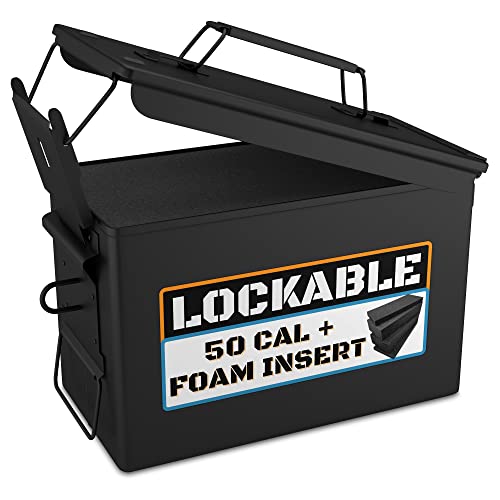
Solid Tactical 50 Cal or 30 Cal Metal Ammo Can
This excellent ammo can is both air and watertight, and you can be confident because each is individually tested before being sold.
The Solid Tactical Ammo Can also come with 3 desiccant packs. That way, you can add your ammo immediately, and the desiccant packs will remove all moisture from inside the can.
This can is tough as hell since it’s made of steel and comes with a money-back guarantee!
We earn a commission if you make a purchase, at no additional cost to you.
↓ Unboxing – Solid Tactical 50 Caliber and 30 Caliber Ammo Can ↓
2. Budget Option

Generic Budget-Friendly Metal Ammo Can
If price is your biggest concern, and you’re looking for the “cheapest” metal ammo box, here it is.
This ammo box serves its purpose.
The paint job is solid in and out, and the overall material build is good, too.
Thos some folks mention a few minor QA issues. But overall recommended IF you’re on a strict budget.
Way better than doing nothing!
We earn a commission if you make a purchase, at no additional cost to you.
3

Redneck Convent Metal Ammo Case Can
This metal ammo can feature a “WORRY-FREE SEAL” that’s considered air and watertight.
It comes with a hinged lid with a locking latch and a flat-folding handle.
It’s built to last since it’s made of heavy gauge solid steel. The lid includes a rubber gasket that ensures a tight fit to keep water and air out.
It comes in classic camo green color (.30 caliber or .50 caliber), tan color (.50 caliber only), or black color (.50 caliber only).
Here’s a helpful comment from one reviewer to consider:
“Here’s what I consider the biggest advantage of this container. I stored loose ammunition in this can, and also in plastic ammo cans made by Plano and MTM. The plastic cans had rubber seals around the inside of the lid. So I assumed they would keep out moisture from humid air. I placed desiccant packs in all the containers…. the kind of desiccants that have beads that go from blue (when dry) to pink (when saturated). The desiccants in the plastic ammo boxes turned pink in less than two weeks. However, the desiccants in this metal can were still blue in the same period. For this reason alone, not to mention the superior strength of the Redneck can… I’m buying more metal cans to store all my ammo.”
One concern is the stackability of these.
The carry handle creates a small “void” on the bottom of each can that’s slightly off-center. This causes a very high stack of them to slant…
We earn a commission if you make a purchase, at no additional cost to you.
And just for fun, here are 25 survival uses for ammo cans!
↓ Why Buy Ammo Cans? 25 Survival Uses ↓
As A Way To Introduce You To Skilled Survival, We’re Giving Away Our #78 Item Complete Prepper Checklist. Click Here To Get Your FREE Copy Of It.
More About Desiccants
Good ammo cans keep the air inside the can from co-mingling with the air outside the ammo can. Allowing for complete control over the air inside the ammo can.
When you isolate and control the ammo can air, you can now 100% control the humidity.
How so? Using something called a desiccant.
With Silica Gel Dehumidifier Desiccants.
Toss one of these desiccant canisters into each air-controlled ammo can, and they will remove the moisture from the air.

By trapping the moisture in the desiccant, the remaining air inside the ammo can will remain dry.
So the surrounding ammo can air that touches your precious ammo will be arid with little to no moisture.
And as we discussed earlier, moisture is what causes metals to corrode.
So by removing moisture from a controlled box of air, you eliminate ammo corrosion.
It’s simple math.
- No moisture equals no rust.
- No rust equals no corrosion.
- And eliminating ammo corrosion extends your ammo’s shelf life, reliability, and accuracy.
In this process, you’ll occasionally find desiccants that need a recharge.

My Recommended Rechargeable Desiccant
1. First, they’re designed for up to a 3-square-foot area.
Three square feet is more than enough for a regular-sized ammo can.
So I can standardize on one desiccant style and size for all my ammo cans.
I prefer to use universal parts and components whenever possible.
It’s always a headache to use several styles of desiccants and then have to keep track of backups for each can. No thanks.
2. Second, they include a color code.
If you see an orange color, they are still doing their job.
If it’s no longer orange but clear, it’s time to recharge them. This color coding makes it simple.
Open your ammo can, look at the desiccant color, note the ones with clear color, and replace them.
Easy peasy.
3. Third, they are rechargeable.
They pull moisture from the air continuously until they “fill up.”
At some point, the desiccant can no longer draw more moisture from the air because it’s reached its moisture capacity.
It’s at this time that the color turns clear. But they are not one and done.
You get to reuse them over and over again.
These desiccants just need 3 hours in an oven at 300 degrees to reset them.
So these amazing desiccants are a nice little investment and worth every penny.
4. Fourth, they don’t use cancer-causing chemical agents.
They don’t use the nasty chemical Cobalt Chloride.
This chemical has become classified as Group 2B, which states Cobalt Chloride is possibly carcinogenic to humans.
No way I’m handling a carcinogen and putting them in my oven.
With these desiccants, you never have to worry about that.
As A Way To Introduce You To Skilled Survival, We’re Giving Away Our #78 Item Complete Prepper Checklist. Click Here To Get Your FREE Copy Of It.

Ammo Storage Action Plan
1. Decide on a cool, dry, dark, and safe location.
Put some serious thought into your ammo storage site based on what we discussed earlier.
The best advice I can provide is where NOT to store your ammo.
Don’t store your ammo in an:
- An unheated/cooled garage
- An unheated/cooled attic
- Your vehicle
2. Purchase high-quality ammo cans and put all your ammo into them.
I recommend you dedicate each ammo can to only one caliber size for sound organizational practices.
Don’t mix and match.
Then label each ammo can so you know exactly what’s inside without having to open it.
↓ How Much 9mm Fits Into An Ammo Can? Surprisingly HEAVY ↓
3. Add fresh desiccants to each ammo can.
4. Create a master schedule and reminders to check your ammo can’s desiccants.
Then replace and recharge as necessary.
See, that wasn’t so hard!
Here’s a short video overview of your ammo storage plan:
↓ Ammunition Storage 101 ↓
And finally, keeping all your ammo cans stashed away in a large gun safe is a good idea.
That way, everything is double secure from intruders, fires, or kids.
Congratulations!
You are now on your way to protecting your ammo storage investment correctly.
The way that maintains your precious ammo investment for years, decades, and centuries to come.
Prepare, Adapt, and Overcome,
“Just In Case” Jack
P.s. Are you ready for the tough times ahead?
Find out now by taking my short Readiness Score Quiz – it’s absolutely free.
Once complete, you’ll know exactly where you stand on the “fragile” vs.” resilient” spectrum.
So click here to start the Quiz….And don’t worry; the questions are so easy a 3rd grader could answer them.

Click on the image to begin the Quiz and find out once and for all if you’re part of “The Fragile Masses” or “The Resilient Few.”
The post Ammo Storage: How To Avoid Common Amateur Mistakes appeared first on Skilled Survival.