Survival Gear is the most unused product until a natural disaster happens, then it’s the most desired products, but usually too late to help those that really need the help.

We sell around the World, and pride ourselves on offering a level of customer service that we would want to see ourselves if we were shopping online.
Our product ranges change regularly, so we hope that you come back to our sites to see some of the fantastic offers that we regularly have.

Get In Touch

7 Best Kayaks To Make Your Friends Insanely Jealous

Best Fishing KayakIf you’re on the hunt for a kayak but are struggling to figure out the BEST kayak for YOU – you’re in the right place.

Today, I’m going to break down everything you need to know to find the kayak that will best meet your needs.

  • Maybe you’re looking for a damn good fishing kayak
  • Perhaps you want a kayak to use as a rescue vehicle in a future floodwater emergency
  • Maybe you’re interested in using a kayak for epic backcountry camping trips
  • Or perhaps you’ve been thinking about using a kayak as a bug-out vehicle in a disaster…

But regardless of the reason why you want a kayak – I’ve got you covered either way…

Because buying a kayak should NEVER be an impulse purchase. For example, just because you see one on “sale” at a big-box retailer doesn’t mean it’s right for YOU.

Plus, there are so many kayaks to choose from today; you need someone you can trust to help you wade through the overwhelming confusion. And that’s precisely why I wrote this article.

So today, I’m going to share everything I know about kayaks and even recommend a few I feel worth an investment. Here’s what I’m going to cover:

Note: click any of the links above to skip ahead – but make sure to check out our 7 detailed “Best” Kayak Reviews

As A Way To Introduce You To Skilled Survival, We’re Giving Away Our Ultimate Survival Gear Checklist. Click Here To Get Your FREE Copy Of It.

flooded road with sign

Top 4 Reasons Why You Should Invest In A Kayak


1 – Recreation / Fun

The number one reason why anyone gets a kayak is that they’re fun!

Getting out on the water is one of the most enjoyable ways to spend a beautiful day.

Whether it’s a pristine lake, calm sea, or extreme rapids, they’re a freakin’ blast!

I mean, it would be such a shame to buy a kayak and never use it. So make sure you find time every year to take yours out of the garage and get out on the water.

2 – Remote Camping

With the right kayak, you can go beyond day trips out on the water to overnight excursions.

With a kayak, you can take a lot of essential camping gear with you WITHOUT having to carry everything on your back.

I know a lot of people who love the feeling of freedom and remoteness than backpacking provides. But don’t want to hike 10+ miles with 35 lbs of gear on their back. So they’ve taken up overnight kayak trips instead.

It allows you to escape into the REAL wilderness without breaking your back.

2 – Fishing

Kayaks are becoming more popular among fishermen. Why? Because they are an incredibly lightweight alternative to the traditional aluminum Jon Boat.

I don’t relish the days of yesteryear struggling to maneuver my father’s Jon Boat in and out of the water.

Instead, with a kayak, you get much of the same fishing experience with much less hassle.

You can even go extremely lightweight with an inflatable fishing boat!

Nowadays, many inflatable kayak models are designed with fishing in mind from the ground up.

3 – Emergency Rescue Device

We’ve all heard the term “up sh*t creek without a paddle.” And typically, this famous “saying” is used to describe all sorts of bad situations – not just water-related ones.

Unfortunately, it often becomes a reality in flooding emergencies!

Did you know, in the US, the most deadly natural disasters usually involve flooding?

On average, U.S. flooding kills more than 100 people a year — more than any other single weather hazard, including tornadoes and hurricanes, according to the University Corporation for Atmospheric Research (UCAR).

For example, in both Houston and New Orleans, hurricane-induced surge and rain caused unprecedented urban flooding. Rising waters swamped homes, decimated businesses, and shut down entire cities.

Not to mention all the chemicals, fuel, sewage, and other dangerous pollutants that dumped into the rising water.

Many people became instantly trapped, waiting around for rescue.

But those who owned small boats or kayaks were far better off in the immediate aftermath. Why? Because they could evacuate, search for supplies, and move around as needed.

But, even much less dramatic flooding happens all across the nation – wreaking disruptive havoc and dangerous conditions.

It only takes a couple of feet of water to cause roads to be impassible for cars, SUVs, and trucks.

For example, during a recent flood in my hometown, the police asked for civilian help. They needed anyone with boats to evacuate a neighborhood due to just 18 inches of floodwater.

Kayaks, canoes, and small fishing boats saved the day.

It allowed them to get to dry land and on with their lives until the water receded.

4 – Stealthy Bug Out Transportation

In a worst-case emergency scenario, a small, discrete boat can get you off the streets and away from crowds

Moving away from danger to safety is called “bugging out.”

And even the tallest, bulletproof bug out vehicle can’t overcome deep dangerous floodwaters. But a kayak can.

A kayak is a quiet boat that requires no fuel and leaves no tracks behind.

  • It slips stealthily through shallow water and floating vegetation.
  • You can easily haul it up on shore when you reach a safe camp.
  • It can be easily hidden from view by others on the water during a rest stop.

If you want the ultimate in stealth capability, look into duck hunting kayak setups. These kayaks are a floating blind camouflaged with netting and woven vegetation.

A well-concealed kayak blind can hide you from more than just your prey, but also anyone who might be hunting YOU!

Here’s a video of a kayak that’s been turned into a stealth machine for duck hunting. It shows you what’s possible:


Exclusive Bonus Content –
Skilled Survival’s 104 Item Bug Out Bag Checklist – the only bug out checklist worth using. Click Here To Get Your FREE Copy Of It.

Kayaking and canoeing with family. Children on canoe. Family on kayak ride.

Explaining The 5 Main Type Of Kayak You Can Choose


The right kind of kayak for YOU depends upon:

  • the type of water you’ll be using in on
  • how you plan to use it (whitewater, lake, fishing, bugging out)
  • how much equipment you want to bring along

Here’s the deal, there are thousands of unique kayaks on the market today (making research overwhelming). But the good news is – they all tend to fit into just a few categories.

So, if you can figure out which category of kayak you want, you’ll be able to focus in on the right one for you fast.

Here’s a video that goes over each of the different kayak categories in detail (or you can read more about each category below):


1 – Whitewater Kayaks

We’ve all seen videos of extreme kayakers dropping 100+ foot waterfalls and surviving. Chances are they’re in a very specialized whitewater kayak.

These are highly reinforced, extremely durable boats. But they’re not designed for much more than running whitewater rapids.

Why? Because They’re small (up to 7 feet long), have very little storage, and are not very comfortable in the long term. Plus, whitewater kayaks require very advanced paddling techniques and a lot of focused training.

So this is NOT your type of kayak – unless your plans include “extreme sports,” and you can accommodate these drawbacks.

Otherwise, you don’t “need” these capabilities, and a whitewater kayak is NOT the type of kayak that’s best suited for you.

2 – Inflatable Kayaks

If your kayak plans include some lake fun, gentle whitewater (not huge rapids), and fishing, then an inflatable kayak is your best bet.

These 10′-14′ foot boats are designed and built the same way as whitewater rafts, except they include several durable inflatable chambers.

These inflatable chambers provide the main structure and floor of the boat.

Most are also self-bailing, so any water that splashes in can drain out the bottom.

You can load your gear in waterproof drybags and lash it down in the bow and stern. And, best of all, they can be inflated when needed and deflated when you’re off the water!

3 – Touring Sea Kayaks

When kayaking long distances in open water (whether at sea or on big lakes), a touring sea kayak is likely your best option.

These boats are designed for efficient paddling and covering distances quickly.

The sit-inside design keeps your center of gravity low which helps to prevent tip over. Sitting low also helps to keep your lower body protected by a spray skirt. A spray skirt is a waterproof cockpit cover that fits snugly around the waist.

Many models have:

  • integrated flotation
  • gear tie-downs on deck for small, frequently accessed items
  • sealed cargo hatches over internal large gear compartments

The long (16′ foot and up) and narrow profile makes them cruise through the water with ease. And the retractable rudders and skegs keep you tracking straight towards your destination.

One drawback of gear compartments is that everything has to be able to fit through a small hatch. So you’ll have to figure out how to pack your boat efficiently to ensure everything fits.

4 – Surfing Kayaks

Most touring sea kayaks do well with smaller surf. But not if your coastline has some bigger gnarly waves.

In such cases, a surf kayak is ideal for handling and piloting successfully through large breakers – which is vital when launching and landing in rough seas.

Surf kayaks feature a hull design that’s more agile than a touring boat. But it still maintains some cargo holds which are lacking in a traditional whitewater boat.

Again, these are more specialized models and take some specific training and techniques. So don’t expect to pick one up and be a pro the next day.

5 – Recreational Sit-On-Top Kayak

Finally, one of the most versatile types of kayaks is a recreational sit-on-top.

These have similar durability and use rotomolded plastics (similar to whitewater boats). However, rather than sitting down inside the kayak, the paddler sits on top.

That’s because the seat is molded directly into the upper deck of the boat.

Now, this seat location does have it’s drawbacks. For example, it’s not nearly as stable as other kayak styles so they are best suited for calm waters. However, the seat location does make getting in and out of the boat a breeze.

More extensive models feature internal cargo compartments with waterproof hatches.

They also include cargo areas to lash down drybags on deck, and some can even carry hundreds of pounds of gear.

There are some models with accessory attachment points. These attachment locations are ideal for adding a small electric trolling motor and fishing rod holders!

Note: Most fishing kayaks are of the “sit-on-top” variety. I’ve also seen a few decent inflatable kayaks used for fishing as well.

As A Way To Introduce You To Skilled Survival, We’re Giving Away Our Ultimate Survival Gear Checklist. Click Here To Get Your FREE Copy Of It.

Kayaking Out Of Channel Into Open Water

7 Best Kayaks On The Market Today (with Video Reviews)


So, what’s the best kind of kayak for you?

It depends a lot on your specific usage plans. But versatility, durability, and ease of use are all things to keep in mind.

Here are a few of the best-rated models out there and what makes them stand out:

1 – Wilderness Systems ATAK 140

The Wilderness Systems ATAK 140 is a stable kayak fishing platform with a bunch of modern features.

It’s stable enough to stand up but still agile for paddling. It has a suspension seat and large padded foot braces to keep you comfortable while paddling.

The storage options are great, including a live-well for fish!

PROS

  • Stern and center mount storage
  • Great, comfortable seat
  • 400lb cargo and paddler capacity

CONS

  • Expensive
  • Heavy (95lbs)

Check Out Today’s Price

Here’s a much-watch walkthrough video of the Wilderness Systems Premium Angler fishing kayak:


2 – Perception Pescador 10

Perception has been in the business of making kayaks for a long time, and this one lives up to their quality name.

The Perception Pescador 10 is a sit-on-top fishing kayak designed to be one of the best kayaks for the money.

This kayak includes a large open storage area, a covered dry storage box, plus two individual rod holders.

It also includes multiple gear tracks and a Solo Mount recesses to make it extremely easy to add lots of fishing accessories.

PROS

  • Convenient seatback positioning
  • Quick-adjust footrests

CONS

  • Not as much storage space as other models
  • Gear mount rails not as good as other models

Check Out Today’s Price

You’ll get a real sense of the real value of this budget-friendly fishing kayak in the following review video:


3 – Old Town Topwater 106

Old Town is one legendary canoe and kayak maker. They’ve spent a century building a reputation of quality and craftsmanship.

This Topwater is a purpose-built fishing kayak. But the features that make it well suited to that task also make for an excellent bug-out boat.

But the standout here is the pedal drive. Being able to maneuver the boat forward and backward WITHOUT putting down the rod is a major bonus!

This feature also makes this kayak an ideal option for those with limited arm strength or mobility.

PROS

  • Stable platform
  • Great storage and mounting options
  • Comfortable deck pads and seat
  • PEDAL DRIVE!

CONS

  • Very expensive

Check Out Today’s Price

The following walkthrough video does a nice job highlighting all the unique features of this excellent fishing kayak:


4 – Lifetime Tamarack Angler

Lifetime is a newer brand on the kayak market, but they make quality sit-on-top kayaks at a reasonable price point.

The Tamarack Angler is a stable fishing kayak platform boat. But it doesn’t have all the storage options that more expensive models offer.

Yet, with a good set of drybags and some proper packing, this can be overcome.

PROS

  • Inexpensive
  • Quality gear lash down points
  • Lightweight

CONS

  • Limited internal storage

Check Out Today’s Price

The following video not only reviews the Lifetime Tamarack but provides many smart modifications as well:


5 – Driftsun Rover 120/220

At only 28lbs, this inflatable kayak is perfect for those who want mobility both ON and OFF the water.

When rigged as a single person boat, it has more than enough storage for gear lashed down in drybags where a second person would normally sit.

PROS

  • Lightweight
  • Can be packed small for storage and transportation

CONS

  • Can be punctured
  • Challenging to pack down into a case

Check Out Today’s Price

This video shows how easy it is to grab this kayak, throw it in a vehicle and get on the water without breaking a sweat:


6 – Riot Escape 12

The Riot Escape 12 is another excellent fishing kayak that would serve well as an emergency bug out boat, especially with a  name like “Riot Escape”!

It has all the options you’d expect on a well-rigged fishing boat. This kayak includes ample storage, mounting brackets, comfortable seats, and a stable profile.

PROS

  • Great rudder system
  • Five-rod holders
  • Center console storage

CONS

  • Doesn’t track as well as other models

Check Out Today’s Price


7 – Pelican Argo 100XP Angler Kayak

The Pelican Argo 100XP is another budget-friendly fishing kayak.

First off, this fishing kayak has ergonomic carrying handles to make hauling this relatively light 41 lbs unit around a breeze.

You’ll also be thankful for its adjustable footrests and Ergofit G2 Seating System. This means it comes with an adjustable and ergonomically padded backrest and seat cushion.

Anyone who’s spent a lot of butt time in a kayak will appreciate it.

As far as storage options go – it has a convenient front Quick-Lock hatch and a rear hatch with a storage bag.

It also has an open rear tank well that’s equipped with mesh deck cover.

So with all these storage options, you’ll have plenty of room to bring along all your most critical gear.

Finally, this Pelican Argo comes with a cockpit table with compartments and a smartphone holder, as well as a bottle holder built-into the seat to keep things within easy reach.

PROS

  • Budget-Friendly compared to models with similar features
  • Decent overall storage options
  • Lightweight kayak (41 lbs)
  • Comfortable seat

CONS

  • Limited amount of internal “hatch” storage options

Check Out Today’s Price


As A Way To Introduce You To Skilled Survival, We’re Giving Away Our Ultimate Survival Gear Checklist. Click Here To Get Your FREE Copy Of It.

Expert Tips and Advice On Gear Loading and Kayak Storage


One of the best parts of any boat trip is letting the boat take the load rather than your back.

You can bring heavier items and some luxuries that would never fit in a backpack (such as a lightweight camp table).

Many kayaks have load ratings in the 300-500lb range, including the paddler. This extra capacity leaves you with several hundred pounds of gear storage (fishing gear, camping gear, or even survival gear).

And when you get off the water at the end of the day, you’ll still have fresh legs and not a sore back!

Think of kayak camping as car camping, but away from the vehicles! Of course, you still need to load your boat correctly to keep it balanced and stable.

There are a lot of options for loading. But in general, try to keep the heavy items low in the boat and towards the center.

This loading technique goes for both front-to-back and side-to-side storage.

If you do this right, it will help keep you from tipping while maintaining maneuverability.

Each boat design is different, so it’ll take some practice to see how everything fits.

I recommend starting with smaller loads and spend a couple of hours on the water to test it out. Then move up to weekend trips to shake down your gear and skills.

Taking shorter trips will also allow you to learn the paddling skills needed for your boat.

As A Way To Introduce You To Skilled Survival, We’re Giving Away Our Ultimate Survival Gear Checklist. Click Here To Get Your FREE Copy Of It.

The 8 Fundamental Kayak Strokes Every New Kayaker Should Learn


There are several basic paddle strokes and rudder/skeg controls you should learn. Because paddling more efficiently will help you with maneuverability and endurance in any situation.

You can learn a lot online and take those skills to shallow, calm water for practice. But always have a friend or an instructor to help you in case of an emergency.

1 – Forward stroke

The forward stroke is the most used of all the strokes in kayaking; you’ll be using it ALL THE TIME. That’s why you’ll need lots of endurance in these arm muscles and a lot of power to keep forward motion.

You also need solid core and back muscles to do the heavy pulling that powers the stroke.

You’ll want to keep an upright body position and braced foot and knee. Maintaining the correct body position helps with both balance and efficiency.


2 – Reverse stroke

The opposite of the forward stroke, the reverse stroke. The reverse stroke technique is essential to stop your kayak in an emergency.

It requires many of the same muscles, just applied in the opposite direction. It means pushing instead of pulling and rotating your hips and shoulders in reverse.


3 – Sweep stroke

The sweep stroke allows you to apply a full, wide turn without a rudder.

It’s like the forward stroke, but with the paddle extended further out away from the boat to pivot.

When applied with a rudder, the sweep stroke can affect a quicker turn.


4 – Draw stroke

Draw strokes allow you to move your boat straight to the side.

It’s particularly useful when you want to tie several boats together. Because tied together, kayaks allow for more comfortable conversations or even enjoying a communal lunch on the water.

But the stroke is just as necessary when you’re pulling up alongside a dock or steep bank landing.


5 – Rudder Stroke

The rudder stroke is useful to keep control over the direction you’re heading.

Unlike the other strokes, the rudder stroke ends with the paddle blade, giving you indirect control over the gliding path forward between strokes.

If you plan to surf or whitewater kayak, you’ll need to use the rudder stroke. It allows you to maintain control without spending all your energy course correcting.

In fact, you can even use it if the wind is at your back and propelling you along without paddling.


6 – Edging

Edging is a maneuver that allows you to tilt your kayak slightly to one side.

Edging lets the curve of the hull act in a carving turn. The key is to learn the balance point of your boat and not over-rotate until you capsize.


7 – High/Low Brace

Bracing is an emergency maneuver. It helps you correct the momentum of a boat that has rolled past its tipping point.

It’s the first step in recovering a tipping boat. Bracing is also the primary technique of rolling up a kayak that has capsized entirely.

Keep in mind that it puts a lot of force on your shoulders and can cause injury if done incorrectly.

The difference between high and low braces is in hand and paddle position, but the purpose is the same.


8 – Self Rescue (if kayak flips over)

Finally, what if the high/low brace doesn’t work and you flip? Well, you’re now in the territory of a self-rescue…

This is one technique you should master before you stray too far away from shore – as it could save your life. 

In freezing cold water temperatures, you won’t have enough time to swim to shore – unless you’re very close. So you’ll need to get back into your kayak and out of the water fast. Here’s a video showing you how:


As A Way To Introduce You To Skilled Survival, We’re Giving Away Our Ultimate Survival Gear Checklist. Click Here To Get Your FREE Copy Of It.

How To Keep Your Kayak Gear Clean and Dry


No matter what kind of kayak you choose, it’s imperative that you keep all your gear dry and safe from water.

Saltwater is a big concern for corrosion – since salt is highly corrosive. But even freshwater can ruin your tools, food, sensitive/expensive electronics, and ammunition.

Hard cases (Pelican), as well as kayak dry bags, are the first line of defense.

Pack all your gear in waterproof containers and double wrap the critical stuff. I like to line drybags with heavy-duty trash bags, just in case a slight leak makes it into the outer bag.

Heavy-duty Ziploc bags are also invaluable inside the larger packs. These help to keep critical maps, batteries, and other supplies dry even if the compartment becomes swamped.

Quick Note On Navigating In A Kayak


While you may have a great sense of direction on land, it’s easy to lose your bearings on the open water.

That’s why it’s crucial to practice navigation on waters you know well first — with a map/chart and compass.

Your GPS may be great (and should be your primary navigation tool), but it’s not any use if it gets dumped overboard.

Make sure your compass skills are up to the task, so you’re not stuck on the water with no backup plan.

It won’t take long to become familiar with picking out navigation landmarks from the water. You’ll discover that these techniques are like navigation on land.

Final Thoughts


Kayaks are a fun, versatile, efficient mode of transportation in all sorts of situations. Kayaks allow you to cover marathon distances or cross murky waters with ease.

So if your idea of fun includes water travel, a kayak is a wise option to have at your fingertips.

It’s stealthy, discrete, and can carry a ton of gear and supplies without putting a strain on your back.

Think about how they can fit into your life and give kayaks a try – you might find they’re your perfect bug out vehicle!

Jason K.

P.s. Do you know where the closest nuclear bunker is from your home?

There are a lot of natural nuclear shelters in the US that are absolutely free. And one of them is near your home.

Click on the image above to find out where you need to take shelter.

The post 7 Best Kayaks To Make Your Friends Insanely Jealous appeared first on Skilled Survival.

The Majority Of Coronavirus Victims Are Men, And The Virus Is Hitting Adults Far Harder Than It Is Hitting Children

This coronavirus outbreak just keeps getting weirder.  With each passing day the number of confirmed cases and the number of deaths continue to rise, but not all demographic groups are being affected equally.  That seems very odd, but it may also give researchers important clues about how to fight this very deadly virus.  On Tuesday, global health officials finally gave this mysterious new coronavirus an official name.  From now on they will be calling it “COVID-19”, but I doubt that moniker will really catch on with the general public.  In any event, what everybody can agree on is the fact that this disease has the potential to rapidly spread all over the planet, and let us hope that the extreme measures that are being taken to prevent it from getting out of control will be enough.

One of the things that we have just learned about this virus is that it does not seem to affect men and women equally.

According to two different studies, it appears that men are significantly more likely to get infected than women are…

More men than women seem to contract coronavirus, several recent studies of patients at the heart of the outbreak suggest.

Among the Wuhan University hospital patients documented in one study, 54 percent were men. Another earlier study of hospitalized patients was made up of 68 percent men, Business Insider reported.

Scientists do not currently understand exactly why this is happening.

But researchers have pointed out that there was a similar pattern during the SARS outbreak

The 2003 outbreak of SARS struck more women among younger adults (20-54), but was more prevalent among men in older ages (55 and up).

When University of Iowa researchers exposed male and female mice to the virus, the males were more likely to contract SARS.

Could there be something about male physiology that makes us more vulnerable to a coronavirus outbreak?

This is something that scientists should investigate further.

Another thing about COVID-19 that seems quite strange is the fact that children seem to be a lot less vulnerable to the disease.  The following comes from CNBC

The new coronavirus that has already killed more people than the 2003 SARS epidemic appears to be sparing one population group: kids.

Of the more than 43,100 people it’s infected since Dec. 31, World Health Organization officials say the majority are over 40 years old and it’s hitting those with underlying health conditions and the elderly particularly hard.

Some researchers are theorizing that a lot of kids are actually getting infected but that their stronger immune systems are preventing severe symptoms from manifesting

The apparent lack of children among confirmed coronavirus cases could also be because they are getting infected but developing more mild symptoms and aren’t being reported to local authorities, according to Marc Lipsitch, a professor of epidemiology at the Harvard School of Public Health. World health officials say they are working to improve surveillance of the disease and expect more mild cases to be reported. It could be a while before we have a clear picture on cases, Lipsitch said.

With any disease, those that have weaker or compromised immune systems are always going to be more vulnerable.

And if this outbreak starts to spiral out of control all over the globe, the number of victims could potentially be absolutely staggering.

In fact, Hong Kong epidemiologist Gabriel Leung is warning that 60 to 80 percent of the entire global population could potentially end up catching this virus if urgent action is not taken…

Prof Gabriel Leung, the chair of public health medicine at Hong Kong University, said the overriding question was to figure out the size and shape of the iceberg. Most experts thought that each person infected would go on to transmit the virus to about 2.5 other people. That gave an “attack rate” of 60-80%.

“Sixty percent of the world’s population is an awfully big number,” Leung told the Guardian in London, en route to an expert meeting at the WHO in Geneva on Tuesday.

The official death rate is still fairly low, but if billions of people end up catching this bug it could result in tens of millions of deaths

With the global population currently at more than 7 billion (7,577,130,400), that means that the virus has the potential to infect more than 4 billion (4,546,278,240) if Professor Leung is correct and its spread continues to accelerate.

And if one percent of those people die, that means there will be more than 45 million deaths.

A death toll of that magnitude would put this crisis on par with the Spanish flu pandemic of 1918.

Once again, I want to stress that there is absolutely no guarantee that such a scenario will actually unfold.  The SARS outbreak in 2003 was eventually brought under control, and my hope is that this outbreak will eventually be brought under control as well.

But even if this outbreak ends tomorrow, life is not going to go back to normal.  In fact, the truth is that our problems are just getting started.

As far as COVID-19 is concerned, we would be in far better shape if the Chinese had locked down the entire city of Wuhan much earlier.  By waiting as long as they did, it allowed five million potential carriers to leave Wuhan for other areas of China…

EXPERTS fear it is too late to stop the deadly spread of coronavirus as FIVE MILLION people left the outbreak epicentre before it was even put on lockdown.

Millions continued to pour out of Wuhan – now dubbed zombieland – long after the first reports about a deadly new virus broke.

Now there are confirmed cases in every single province of China, and we will wait to see if this virus ultimately spreads all over the globe.

Thankfully, world health officials are taking this threat very seriously.  On Tuesday, the head of the WHO warned that “a virus is more powerful in creating political, economic and social upheaval than any terrorist attack”

WHO chief Tedros Adhanom Ghebreyesus told reporters in Geneva the vaccine lag meant “we have to do everything today using available weapons” and said the epidemic posed a “very grave threat”.

“To be honest, a virus is more powerful in creating political, economic and social upheaval than any terrorist attack,” Dr Ghebreyesus said.

And he is right.

This virus has the potential to absolutely turn the entire planet upside down.

I am still hoping that does not happen, but I am also encouraging all of my readers to get prepared for the worst.

About the Author: I am a voice crying out for change in a society that generally seems content to stay asleep. My name is Michael Snyder and I am the publisher of The Economic Collapse Blog, End Of The American Dream and The Most Important News, and the articles that I publish on those sites are republished on dozens of other prominent websites all over the globe. I have written four books that are available on Amazon.com including The Beginning Of The End, Get Prepared Now, and Living A Life That Really Matters. (#CommissionsEarned) By purchasing those books you help to support my work. I always freely and happily allow others to republish my articles on their own websites, but due to government regulations I need those that republish my articles to include this “About the Author” section with each article. In order to comply with those government regulations, I need to tell you that the controversial opinions in this article are mine alone and do not necessarily reflect the views of the websites where my work is republished. This article may contain opinions on political matters, but it is not intended to promote the candidacy of any particular political candidate. The material contained in this article is for general information purposes only, and readers should consult licensed professionals before making any legal, business, financial or health decisions. Those responding to this article by making comments are solely responsible for their viewpoints, and those viewpoints do not necessarily represent the viewpoints of Michael Snyder or the operators of the websites where my work is republished. I encourage you to follow me on social media on Facebook and Twitter, and any way that you can share these articles with others is a great help.

Book Review: US Military’s Dog Training Handbook

Dogs are commonly discussed as being a part of various preppers’ preparedness plans, but those discussions are typically centered on whether you’re better to have a dog or not; and if you have a dog, which dog is the best for survival. Less commonly discussed is how to actually use that dog in a survival situation; and ultimately, how to train it.

By Rangerman, contributing author to SHTFblog and Survival Cache

Dogs in Survival Situations

It should be no surprise to anyone that dogs have many uses, particularly in survival situations. Soldiers have known their value since ancient times. Egyptians, Greeks, and Romans all used dogs in warfare. Dogs were trained in combat, as scouts, guards, and as trackers.

In ancient times, dogs, often a large mastiff, would be strapped with armor or spiked collars and sent into battle to attack the enemy. They were (and are) also commonly used for search and rescue duties. Intimidation is another use, and – of course – therapy. The latter is becoming increasingly popular – therapy dogs. And after the apocalypse hits, everyone will need some therapy.

Dogs and Prepper Fiction

Dogs have long had a place in prepper fiction. Think of the post-apocalyptic movies with a dog as a prominent character. Mad Max had his Australian Cattle Dog in Road Warrior. Will Smith, playing Dr. Neville in I Am Legend, had Abbey, his German Shepherd who was both a loyal companion and defender. Hell, there was even the odd 1975 post-apocalyptic classic A Boy and His Dog where the dog was one of two main characters. You even get a dog, Dogmeat, in the popular video game Fallout 4. It’s clear that the idea of surviving the apocalypse with your dog at your side is widely shared.

Training Your Post-Apocalyptic Pooch

So, assuming you’re in the “have a dog” camp, how do you actually train that dog so it can best assist you in a survival situation? Teaching your dog to “stay,” or “beg,” or even bark at strangers are pretty easy tasks that don’t require much know-how on the part of the trainer. But when you start getting into more advanced security-type training, that’s when the trainer needs training. Where better to look for that training than from the U.S. Military Working Dog (MWD) Program?

Military Working Dog Program

Senior Airman Cullen Thomas, 824th Expeditionary Base Defense Squadron military working dog handler, and his military working dog Klepa perform a perimeter check at Nigérien Air Base 201, Niger, Dec. 9, 2018. The military working dog section plays a critical role in keeping service members safe and base assets secure. (U.S. Air Force photo by Staff Sgt. Daniel Asselta)

The U.S. military has a distinct and critical dog training program for their K-9 comrades. An Army.mil article states:

“They make this job look easy. But make no mistake, without extensive and continuous training, the Army wouldn’t have any military working dogs.

Many consider the dog-handler profession to be an art form as there are so many nuances that the human must be able to interpret. Indeed, not just anyone can step in and perform the job. The hours are long, and the missions require the kind of autonomy that not everyone is mature enough to handle. Then, there are the dogs, which have distinct personalities just like humans do.”

This Military Working Dog Program comes with its own manual, of course – the U.S. Military’s Dog Training Handbook. This is a paperback version of the United States Air Force Working Dog Program Manual (31-219), and short of actually going to school for training, this is about the best information you’ll find on the subject.

The Good

You can find countless books on how to train your dog, but this one is unique in that it is specific to combat-related training. For preppers, this is the type of training you are most likely to want for collapse and post-collapse skills you want your K9 to have. The reader will gain knowledge on the different types of conditioning and behavior modification. There is a chapter on patrol dog training that covers obedience commands, agitation, tracking, building search, etc. You can learn how to use decoys, rewards, address learning curves, and more.

The book has training for you, too. More than just knowing how to train your dog, the book has an entire chapter devoted to veterinary skills. It’s not as complete as the U.S. Army’s Guide to Veterinary Care of Military Working Dogs, but it does cover the basics: performing a physical exam of your dog; first aid for a bleeding wound, heat injury, abdominal wounds, etc.; how to induce vomiting; applying bandages; first aid kits; and more.

The Bad

Staff Sgt. Victoria Dames, a 35th Security Forces Squadron military working dog handler, carries MWD Elvis during the second annual security forces advanced combat skills assessment at Andersen Air Force Base, Guam, June 6, 2017. The Defenders Challenge provided Airmen with invaluable interaction with other security forces members by exchanging tactics and skills between those in attendance. (U.S. Air Force photo by Airman 1st Class Gerald R. Willis)

Military manuals are not always written in the most reader-friendly manner. They are dense and often reference various military programs and use unique acronyms. Short of a book like the US Army Survival Guide, which assumes you are trying to survive on your own, military manuals are also written in the context of a large support system. This book is no exception. For example, the book describes how to perform cardiopulmonary resuscitation on a dog (good to know), but also describes the administration of subcutaneous fluids. That’s great if you have a medic in your party, but for the post-collapse dog owner, only if you have access to such medical equipment.

The book could have used more diagrams and instructional photos. These aren’t entirely necessary for most topics discussed, but they would help in some instances. Prepper Press did add several photos (that are not in the original version of the book) to break up the content, but they are images of military working dogs in action, not on the actual instructional content of the book.

The Verdict

This book can’t be all things to all people, and while I don’t care for the few pages devoted to things like completing administrative records, the book does cover important training know-how for serious dog owners who see their dog as an integral part of their preparedness plans. But the reality is that dog owners see their pet as being more than just a part of one’s preparedness plans. They’re not water purifiers or portable generators. Dogs become part of the family, and dog owners see them as such. This makes giving them proper training more than just an act of self-preservation or preparedness.

Dog owners put considerable time and money into their pets. From that perspective alone, the book is well worth the purchase price when compared to the years’ worth of dog food and veterinary bills you’ll inevitably incur.

MOVEMENT IN TRACKING AND THE PRINCIPLES OF STALKING

Written by Guest Contributor on The Prepper Journal.

Editor’s note: This is the last in the series of articles by guest author Kyt Lyn Walken on tracking and its applicability to prepping. — Wild Bill

In the previous article we learned some of the “tools of the trade” for the Art of Tracking, and we discovered that proper observation can lead to significant deductions and to the correct interpretation of an entire trackline, either in daylight or night, either in the great outdoors or in an urban environment.

Now it’s time to discuss about two further aspects: movement and, consequentially, the principles of stalking.

Since the ground is “the oldest newspaper in print” (David Michael Hull, 2015), by the correct use of all the tools this Art provides us, we can understand what happened at a certain time and place.

Move silent, move deep

But what if we are literally approaching our prey, either if it is a human we are tracking or a animal we are hunting? What mechanisms do our brains and bodies activate in a moment like that?

In this article we will get more deeply into this inner dimension.

Author demonstrating technique

The tragedy of life is not what men suffer, but what they miss” (Thomas Carlyle, quoted by Tom Brown Jr. in “Tom Brown’s Field Guide – Nature Observation and Tracking”, 1983). Taking this as a starting point, it is crystal clear that observation of tracks does not only involve a good pair of eyes, but also a brilliant brain and an inquisitive approach. We covered in previous articles about the employment of all five senses, plus instinct. We have now to consider how we should move during our follow-up.

This might sound odd, but I believe we really need to learn how to move in the outdoors. The chaotic life most of us live inside metropolitan areas has stolen our capacity to move at a slow rythm. Nature, however, requires it, especially if we are tracking animals.

Slowness and deliberation, in fact, offer several benefits:

  • we can catch many more details of our surrounding environment
  • attune us to more of the sounds and noises in our area
  • allow our brain to adapt to the inner rythm of Nature, as suggested by Tom Brown Jr in “The Science and Art of Tracking” (1999)

Blend in

Fundamentally, it is a matter of being able to blend inside the forest or other outdoor area you are in. I often admonish my students as their eagerness to learn tracking pushes them into a much hectic (and rapid!) walk while on the Trackline, telling them, “If you miss out, you mess up!” In fact, once the tracks have been contaminated…by other prints, as one example…they gone for good. The chances of picking up the correct tracks and sign again will be very small, especially for absolute beginners.

Haste and ego are your worst enemies in Tracking. You don’t stand alone and fierce in your surroundings, but blend into it. Quite simply, you disappear, a concept anyone acquainted with the art of camouflage will understand.

Author demonstrating technique

Move slowly, stepping to the outsides of your feet and then rolling quietly on the inside, staying silent, and proceeding with the palms of your hands upon your knees, or even crawling (or slightering, if needed!)..are all useful when it comes to tracking.

To blend into the environment even more, especially if you are a hunter, you should avoid products or actions that would leave a strong smell on you (deodorant, perfume, colone, toothpaste, chewing gum, alcohol, tobacco and so on).  In the same manner, you should be aware of wind direction in order not to give away your position. Starting a camp fire is, obviously, strictly forbidden.

All the above mention aspects for approaching prey fall under the category of “Stalking techniques.” Freezing in place is also a good technique to use, if you’re in a situation where you’re liable to be spotted.You immediately and silently freeze in your position, waiting to hear and/or see more.

Apply what you’ve learned

Now that you are one with the environment, you are should apply what you know about Tracking to the trackline you are creating by yourself. By that, I mean be conscious of your actions; do not break what you can overcome, do not tear what you can bend.

In other words, leave the minimum damage to the surrounding vegetation, but pass through it reducing any sign, creating the smallest alteration. Blend in with it and keep on being on track!

REFERENCES

For more information on tracking techniques, here are some books and websites you may find resourceful:
https://man-tracking.com/free-download-tracking-docs-texts/

To purchase Mike Hull’s book:
https://www.amazon.com/Man-Tracking-Law-Enforcement-www-hullstrackingschool-com-ebook/dp/B07NPVB13W

On historical backgrounds & news on Tracking:
www.Facebook.com/tributestotracking

Kyt Lyn Walken is the official European representative and instructor for Hull’s Tracking School (Virginia, USA), and is a certified Conservation Ranger for C.R.O.W. (Conservation Rangers Operations Worldwide). She has been an outdoors and tracking enthisast since childhood. Kyt lives and works in Europe, and can be contacted at www.man-tracking.com

The post MOVEMENT IN TRACKING AND THE PRINCIPLES OF STALKING appeared first on The Prepper Journal.

How to Deal with Mosquitoes Without Using Chemicals

Written by Guest Contributor on The Prepper Journal.

Editor’s note: Post by guest contributor Jenna King — Wild Bill

Traveling off the grid is an incredible way to enjoy nature. The sights and scents of native plants and wildflowers are hard to ignore. But those scents also attract nature’s worst. Whether you’re hiking through woodlands or relaxing in your backyard, there’s no escaping those darn mosquitoes. And unlike human intruders and squatters, it’s tough to fence out these critters.

Hey Mosquitos, Why Me?

There’s no denying mosquitoes prefer to bite some people rather than others. Scientists think genetics, the skin’s surface, and a person’s unique body chemistry make some people mosquito magnets. Mosquitoes have an excellent sense of smell and are attracted to carbon dioxide — especially to people who release large amounts of it. When you’re hiking, playing or walking outdoors, the heat, and humidity activates the sweat glands. The skeeters get a whiff and then chomp down! 

These bloodsuckers are annoying and sometimes deadly. Most cities rank them as the worst insect pestbecause they spread viruses and diseases such as malaria, dengue fever, West Nile Virus, and Zika. Many commercial bug repellents contain Deet, a chemical that’s effective at masking humans’ presence from mosquitoes. While the Environmental Protection Agency has found it poses no risk under normal use, it does recommend you wash it off as soon as you come indoors.

Permethrin is another common repellent. It kills the mosquitoes but is also toxic to bees and fish. Cats can also be susceptible to permethrin. The EPA has listed permethrin as a carcinogenic, meaning it can cause cancer — but only if you eat it.

Natural Mosquito Repellents

If you are considering natural mosquito repellents as an alternative to the chemicals, you have several options:

Cinnamon Oil. This oil acts as an agent to kill mosquito eggs. It’s also effective against adult insects. Mix ¼ teaspoon (24 drops) of cinnamon oil into 4 ounces of water for a diluted solution. Spread evenly when spraying the spicy water on your skin and clothes.

Citronella. Oil of citronella is made from a combination of citronella plants and herbs and sold in many forms. It works by masking the scents that attract mosquitoes and other insects. Citronella plants are also excellent for keeping mosquitoes at bay. Plant them around the perimeter of your patio for a pest-free zone. Keep in mind, citronella is a repellent, not a bug killer.

Geraniol. This alcohol-based substance comes from plant secretions like lemongrass, citronella, and rose. It only works for two to four hours, so it’s best applied just before a hike. Geraniol may cause skin or eye irritation.

Lavender. The sweet-smelling floral fragrance of crushed lavender can ward off adult mosquitos. It’s also soothing to the skin after the bugs bite. If you don’t want to search for a lavender-based product, try growing the flowers in containers or an outdoor garden. Crush the blooms and add to vitamin E oil.

Oil of lemon eucalyptus (OLE). Scientists found this oil is nearly as effective as Deet in repelling mosquitoes. It’s been used since the 1940s and is now on the list of ingredients approved by the CDC for ingredients to be used in bug repellents. – You can apply it every 3 hours, but oil of lemon eucalyptus is not recommended for children under 3. 

Neem oil. Generally used for protecting plants against munching pests, neem oil can be rough on sensitive skin. Studies show it might be effective for about three hours after application.

Thyme oil. It’s time to try thyme. Just toss the herb’s leaves into your campfire to help keep mosquitoes away. To mix up your own solutionadd 4 drops of thyme oil to one teaspoon of base oil – olive or jojoba works well. Two drops of thyme oil with 2 ounces of water makes an effective spray.

The scent of these oils really bugs mosquitoes. Several plants will also keep the bugs at bay including peppermint, basil, catnip, and rosemary (Carry a pouch of catnip in your pocket and watch the mosquitoes head in the other direction.) The same spices you use in your meals could prevent you from becoming the next meal for a mosquito.So spice up your next hike with these natural ingredients, and watch the mosquitoes take a hike. While enjoying Mother Nature’s best, you’ll be able to avoid her worst outdoor pest and the deadliest creature on the planet.

Jenna King is a writer, avid hiker, and self-proclaimed survivalist. She spends most of her time backpacking and using organic elements within nature.

The post How to Deal with Mosquitoes Without Using Chemicals appeared first on The Prepper Journal.

Cruise Ship Horror: Confirmed And Potential Coronavirus Cases On 4 Different Ships Cause A Frenzy Of Panic All Over The Globe

If the coronavirus is not a serious threat, why are countries all over the world acting so crazy all of a sudden?  Perhaps someday we will look back and laugh about how this coronavirus outbreak caused so much hysteria, but right now government officials around the globe are certainly acting as if we were right in the middle of a really bad science fiction movie.  Are they just being overly cautious, or is this virus actually more dangerous than we are being told?  As I discussed yesterday, one AI-powered simulation is projecting that this virus could kill 52 million people.  Even if that projection is off by 95 percent, it would still make sense for countries to do all that they can to keep infected people from crossing their borders.

So that may help to explain why there is such a frenzy of panic about confirmed and potential cases aboard cruise ships right now.  For example, a cruise ship named The Diamond Princess is anchored off the coast of Yokohama, Japan at this moment.  There are 2,666 passengers and 1,045 crew members on board, and the ship has been placed under strict quarantine since Tuesday.

And they are being quarantined for good reason.  At this point, the number of confirmed cases on board the ship has now risen to 61

At least 61 passengers — including 11 Americans — aboard a cruise ship in Japan have been infected with the coronavirus. The number of cases on the ship tripled overnight from 20 to 61, CNN’s Will Ripley reports.

Ripley reports that passengers aboard the ship have to stay inside 23 hours a day. They are allowed outside for less than an hour under close supervision, and they have to stand 3 feet away from each other and wear masks.

The quarantine of the ship is scheduled to last for 11 more days.

There are 428 Americans on board, and when the quarantine is over they will want to come home.

But will it be safe from them to do so?

In an interview with Fox News over Skype, two of the American passengers were pleading for help from President Trump

‘We are kind of worried because we’ve still got two weeks on here assuming that works out in our favor and we still have to get onto American soil,’ passenger Gaetano Cerullo explained to Fox News over Skype from their cabin on board. ‘And, if Donald Trump could help us in any way…’

‘We need help. We are in a desperate, desperate state,’ his wife Milena Basso pleaded. ‘We’re American citizens and we just want to get home.’

Meanwhile, Royal Caribbean’s Anthem of the Seas is currently docked in Bayonne, New Jersey.  Of the 27 passengers that had “recently traveled from mainland China”, four were taken off the ship to a nearby hospital

More than two dozen passengers on a cruise ship docked near New York City have been tested for the new coronavirus, state officials said Friday, and four have been hospitalized.

Personnel from the Centers for Disease Control and Prevention boarded the ship to test 27 passengers “who recently traveled from mainland China,” New Jersey Gov. Phil Murphy said Friday.

We haven’t been told if any of those passengers are infected or not, but what we do know is that the emergency workers that took them to the hospital were not wearing masks, and considering how easily this virus spreads that is quite alarming.

A third cruise ship that is making headlines doesn’t have anywhere to dock because it has been turned away from four different countries.

The MS Westerdam is operated by Holland America, and it left Hong Kong on February 1st carrying 802 crew members and 1,455 passengers.

The crew insists that there are no coronavirus cases on board at all, but they are being turned away at port after port

More than 2,000 people are marooned at sea after four countries denied entry to a cruise ship over coronavirus fears – despite the crew’s insistence that there are no virus cases on board.

Japan, Taiwan, the Philippines and the US territory of Guam have all denied permission for the MS Westerdam to dock.

Japanese leader Shinzo Abe yesterday said his country would not allow foreign passengers to disembark, saying there were suspected virus patients on board.

Is this a case of needless hysteria, or is the crew not being entirely honest with authorities?

According to CNBC, a fourth cruise ship that is currently docked in Hong Kong is being quarantined after “several crew members reported symptoms” that are associated with the coronavirus…

And almost 2,000 tourists are being held on a cruise ship operated by Genting’s Dream Cruises in Hong Kong and being tested for the coronavirus after several crew members reported symptoms associated with the illness.

Things are getting crazy out there, and I have a feeling that they are only going to get crazier as this year rolls along.

Stock prices had been doing relatively well this week, but concern about the coronavirus pushed the Dow Jones Industrial Average down more than 270 points on Friday…

Stocks fell on Friday as worries over the coronavirus’ impact on the Chinese economy outweighed the release of stronger-than-expected U.S. jobs data.

The Dow Jones Industrial Average closed 277.26 points lower, or nearly 1%, to 29,102.51. The S&P 500 dipped 0.5% to 3,327.71. The Nasdaq Composite also slid 0.5% to close at 9,520.51.

If this coronavirus outbreak fizzles out, and that is what I am still hoping, then the impact of this crisis is not going to weigh too heavily on Wall Street.

But if the number of cases worldwide soars into the millions, it is going to be absolutely devastating for stock prices.

We will wait and see what happens.  Here in the U.S. authorities continue to insist that we don’t have very much to be concerned about, but at the same time the WHO is warning of “a chronic shortage of gowns, masks, gloves and other protective equipment” around the world…

The world is facing a chronic shortage of gowns, masks, gloves and other protective equipment in the fight against a spreading coronavirus epidemic, World Health Organization (WHO) chief Tedros Adhanom Ghebreyesus said on Friday.

The U.N. agency has been sending testing kits, masks, gloves, respirators and gowns to every region, Tedros told the WHO Executive Board in Geneva.

Will lots of “testing kits, masks, gloves, respirators and gowns” soon be needed in every part of the globe?

Is there something they aren’t telling us?

Unfortunately, there is probably quite a bit that they aren’t telling us.

In any crisis, one of the top goals for authorities is to keep the public “calm”, but that comes at a great cost.

Right now most people are not doing anything to get prepared for a potential pandemic, and that could have very serious consequences down the road.

About the Author: I am a voice crying out for change in a society that generally seems content to stay asleep. My name is Michael Snyder and I am the publisher of The Economic Collapse Blog, End Of The American Dream and The Most Important News, and the articles that I publish on those sites are republished on dozens of other prominent websites all over the globe. I have written four books that are available on Amazon.com including The Beginning Of The End, Get Prepared Now, and Living A Life That Really Matters. (#CommissionsEarned) By purchasing those books you help to support my work. I always freely and happily allow others to republish my articles on their own websites, but due to government regulations I need those that republish my articles to include this “About the Author” section with each article. In order to comply with those government regulations, I need to tell you that the controversial opinions in this article are mine alone and do not necessarily reflect the views of the websites where my work is republished. This article may contain opinions on political matters, but it is not intended to promote the candidacy of any particular political candidate. The material contained in this article is for general information purposes only, and readers should consult licensed professionals before making any legal, business, financial or health decisions. Those responding to this article by making comments are solely responsible for their viewpoints, and those viewpoints do not necessarily represent the viewpoints of Michael Snyder or the operators of the websites where my work is republished. I encourage you to follow me on social media on Facebook and Twitter, and any way that you can share these articles with others is a great help.

The post Cruise Ship Horror: Confirmed And Potential Coronavirus Cases On 4 Different Ships Cause A Frenzy Of Panic All Over The Globe appeared first on The Economic Collapse.

The Bear Essential: The Glock 43 as a Bear Gun

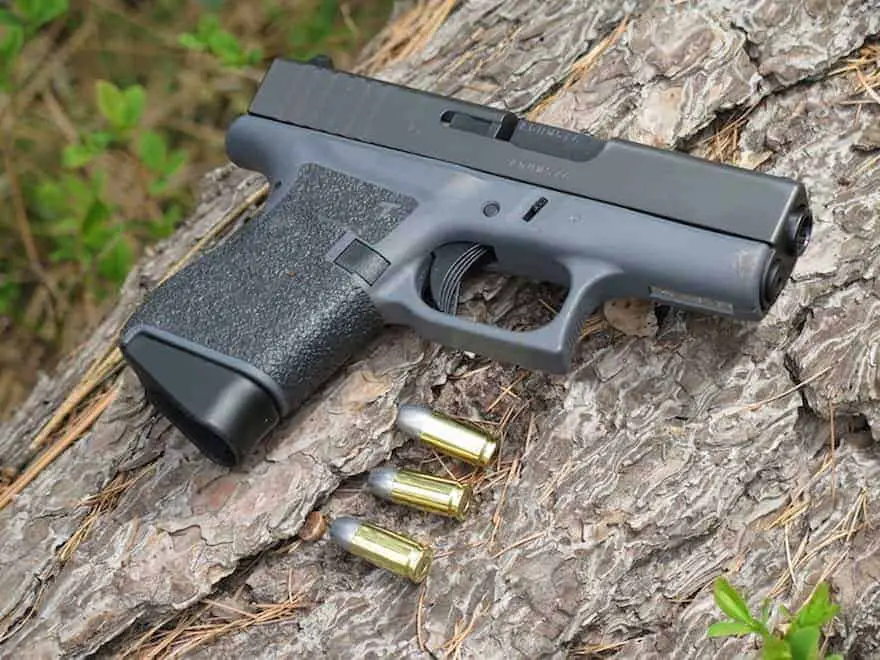
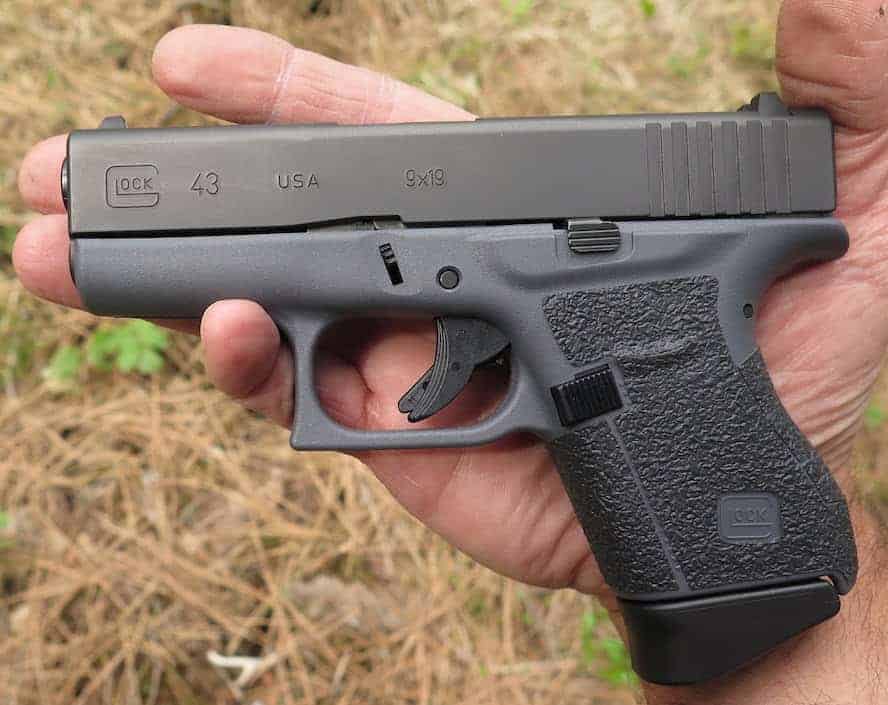
There is only a difference of one between a 43 and 44 right? What about a G43 and a .44 magnum?  That’s my thinking….just kidding! Over time, my bear guns have been getting smaller. From a 12 gauge pump, to a 30-30, to a .44 magnum revolver then to a 10mm, to a double stack 9mm Glock 26, and now to a single stack Glock 43. I’ve learned much over that time. While I’m not ready to consider a +P .22LR Glock 44 for bears, the progression has been both one of practicality and need, and actually makes sense. Sort of.

By Doc Montana, contributing author to Survival Cache and SHTFblog.com

Over 99 percent of the time I’m headed out into the wilds with little more than a water bottle and pocket knife, and often without a water bottle. And that’s because I wander into the sticks almost every day. That said, I have had to make decisions about what to carry, and if minimalism is essential, then I need an essential bear gun option as well. Thus, the G43 Bear Essential.
Let me be very clear: I do not want to ever kill a bear unless I am deliberately hunting one. But the bear might have different ideas about me or the people I’m with. All that said, I do believe that bear spray is the first and best alternative. However, bear spray doesn’t last forever, and it has a limited range, is sensitive to wind, and can be hard to use for more than a few seconds. Therefore I have a go-to backup of a bear gun of some sort.

Also read: Survival Gear Review: UDAP Bear Spray

While bigger is better, especially when it comes to bears, bigger is also less convenient. Pardon the pun, but heavy weighs on your activities. Playing in the forest with five pounds of stainless .44, ammo and chest rig does get old. So once moving off the Dirty Harry platform, things become flexible. A .44 to a .41 is not too much of a jump. Nor is a .41 to a .357. And if a 10mm is like a .41ish, then a 9mm is like a sluggish .357ish.  But then a plus-P 9mm really blurs the lines. Add some actual intel like the 9mm stopping a charging Alaska brown bear (aka grizzly), and the universe just expanded.

Having experience with bears, +P .44 Mag ammo, and +P 10mm, I can say through experience, that shooting a +P 9mm, even through a mouse-ish pistol like the G43 is nothing to fear. A 9mm just cannot pack enough oomph to recoil beyond expected gun activity. Follow-up shots are quick, and you could shoot 9mm +P all day long if you could afford it. The 10mm is snappy, and +P just makes it more shocking. The .44 mag +P, on the other hand, is like swinging an aluminium baseball bat into a brick wall six times in a row before reloading. It’s a gift that keeps giving through wrists and forearms. So in a nutshell, an advantage of a 9mm +P bear load is that you can rapid fire because the muzzle (in a trained hand) won’t move far off target during recoil.

Another issue with a bear gun is actually pulling it on a bear. I meet many folks new to the real woods that think they will have plenty of time to assess and react when a bear appears. That’s like a new driver thinking they can avoid a collision or a fresh faced motorcycle rider who doesn’t need a helmet because they don’t plan on crashing, and if so, they won’t hit their head. I have to bite my tongue when I see an old high school friend learning to walk again after a minor tumble off his Harley.
Since bears have a habit for appearing without warning, and behaving somewhat unpredictable, there is a very good chance that by the time you get to process and react to a bear encounter, you might be rolled up in a ball on the forest floor. For that reason, I have worked on what I call the “Fetal Carry.”

Imagine curled up in a ball with a bear breathing down your neck. In order to draw from a conventional holster, you would need to uncurl a little and reach around hard to the side. Bad idea if you are trying to convince a grizzly you are dead. Instead, imagine being able to pull your gun with your right hand from somewhere on your left, all while playing dead in a ball on the ground.

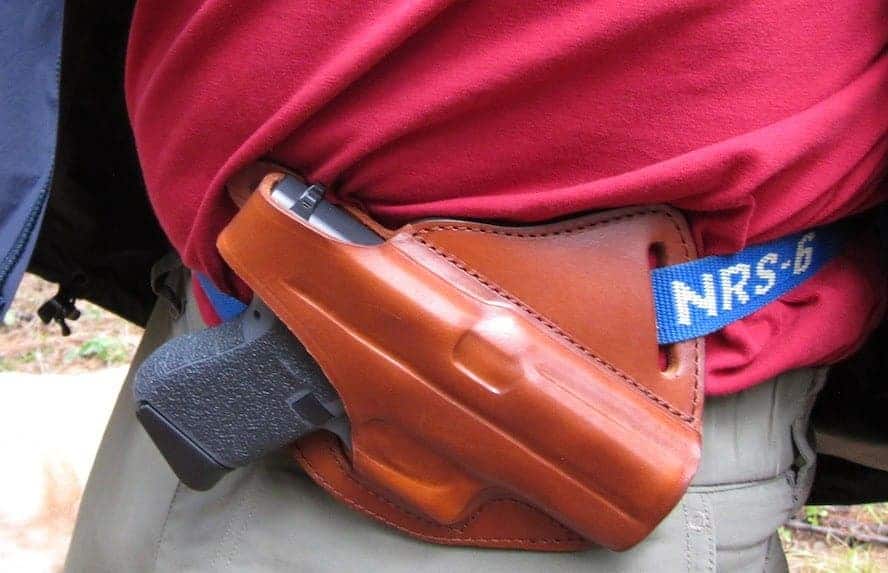
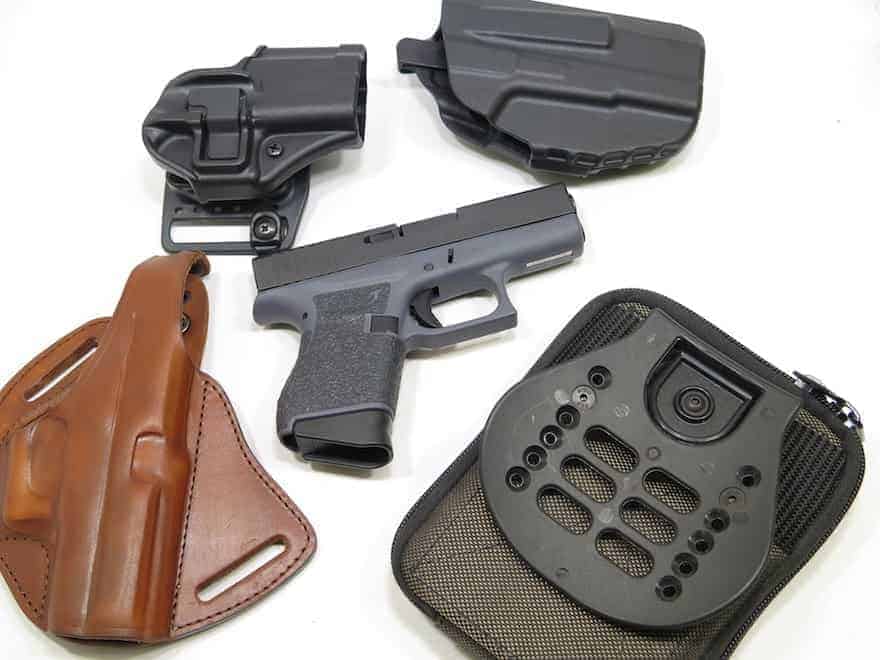
My solution was to head to Craft Holsters and get set up with a nice leather cross draw holster for my Glock 43 bear gun. The leather cross draw pancake from Craft Holsters is a wonderfully capable and versatile holster exactly for the purpose I need it for. Cross draw holsters are popular with those who might need to draw from a seated position or have some affinity reaching across one’s body rather than around. Cross draw holsters can mimic appendix carry, or weak hand hip holsters. And speaking of weak hand, while a weak hand draw from a strong hand mounted cross draw holster (sorry, I don’t know where to place all the hyphens), is possible, it takes a little practice to get the bends right. That said, I think you could figure it out with a disgruntled grizzly at bad breath distance.

Related: Survival Gear Review: The Ruger Alaskan

To aid in the wearability of the Craft cross draw pancake holster is the use of a webbing strap or simple belt worn separately from the traditional belt. This strap belt allows for easy on/off of the holster, quick tightening and loosening, and massive adjustability in length allowing for wearing the holster on the outside of a bulky coat, or outside athletic shorts.

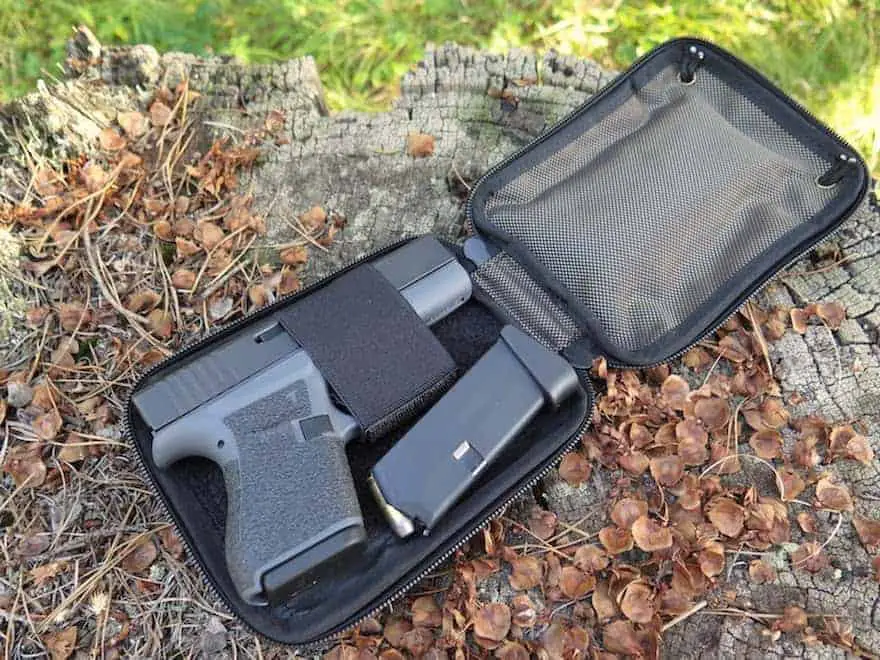
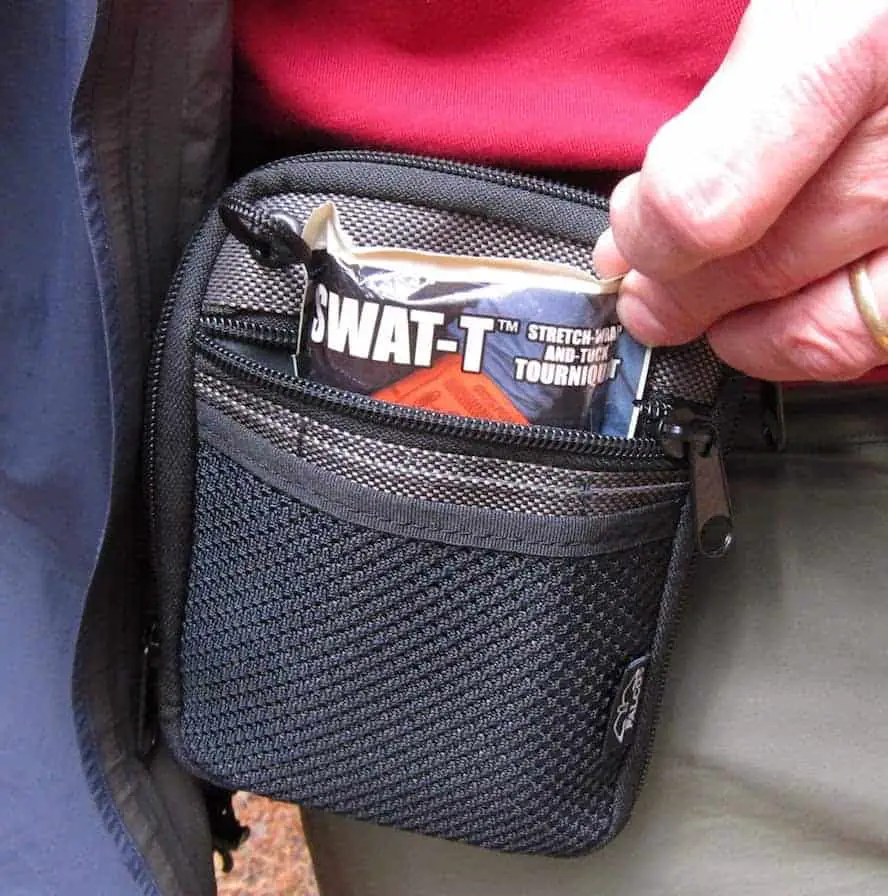
A second carry option for more civilized environs was also sourced from Craft Holsters with the Concealment Belt Pouch with internal holster. The G43 fits fine along with an extra magazine. The rip-open design allows for quick access, all while truly exhibiting world-class incognito. The Belt Pouch is also quite effective for all those outdoor pursuits where bulky clothing, specialized clothing, or even the lack of clothing limits carry options. And it is a fine general carry/storage option as well. The coup de grâce with the Belt Pouch, however, includes a SWAT-T tourniquet nestled into the small zippered front pocket. Remember, should the Bear Essential need to be pulled into service, there is a better than average chance that a tourniquet will be needed as well.
All that said, I also have a Blackhawk Serpa for the G43, as well as a Safariland active retention holster. So I’ve experimented with various options all through the lens of minimalism. For if I go outside the minimalist concept, I will move to a larger caliber without hesitation.

Since activity outdoors usually involves sweat, water, and their offspring, mud, I seriously encourage anyone considering this to install something on the pistol grip to improve grip. I use Talon Grips which are a simple stick-on tape-like solution that weighs nothing and will always work.

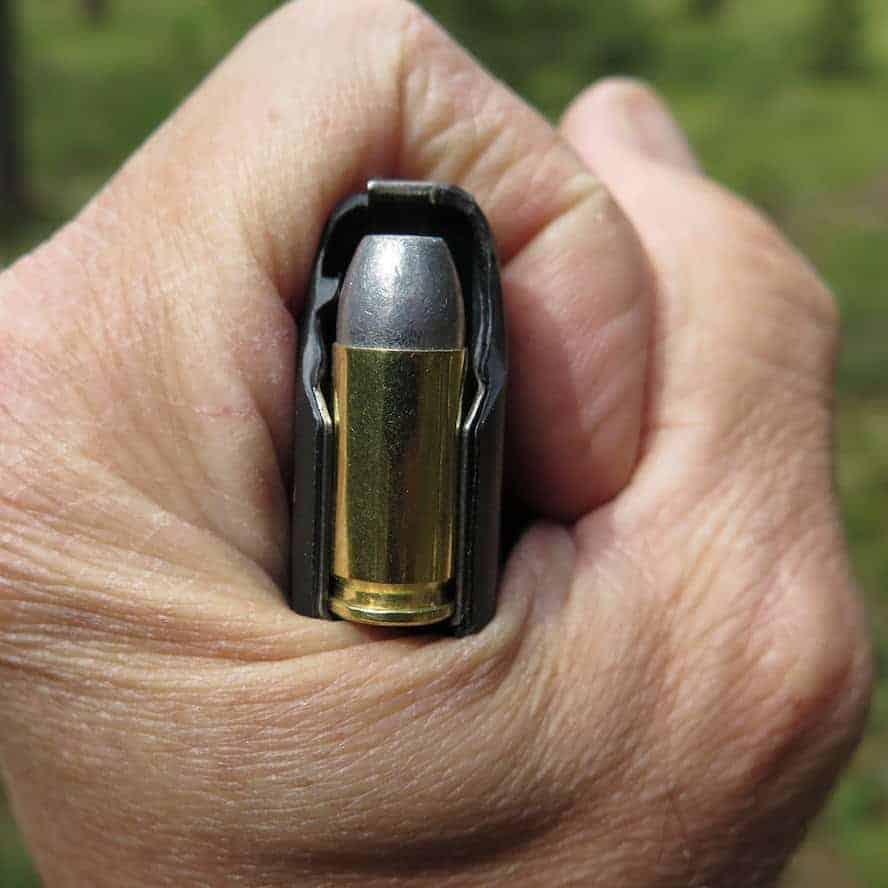
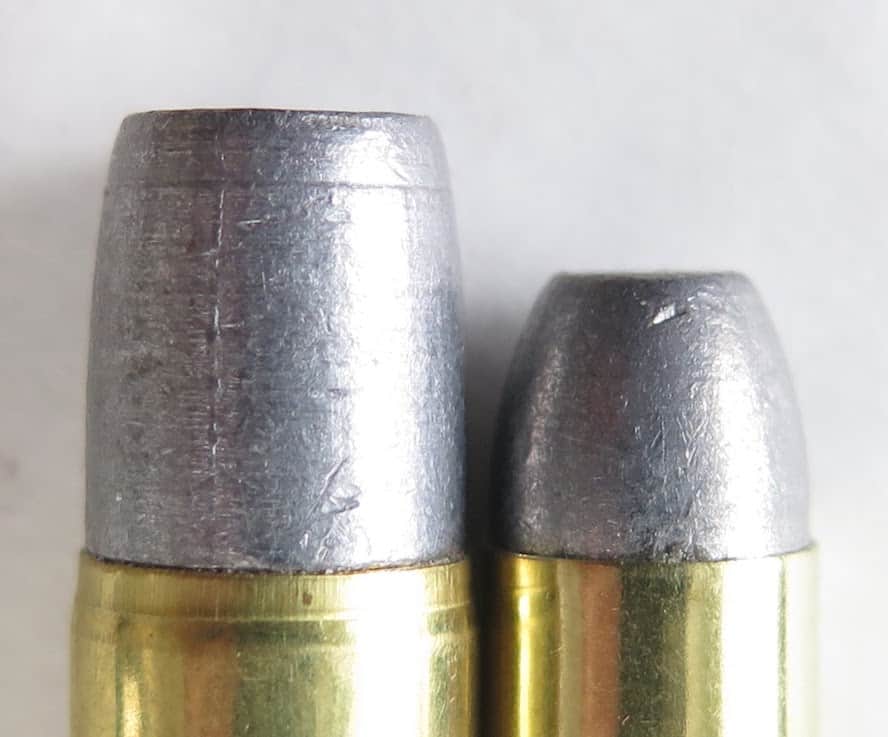
For 9mm bear ammo, I went to where I usually go: Buffalo Bore Ammo. Their 9mm Outdoorsman solid cast bullets are designed to penetrate, not expand. Rather than the largest wound channel, the solid casts are for penetration and breaking bones. The metabolism of a bear is slow enough that you personally can be shredded and dead long before the mortally injured bear collapses for good.

The Buffalo Bore Outdoorsman 147 grain hard cast bullets leave the G43 barrel at around 1050 feet per second. That’s about 395 foot/pounds of energy at the muzzle, with it dropping to about 365 ft/lbs at 25 yards. Sounds all fine and dandy until you compare it to something like the .44 mag +P+ hard cast rounds I use in my Ruger Alaskan. In that case, the 340-grain .44 Magnum bullet is leaving the muzzle at about 1300 feet per second, carrying around 1275 foot pounds of energy. Or in other words, the energy of the .44 +P+ out at around 700 yards is the same as of the G43 at the muzzle. Okay, not quite so comforting, but whoever said using a handgun to engage an agitated bear in the wild was comfortable? It certainly wasn’t Hugh Glass.
The modern 9mm is not your grandpa’s ballistics. The nine is a true performer, and with the explosion of pistol caliber carbines in 9mm, there is a resurgent interest in the overall capabilities of the nine even out to long distances. And shortly after that is the consideration of using the 9mm as an actual hunting round for critters up to deer-sizes.

In the end, however, bears, like sharks, have a unpredictability beyond most. They can appear without warning. Completely ignore you. Chase you down unprovoked. Or mount a bluff attack. While bear spray is a proven deterrent, sometimes another option is needed. And in my case right now, the G43 Bear Essential is what will be in my hand.

The post The Bear Essential: The Glock 43 as a Bear Gun appeared first on Survival Cache.

Survival Knives, Best Bang for your Buck

Everyone has their own opinion of what constitutes the “best” survival knife. For me it comes down to a quality to price comparison.

View this post on Instagram

#morakniv #moraclipper

A post shared by Smaug (@_paul_baumer) on Jun 16, 2018 at 12:12pm PDT

In my opinion, Frost Mora makes a knife that gives you the most bang for your buck, coming in at around $10.00-15.00 depending on the model.

The Mora Clipper is my favorite fixed blade knife, I keep one in my vehicle and two of them in my B.O.B. The only real downside is that it only has a ¾ tang on the knife, but this is quickly counteracted by the fact that you can purchase three or four of these knives for the price of one of the good (more expensive) name brand knives such as Kabar.

Pros

High carbon steel blade
Large handle with plenty of grip
Extremely economical
Plastic handle is easy to sanitize

Cons

Not a full tang on the blade
Plastic case is a bit bulky
Plastic case feels cheap

A little history on Frost/Mora:
With a name that is synonymous with over 300 years of knife-making under its belt, Mora of Sweden manufactures knives that combine the skill of a knife smith with the latest technology manufacturing methods. A variety of specialized models are available in to meet the complete needs of sportsmen active in bush craft survival, hunting, camping, sports fishing and boating; woodworkers, craftsmen and tradesmen; as well as professionals in the commercial fish, meat, and poultry industries.

Mora knives come highly recommended by notable bushcraft teachers Ray Mears, Cody Lundin and Mors Kochanski.

Want to read more about survival knives? Check out these related articles from our site:

Best Survival Knives

Survival Knives: SOG Aura Hunt Review

11 Reviews of Small Survival Knives

Save

Originally posted on: September 17, 2012 @ 3:45 AM

Mitt Romney Is The First Senator To Ever Vote To Convict A President From His Own Party

We have seen lots of strange things happen during President Trump’s time in the White House, and Mitt Romney added to that list on Wednesday when he voted to remove Trump from office.  It was the first time in American history that a U.S. Senator has voted to convict a president that belongs to the same political party, and this probably marks the beginning of the end of Romney’s political career.  Amazingly, Romney voted against Trump even though he knew that it would not affect the outcome of the vote.  In fact, Romney knew that he was going to be the only Republican to vote against Trump and he still did it anyway.

There have been two other instances in which the U.S. Senate has voted to either convict or acquit a sitting president.  In 1868, President Andrew Johnson would have been convicted if even a single member of his own party had voted against him.  The following comes from the Washington Post

In 1868, Johnson, a Democrat, faced 11 articles of impeachment from a Republican-controlled House. The Senate considered those articles, ultimately deciding that all but eight were “objectionable.” A vote was held on three, all centered on Johnson’s having violated the Tenure of Office Act that Congress passed to try to constrain his behavior in office.

Thirty-six votes were needed to convict Johnson and remove him from office in the then-smaller Senate. On all three counts, 35 Republicans voted to convict. On all three, 10 Republicans and nine Democrats voted to acquit.

Bill Clinton was in danger of being removed from office in 1999, but every single Democrat and several Republicans in the Senate stood with him

In 1999, Clinton, a Democrat, faced two articles of impeachment of four originally introduced in the House. On a charge of perjury, 45 Republicans voted to convict Clinton while 10 Republicans and 45 Democrats voted to acquit. On the other article, focused on obstruction of justice, five Republicans switched from not guilty to guilty. It didn’t matter, though; Republicans were still well shy of the 67 votes needed to remove him from office.

Most experts were anticipating that every single Republican would side with Trump for this vote, and so Romney’s decision was a huge surprise.

In an emotional speech on the Senate floor, Romney explained that he had to vote against Trump because his “oath before God demanded it”

“I am aware that there are people in my party and in my state who will strenuously disapprove of my decision, and in some quarters, I will be vehemently denounced. I am sure to hear abuse from the President and his supporters. Does anyone seriously believe I would consent to these consequences other than from an inescapable conviction that my oath before God demanded it of me?”

If you have not seen it yet, you can view his full speech right here.

Needless to say, the reaction from Republicans all across the nation was swift and severe.  During a conversation with reporters, Romney said that he was prepared to “accept whatever consequence is sent my way”

“I will accept whatever consequence is sent my way and recognize that’s part of the job. People don’t expect me to be a shrinking violet,” he said. “I’m feeling the weight of the responsibility for the vote I’ve taken and know that it will have impact on me and my family for a long, long time to come.”

But will there actually be any consequences?

Immediately following the vote, Donald Trump Jr. suggested that Romney should be expelled from the Republican Party

“Mitt Romney is forever bitter that he will never be POTUS,” tweeted Donald Trump Jr. about the Utah senator’s decision. “He was too weak to beat the Democrats then so he’s joining them now. He’s now officially a member of the resistance & should be expelled from the @GOP.” The Republican National Committee blasted out a press release to reporters with the subject line: “Mitt Romney turns his back on Utah.”

Of course nobody is going to actually try to force him out of the Republican Party.  The only way that he would leave is if he does it willingly.

And at this point Romney has nearly five years left in his Senate term.  He is not up for re-election again until 2024, and so he has quite a long time before he has to face the voters again.

But could it be possible that he could be recalled?  A lawmaker in Utah has actually introduced a bill that would make it possible, and Romney’s vote has created a surge of interest in that legislation…

As news of Sen. Mitt Romney’s vote to convict President Donald Trump spread, interest in a Utah lawmaker’s bill to allow Utahns to recall an elected U.S. senator began to catch fire at the state Capitol.

Rep. Tim Quinn, R-Heber City, said Wednesday he received more than 100 phone calls and 250 emails in just over an hour that were “100% positive to the bill.”

We shall see what happens, but at this point we are being told that the bill has very little chance of actually passing.

And if it did, it would probably be immediately challenged in court.

So the truth is that Mitt Romney is not going anywhere, and he will continue to be a thorn in President Trump’s side for the foreseeable future.

There were some other “moderate” Republicans in the Senate that almost certainly were thinking of voting against Trump, but in the end the political cost was just too great to make such a move.  Maine Senator Susan Collins is up for re-election in November, and Alaska Senator Lisa Murkowski is up for re-election in 2022, and neither of them was interested in potentially committing political suicide.

But Mitt Romney does not seem too concerned about his political future.

Does he intend to only serve one term in the Senate?

Has he totally given up on the idea of ever running for president again?

Only Mitt Romney can answer those questions, and right now he is not saying very much about his future plans.

But this vote will definitely guarantee him a spot in the history books, and Trump supporters will never forget what he has just done.

About the Author: I am a voice crying out for change in a society that generally seems content to stay asleep. My name is Michael Snyder and I am the publisher of The Economic Collapse Blog, End Of The American Dream and The Most Important News, and the articles that I publish on those sites are republished on dozens of other prominent websites all over the globe. I have written four books that are available on Amazon.com including The Beginning Of The End, Get Prepared Now, and Living A Life That Really Matters. (#CommissionsEarned) By purchasing those books you help to support my work. I always freely and happily allow others to republish my articles on their own websites, but due to government regulations I need those that republish my articles to include this “About the Author” section with each article. In order to comply with those government regulations, I need to tell you that the controversial opinions in this article are mine alone and do not necessarily reflect the views of the websites where my work is republished. This article may contain opinions on political matters, but it is not intended to promote the candidacy of any particular political candidate. The material contained in this article is for general information purposes only, and readers should consult licensed professionals before making any legal, business, financial or health decisions. Those responding to this article by making comments are solely responsible for their viewpoints, and those viewpoints do not necessarily represent the viewpoints of Michael Snyder or the operators of the websites where my work is republished. I encourage you to follow me on social media on Facebook and Twitter, and any way that you can share these articles with others is a great help.

The True Number Of Coronavirus Victims Is Far Larger Than You Are Being Told

The World Health Organization says that we are facing an “unprecedented outbreak”, and they are basing that assessment on the official numbers that we have been given so far.  But what if those numbers are not accurate and this outbreak is actually much, much worse than we have been led to believe?  According to the Chinese government, there are now 9,692 confirmed coronavirus cases in China, and the official death toll has risen to 213.  But the Wall Street Journal has already documented the fact that the death toll is being artificially suppressed.  As I discussed the other day, many of those that have died are being categorized as dying from “severe pneumonia” so that they won’t count as coronavirus deaths.  Meanwhile, it is becoming exceedingly clear that the number of confirmed cases is also much lower than it should be.  Large numbers of victims are being classified as “suspected cases” even after it is quite obvious that they have the virus.

CNN spoke to a Chinese woman named Shi Muying who has been told by her doctor that she has the coronravirus, but because a fourth test has not been administered yet she is still considered to be a “suspected case”

By January 26, Shi began to have a fever — one of the symptoms of the novel coronavirus. She went to the hospital’s fever clinic where she found over 20 patients, all waiting to be tested by one doctor.

She says she was given three tests — a nasal swipe to rule out the flu, a CT scan to compare her lungs against those of infected patients, and a blood test. After nine hours of tests and waiting for results she says the doctor told her that she had coronavirus, but because he could not give her the fourth and most definitive test, she could only be considered a suspected patient. Her 67-year-old father is in the same situation.

So this woman and her father do not count as confirmed cases at this point.  Instead, they are among the 12,100 suspected cases that are still supposedly waiting to be confirmed.

Of course Shi and her father were quite fortunate to actually be tested in the first place.  Many others have visited hospital after hospital only to be turned away each time.

The truth is that the Chinese medical system is simply unable to handle an outbreak of this magnitude.  The hospitals are being absolutely flooded by very sick people, and there aren’t enough doctors or enough resources to deal with them all.

According to a nurse that works at a hospital in Wuhan, what they are facing is truly a very desperate situation

According to a nurse in Wuhan who asked not to be identified for fear of professional repercussions, staff are overwhelmed, resources are running low, and there are no beds. There are so few hazmat suits that staff disinfect them at the end of their shift to wear again the next day, she said. Around 30 of the 500 medical staff at her hospital are now sick and admitted to hospital, and others — including her — have self-quarantined at home.

There really are a lot of people who can’t get admitted, but there’s no point in blaming the nurses. There are no beds, no resources. Are we supposed to just fight this battle bare-handed?” she said. “Right now, loads of medical staff are at breaking point … I see my sisters charging toward the front line and I feel so powerless.”

Will similar things start happening in other countries all over the globe?

On Thursday, the number of confirmed cases outside of China surpassed 100 for the first time.  The World Health Organization finally declared a global health emergency, and the head of the WHO warned that this is truly “an unprecedented outbreak”

“Over the past few weeks we have witnessed the emergence of a previously unknown pathogen that has escalated into an unprecedented outbreak,” WHO Director-General Tedros Adhanom Ghebreyesus said during a news conference at the organization’s Geneva headquarters on Thursday. “We must act together now to limit the spread.”

Of course there has only been a handful of cases in the United States so far, and so most Americans are not really overly concerned about this crisis at this point.

But if this virus continues to spread, that will soon change.

Reuters interviewed a 21-year-old American-born college student that is living in Wuhan named Nicholas Schneider, and he told Reuters that he has been trying to find a way out of the city.  Now that Wuhan has been totally locked down, he says that he feels “like I’m in an apocalypse somehow”

An eerie calm has descended on the normally bustling streets of the city of 11 million people, where Schneider has been studying geodesy – a branch of applied mathematics – at Wuhan University, about 10 miles (16 km) from where experts believe the new coronavirus originated in a market illegally trading in wildlife.

“It’s like a ghost town, barely any people and cars. It’s a weird feeling. I feel like I’m in an apocalypse somehow,” said Schneider in a phone interview with Reuters on Wednesday.

If this virus starts spreading like wildfire in the U.S., it is just a matter of time before U.S. cities are locked down in a similar manner.

And will our medical system be able to handle a large scale outbreak?

Certainly our system has more resources than China’s does, but the truth is that there aren’t enough hospital beds for all of us.

In fact, right now there are less than a million hospital beds in the entire country.

And there won’t be enough test kits for everyone either.  So far, all testing in the U.S. has been done at the CDC, and officials are hoping to make test kits available to local communities soon.

But what if thousands of sick people showed up at your local hospital demanding to be tested?

Would there be enough test kits?

In China, one journalist tried to get tested, and he was told there are only “100 or several hundred test-kits per hospital per day”

I tried getting tested at a hospital to see what the process was like. They asked me questions and told me to queue for testing. I went with a patient to Tongji Hospital. Lots of patients had been to multiple hospitals. I was genuinely scared.

The corridors in the out-patients department were all full of beds, lots of people were breathing with masks and oxygen tanks. In the corridors. They had to be seriously ill.

Dr said we need to select which patients to do the test on. There are only I was told 100 or several hundred test-kits per hospital per day. There aren’t enough, so doctors need to select those to check. So some people have been to 5-6 hospitals trying to get tested.

So a lot of sick people in Wuhan may never get tested at all.  Instead, many of them will just sit at home “and wait to die”.

Ultimately, we really do not know how many coronavirus victims there are in China right now.  As I discussed yesterday, researchers at the University of Hong Kong are estimating that there could be 44,000 victims at this point, but they have no way of knowing for sure.

But what we do know is that this pandemic is getting worse with each passing day.  Even if you just look at the official numbers, they are growing at an exponential rate.  Mysterious pandemics are one element of “the perfect storm” that we have been anticipating, and it looks like this current pandemic is only going to intensify in the months ahead.

And the more this pandemic grows, the more fear we are going to see.  Large numbers of people are going to be desperately afraid of getting sick and dying, and that has the potential to paralyze our society to an extent that we have never seen before.

About the Author: I am a voice crying out for change in a society that generally seems content to stay asleep. My name is Michael Snyder and I am the publisher of The Economic Collapse Blog, End Of The American Dream and The Most Important News, and the articles that I publish on those sites are republished on dozens of other prominent websites all over the globe. I have written four books that are available on Amazon.com including The Beginning Of The End, Get Prepared Now, and Living A Life That Really Matters. (#CommissionsEarned) By purchasing those books you help to support my work. I always freely and happily allow others to republish my articles on their own websites, but due to government regulations I need those that republish my articles to include this “About the Author” section with each article. In order to comply with those government regulations, I need to tell you that the controversial opinions in this article are mine alone and do not necessarily reflect the views of the websites where my work is republished. This article may contain opinions on political matters, but it is not intended to promote the candidacy of any particular political candidate. The material contained in this article is for general information purposes only, and readers should consult licensed professionals before making any legal, business, financial or health decisions. Those responding to this article by making comments are solely responsible for their viewpoints, and those viewpoints do not necessarily represent the viewpoints of Michael Snyder or the operators of the websites where my work is republished. I encourage you to follow me on social media on Facebook and Twitter, and any way that you can share these articles with others is a great help.

The post The True Number Of Coronavirus Victims Is Far Larger Than You Are Being Told appeared first on The Economic Collapse.