Survival Gear is the most unused product until a natural disaster happens, then it’s the most desired products, but usually too late to help those that really need the help.

We sell around the World, and pride ourselves on offering a level of customer service that we would want to see ourselves if we were shopping online.
Our product ranges change regularly, so we hope that you come back to our sites to see some of the fantastic offers that we regularly have.

Get In Touch

These 5 Doomsday Bunkers That are Redefining Luxury

Where will you go when disaster strikes? For many wealthy preppers, the answer lies underground – in a ridiculously swanky bunker. Check out these luxurious doomsday bunkers that are changing the survival shelter game.

Doomsday Bunkers from Around the World

Many survivalists dream of owning the ultimate underground bunker – but for these super wealthy preppers, that dream is now a reality. Complete with swimming pools, movie theaters and more, these luxurious doomsday bunkers are the best of the best. Check out these 5 doomsday bunkers that are the ultimate in survival shelters.

1. The Missile Silo Bunker

Created by Larry Hall in Kansas, the Missile Silo stretches 174 feet underground and has walls that are nine feet thick. This bunker offers a luxurious safe haven for when things get out of hand. It includes a swimming pool, library, and even a movie theater. You can purchase a condo inside the Missile Silo for $2 million.

2. The “Europa One” Bunker

Vivos is currently working on a luxurious fallout bunker in Germany called the Europe One. The bunker will be able to withstand a nuclear blast, chemical agents, earthquakes and any other disasters. The bunker will be 250,000 square feet and will be able to house 6,000 people. The Europe One will come fully equipped with luxurious swimming pools, theaters, gyms and a self-contained water and power generation system.

3. The “Home Within A Home” Bunker

During the Cold War, the original owner of this home decided to build a bunker 26 feet under his home. The owner designed the bunker to be a “home within a home” for a long-term stay. He added an outdoor area and a swimming pool, plus many more unique features. The home is estimated to cost about $1.7 million. Click here to check out the home within a a home bunker.

4. The Seed Vault Bunker

The Svalbard Global Seed Vault is located 810 miles away from the North Pole. Various countries contributed towards the building of the bunker back in 2006. The facility stores seeds from a variety of plants in case a major catastrophe occurs. It was reported in 2015 that the bunker held about 420 million seeds.

5. The Atlas Bunker

Atlas, an American company, constructs affordable survival shelters priced between $36,000 to $86,000. For $85,000 you can buy a 10×51 shelter with an air filtration system, blast-proof doors, dinner table, kitchen, shower, entertainment center, bunk beds and under-floor storage.

Check out the video below to learn more about these doomsday bunkers:

These 5 Doomsday Bunkers are Redefining LuxuryThese 5 Doomsday Bunkers are Redefining Luxury

For awesome survival gear you can’t make at home, check out the Survival Life Store!

Want to read more about doomsday bunkers? Check out the posts below!

Shelter in Place | How to Stay Safe in a Pandemic

Family-Friendly Storm Shelters

The Weakness Of Underground Bunkers

UNDERSTANDING THE FUNDAMENTALS OF TRACKING

Written by Guest Contributor on The Prepper Journal.

A very small percentage (I’d day less than 1%) of Tracking Students will have, or will take, the time and dedication to become good trackers”
— AB Taylor, former US Border Patrol Agent*

Let me tell you the truth: this Art is tough.

Beside the fact that the fundamentals of this Art (for either tracking men or animals) are quite a few, the main role, as suggested by the above quote by the legendary AB Taylor, consists on experience. The terminology of Tracking defines it “dirt time on ground“.

In this article we will look at the information we can gain by observing a set of tracks (called the trackline), using size, measurements, and light angle, as well as cover the major differences between tracking men and animals.

Track Traps

The most friendly terrain to Trackers (even for absolute beginners) are called “Track Traps,” which refers to muddy or sandy areas where you can easily detect the presence of a whole track (a track which appears in her “entirety”) or a well-defined partial track, whether it’s a shoe impression or an animal’s paw.

© Kyt Lyn Walken. Used with permission.

But track traps are not limited to nature; there are many you can run across in an urban environment, such as construction sites, gardens, playgrounds, and similar locations. A fundamental skill for any Tracker is to keep their eyes on the ground, even in challenging environment like cities or small towns.

Track Traps allow us to gain a lot of information, which become part of the mental database of any Tracker. I like to consider any individual devoted to following tracks as a sort of detective: his/her task is to acquire information from the ground, build a mental picture of what happened in a certain place at a certain time, then put all the pieces of the puzzle together to tell a story.

Elements of Observation

Length and width of a track. The length is measured from the toe to the heel, keeping the measuring device a safe distance from the track’s side in order not to contaminate it or damage the track in any way. The width is taken at the largest part of the toe, of the heel, and the arch (the intersection between the two parts of the foot). The length and the width of a whole track can allow us to determine if the subject is male or female, adult or child.

© Kyt Lyn Walken. Used with permission.

By analyzing how the track appears inn the soil, we can determine if the person is carrying a load on his/her shoulders by how the weight shifts from the heel to the toe. In the case of animals, we would observe the impression from the top to the bottom of the track, the reverse of a human track. The dimensions will reveal if the animal is a male or female, as withhumans. The disturbances on the ground can also tell us if the person or the animal was walking or running, based on the tracks’ distance on the ground.

The faster an animal or human runs, for example, the more evident the disturbances on the ground will be. Further considerations on the “pressure releases”, the definition given by Tom Brown Jr. for these types of disturbances, can give us the details about the position of the head and body due to the intention to look towards a specific direction. The ability to do that depends on the accurate analysis of how the soil reacted to the passage of the subject in a specific time.

Shoes, Boots and Heels

The shoe pattern. The shoe pattern is basically the design of the mold of each shoe’s sole. Knowing what the subject was wearing at the time of the passage is, as you can easily understand, one of the keys of every search and rescue or manhunt mission. Due to the presence of millions of different shoes in commerce, we recognize three main categories: flat shoes (like sneakers), boots, and classic shoes (in which heels are pretty visible).

© Kyt Lyn Walken. Used with permission.

We can also determine how many people passed in a distinct area by shoe patterns: we can select all the different patterns (I recommend identifying them with different colored marks). This method is called the “Comparison Method.” Another method consists in just counting all the shoes inside an ideal box bordered inside an area of at least 4.6 feet and count all the different tracks you can spot inside, called the “Direct Count” method.

In Tracking, be sure to keep an open mind and not immediately jump to conclusions. A good thing is always keeping things “large”, for example making deductions about “at least six persons passed through this area” or “less than five female deer crossed this point”.

It’s not always that easy

Outside of “Track Traps”, challenges for Trackers increase dramatically. Terrain covered by dry leaves, or craggy slopes, or entirely rocky areas are the most tough to track in.

On areas like these, Trackers cannot leave anything to chance: their task is to analyze any compression, any flattening of grass (this can reveal the direction of travel), or any dislodged pebble, looking for ground spoor (signs left by paws or feet) as well as for aerial spoor (upper vegetation damaged, shifted or broken). If we are lucky enough to run across spoor such as discharged materials, droppings, or blood, we can surely gain more data to add to our follow up, either if we are on man trails or animal trails.

© Kyt Lyn Walken. Used with permission.

When considering the differences between tracking men and animals, please never forget that humans move withintention, while wild creatures by instinct. Thus, if we are willing to observe the fauna, we should be not only 100% familiar with the species of a certain areas, but also with their habits, their feeding spaces and sleeping area, too. In both of the two types of follow up, keep in mind that a Tracker uses all his senses (plus, a good role is played by their sixth sense, intuition).

Use all your senses

You track using not only eyes, but with your ears (to detect any sudden noise, for example, which can put you on alert), your nose, your brain, and your sense of touch (disturbed ground is often colder, since dry leaves have been swept away by feet or hoofs!).

One of the senses you need to consider is your common sense, which can lead you towards the proper interpretation of tracks, as we will see in the next article, based on some real case scenarios.

*Fundamentals of Mantracking: The Step-by-Step Method: An Essential Primer for Search and Rescue Tracker, by Albert “AB” Taylor and Donald C. Cooper (non-affiliate link)

Author Kyt Lyn Walken

Kyt Lyn Walken is the official European representative and instructor for Hull’s Tracking School (Virginia, USA), and is a certified Conservation Ranger for C.R.O.W. (Conservation Rangers Operations Worldwide). She has been an outdoors and tracking enthisast since childhood. Kyt lives and works in Europe, and can be contacted at www.man-tracking.com

The post UNDERSTANDING THE FUNDAMENTALS OF TRACKING appeared first on The Prepper Journal.

Bug Out Tip: Layers To Live By

After visiting San Diego in my youth I thought how wonderful it would be to live in a climate that had roughly one season. True San Diego does experience four seasons but not like where I live. The thought of a perpetual summer was enticing.  More time to play in the warm weather and not having to wear a lot of different clothing or layers. Alas I never moved and as I got older I am very happy that I didn’t. True four seasons keeps it interesting. There is a joy that I get in each season and watching the cycle. With the cycle of seasons though comes a very important lesson in layering. With ever fluctuating temperatures and weather conditions one cannot just count on a single piece of clothing to shrug off what mother nature throws at you. One must understand how to layer their clothing. Of course this is beneficial in our daily lives but even more so when a survival situation occurs, because your clothing is your first shelter.

By Grimm, contributing author to SHTFblog and Survival Cache

In a modern day world where houses, apartments, condos i.e. shelters are everywhere, its hard to imagine a moment when you cant access one but it happens. People get locked out or lost. Vehicles break down or crash. Which that thought brings me to a great example of poor layering. I was driving home from work and it was December. I was wearing my work shirt, pants and a leather jacket. Easily enough to keep me warm in my heated car or inside my work which is heated. Needless to say I was rear ended and I had to stand outside on the side of the road while police came and tow trucks dragged my totaled car away. I was freezing. I did not layer properly. I had two layers tops and nothing to cover my head or hands. Now I always make sure I have decent layers no matter where I go and you should as well.

These layers, which usually amounts to three, help keep the body protected from the elements. Rain, snow and wind can chill the body down together or separately causing hypothermia. Wind and sun can rob the body of moisture causing hyperthermia. These layers shrug off the wind, rain or snow or shield the body from the suns UV rays. Now you might ask why usually three. Well just like how the weather changes frequently so does your physical activity. More physical activity means more heat and possible perspiration. So layers can be taken off to keep cool and limit sweat. Remember sweat is produced to cool the body down. That’s good but just like rain it will affect the insulating properties of your clothing. Having layers gives the person the ability to adapt to the weather changes as well as their activity.

Check out: It’s Winter! Don’t Go Hiking Without Proper Clothing!

Another point to consider, though one might have good layers on do not forget about your head, neck, hands and feet. I understand that wearing two pairs of socks is not always an option in our daily routine but a hat, scarf, and gloves can go a long way to help the body stay protected. I know if I merely had a wool hat and scarf when I was in my accident I could have been a bit warmer on that day. True I wasn’t in a survival situation that day but next time I might not be as lucky. Of course this blog only touches the tip of the iceberg when it comes to layering so check out the video for more helpful information on Layers to Live by.


The Mysterious New “SARS-Like Virus” That Is Killing People In China Has Now Spread To Japan

On top of everything else that has happened so far in 2020, a very mysterious “SARS-like virus” that doctors have never seen before is causing grave concern among global health officials.  It has been identified as “a coronavirus”, but that category covers a very broad range of illnesses.  If you have a common cold right now, it was caused by a coronavirus.  But SARS and MERS also came from the same virus family, and those two outbreaks made headlines all over the world.  In 2002 and 2003, SARS infected more than 8,000 people worldwide, and more than 700 of them ended up dying.  Global health officials are hoping that what we are now facing won’t be any worse than that, but at this point they just don’t know enough about this mysterious new virus to make any firm projections.

What we do know is that this outbreak just started, and China has just announced that this virus has claimed a second life.  The following comes from the BBC

A second person has died in China from a new, pneumonia-like virus, local officials have announced.

They say the death was recorded in the eastern city of Wuhan, where the outbreak began in December.

And we also know that there have been at least two cases where people have transported the virus outside of China via airplane.

The first case happened earlier this week when a woman flew from China to Thailand

The new virus, known for now as 2019-nCoV, was first identified on Jan. 7, about a week after officials first reported a cluster of pneumonia cases in Wuhan, WHO said.

Recently, officials reported the first “exported” case of the virus in Thailand. In that case, a resident of Wuhan got on a direct flight to Thailand along with several members of her family and a tour group, according to WHO. When the 61-year-old woman arrived at the airport, she was found to have a fever, and she was taken to the hospital where she tested positive for 2019-nCoV.

Subsequently, on Thursday we learned that a man that flew from China to Japan had also contracted the virus.  The following comes from Time Magazine

Japan’s government said Thursday a man treated for pneumonia after returning from China has tested positive for the new coronavirus identified as a possible cause of an outbreak in the Chinese city of Wuhan.

The man developed a fever and coughs on Jan. 3 while in Wuhan, returned to Japan on Jan. 6, and was hospitalized four days later due to persistent coughs and fever, with his X-ray image showing signs of pneumonia, the Ministry of Health, Labor and Welfare said.

At first, global health officials were greatly downplaying the possibility of human-to-human transmission.

But now even the World Health Organization has been forced to admit that “limited human-to-human transmission” may be happening…

There may have been limited human-to-human transmission of a new coronavirus in China within families, and it is possible there could be a wider outbreak, the World Health Organization (WHO) said on Tuesday.

In other words, the evidence has forced them to change their tune, but they are still trying to not alarm the general public too much.

Unfortunately, the truth is that this outbreak is still very new, they have never seen this virus before, and they are still trying to figure out exactly how dangerous it is.

Hopefully this is not going to develop into a major pandemic.  Without a doubt, it is certainly possible that this whole thing could fizzle out even faster than the bird flu scare did.

But let us not forget that a horrific pandemic about 100 years ago killed between 50 million and 100 million people.  The following comes from Wikipedia

The 1918 influenza pandemic (January 1918 – December 1920; colloquially known as Spanish flu) was an unusually deadly influenza pandemic, the first of the two pandemics involving H1N1 influenza virus.[1] It infected 500 million people around the world,[2] including people on remote Pacific islands and in the Arctic. Probably 50 million, and possibly as high as 100 million (three to five percent of Earth’s population at the time) died, making it one of the deadliest epidemics in human history.[3][4][5]

Bill Gates has identified pandemics as one of the three greatest threats that humanity is facing, and he says that we are woefully unprepared if one were to break out today.

In fact, he says that we should be preparing for one right now as if we were preparing for war

“In the case of biological threats, that sense of urgency is lacking,” Gates said in a 2018 presentation hosted by the New England Journal of Medicine. “The world needs to prepare for pandemics in the same serious way it prepares for war.”

Sadly, authorities will probably never make preparation a true priority until a major pandemic has already begun.

The symptoms of this new mystery virus include congestion, headache, cough and fever.

Of course those exact same symptoms are associated with the common cold.

If you have shortness of breath, chills or body aches in addition to the other symptoms, that could be an indication that you should get checked out.

But there have been no reports of this virus reaching the United States yet, and hopefully we won’t see that happen at all.

For the Chinese, this outbreak comes at a particularly bad time, because their Lunar New Year celebration is on January 25th.  Hundreds of millions of people will be traveling around China, and that could potentially accelerate the spread of the virus.

It may have been prudent for Chinese officials to completely cancel all of the festivities, but at this point there are absolutely no plans to do that.

So we will watch and see what happens.  If this particular virus doesn’t become a pandemic, scientists assure us that it is only a matter of time before some other virus does.  And considering the hour in which we live, we are certainly very vulnerable to a potential pandemic right now.

Once again, I want to stress that there is no need for people in the U.S. to start freaking out about this virus just yet.  Only two people have died, and there have been no reported cases in the U.S. so far.

But as we have seen in the past, global air travel can spread a virus around the world very quickly, and authorities are still trying to figure out how dangerous this new mystery disease really is.

About the Author: I am a voice crying out for change in a society that generally seems content to stay asleep. My name is Michael Snyder and I am the publisher of The Economic Collapse Blog, End Of The American Dream and The Most Important News, and the articles that I publish on those sites are republished on dozens of other prominent websites all over the globe. I have written four books that are available on Amazon.com including The Beginning Of The End, Get Prepared Now, and Living A Life That Really Matters. (#CommissionsEarned) By purchasing those books you help to support my work. I always freely and happily allow others to republish my articles on their own websites, but due to government regulations I need those that republish my articles to include this “About the Author” section with each article. In order to comply with those government regulations, I need to tell you that the controversial opinions in this article are mine alone and do not necessarily reflect the views of the websites where my work is republished. This article may contain opinions on political matters, but it is not intended to promote the candidacy of any particular political candidate. The material contained in this article is for general information purposes only, and readers should consult licensed professionals before making any legal, business, financial or health decisions. Those responding to this article by making comments are solely responsible for their viewpoints, and those viewpoints do not necessarily represent the viewpoints of Michael Snyder or the operators of the websites where my work is republished. I encourage you to follow me on social media on Facebook and Twitter, and any way that you can share these articles with others is a great help.

The post The Mysterious New “SARS-Like Virus” That Is Killing People In China Has Now Spread To Japan appeared first on The Economic Collapse.

7 Major Earth Changes That Are Happening Right Now That Everyone Needs To Know About

This article was originally published by Michael Snyder at The Economic Collapse Blog. 

There has never been a time in modern human history when our planet has been changing as rapidly as it is changing right now.  The sun is behaving very strangely, freakishly cold weather is breaking out all over the world, ocean temperatures continue to rise, volcanoes all over the globe are shooting ash miles into the air, Australia is experiencing the worst wildfires that they have ever seen, and the north magnetic pole has been moving at a pace that is deeply alarming scientists.  Could it be possible that all of this bizarre activity is leading up to some sort of a crescendo?

Sadly, most people don’t even realize what is happening, and that is because the mainstream media only emphasizes stories that fit with the particular narratives that they are currently pushing.

But it has gotten to the point where nobody can deny that really weird things are happening.  The following are 7 major earth changes that are happening right now that everyone needs to know about…

#1 According to NASA, solar activity has dropped to the lowest level in 200 years.  The following comes from the official NASA website

The forecast for the next solar cycle says it will be the weakest of the last 200 years. The maximum of this next cycle – measured in terms of sunspot number, a standard measure of solar activity level – could be 30 to 50% lower than the most recent one. The results show that the next cycle will start in 2020 and reach its maximum in 2025.

Of course, NASA insists that everything will be just fine, but others are wondering if this lack of solar activity could potentially spawn another “Little Ice Age”

When solar activity gets really low, it can have the effect of a “mini ice age.” The period between 1645 and 1715 was marked by a prolonged sunspot minimum, and this corresponded to a downturn in temperatures in Europe and North America. Named after astronomers Edward Maunder and his wife Annie Russell Maunder, this period became known as the Maunder Minimum. It is also known as “The Little Ice Age.”

#2 When solar activity gets very low, it has traditionally meant very cold and very snowy winters, and right now we are seeing snow in places that are extremely unusual

The Egyptian capital, Cairo, was also turned white at the start of the month, despite the city not having snow in 112 years, and experiencing less than an inch of rain each year.

Many parts of Greece were covered in snow in early January, with low temperatures and strong frost.

The cold front named ‘Hephaestion’, after an Ancient Greek army general, thrashed the Greek landscape, bringing rain, sleet and ice in the east.

#3 Meanwhile, the oceans of the world just keep getting hotter and hotter.  In fact, ocean temperatures off the California coast have been setting new all-time record highs.  It is odd that this is taking place at a time of such low solar activity, but according to NBC News this is definitely happening…

The world’s oceans hit their warmest level in recorded history in 2019, according to a study published Monday that provides more evidence that Earth is warming at an accelerated pace.

The analysis, which also found that ocean temperatures in the last decade have been the warmest on record, shows the impact of human-caused warming on the planet’s oceans and suggests that sea-level rise, ocean acidification and extreme weather events could worsen as the oceans continue to absorb so much heat.

#4 There have always been wildfires, but we have never seen anything like this.  During the summer, countless catastrophic fires burned millions upon millions of acres in the Amazon rainforest, and this winter Australia’s fires have actually been a total of 46 percent larger than the fires that we witnessed in the Amazon.  Australia has never seen anything like this before, and according to NASA the smoke from these fires will completely circle the Earth

Once was bad enough, but smoke from Australia’s devastating bushfires is set to return to the country to complete a round-the-world trip that has seen it impact on air quality as far away as South America.

By Jan. 8, the smoke had made its way halfway around the world and will make at least one full circuit, according to scientists at NASA, citing satellite tracking data. New Zealand experienced severe air quality issues, while hazy skies and colorful sunsets and sunrises were seen in parts of Chile and Argentina.

#5 During the first half of 2020, volcanoes all over the world have been roaring to life and have been shooting giant clouds of hot ash miles into the sky.  For example, in the Philippines the Taal volcano shot ash nine miles into the air on Sunday, it has also been shooting scorching hot lava half a mile into the air, and the ground around the volcano is starting to crack wide open.

But even after all the devastation that we have already seen, authorities are warning that it could “re-explode at any moment”

The gray ash is knee-deep. It covers the homes, the bloated cadavers of cows and horses, their limbs protruding at unnatural angles in the shadow of a sulking volcano that could re-explode at any moment.

“My home is now gone,” said Melvin Mendoza, 39, a boatman who returned on Tuesday to Taal, the volcanic island in the middle of a freshwater lake just 40 miles south of Manila, which erupted on Sunday like an atomic bomb mushroom cloud.

Let us hope that this volcanic activity does not spread throughout that general area, because the largest super volcano caldera in the entire world has been discovered not too far from the Philippines

A team including members from GNS Science have identified an ancient mega-volcano that could have the largest known caldera on Earth.

The 150km (93.2 miles) wide feature is on the crest of Benham Rise, an oceanic plateau off the Philippines coast. In comparison, the caldera at Taupō is about 35km (21.8 miles) wide, and that at Yellowstone about 60km (37.3 miles).

#6 All of this is taking place while the north magnetic pole is moving toward Russia at a very rapid pace.  The following comes from CNN

The north magnetic pole has been slowly moving across the Canadian Arctic toward Russia since 1831, but its swift pace toward Siberia in recent years at a rate of around 34 miles per year has forced scientists to update the World Magnetic Model — used by civilian navigation systems, the North Atlantic Treaty Organization, and US and British militaries — a year ahead of schedule.

#7 On top of everything else, the Earth’s magnetic field has been steadily weakening over time, and this has some experts extremely concerned

In a forum on Quora, science fiction writer and journalist C Stuart Hardwick revealed that satellite data, such as those collected by the European Space Agency’s SWARM mission, revealed that the magnetic field has been weakening for about 5 percent each century. He noted that currently, the strength of the magnetic field is at 29.5 microteslas, which is 14 percent weaker than its previous state three centuries ago. According to Hardwick, the SWARM satellites detected increased deterioration within regions of the magnetic field over North America. He said these regions weakened by about 3.5 percent over the span of just three years.

Without our magnetic field, life on Earth could not exist for long.

And it doesn’t have to disappear completely to be a massive problem.  If it simply gets weak enough, dwelling on the surface is going to become exceedingly difficult.

As I keep warning, our planet is becoming increasingly unstable, and what we have experienced so far is just the beginning.

The demands of life can often cause us to focus on things that don’t really matter.  Hopefully, we can get more people to wake up while there is still time because the clock is ticking for humanity and for our planet as a whole.

About the Author: I am a voice crying out for change in a society that generally seems content to stay asleep. My name is Michael Snyder and I am the publisher of The Economic Collapse BlogEnd Of The American Dream and The Most Important News, and the articles that I publish on those sites are republished on dozens of other prominent websites all over the globe. I have written four books that are available on Amazon.com including The Beginning Of The EndGet Prepared Now, and Living A Life That Really Matters. (#CommissionsEarned) By purchasing those books you help to support my work. I always freely and happily allow others to republish my articles on their own websites, but due to government regulations, I need those that republish my articles to include this “About the Author” section with each article. In order to comply with those government regulations, I need to tell you that the controversial opinions in this article are mine alone and do not necessarily reflect the views of the websites where my work is republished. This article may contain opinions on political matters, but it is not intended to promote the candidacy of any particular political candidate. The material contained in this article is for general information purposes only, and readers should consult licensed professionals before making any legal, business, financial or health decisions. Those responding to this article by making comments are solely responsible for their viewpoints, and those viewpoints do not necessarily represent the viewpoints of Michael Snyder or the operators of the websites where my work is republished. I encourage you to follow me on social media on Facebook and Twitter, and anyway that you can share these articles with others is a great help.

Eat Gluten Free and Survive With Valley Food Storage

Whether you choose to accept it or not, human cases of food allergies are on the rise. While the reasons why this is happening is a debate for another forum, the plain and simple fact is that you or someone within your circle of caring may very well develop a food allergy – and it won’t necessarily start at birth – it could develop at any time.

By Drew, contributing author to Survival Cache and SHTFblog
My wife developed concurrently a gluten allergy and a lactose intolerance. This occurred suddenly when she was about 30 years old, and it took a battery of tests and throwing a dart at the diet board to figure out what was going on, since the two allergies formed at the same general time. The symptoms are reportedly pretty wretched – crippling stomach pain, headaches, and severe diarrhea with accompanying dehydration, with onsets of the symptoms giving her almost no notice to get to the appropriate location to take care of the task at hand. As a consequence, her diet is severely limited, and a lot of time is spent in the grocery store aisle carefully reading labels. Dairy is not a huge issue to avoid, but gluten is sneaky and can be found even in foods labelled “gluten free”, if the product is even processed in a plant that works with gluten-based products. It’s a less-than-fun game with no winners – especially when it comes time to prep for long-term survival.

All of this means a couple things for me: one) I’ve sampled pretty much every gluten free food option there is, and two) prepping long-term storage food for unforeseen disasters is a complete pain in the posterior. Thankfully, the seriousness of gluten and other food allergies is starting to come to light with a corresponding semi-lackluster (but honest and definitely increasing) response from the market in general. However, a person or family with a need to keep an eye on the fixin’s still must struggle to find dedicated products with value. And when you whittle the available products down to a niche market such as specifically designed long-term storage food, choices are slim indeed – making me wonder if a subject with a gluten allergy would rather wish they had punched out when the bomb dropped instead of being caught in a bunker eating the same meal of bulk freeze dried beef cubes, peas, and rice for four years straight.

Enter Valley Food Storage
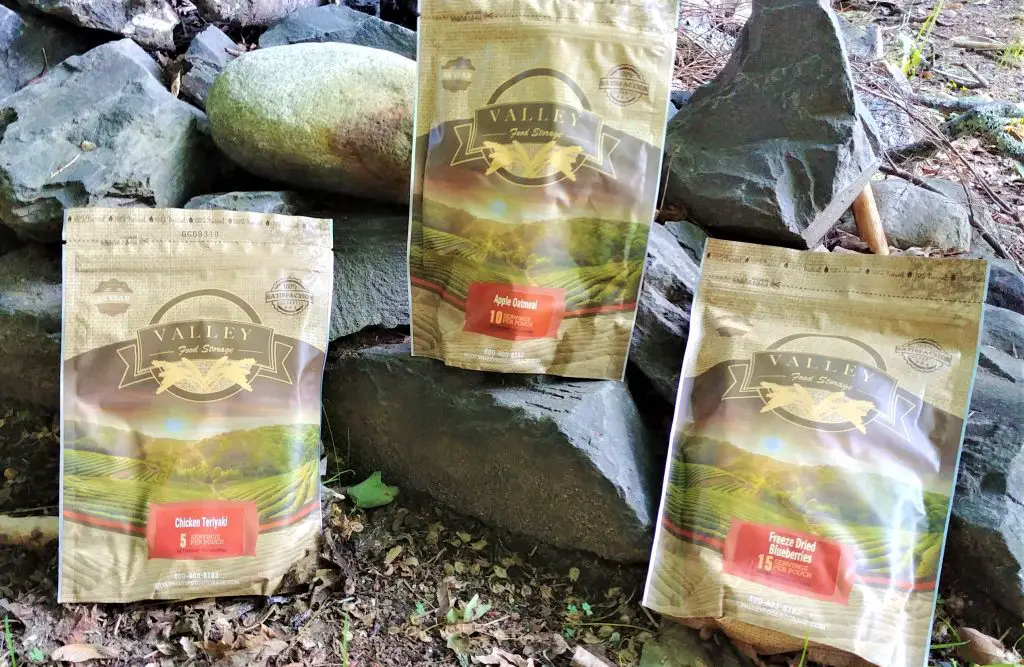
I was fortunate enough to be contacted by Valley Food Storage with an offer for a free sample of their freeze-dried food offerings (which you can get yourself on their website). I clicked over to Valley Food Storage’s website, and was pleasantly surprised when I saw that they have a dedicated suite of offerings that are specifically gluten free. (They also have other specific dietary-considerate options, to include lactose free, soy free, and vegetarian.) Admittedly, a large chunk of the products on the GF page are more side dishes or desserts instead of full entrees, but there are a few selections available to make a decent day’s full meal plan. This is refreshing – I have found that more often than not, a freeze dried food manufacturer’s “Gluten Free” options are pretty much a packet of dried strawberries or something similar. 

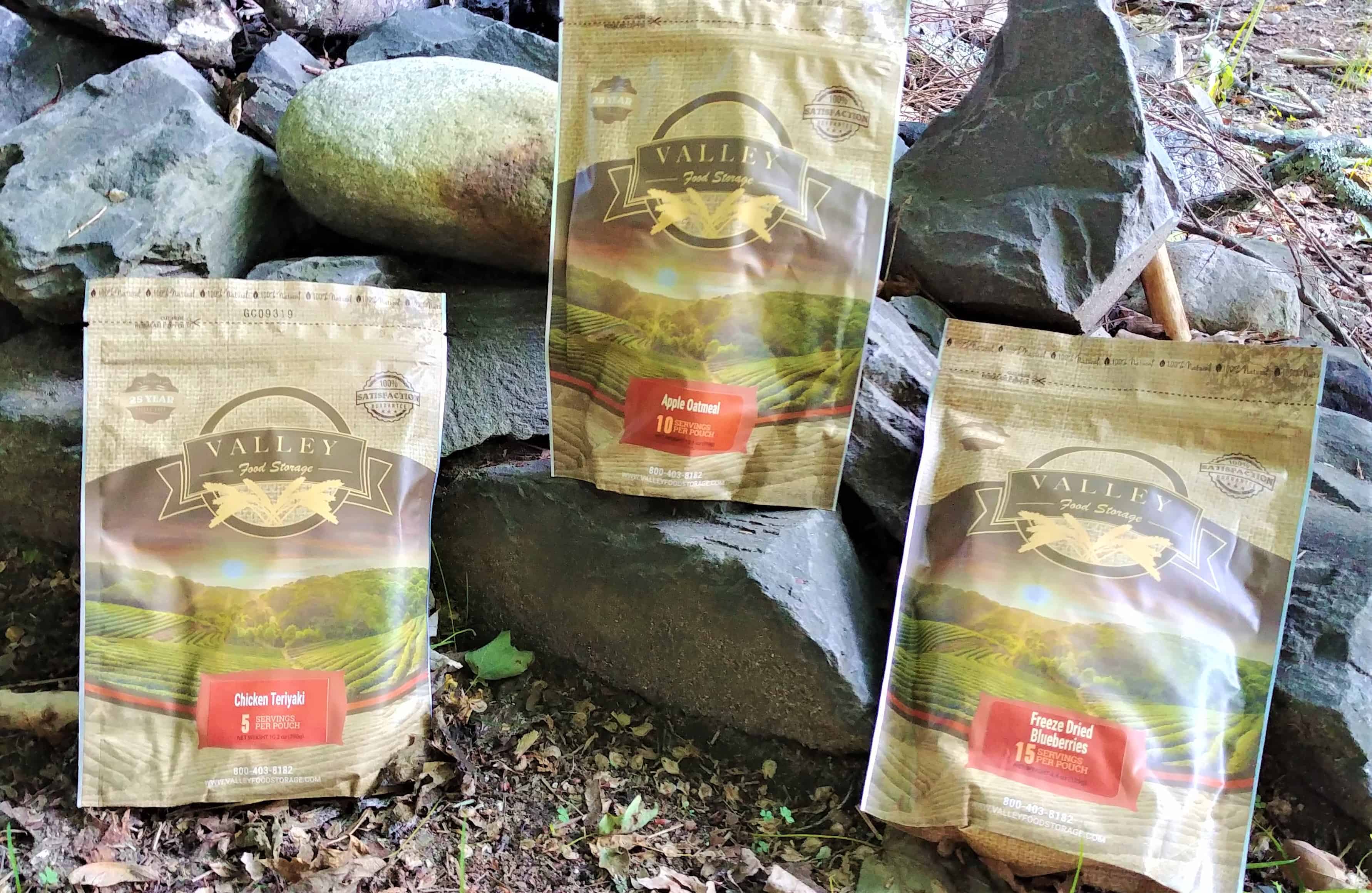
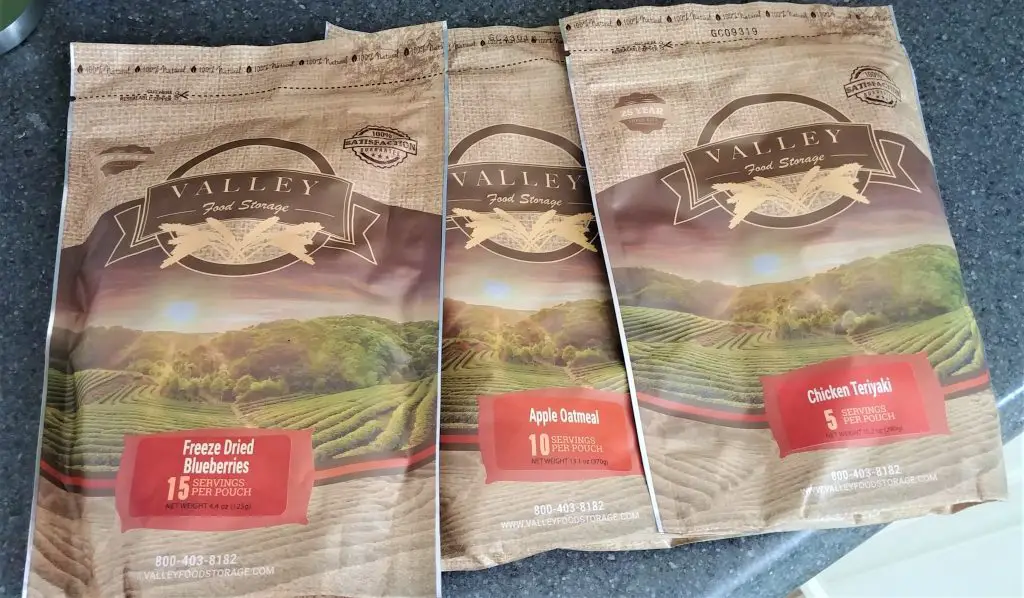
Also noticing that Valley Food Storage happily boasts that all their food products are 100% natural ingredients, with no fillers, GMOs, artificial flavors, preservatives, fillers, or MSG, I took stock of what was available and requested three packets, which Valley Food Storage was very generous to provide for this review: Freeze Dried Apple Oatmeal, Freeze Dried Blueberries, and Freeze Dried Chicken Teriyaki. Just a couple of days later, a package full of dehydrated goodness was in my mailbox.

I was hoping to scoop up my wife and son and tromp out into the woods and start a fire for the proper testing field testing ambiance, but alas, my preferred scenario was not in the cards. Therefore, the “field” consisted of my work office, and “testing” comprised of dumping water in bowls of freeze-dried food while watching the clock drain away my lunch break minute by minute. I soldiered on for science and for you, dear reader.

Apple Oatmeal For Breakfast

My first victim was the Apple Oatmeal. Opening up the bag and inspecting the contents confirmed my suspicions that the Valley Food Storage Apple Oatmeal would indeed look just like instant oatmeal offerings from other companies. A whiff told me it smelled really great, and so I poured the requisite serving size (½ cup) into a bowl I keep handy for eating occasions, and dumped in the proper amount of hot water (also ½ cup). While I absent-mindedly stirred the whole goopy mess up, I read the ingredients. Not much there – oats, sugar, apple granules, and non-fat milk powder. That’s it.

Apparently less is more, because the first spoonful was, without any hyperbole, as good or better than any other “instant oatmeal” I’ve ever tried. I wolfed down the first bowl and decided against another as I noticed the 15 grams of sugar per serving. However, I did make a bowl of the gummily delicious oatmeal up later for my wife to try, and the Valley Food Storage Apple Oatmeal received an official  thumbs-up…once she recovered from me stuffing a spoon laden with oatmeal in her mouth with little to no warning.

Lunch: Freeze Dried Chicken Teriyaki

For my lunchtime course, I opened up the mylar bag containing the Freeze Dried Chicken Teriyaki. The directions noted that I should combine the ingredients with water and then boil the whole works, but i just went with standard survivalist behavior and combined the bag contents with the called-for amount of already-hot water, and let sit. After the requisite time had passed, I tried out the Chicken Teriyaki. It was kinda more like soup than I thought it would be – probably because I didn’t boil the ingredients together. I added more Chicken Teriyaki and let it sit for a bit longer.

12 minutes later, when I finally tried the meal, I was very pleased. What I thought were chicken chunks were actually bits of very sweet pineapple, and a mild, slightly peppery wasabi-ish flavor twinge really rounded out the palette. Again, no exaggeration here – I really, really enjoyed the Valley Food Storage Freeze Dried Chicken Teriyaki. The wife did not try it, since I actually demolished the bag over a few days at work for lunch. I’m going to bet she would have liked it. We’ll go with that.

Dessert – Freeze Dried Blueberries

Up for “dessert” (more like a at-desk snack) I tried out some of the Valley Food Storage Freeze Dried Blueberries (ingredients: 100% Blueberries) First up, I prepared by soaking in water per the directions, and found that the soaking time on the package seemed to be a general guideline – some were mushy, some were still a bit crunchy. It seemed to be a bit of a crapshoot which berries absorbed the water but they were pretty good. I drank the blue-twinged water that resulted from the blueberry soak, since I imagine it had a few nutrients there for me to use, and I’d likely be following a similar routine if I was eating these berries in a survival or disaster situation. Not bad.

Also read: Freeze Dried Foods As Part Of Your Preps

I found, however, that the best way (in my opinion) to eat these freeze dried blueberries was just simply to reach in the bag and pop them directly into my mouth, no soaking involved. It was a crisp, tasty snack that lasts quite a while – there’s a lot of blueberries in that there bag! Pro tip: combine the blueberries with the Valley Food Storage Apple Oatmeal for a little slice of freeze-dried mouth heaven. (be sure to prepare the two separately , THEN combine)

Oh yeah…when my wife tried them, well, I didn’t get the bag back. The Freeze Dried Blueberries were a runaway hit. Absolutely get you some!

Wrapping Up

It’s really superb that Valley Food Storage is addressing the needs of people with specialized diets in such a great, tasty manner. The food itself once prepared is outstanding, and the ingredients are simple and delicious. I absolutely love the fact that no preservatives or multi-syllable BS ingredients make their way into the packages – these Valley Food Storage meals are just plain food – nothing artificial or nasty added in the name of preserving the food for your bunker pantry. Don’t be fooled, though – properly stored, these Valley Food Storage freeze dried meals will last for many years (25 of them, according to the packaging) in your supply cache.

I will say that the serving size on the packages did seem to be a bit subjective; you’ll need to review your dietary and caloric needs before you take the serving quantities on the package as holy writ. A 1/3 cup serving of the Apple Oatmeal only provides 140 calories, so if one serving of this specific meal is what you were planning on tiding you over through a high-activity day, you’re gonna be a hurtin’ unit. All the dietary information for every Valley Food Storage product is available on their website, so you can review and plan ahead. You can also call and chat with the VFS team over the phone, and they’ll help you work out a specific food plan for you.
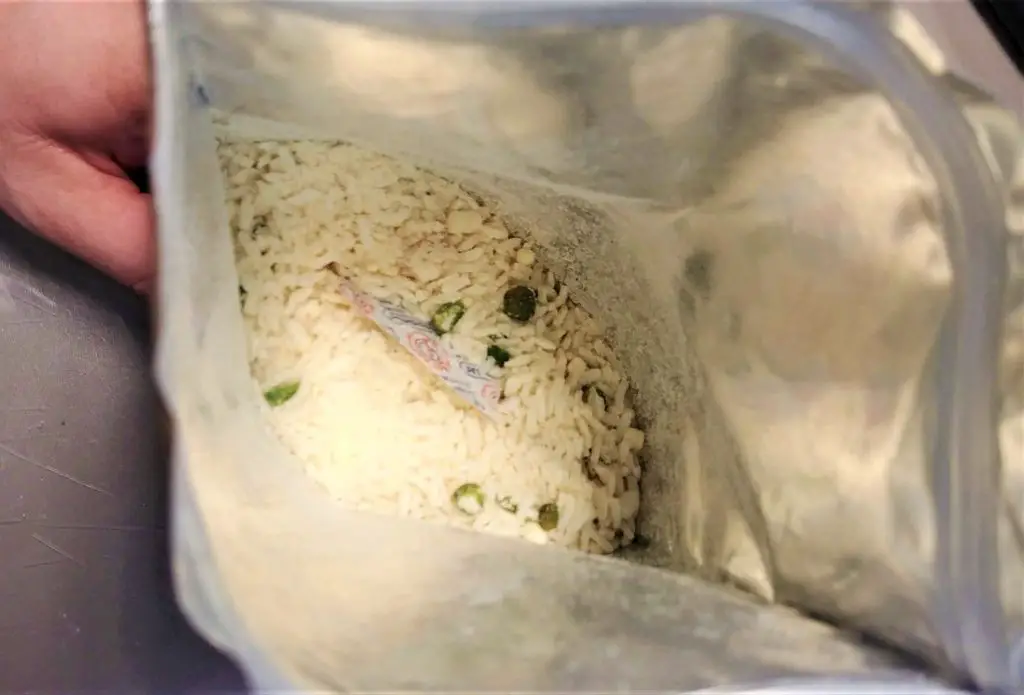
Also, be sure to check out Valley Food Storage’s other offerings – to include pre-built 72-hour kits, food subscription services, heirloom seeds, 30- and 55 – gallon blue water storage drums, a few knives, paracord, water purification tablets, and even financing for large volume orders.

So I’ll wrap up this little review by saying I wholeheartedly endorse the direction Valley Food Storage is going with their products, and I truly appreciate the fact that I now have viable options to feed the people in my family with special dietary needs. The Gluten Free offerings from Valley Food Storage are absolutely delicious and made with natural ingredients- and they are the direction I’ll be heading  towards when it comes time to re-fill my long-term food storage larder. There’s not much I can say about freeze-dried foods in general that hasn’t been said before, but the Valley Food Storage offerings are a cut above the rank and file and are definitely worth your attention…especially if you have dietary restrictions.

The post Eat Gluten Free and Survive With Valley Food Storage appeared first on Survival Cache.

Happy New Year

Written by Pat Henry on The Prepper Journal.

So Long, 2019. Hello 2020.

As we at The Prepper Journal look back at 2019, there are a lot of things to be thankful for:

  • Not dying
  • A good economy and low unemployment
  • Preparedness becoming more mainstream as communities and individuals realize the government can’t be relied upon
  • Good guys with guns stopped bad guys with guns
  • Old friends & new friends

But as we go into the last evening of the decade, we can’t help but wonder how the upcoming year will play out, with the constant assault on our rights, the distortion of the meaning of our Constitution, and the upcoming election fiasco. We hope that 2020 winds up being a bit saner in this area, but we remain skeptical.

Stay safe tonight, as New Year’s Eve brings out the stupid in a lot of people. We’ll be staying in, celebrating with family and avoiding the crowds.

What are your plans for tonight, and any predictions about what 2020 will bring? What subjects would you like to see us cover in the upcoming year?

Happy New Year,

Pat, Wild Bill, and the rest of the TPJ gang

The post Happy New Year appeared first on The Prepper Journal.

Virginia vows to shut down all gun ranges

Written by Pat Henry on The Prepper Journal.

SCOTUS: Second Amendment is a right
Virginia Legislature: Hold my beer.

Looks like the legislature is demonstrating what potential tyranny looks like.

Recent legislation in the form of House Bill 567 would probibit any indoor shooting range, by law, unless it was inside a building owned or leased by the state.

Folks, this is what we’ve feared. Virginia is becoming the California of the East Coast in terms of trying to disarm the population.

Unlike California, a number of county officials have stood up and declared they will not enforce unconstitutional laws.

Read more about the proposal here.

If you’re from Virginia, this upcoming election will be one of the most important you’ll participate in.

If you’re not in Virginia, be vigilant, because if the state legislature in the Old Dominion is successful, it will be spread across the country.

Ironic for a state whose motto is Sic Semper Tyrannis, “Thus always to Tyrants.”

Let’s hope the good people of the state live up to the motto.

The post Virginia vows to shut down all gun ranges appeared first on The Prepper Journal.

Survival Cache Podcast Episode 17: Camp Stoves For Bug Out

camping stove for bug out

When the balloon goes up and you suddenly have to think about cooking your food either away from home or in your home without your current stove working, this will be the podcast you were camping stove for bug outglad you didn’t miss. Drew picks Doc’s brain about all things camp stoves from high tech tiny wood burners, to liquid gas, compressed gas, dual burners, and even the backyard grill. Whether bugging in or bugging out, there is a stove for your situation and Doc Montana has already thought it through.

Want to comment about this podcast? Sound off below in the comments.

A fun episode with lots of opinions, click on one of the links below to listen now or download to your phone and listen later. Also, if you love the podcast, please leave us a review on iTunes, Stitcher, or Podbeam. It really helps!!!

SHTF podcast for preppers

Best Survival Podcast

The post Survival Cache Podcast Episode 17: Camp Stoves For Bug Out appeared first on Survival Cache.

7 Edible Insects You’ll Need to Know Before SHTF | Survival Life

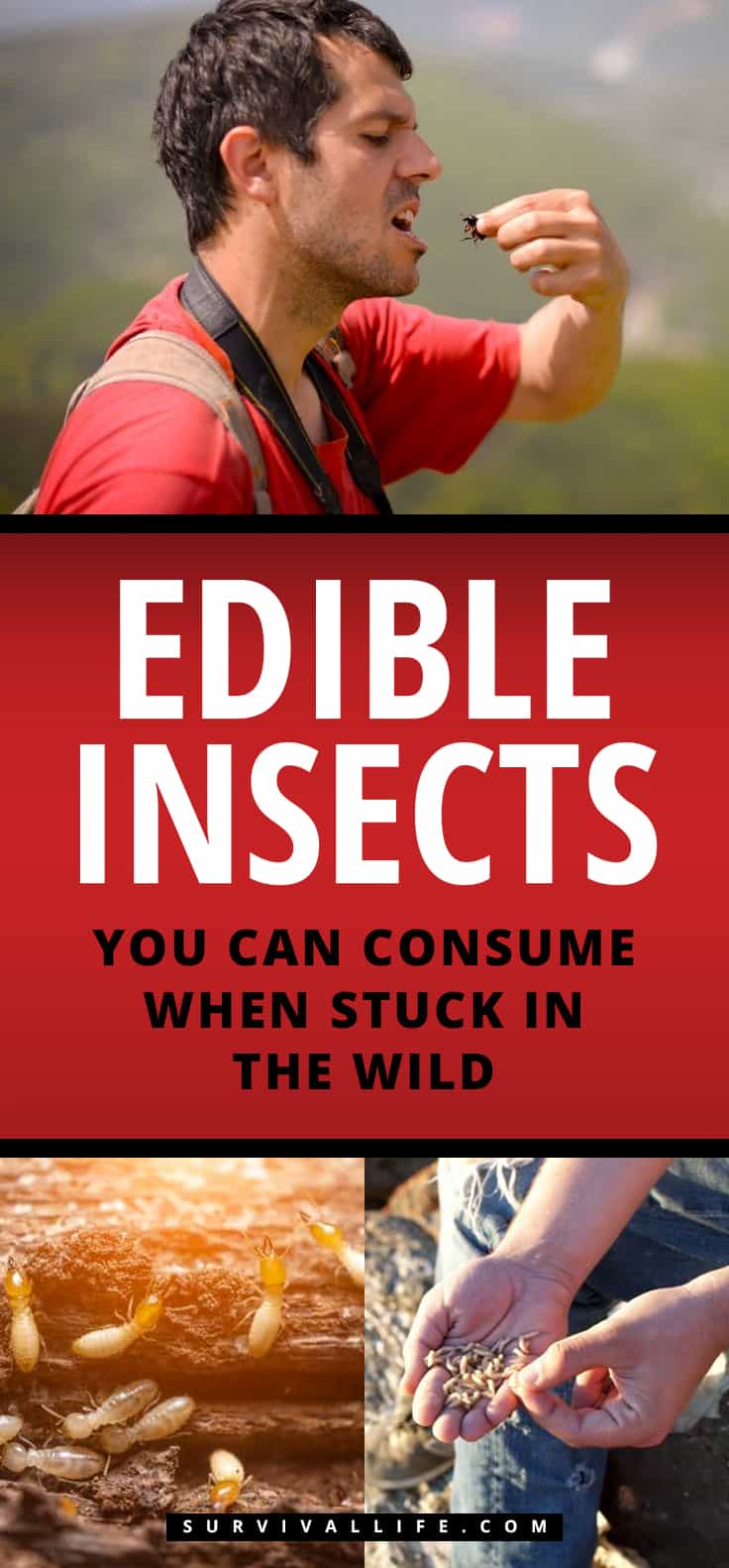
In the wild, you can survive by making a meal out of edible insects. You’ll be glad to know they are actually nutritious and could fill your protein needs.

RELATED: How To Identify Edible Insects And Eat Like A King After TSHTF

7 Edible Insects to Survive Starvation Outdoors

Eating Insects in the Wild

Being stuck in the wild can make you think of crazy things like having insects for lunch. Disgusting as it may sound, this could actually save your life.

If you’re in no luck finding some edible wild plants outdoors, you might as well start looking for edible insects to get through your hunger problem. You’d be surprised to know of this edible insects list is, in fact, abundant with nutrients that can provide your cellular needs.

It’s better to be prepared and know what can help you survive in the wild, so go on and read along!

1. Ants

|

One great thing about ants is that you can find them in a lot of places. Dig among anthills and scoop up the ants into a container.

It is recommended for you to boil them first before eating to remove the bitter and vinegary taste it has. An ounce contains about 14 grams of proteins and 5.7ml of iron.


2. Termites

|

Termites can be found in hordes and fill your protein needs easily. 100 grams of termites is equivalent to 14.4 grams of protein.

A termite mound can feed a couple of people in one go. These edible bugs for humans are in damp climates like coastal areas and thick forests.


3. Maggots

|

If you ever find a corpse of an animal laying there and being fed on by maggots, never think of these maggots as a waste.

While the maggots are feeding upon the corpse of an animal, you may feed on those maggots in exchange and have the meat they’ve eaten for yourself. Maggots contain both protein and carbohydrates you would need for energy.

RELATED: 5 Beneficial Insects For The Garden: Good Bugs Vs. Bad Bugs

4. Slugs

|

These slimy creatures are rich in minerals which help maintain normal blood flow. Slugs are carriers of harmful parasites that can kill you so it would be wise to cook them first before eating it.

These edible insects can be found abundantly during the rainy season.


5. Cockroaches

|

These are the ones you can find in the wild and not those pesky little buggers that fly around your house. The ones found in the wild feed on fruits and vegetation which are rich in fibers and vitamins A and C.

Have them fried or boiled to kill any bacteria they might have.


6. Locusts

|

Locusts can actually save your life from hunger plus it is rich in both protein and calcium. They travel in swarms and are much bigger than the grasshoppers.

Locusts go to places that have fertile soil, thus, it would be best to look for these edible insects in those places.


7. Grasshoppers

|

Grasshoppers are very rich in protein — for every 100 grams of grasshoppers, there are around 20.6 grams of protein. They can be eaten raw or cooked. But, to add some palate of crunchiness, consider having them cooked.

You can find them on meadows and grassy fields.


Here’s what you need to know about eating edible insects by STORYHIVE:

When SHTF and you run out of food to eat or there are no edible plants in sight, hunt for these edible insects and you’ll get by. However, while these insects are quite nutritious, there are also some that can be poisonous.

Be aware of what you can eat or it could lead to having an upset stomach or something even worse. Make sure to know how these edible insects look like and not mistake them for a poisonous kind.

With that said, it’s also imperative to know how to identify edible insects for your safety.

Have you tried eating any of these edible insects? How was the experience? Share your survival stories in the comments section below!

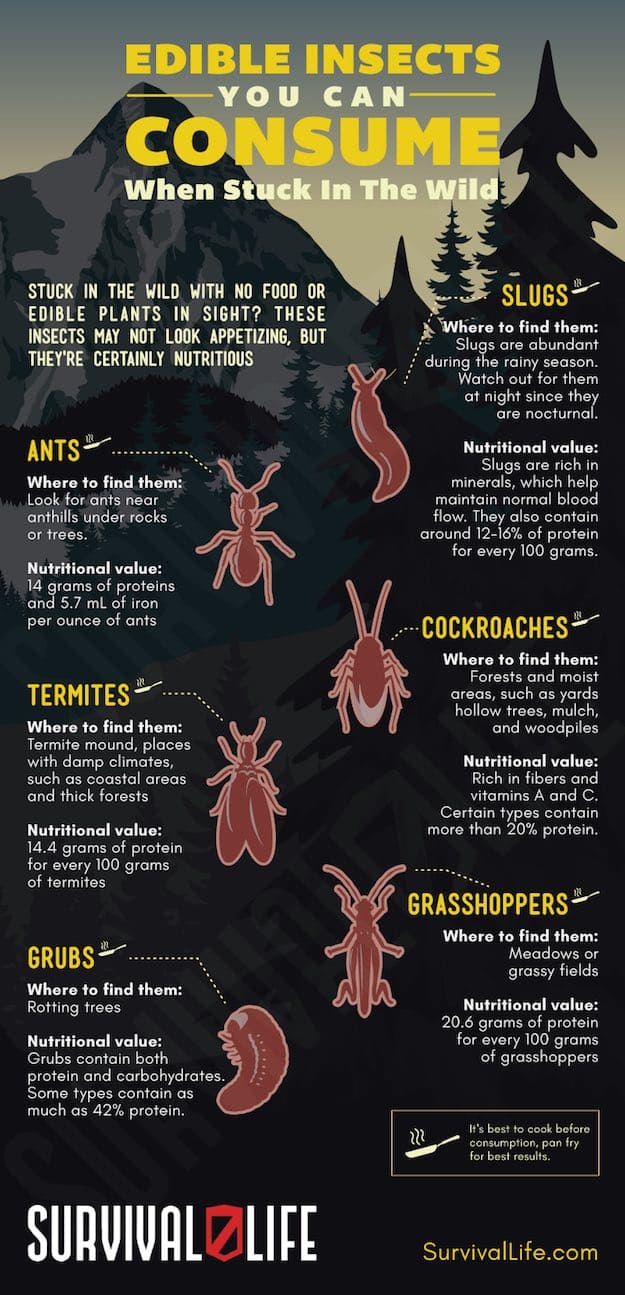
Infographic | Edible Insects You Can Consume When Stuck In The Wild

UP NEXT:

Check out 7 Edible Insects You'll Need to Know Before SHTF | Survival Life at https://blog.gunassociation.org/edible-insects/

Follow us on FacebookInstagramTwitterPinterest, and Tumblr!

Edible Insects You Can Consume When Stuck In The Wild | https://survivallife.com/edible-insects/

Editor’s Note: This post was originally published on July 17, 2017, and has been updated for quality and relevancy.