Survival Gear is the most unused product until a natural disaster happens, then it’s the most desired products, but usually too late to help those that really need the help.
We sell around the World, and pride ourselves on offering a level of customer service that we would want to see ourselves if we were shopping online. Our product ranges change regularly, so we hope that you come back to our sites to see some of the fantastic offers that we regularly have.
People of a certain age might remember the old John Birch Society slogan “Support your local police!” The idea here is that your local policeman is a liberty-loving buddy of yours who would only ever support just laws and constitutional mandates. Only those bad guys in the FBI or BATF would ever consider violating your rights.
Now, obviously that has always been a rather naïve fantasy, but the notion certainly has a long history of support among American conservatives. The idea that unionized, well-paid government employees sympathize with the common man instead of with the government that signs the cops’ checks apparently has long made sense (for some reason) to conservatives and many others.
But thanks to the ongoing “state of emergency” and the fact that state governors, mayors, and health officials now rule by decree, we’re witnessing more and more how local law enforcement officers have no particular interest in the rule of law, the Bill of Rights, or basic human rights of any sort. Police have been at the forefront of arresting business owners for the “crime” of using their own private property, using city parks, and engaging in other peaceful activities.
As Judge Napolitano has noted, these “stay-at-home orders”—and the penalties that accompany them—aren’t even real laws since they were never passed by a legislature or brought into being by any process other than on the authority of a single person who is usually a state governor or municipal official. By no definition of “rule of law” do these measures meet basic moral requirements for their imposition on peaceful citizens.
But the police are enthusiastically enforcing these edicts nonetheless and using them as an excuse to harass the taxpayers.
Here are just a few examples from around the United States.
Keep in mind that no one is required to go near these places or interact with anyone involved. Those who wish to isolate themselves from these businesses and their clientele may freely do so. Yet these are just a handful of the many cases of police harassment involving citations, arrests, and other forms of coercion and intimidation brought against people who are just trying to live their lives. Nor should we assume that this is “as bad as it gets.” Since there is no longer any due process or public legislative process subject to checks and balances, governors and mayors can unilaterally decide at any time to ramp up social distancing requirements and business closures. If the public appears uncooperative, public officials can simply order police to be making mass arrests. We have no reason to think the police would not comply with this order.
After all, police personnel, who do not have a particularly impressive record when it comes to stopping or investigating real crime, have plenty of resources to crack down on nonviolent “perpetrators.”
The cases of New York and Odessa are instructive. Odessa law enforcement officers apparently have the extra time and resources to assemble a SWAT team in response to protests, but does this mean there is no real crime that needs investigating in Odessa? Of course not. According to the FBI’s 2018 crime survey, Odessa had 1,049 violent crimes in 2018, including 118 rapes and 819 aggravated assaults. If late 2019 and early 2020 were at all similar, then we’re talking about hundreds of violent crimes that Odessa-area police officials are ignoring in order to harass people for entering a tavern.
Indeed, if Odessa law enforcement agencies are anything like countless police agencies in other areas, only about half of the violent crimes are “resolved” at all. That is,
only 45 percent of violent crime lead to arrest and prosecution. That is, less than half of violent crimes result in what is known as a “clearance” of the crime. Property crime clearances are much worse. Only 17 percent of burglaries, arsons, and car thefts are “cleared.”
Among violent crimes, homicides experience the highest clearance rate by far, at 61 percent. Aggravated assault comes in at 53 percent, and rape at 34 percent.
But these are just cases where arrests are made and prosecutions are initiated. A smaller number of cases actually lead to convictions. A crime may be cleared even when the suspect is later exonerated.
New York is not exempt from these trends, yet the New York mayor recently dispatched one thousand cops to break up Jewish funerals and ensure that people don’t have barbecues on warm spring days.
By the way, there were more than forty-six thousand violent crimes in New York in 2018. But don’t fear, the police have extra personnel to come and break up your small backyard gathering.
Police are always careful to use the legal defense that they are not obligated to actually protect anyone from anything. The courts agree with this defense, and it is now well established legally that although you have an obligation to pay the police to “protect and serve,” the police have no obligation to actually provide protection.
But police officers and their bosses have convinced themselves that the really important policing right now involves hauling dog groomers off to jail and collecting revenue from parkgoers who are only standing five feet from the next person. But if you have a problem with real crime? You’re likely out of luck.
Editor’s note: This prepping primer was written by guest contributor Mark Hedman.
So, you bought into the idea of hoping for the best but preparing for the worst, which is great! But how do you get your family onboard the prepper lifestyle when they may be less excited about it than you?
Whether you’re trying to convince your extended or immediate family to adopt the prepper lifestyle, it can be a difficult task. Here’s why some people are leery of prepping for the worst and some simple tips to get your family on board.
Why Some People are Reluctant to Start Prepping
First, having reluctant family members is common. Sometimes it’s as simple as laziness because prepping takes work. Others fear disaster, so, by not prepping, they adopt the “bury-your-head-in-the-sand” attitude. They don’t want to acknowledge the possibility of disaster and possibly death.
“The Normalcy Bias”
This bias is the state of mind that people often have when they think about the reality of a potential disaster. They tend to underestimate the possibility that a disaster could occur at any time, as well as the effects of a disaster.
“Death Would Be Better”
Many people say they would rather die than survive a disaster. They often develop the mentality that death would be better. Some of these people may eventually come around to the prepping lifestyle, but if this is their honest belief, respect their opinion.
“There’s No Money in the Budget to Prepare for a Nuclear Armageddon”
The cost of prepping is a legitimate concern. Many people struggle to make ends meet, and they think there just isn’t enough money to prep the right way. Prepping over time is much less expensive, though, and makes prepping totally doable.
Tips for Introducing Your Family to Prepping for Disasters
Here are some helpful tips to help get your family on board with prepping for the worst.
1. Discuss It in More Immediate Terms
Your family may not understand prepping for something that may never happen like all the people building bunkers during the Cold War. (News flash! Nuclear Armageddon could still occur, and maybe those people were smart.) Talk about disasters we see regularly, such as power outages and hurricanes, instead of nuclear war. You might be able to spark their interest and then bring them around to more hardcore prepping once they warm up to the idea.
Approach slowly because, if you don’t, you risk increasing their resistance to the idea, which defeats the purpose of getting them on board. Most people don’t like making decisions when they feel rushed.
2. Try Different Family Vacations
If your family goes to the beach every year, try camping in a national park near you. Camping will introduce your family to critical survival skills like building a shelter as well as living and cooking in the wild.
It will also teach them the vital things to pack, such as essential first aid supplies and shelf-stable food. They’ll learn how important a durable tactical flashlight is when there’s no electricity. Remind them of necessities such as a can opener if you have canned food in your stockpile.
3. Ask Someone to Help Get Your Family Onboard
Perhaps another family member believes in the prepper lifestyle and may be able to help you pitch the idea to your family. Or maybe it’s a friend that they’ll listen to because, let’s face it, sometimes the inspiration needs to come from someone else.
4. Use the News to Warm Them Up to Prepping
Sometimes a reputable source can help get your point across. Your family may digest this information much easier than you speaking to them directly about it. The TV news is full of terrorist attacks, natural disasters, illnesses, disease scares, and more. If you’re watching the news with your family and one of these stories pops up, it’s the perfect time to mention prepping.
5. The Indirect Way of Talking About Your Day
An indirect conversation is a perfect way to introduce your family to the prepping lifestyle. You may sit down to dinner with your family, and you’ll ask your kids how their day was. In return, they may ask about your day. You can reply, “I cleaned out the garage to make room for emergency supplies” or something similar.
Mentioning it indirectly won’t make your family feel like you’re pressuring them. Don’t say you’re stocking up on supplies in case of a nuclear holocaust. Dramatic flair won’t help you in this instance.
6. Books About Prepping
Books are an excellent way to explain the importance of prepping for the unexpected. They can be non-fiction, but even fiction books work well if they’re about learning to survive in the wilderness or after an apocalypse. They’re good conversation starters, especially those that illustrate what happens if you don’t prepare for the worst. These books make good gifts.
7. Prepper Games
There are some prepper games out there that you can play with the family. Buy a survival-related set of playing cards for family game night. There are also card games and board games about surviving an apocalypse. A game is a fun way to shine light on a serious topic.
8. Movies, Documentaries, and TV Shows
There are plenty of movies and shows related to the prepper lifestyle. Some of these include:
The Purge
Contagion
The Impossible
Apocalypse 101 by National Geographic
Apocalypse Now by the Discovery Channel
American Blackout by National Geographic
Blindness
Babylon AD
Catching Fire
City of Ember
Dante’s Peak
Deep Impact
The Walking Dead
Electronic Armageddon National Geographic
I am Legend
Life After People by the History Channel
Live Free or Die Hard
And many more
It may take some convincing to get your family on board with the prepping lifestyle, but avoid direct confrontation or you may sabotage your efforts to make sure that your family can survive after a major disaster. Whether you choose a movie for the family to watch or give your wife a prepping book for Christmas, use these tips to educate your family on preparing for the worst.
Mark Hedman is the CEO of LA Police Gear, located in Valencia, CA.
Prepping can involve building things useful for survival or comfort during lean times. Here are the tools preppers should consider having to make the job easier.
Editor’s note: This prepping primer was written by guest contributor Brandon Smith.
Preppers are always ahead of the curve when it comes to being ready for any eventuality. If you don’t know all the basics around food, health and general survival preparedness for something like the recent COVID-19 outbreak then take a look through this guide.
Here, I’m going to take you through the best power tools for preppers.
Whenever we talk about having power tools, we usually mean hand power tools that are easy to use and get the job done. It’s important to have some manually powered tools to hand just in case the grid goes down, but power tools will make things easier.
Power tools can make life easier
Prepping is all about being prepared. If SHTF then there isn’t going to be any time to learn to build a log cabin in the woods and if the grid goes down, it will take you too long to build it using manual tools.
That’s why it makes sense to add a few power tools to your tool kit. Use them now to build any structures or defenses to help you through the tough times ahead.
The power tools that every prepper needs:
Cordless Drill
Circular Saw
Angle Grinder
Reciprocating Saw
Charger
Cordless Drill
This should be your first purchase if you don’t own any power tools. It’s versatile and can be used for jobs around the house like putting up shelves or fixing new cabinets. It will also be used for fence or gate repair and will be your go-to tool when boarding up windows.
The best type to buy is a hammer drill. It will do all the general jobs like acting as a screwdriver and drill holes in wood, plastic and metal, but it also works well on concrete and other harder surfaces.
It’s going to cost a little more than a standard drill/driver, but when you need to drill into masonry or other toughened material you’ll be glad you have it. Ensure it can handle 1,000lbs of torque, has a ratcheting chuck, has a side handle (to prevent kickback), and that you buy some masonry, Cobalt and titanium-coated drill bits.
Circular Saw
A circular saw is an important tool for a prepper to have. If you’re building any type of structure then this is what you will use to cut wood or metal. The decision over a cordless or powered one will depend on its use. If you’re building things and using it to prepare structures then a corded one is more powerful.
But, having a corded power tool when the power goes out isn’t much use. I’d suggest buying a cordless one with a larger battery by a professional brand.
Angle Grinder
This is a powerful tool that has several functions. It can be used to grind and shape different material like stone, metal and concrete as long as the right blade is attached.
If you need to remove paint or rust from surfaces then this is the tool. They come in different sizes, so choosing the right size is important. Most preppers will find one that is 4 ½ inches suitable for most jobs.
Some attachments to purchasing are discs (different types for different materials), diamond-tipped discs (for granite and asphalt), sanding pads & discs (removing and finishing), and cut-off discs (similar to a Dremel but much more powerful).
Reciprocating Saw
This piece of kit, alongside a cordless drill, should be on every prepper’s “I have to buy this tomorrow” list. It’s versatile and if you select the right blade you can cut through almost any material.
You can cut wood, prune branches and bushes, and easily cut through thick wood and metal. This is the tool you see firefighters use when they remove car roofs to free a victim in a crash.
When you buy this piece of kit, get an assortment of blades too. You will then be able to cut through different types of material. Keep in mind that the blades won’t last forever, so having a stock of some regular ones you use is advisable.
Charger
Lots of manufacturers sell chargers that can plug into the 12-volt power port in your car or van. This works in a similar way to charging the tools when you plug them into the wall. It ensures you can charge your equipment should the power go out and expands your ability to keep the batteries charged.
Most of them have indicator lights to show you when the battery charge is full, and many have a sensor to shut off the charger when your vehicle’s battery level gets to a certain point.
Manual Tools
There are lots of manual tools that come in handy too. If you want some of the most popular ones to add to your tool shed then this tool kit page gives some great ideas.
Conclusion
Having some power tools as a prepper will allow you to be self-reliant and build any structure you feel is necessary. Small jobs can be completed around the home and if things head downwards you can be confident you have the right tools for any eventuality.
Brandon Smith is an Editor at TheSawGuy.com – a woodworking & DIY resource for everything from comparing the best table saws and mitre saws, to home and garden projects.
Many Americans have been absolutely shocked by the meat shortages that have started to happen around the nation, but what most of them don’t realize is that the worst is yet to come. More workers keep getting sick, more processing plants keep getting shut down, and Time Magazine is now warning that the meat shortages “could last for months”. And even if meat is available at your local grocery store, you may be limited to one or two of a particular item on each trip. For those not familiar with the concept, this is what is known as “rationing”. And even though President Trump just issued an executive order that “encourages” meat processing facilities to stay open, it actually won’t do very much at all to alter our current trajectory, and I will explain why below.
But first, let’s talk about where things currently stand. According to USA Today, the number of cattle, hogs and sheep being slaughtered is way, way down compared to last year…
American slaughterhouses processed nearly a million fewer cattle, hogs and sheep in the past week than they did during the same time a year ago, marking a new low that experts say will likely increase “spot” shortages of meat at some grocery stores.
And as the number of meat processing facilities closing down due to the COVID-19 pandemic has surged, the decline in meat production has accelerated…
Last week, meat production was down about 25 percent compared to the same time last year, according to the U.S. Department of Agriculture. On Wednesday, production was a full 42 percent lower than the same day last year.
If production continues to stay at such a low level, we are going to run into major supply chain headaches very rapidly.
After all, do you plan to eat 42 percent less meat this year?
I certainly do not.
In recent days, there was hope that President Trump’s new executive order would bring a quick end to the meat shortages. When I first heard about this executive order, I assumed that it would force all of the meat processing facilities to reopen and would shield the owners from any lawsuits. But it turns out that this executive order doesn’t actually do either of those things…
Meanwhile, legal experts said President Donald Trump’s executive order Tuesday declaring meatpacking plants “critical” to keep open will do little on its own to stop the slide in meat production brought on by the spread of the coronavirus among meatpackers.
“It doesn’t compel meat or poultry producers to remain in production,” said Deborah Pearlstein, a law professor at Yeshiva University, and it doesn’t give employers immunity from lawsuits.
Sadly, it appears that this executive order isn’t really going to do much good at all.
Big meat processing corporations are going to be quite afraid to reopen facilities as long as the threat of lawsuits looms large. I can promise you that there are already lawyers circling like vultures, and they are going to try to squeeze millions of dollars out of these large companies.
So when will the threat of lawsuits finally go away?
Well, it won’t just be “weeks”, and “a few months” might be overly optimistic.
In our overly litigious society, reopening facilities and exposing your employees to the virus while a pandemic is still raging is basically the equivalent of begging for a class action lawsuit.
Unless President Trump or Congress steps up and takes bold action, nothing is going to change.
Tyson Foods, one of the U.S.’s biggest meat processors, didn’t mince words in a full page New York Times spread that ran Sunday, in which they warned, “the food supply chain is breaking.”
“As pork, beef and chicken plants are being forced to close, even for short periods of time, millions of pounds of meat will disappear from the supply chain,” John Tyson, Chairman of the Board of Tyson Foods, wrote in a letter published as an advertisement. “As a result, there will be limited supply of our products available in grocery stores until we are able to reopen our facilities that are currently closed.”
And with supplies getting really tight, we are already starting to see prices go into the stratosphere.
In fact, Zero Hedge is reporting that the price of wholesale beef has already risen a whopping 62 percent since February…
Wholesale American beef prices jumped 6% to a record high of $330.82 per 100 pounds, a 62% increase from the lows in February, according to Bloomberg, citing new USDA data.
Eventually, it is likely that we will get to a point where many Americans are forced to cut back on their consumption of meat because they simply can’t afford as much of it anymore.
I hope that you did what you could to get prepared in advance, because it appears that these shortages may be quite painful. If you can believe it, McDonald’s has already implemented a system of “controlled allocation” for their restaurants…
McDonald’s is temporarily changing how restaurants get their supply of beef and pork, as the US faces potential meat shortages due to slaughterhouse closures.
McDonald’s has put items including burger patties, bacon, and sausage on controlled allocation. That means the company’s supply chain will send restaurants meat shipments based on calculated demand across the American system, as opposed to the usual practice of management ordering the amount believed will be needed.
Did you ever imagine that we would see a day when McDonald’s would be worried about potentially running out of meat?
Well, it is actually happening, and supplies are only going to get tighter in the months ahead.
Sadly, farmers are having to euthanize millions of chickens, pigs and cattle because meat processing facilities won’t take them while they are shut down.
So the truth is that there should be plenty of meat to go around, but fear of COVID-19 has caused a total breakdown of the supply chain.
What is happening is truly a tragedy, and hopefully our politicians will step forward and take dramatic action before things get even worse.
About the Author: I am a voice crying out for change in a society that generally seems content to stay asleep. My name is Michael Snyder and I am the publisher of The Economic Collapse Blog, End Of The American Dream and The Most Important News, and the articles that I publish on those sites are republished on dozens of other prominent websites all over the globe. I have written four books that are available on Amazon.com including The Beginning Of The End, Get Prepared Now, and Living A Life That Really Matters. (#CommissionsEarned) By purchasing those books you help to support my work. I always freely and happily allow others to republish my articles on their own websites, but due to government regulations I need those that republish my articles to include this “About the Author” section with each article. In order to comply with those government regulations, I need to tell you that the controversial opinions in this article are mine alone and do not necessarily reflect the views of the websites where my work is republished. The material contained in this article is for general information purposes only, and readers should consult licensed professionals before making any legal, business, financial or health decisions. Those responding to this article by making comments are solely responsible for their viewpoints, and those viewpoints do not necessarily represent the viewpoints of Michael Snyder or the operators of the websites where my work is republished. I encourage you to follow me on social media on Facebook and Twitter, and any way that you can share these articles with others is a great help. During these very challenging times, people will need hope more than ever before, and it is our goal to share the gospel of Jesus Christ with all many people as we possibly can.
I was wrapping up a morning of pigeon control and headed to the truck when a straggler swooped in and perched on a cow barn roof, 40 yards away. Snap… Whap! The .22-caliber pellet struck with a decisive blow. Amidst a shower of feathers, the pigeon slid down the corrugated-steel roof and plopped within inches of a disinterested cow. Others located mere feet from the gun continued to munch on hay. The farmer was happy, his milk supply was uninterrupted, and his dairy was a couple dozen pigeons lighter.
Although downright nasty by air rifle standards, built-in noise reduction features belayed the gun’s full potential. Powered by a pre-charged supply of high-pressure air, its reservoir supplied 45 useful shots. Once back home, I simply hooked it up to a scuba tank and topped it off to 2900 PSI.
No doubt about it, airguns have evolved since the days of Ralphie’s Red Ryder. Actually, you can still buy one, and you can still shoot your eye out!
BUT, you could also tip over a 250-pound hog with some of the latest air-powered systems. Falling in between these extremes are barrel-cocking (springer) pellet guns commonly seen in outdoor catalogs and sporting emporiums – often advertised with extremely optimistic velocities.
Until the last few years, a third level of more exotic pre-charged pneumatic airguns achieved little more than cult status. But, recently, they’ve become more mainstream due to recognition of their true capabilities. Another class of airguns is built specifically for quiet shooting in confined areas. Designed for 10-meter indoor range competition, most true match-grade air rifles shoot .177-caliber pellets below 600 fps. They’re the antithesis of a smooth bore BB gun, but neither generate sufficient power for anything larger than mice or sparrows.
That’s also true of many CO-2 powered airguns which are great for riddling cans. Some are close knockoffs of well-known military arms with full-auto capabilities, and an absolute hoot to shoot! However, for purposes of this post, pest control and small game hunting count, so we’ll need to move up the power ladder.
The upper rung of air guns is occupied by pre-charged pneumatic (PCP) rifles, designed to hunt deer or feral hogs. They’re specialized systems with a bark, and much less suitable for quiet backyard practice. Move downward a few rungs and quiet shooting becomes possible, including elimination of aggravating bird feeder-raiding squirrels. Similar technologies permit hunting in some spots off-limits to firearms. Although less of an issue in my area, I do feel much safer when sniping squirrels from trees with relatively short-range .22-caliber pellets – as opposed to .22 rimfire bullets that can travel a mile.
Modern Airgun Pellet Calibers
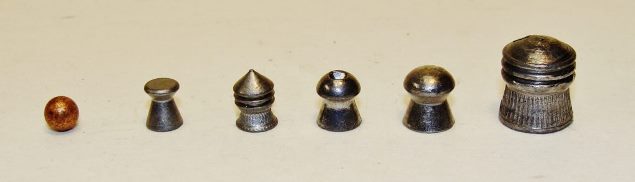
Common airgun pellet calibers range from the common BB to .177, .20, .22, .25, and .35. Niche guns also exist in .30, .35, .45, and .50-caliber.The BB is too light for hunting anything beyond small pests, and they’ll ricochet like crazy off hard surfaces! That leaves pellets as the preferred projectile with .177 being the most common.
Most are made from soft lead, with a solid nose that tapers to a wasp-waist followed by a hollow skirt. The resulting low mass boosts speed, but poor aerodynamic qualities limit their carrying range to several hundred yards (or less), making them the safer choice for settled areas.
(L-R): A common BB shown with pellets of various designs in .177, .20, .22, .25, and .35-caliber.
The small .177 pellets can fly faster than larger calibers, in some cases approaching .22 LR velocities. But .177s quickly fizzle out. Actually, regardless of the airgun, caliber hydrostatic shock is unlikely, so projectiles with greater frontal area are more effective on live targets. Hence, the popular .22-caliber alternative. To a lesser extent, .20 and .25-caliber airguns are encountered.
Some of the “pellets” are actually lead bullets which travel at handgun velocities. Odds of running into them at standard retail locations are remote. All things considered, factoring in useful power and widespread availability, a .22 is hard to beat.
Defining Airgun “Power”
For use against large squirrels or pigeons, I’ll take a .22 airgun with a muzzle velocity of 800 feet per second (fps) or more. At that speed, a typical diablo (wasp-waisted) lead .22 caliber, 15-grain pellet will generate roughly 20 foot-pounds of energy. It will also smack a pigeon with much more authority than a faster .177.
That said, the British have learned to live with less. To avoid onerous Firearms Certificate (FAC) requirements, they use airguns throttled back to 12 ft. lbs. (roughly 600 fps, using .22 pellets). Although anemic by U.S. standards, an entire airgun industry has evolved to meet UK hunting interests which center on rabbits and pest birds. The Brits are careful to take head-shots, and their highly-refined guns have the accuracy to make them. The good news is export FAC versions of these guns have arrived on U.S. shores with no such limitations. As we’ll see shortly, many are pre-charged pneumatic (PCP) types capable of much better numbers – like 900+ fps/30+ ft. lbs. in .22-caliber, with standard 15-grain pellets!
This British-built Air Arms .22 PCP carbine is a full-power U.S. version, adjusted to 800 fps/20 ft. lbs. The woodchuck was anchored only through careful shooting at 30 yards. Large squirrels are a more reasonable upper limit.
To put things in perspective, an “anemic” .22 Short fired at 900 fps develops around 70 ft. lbs. through a bullet twice the weight of an average 15-grain .22 pellet – 29 grains. Hopefully, this will offer some guidance on the size of suitable quarry. Some of the stuff depicted on the various media venues using .22 or .25-caliber airguns is a bit sketchy. Head-shots might sound good on paper, but my standard involves humane upper-body hits.
Even with those, on average-size gray squirrels, my zippy 900 fps .22 air rifle is noticeably less decisive than a .22 LR subsonic HP. In a pinch, I’d use this airgun on a raccoon, but only with a head-shot inside 30 yards. Regarding woodchucks, a feisty .22 LR HP won’t always anchor one with a well-placed chest shot. I have taken a few with air rifles, but only through careful shots to their noggins. Some folks hunt western coyotes with .25s, but .30s or .35s are preferred. Deer are the domain of .45-caliber or larger airgun slugs fired from those big-bore PCP rifles. And, in all cases, shot placement matters greatly!
Useful Airguns
Sticking with backyard or smaller woodlot airguns, to achieve the 20 ft. lb. threshold you’ll need an air rifle – either a PCP, or a potent springer. A few PCP pistols can come close though, and less velocity could even be preferable in some situations.
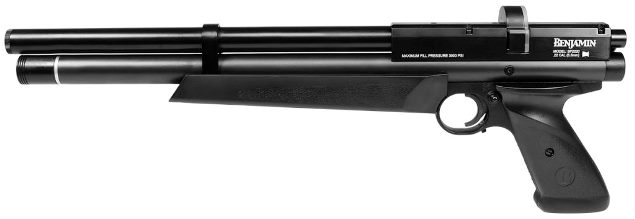
Pistols: One possible pest contender is Benjamin’s U.S-built .22 Marauder. This PCP bolt-action repeater clocks around 700 fps and offers 20-25 shots per charge. Since airguns are not federally regulated, you can even buy one with an accessory shoulder stock! The receiver is grooved to accept optics, too. However, it’s far from a tiny pistol (although I’m still trying to resist one). Pump-up pneumatic and CO-2 pistols will be lucky to break 500 fps in .177-cal. Some springers can do a bit better but they’re big and hard to cock. For critters, the answer is a pre-charged pistol.
Benjamin’s pre-charged repeating Marauder spits out .22-caliber pellets at 700 fps; pretty zippy for a pistol! The shrouded barrel is also quiet. it’s a great candidate for a small dot sight.
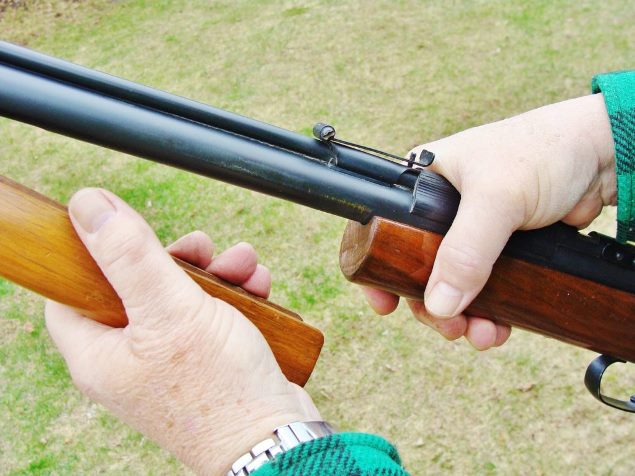
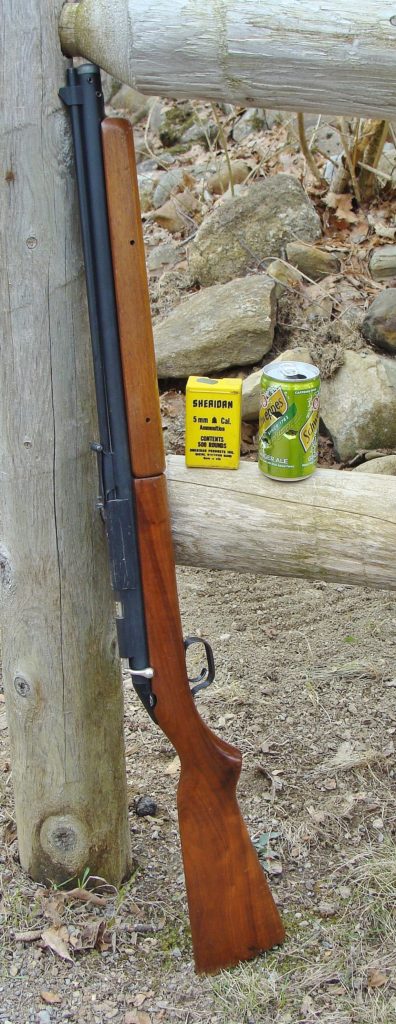
Pump-up (multi-stroke) pneumatic rifles: As a youngster, I saved up for a .20-caliber (5mm) Sheridan, which seemed like a true magnum at the time, but probably struggled to exceed 650 fps. It also had an audible snap, a product of instantaneous decompression; but, it laid a number of starlings and gray squirrels low through careful shooting at prudent distances. Decades later it’s still holding air!
Instead of using the maximum eight strokes, I sometimes just give it 3; just enough to smack the south end of a feeder-raiding squirrel without any lasting effects. These guns are hard to scope so I stick with the open sights. You’ll get plenty of exercise between each shot, meaning long plinking sessions are unlikely. Don’t exceed the recommended pumps or you’ll risk air-locking the valves, but store it with a couple strokes of air to maintain their seating (which keeps out dust particles).
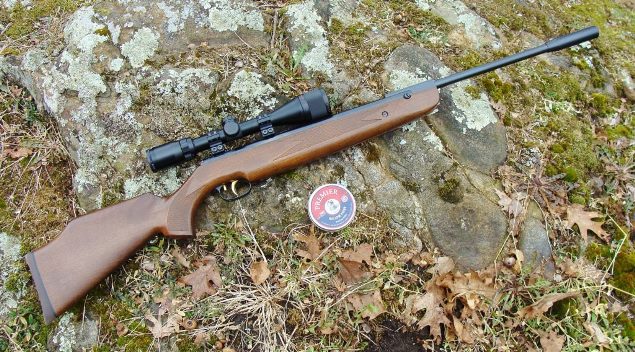
Springers: My experience with these guns goes back to the late 1970s, when Dr. Beeman began importing elegant European models. I’ve owned a bunch of ‘em since and still keep a good barrel-cocking gun nearby, along with a tin of pellets. It’s a perfect grab & go rifle for use against marauding pest birds that invade the backyard feeder.
An old “pumper” still going strong after five+ decades. Eight strokes is the max for this Sheridan, but 5-6 will kill cans.
Mine is a German-built Beeman R-9 in .22-caliber (a bit uncommon since most R-9s are .177s). Typical of most springers, it’s listed velocity of 740 fps is actually 680 fps using standard-weight 14.8 grain pellets. Still, it’ll clobber starlings out to 35 yards or so. I zero it at 30 yards using an airgun-rated scope. Quarter-size groups are the norm with JSB 14.8-grain ExactExpress pellets, but it shoots Crosman 14.8-grain Premier HPs nearly as well and they’re stocked at the local Walmart. So are some barrel-cocking guns of varying lineage and quality; often sold as package guns with scopes.
But big-box businesses are not the realm of guns like the R-9 or good JSB pellets, most of which must be mail-ordered from airgun dealers or off Amazon. Odds are strong you’ll get what you pay for, too. More power comes with increased size, weight, and cocking effort.
Some springers can reach 800 fps (or more) in .22-caliber, but they won’t be small. They’ll also be harder to shoot due to vibration and their unique recoil, which creates a phenomena known as “hold sensitivity” (example: don’t test for accuracy off sandbags). These forces can also unravel scopes not designed for the unique impulse. Springers also shouldn’t be left cocked for long. However, some recent gas-piston designs work like gas struts which eliminate the spring altogether, meaning they can remain cocked (at least, for a while).
I just stick with my German springer because it’s simple and only weighs a bit above eight pounds, scoped. Most 800 fps guns will weigh that much without one. Although decent open sights are often standard, full potential won’t be realized without an airgun-rated scope. Those who can live with a hefty gun might consider Sig’s new ASP20 .22 gas-piston barrel-cocker, some of which come with a decent Sig scope. It has a legal built-in “sound moderator” too, although many springers are fairly quiet without one.
Beeman’s R-9 springer offers a nice compromise of size versus power. This .22 version clocks just below 700 fps, good enough for quiet backyard practice or pesky feeder-raiding birds.The German firm of HW makes this gun, along with a similar HW-95.
Pre-charged pneumatic rifles: To reach 800 fps or more without lugging excess weight, I simply switch to a pre-charged pneumatic. These guns are totally recoilless and dead-nuts accurate, but they do require an external air source to pressurize their onboard reservoirs. Some use separate bottles while others like mine employ a tube below the barrel.
Using a fitting supplied with the gun, I simply connect it to a HP hose assembly and decant air from a scuba tank. Some use a special HP pump, which I avoid due to concerns about accumulating moisture. A few diehards even use pricey compressors designed for these guns. Whatever the source, it needs to produce clean dry air, usually at 3,000 PSI or above! At such pressures, a bare-muzzle PCP gun will produce quite a snap. Fortunately, most are now “moderated” via a barrel shroud that greatly reduces the report. Some aren’t much louder than a heavy-duty stapler!
PCP charging in progress via scuba. A gauge on the hose is used to monitor pressure. The max for this gun is 2900 PSI.
For pigeon control jobs inside barns or stables, I use the above domed 14.8-grain .22 JSB Expresses, shot at 800 fps/20-ft. lbs. The gun of choice is a British-built Air Arms repeating carbine, cocked via a side-lever, and fed from a small revolving 10-shot magazine.
Zeroed at 35 yards with a 3×9 AO scope, it’s capable of tiny groups. The gun’s operating pressure is 2,900 PSI. The power is adjustable, so I throttle it back a bit to gain 40 useful shots from its carbine length air reservoir. The gun’s onboard gauge will then read just below 1500 PSI, meaning it’s time for a refill.
For outdoor pigeon missions, my ultra-quiet, 920 fps, single-shot bolt-action .22 Air Arms rifle is noticeably more effective. Its longer air cylinder also provides 45 useful shots despite the extra 100 fps. That gain wouldn’t matter much with head shots, but because light pellets drift in wind, the upper body is a safer bet.
Even at that, I’ll often wind up holding a half-bird or more to the side at 35-40 yards. Lightweight airgun projectiles quickly shed velocity, but pigeons are still doable at 60 yards (or further) with a rangefinder. Zeroed for 40 yards, it can shoot dime-sized groups with 15.9-grain JSB Exact Jumbos. Out to 50 yards, all impacts will be within an inch or so of the crosshairs. This gun has also accounted for a number of crows, some beyond 80 yards; however, that’s pushing things. Results are much better inside 50 yards. For extra oomph, you could go with the increasingly popular and harder-hitting .25-caliber, assuming the rifle is potent enough to flatten its trajectory.
Benjamin’s U.S.-built Marauder is a popular PCP choice. It’s available as a scoped package for half the price of many imports. Of course, you’ll need a scope and charging gear.
One viable PCP choice (among many) is Benjamin’s Marauder, a U.S.-built repeater. Available in .177, .22, and .25-caliber, it sells for half the price of many high-end imports. My British guns have served me well (one for 13+ years). Like other airgunners, I store them fully charged (to 2,900 PSI). But eventually, at separate times, each needed servicing to fix a slow leak. The repairs involved shipping to a distant airgun specialist. Repairs to the popular Marauder could be less problematic. Its lower cost could also offset the requisite extras like a tank and hose-assembly, or a pump.
More power! You’ll absolutely need a PCP gun to drive the big-bore specialty slugs, many of which travel at .45 ACP speeds. Each shot will suck through lots of air, so frequent recharges are the norm, placing these guns in the realm of true airgun aficionados. Some do have interesting capabilities though – like the ability to shoot arrows!
Airgun Options and Costs
You’ll pretty much get what you pay for. If nothing else, especially with extra time on-hand, it’s fun to surf the net. There are several good airgun dealers spread out across the U.S. The following are just a sampling that I’ve dealt with:
After brief visits, you’ll quickly note that covering everything would be impossible. So, what follows is just a guide, based mostly on personal experience.
Quick and Dirty Guide to Airguns
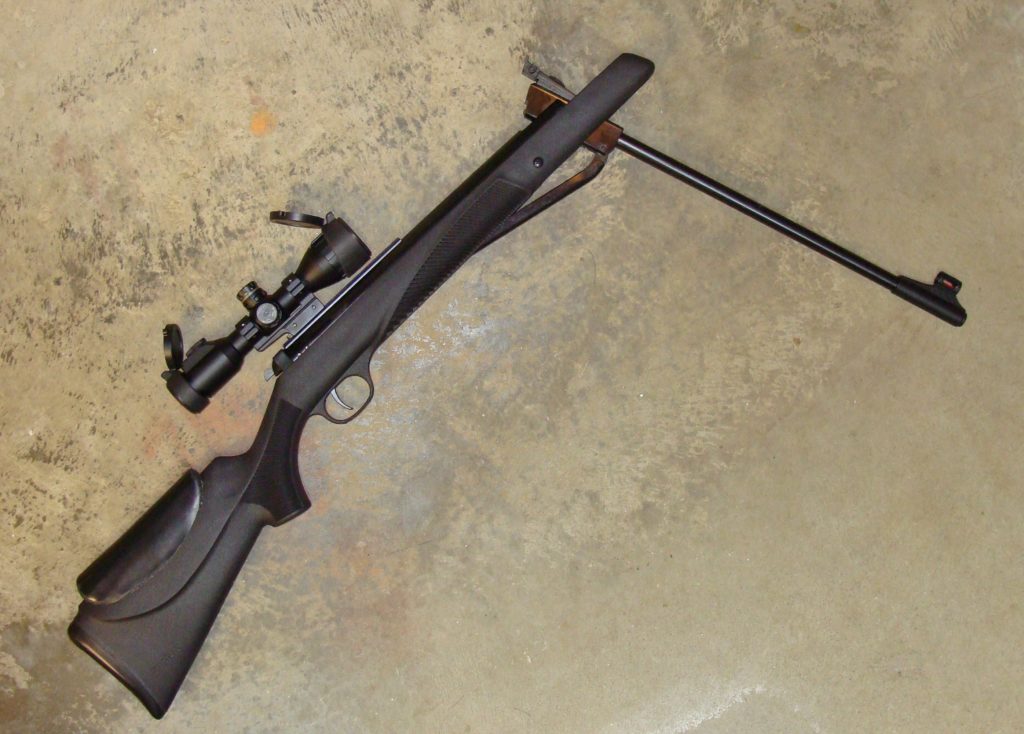
Bargain barrel-cockers: Some people will settle for a $200 “package-gun” which may come with its scope mounted – or not. With only casual use, it may even do the trick. I’d be thorough regarding product reviews, though. Even some of the well-known firearms manufacturers will rebrand guns from regions that also produce viruses. Good chance those supply lines could soon dry up. Also, I’d be leery of buying a used springer. I’ve encountered some in gun shops that were cocked, much to the detriment of their springs.
RWS has been building springers like this barrel-cocking .22 P-34 for years. A cut above the bargain guns, it offers dependable service, starting at under $300.
Next price-point: For more money, several time-proven springer imports can be had. A few example include British Air Arms choices, Germany’s Diana (RWS) offerings, and guns from Herman Weirhrauch (HW) which also makes the Beeman R-series.
A number of these guns sell for well below $500. My middle-of-the-road R-9 springer is still available, scoped for that amount. For around $600, the aforementioned Sig ASP20 gas-piston package can be purchased. Sig is all-in on a full line of shooter-worthy products. Their latest gas-piston rifle is new, but they’ll stand behind it.
Pre-charged choices: The high-end British and European PCP imports from Daystate, Air Arms, Brocock, BSA, and FX, etc., are true works of art. Some easily exceed $1,000. However, most can be serviced through U.S. dealers, and those that value quality won’t be disappointed. The U.S. firm Airforce builds some really interesting guns at various price-points, including models in big-bore calibers.
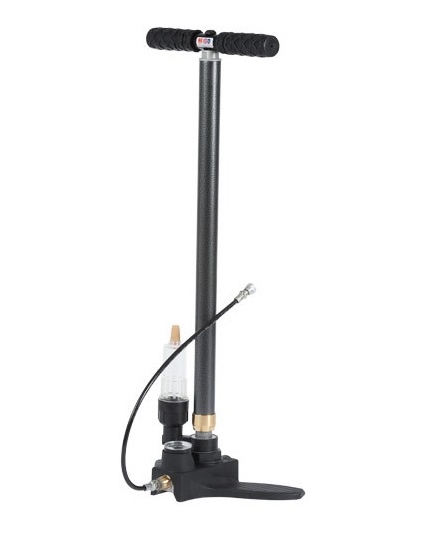
Hill’s high-pressure pump, complete with a water trap.
Benjamin’s PCP Marauder rifle is available as a scoped package for just above $600 (less the charging gear). Benjamin is part of the established Crosman marque, which has been building airguns for decades. They also sell much more affordable PCP choices, some of which come complete with hand-pumps.
Others: Speaking of hand-pumps, Benjamin’s $400 PCP pistol is a good candidate for one. Unlike rifles which will give you quite a workout, the pistol’s smaller reservoir needs less strokes. Or, you could go with their lightweight multi-stroke pump-up rifle. Several strokes per shot will do it, and the Benji has recently been upgraded with a bit more punch, for around $200. Add a tin of pellets and you’re in business for casual use.
Modern Airgun Summary
Regardless of your choice, read the manual! Just for starters, high-pressure air and some lubricants don’t play much better than BBs and eyeballs, and there are other concerns unique to each system. Thus, two designs worth a revisit are springers and pre-charged rifles. Thinking back to my first PCP purchase, I remember being baffled about the charging process, not to mention other details. Turns out springers also have their share of quirks, beyond those briefly covered here.
Stay tuned for future posts on each. Meanwhile, happy and safe shooting. Oh, and be careful, or you’ll shoot your eye out!
“If 2019 was the year of the street protest, of tear gas and rubber bullets, 2020 might be the year the street protest died, or perhaps fell into a deep sleep, and went online.”—Journalist Christopher Miller
Despite all appearances to the contrary, martial law has not been declared in America. We still have rights. Technically, at least.
The government may act as if its police state powers suppress individual liberties during this COVID-19 pandemic, but for all intents and purposes, the Constitution—especially the battered, besieged Bill of Rights—still stands in theory, if not in practice.
Indeed, while federal and state governments have adopted specific restrictive measures in an effort to lock down the nation and decelerate the spread of the COVID-19 virus, the current public health situation has not resulted in the suspension of fundamental constitutional rights such as freedom of speech and the right of assembly.
Mind you, that’s not to say that the government has not tried its best to weaponize this crisis as it has weaponized so many other crises in order to expand its powers and silence its critics.
All over the country, government officials are using COVID-19 restrictions to muzzle protesters.
It doesn’t matter what the protest is about (church assemblies, the right to work, the timing for re-opening the country, discontent over police brutality, etc.): this is an activity the First Amendment protects vociferously with only one qualification—that it be peaceful.
Yet even peaceful protesters mindful of the need to adhere to social distancing guidelines because of this COVID-19 are being muzzled, arrested, and fined.
For example, a Maryland family was reportedly threatened with up to a year in jail and a $5000 fine if they dared to publicly protest the injustice of their son’s execution by a SWAT team.
If anyone had a legitimate reason to get out in the streets and protest, it’s the Lemp family, whose 21-year-old son Duncan was gunned down in his bedroom during an early morning, no-knock SWAT team raid on his family’s home.
Imagine it.
It was 4:30 a.m. on March 12, 2020, in the midst of a COVID-19 pandemic that has most of the country under a partial lockdown and sheltering at home, when this masked SWAT team—deployed to execute a “high risk” search warrant for unauthorized firearms—stormed the suburban house where 21-year-old Duncan, a software engineer and Second Amendment advocate, lived with his parents and 19-year-old brother.
No one in the house that morning, including Lemp, had a criminal record.
No one in the house that morning, including Lemp, was considered an “imminent threat” to law enforcement or the public, at least not according to the search warrant.
Now, what was so urgent that militarized police felt compelled to employ battlefield tactics in the pre-dawn hours of a day when most people are asleep in bed, not to mention stuck at home as part of a nationwide lockdown?
According to police, they were tipped off that Lemp was in possession of “firearms.”
So instead of approaching the house by the front door at a reasonable hour in order to investigate this complaint—which is what the Fourth Amendment requires—police instead strapped on their guns, loaded up their flash-bang grenades, and acted like battle-crazed warriors.
This is the blowback from all that military weaponry flowing to domestic police departments.
This is what happens when you use SWAT teams to carry out routine search warrants.
This is what happens when you adopt red flag gun laws, which Maryland did in 2018, painting anyone who might be in possession of a gun—legal or otherwise—as a threat that must be neutralized.
While in theory, it appears perfectly reasonable to want to “stop dangerous people before they act,” where the problem arises is when you put the power to determine who is a potential danger in the hands of government agencies, the courts, and the police.
Remember, this is the same government that uses the words “anti-government,” “extremist” and “terrorist” interchangeably.
This is the same government whose agents are spinning a sticky spider-web of threat assessments, behavioral sensing warnings, flagged “words,” and “suspicious” activity reports using automated eyes and ears, social media, behavior sensing software, and citizen spies to identify potential threats.
This is the same government that keeps re-upping the National Defense Authorization Act (NDAA), which allows the military to arrest and detain American citizens with no access to friends, family or the courts if the government believes them to be a threat.
This is the same government that has a growing list—shared with fusion centers and law enforcement agencies—of ideologies, behaviors, affiliations, and other characteristics that could flag someone as suspicious and result in their being labeled potential enemies of the state.
Let that sink in a moment.
If you believe in and exercise your rights under the Constitution (namely, your right to speak freely, worship freely, associate with like-minded individuals who share your political views, criticize the government, own a weapon, demand a warrant before being questioned or searched, or any other activity viewed as potentially anti-government, racist, bigoted, anarchic, or sovereign), you are most likely at the top of the government’s terrorism watch list.
Needless to say, if you happen to be passionate about the Constitution and a vocal critic of government corruption, you’ve already been flagged in a government database somewhere.
Likely, Lemp was, too.
Now Lemp is dead and his family is devastated, outraged, and desperate to make sense of what appears to be an insensible act of violence resulting in an inexcusable loss of life.
So in order to voice their objections to police violence and demand answers about the shooting, Lemp’s family and friends planned to conduct an outdoor public demonstration—adhering to social distancing guidelines—only to be threatened with arrest, a year in jail and a $5000 fine for violating Maryland’s stay at home orders.
Yet here’s the thing: we don’t have to be muzzled and remain silent about government corruption, violence and misconduct just because we’re wearing masks and social distancing.
That’s not the point of this whole COVID-19 exercise, or is it?
While there is a moral responsibility to not endanger other lives with our actions, that does not mean relinquishing all of our freedoms.
Be responsible in how you exercise your freedoms, but don’t allow yourselves to be muzzled or your individual freedoms to be undermined.
Understandably, no one wants to talk about individual freedoms when tens of thousands of people the world over are dying, and yet we must.
The decisions we make right now—about freedom, commerce, free will, how we care for the least of these in our communities, what it means to provide individuals and businesses with a safety net, how far we allow the government to go in “protecting” us against this virus, etc.—will haunt us for a long time to come.
At times like these, when emotions are heightened, fear dominates, common sense is in short supply, liberty takes a backseat to public safety, and democratic societies approach the tipping point towards mob rule, there is a tendency to cast those who exercise their individual freedoms (to freely speak, associate, assemble, protest, pursue a living, engage in commerce, etc.) as foolishly reckless, criminally selfish, or outright villains.
What we must figure out is how to strike a balance that allows us to protect those who need protecting without leaving us chained and in bondage to the police state.
We must find ways to mitigate against this contagion needlessly claiming any more lives and crippling any more communities, but let’s not lose our heads:blindly following the path of least resistance—acquiescing without question to whatever the government dictates—can only lead to more misery, suffering and the erection of a totalitarian regime in which there is no balance.
Looking for an alternative to the suppressor? Trying to shoot quietly but don’t want to spend $200 and deal with the hassle of a federal stamp? This post is for you.
by Steve Markwith, contributing writer and author of Survival Guns
At the time of this writing, COVID-19 is running rampant. Beyond meager supplies of hand sanitizer and toilet paper, perhaps the cupboard is looking alarmingly bare. The neighbor’s cat could be safe for the time being, but those annoying backyard squirrels might have more appeal with each passing day. Making matters worse, there sits a perfectly useful .22 rifle and a 500-round brick of .22 LR cartridges.
Suppressor sales are booming. But, alas, procrastination has also left the gun safe devoid of a now-coveted “silencer;” the perfect answer for some quiet sniping through the kitchen window. At that point, brother Billie’s air rifle comes to mind. It sits in his closet unused, 20 miles away, and might as well be on the moon due to social distancing. The brick of .22 LR ammo grows more tempting with each passing day.
The Problems with Noise
Trouble is, even in many less-settled areas, the crack of a .22 LR could be beyond acceptable, and a silencer alone won’t totally eliminate the telltale signature of every load. Actually, most centerfire rifles will be as loud as a bare-muzzle .22 LR, even when fired through a silencer (commonly referred to as a suppressor or “can”). Turns out spinning one on offers no immediate fix. There are a few reasons for that:
The federal requirements and process, including a $200 registration stamp.
Local restrictions and/or prohibitions.
A pesky hurdle otherwise known as the sound barrier.
Hence, the appearance of the .300 Blackout, which achieved quick popularity due to its suppressor-friendly characteristics. It can function in AR-15s via extremely heavy .30-caliber bullets lobbed at just below the speed of sound. The result is a very quiet rifle cartridge – with the trajectory of a brick. Recognizing this shortfall (pun intended), many also shoot lighter .300 BLK bullets driven at much higher velocities.
Suppressor Alternatives
However, the unavoidable supersonic crack is unmistakable; roughly on par with, perhaps, a .22 LR high-velocity CCI Stinger. A suppressed .223 (5.56 NATO) fired from a similar-length 16-inch carbine will sound more like a .22 Magnum. Some may wonder about a switch to subsonic bullets, but beyond the myriad functional challenges, at that point you’d be entering .22 rimfire-equivalent territory. It just makes more sense to screw a can on a .22 Long Rifle barrel and fire readily available subsonic loads – assuming you own such a device. If not, all is not lost! Other solutions exist.
The ubiquitous .22 LR can digest some really interesting loads. Unsuppressed, some will be quieter than trendy .300 BLK combinations. Velocity will also be similar; a tad below 1,000 fps. One obvious difference will be their much lighter projectile weights (around 20%), which could actually be a good thing. As such, the twenty-two makes a good starting point.
Quiet .22 Rimfire Alternatives
I’ve covered these before but they still rate another look. Many gun owners have a rifle on hand stamped .22 LR. If so, it can safely accept some useful lower-powered alternatives based on .22 Longs and .22 Shorts. Actually, many tubular-magazine lever, pump, and bolt-actions can fire all three interchangeably. Most semiautos won’t function without .22 LR ammunition, but the lower-powered loads can often be chambered manually. As a frame of reference most economy-type .22 LR loads (purchased in bulk packs) launch their 40-grain bullets at somewhere around 1250 feet per second (fps). As such, they generate a supersonic crack. The speed of sound varies by temperature but averages around 1125 fps at 70 F. Many .22 LR subsonic offerings clock 1050 fps and are noticeably quieter through a bare muzzle. But, there are other rungs on the noise ladder so let’s descend by volume level.
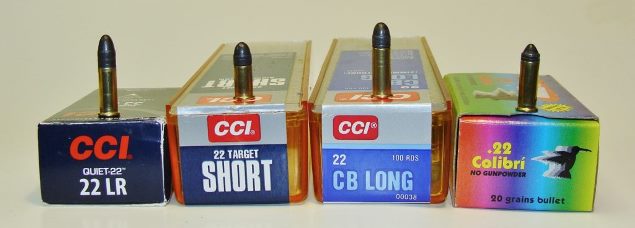
Stealthy .22 loads in descending order of noise.
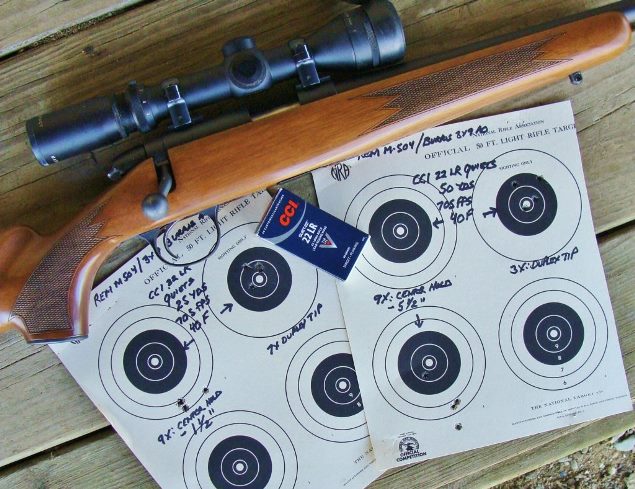
.22 LR CCI Quiets: Being a lower-power .22 LR load, the Quiet makes a good repeating-rifle choice. Its standard-weight 40-grain bullet is rated at 710 fps, so trajectory will be noticeably steeper but, sometimes, this disparity can be overcome through creative aiming tricks. For example, I can shoot plinking-class 50-yard groups that coincide with the lower duplex/crosshair juncture of one variable 3-9 scope, once its magnification is adjusted to 3X. The host bolt-action is zeroed at 50 yards with standard-velocity (1,180 fps) ammo and, by using this trick, the scope’s turrets are never touched.
CCI’s Quiets feed normally through its 5-shot magazine, making it a useful backyard trainer. Same story regarding several other rifles with tubular magazines (I’ve cycled them manually through semi-autos). Although the report is, maybe, the equivalent of a tack-hammer, the impact of bullets on steel silhouettes is actually louder. In the woods, Quiets are just that. With careful shooting they’ll take small game (like gray squirrels) inside reasonable distances, with less worries about collateral damage. CCI now lists a 45 grain semi-auto version rated at 835 fps but, so far, I haven’t tried them.
CCI .22 LR Quiets fired at 25 & 50 yards, using center-holds on the upper bullseyes (the rile was zeroed at 50 yards using .22 LR standard velocity). Note the significant drops! Easy corrections though. The magnification of the 3×9 scope was adjusted until spot-on aiming was possible using the lower tip of the reticle’s duplex post (in lieu of crosshairs). Muzzle velocities were recorded via chronograph.
.22 Shorts: I often enlist a basic single-shot .22 LR bolt-action for anti-critter duties. The load is a 29-grain CCI .22 Target Short with a listed muzzle velocity (MV) of 830 fps. This stuff shoots a tad flatter than 40-grain Quiets. Unlike some high-speed versions, Target Shorts also reduce noise by another rung. However, as many seasoned shooters know, they’ll still work for small game. I shoot them out to 50 yards where they hit much harder than most so-called “magnum” .22-caliber air rifles (which typically launch pellets weighing only half as much at similar velocities).
Using the above single-shot, loading is as simple as dropping a Short into the action and closing the bolt, making it a great combination for use with new shooters. However, these little cartridges can be fiddly to chamber in some actions. They’ll also produce an annular fouling ring which can interfere with .22 LR chambering and extraction over time. That’s why I gravitate to the simple bolt-action. Brushing out the chamber is a breeze after tool-less removal of the bolt. It’s 24-inch barrel is also the key to full reduction of the report.
.22 CB Caps: Like .22 Shorts, these loads employ a 29-grain bullets. The main difference is less propellant, resulting in an even quieter report and, of course, less velocity. From a rifle-length barrel the loudest sound may be the firing pin striking home. I most often use CCI CB Longs which employ a LR case, but CB Shorts are also available. CCI lists both at 710 fps, the same speed as their .22 LR Quiets. But, due to their lighter mass CBs seem to fizzle out sooner. Still, they’re useful out to around 25 yards. For feeder-raiding squirrels, CBs are hard to beat.
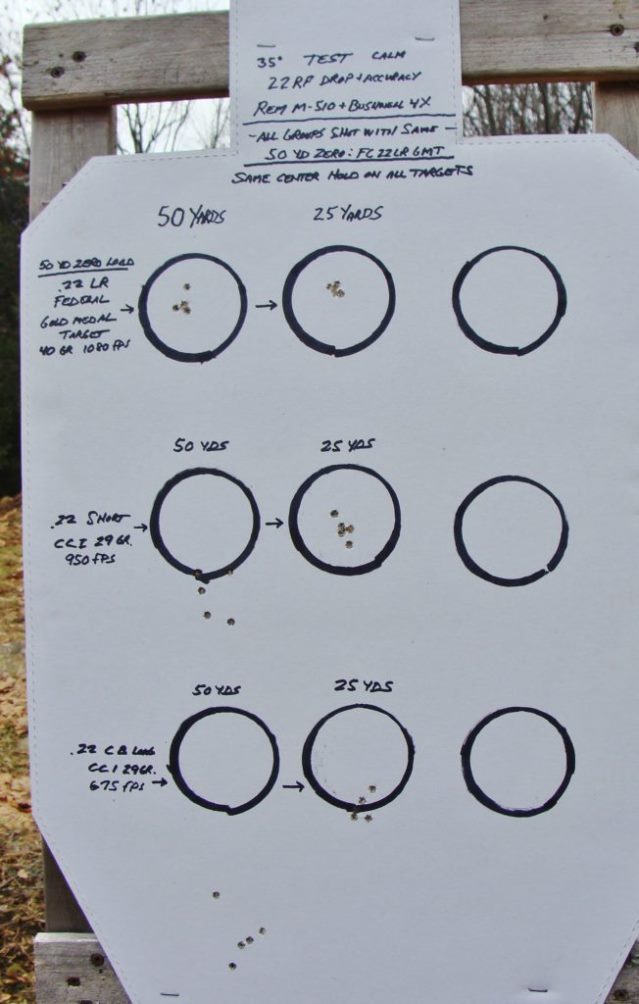
Accuracy and comparative drop at 50 and 25 yards shooting .22 LR standard velocity, .22 Shorts, and .22 CB Longs Top (L-R): .22 LR @ 1080fps, zeroed for 50 yards. Middle (L-R): .22 Shorts @ 950 fps, still aiming at center of circles. Bottom (L-R): .22 CB Longs, 675 fps, still aiming at center of circles. Targets are 3″ diameter. Muzzle velocities recorded via chronograph.
.22, Colibris & BB Caps: Aguila sells even milder Colibris, available in two power levels, both loaded with 20-grain bullets. The plain Colibri is listed with a MV of 420 fps. their Super Colibri is rated at 590 fps. Both are crazy-quiet in rifles and not much louder in handguns – unlike the others described above. But, Aquila cautions against use of the slower load in rifles due to the risk of a stuck bullet from friction. Regarding either, novelty aside, usefulness should be measured in feet. A similar and now obscure BB Cap is in the same boat. CB Caps are the more practical cut-off concerning noise and practicality.
Note on brands: I have no affiliation with CCI rimfire loads, beyond personal use. Equivalent loads are available from other well-known manufacturers like Winchester, etc.
A caution: if an easy-to-load .22 rifle is employed, all of these loads are great for starting newbies of various ages. However, concern is a higher incidence of ricochets. Unlike many high-speed .22 LR bullets, the slow loads don’t always disintegrate upon contact with hard surfaces.
Quiet .22 Handguns
The above loads help, but none will be truly quiet. After several optimistic but futile trials involving revolvers (invariably louder) and semi-autos (with feeding issues) I hit upon the idea of a simple bolt-action single-shot pistol with a 10 ½-inch barrel. This .22 LR Crickett shot everything well to great, and velocities didn’t seem to suffer much. But, it was still noticeably louder.
This 10 1/2″ Crickett produced tack-driver accuracy with .22 LR CCI Quiets and CCI Shorts but the reports were beyond backyard-friendly. Aguila’s Colibris were extremely quiet, but at 425 fps, they dropped like bricks.
CB longs sounded sorta like .22 LR Quiets in a 24” rifle; useful, and even a bit faster, but not fully stealthy. Thus, my hopes of dispatching highly annoying red squirrels that chattered incessantly during bow hunts were dashed. But, it’s still a hoot to shoot with CCI Quiets right behind the house! Move up to centerfires and you’ll need a pistol with a suppressor. So, from now on, it’s all long guns.
Quiet Centerfire Loads
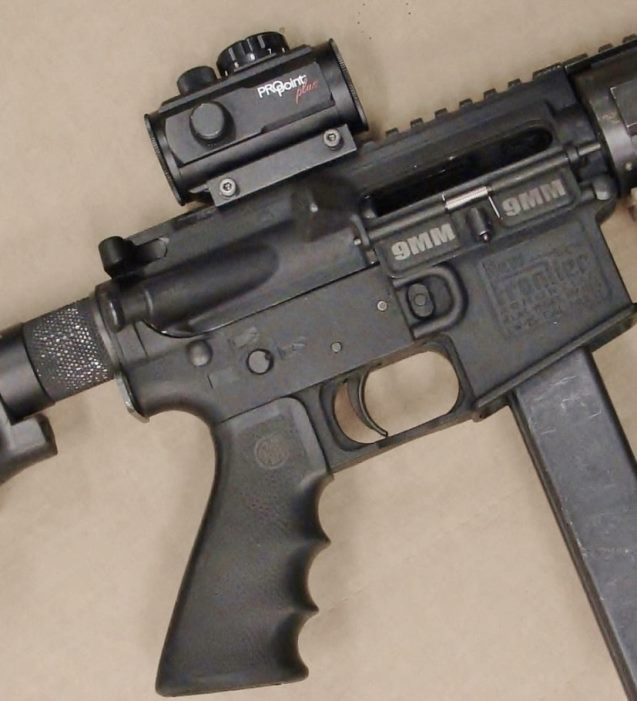
Although far from dead-quiet, some handgun calibers are much less noisy in bare rifle barrels. This accounts for the popularity of 9mm AR-15s which sound more like .22 LRs when fired in carbines.
If .38 Specials are fired in .357 Magnum rifles, noise decreases substantially while velocity dramatically improves. People equate suppressors with noise reduction, but tactical folks also use them to eliminate muzzle-flash within confined spaces. Turns out, pistol-caliber carbines do pretty well sans cans.
Other rifle owners have some new subsonic options. Hornady has expanded their expanding SUB-X line beyond .300 Blackout to .30/30, .45/70, and .450 Bushmaster. The bullets employ Hornady’s Flex-tip technology making them safe for tubular magazines. I’ve taken coyotes and bobcats with their .300 BLK 190-grain load (1050 fps), which is extremely quiet when suppressed. The bare-muzzle report is pistol-caliber class, however semiauto function could be iffy without the increased back-pressure of a can. Of course, most manually operated rifles like a lever-action .30/30 should cycle them just fine.
Although Hornady’s Subsonic .300 Blackout load is intended for use with suppressors, it’s fairly quiet without one. Their new .30/30 version has real potential.
Quiet Shotgun Solutions
I’ve been known to play with some weird toys but my Metro Gun Systemsbarrel ranks right up there. Picture a 33-inch choke tube full of holes. You thread it into the muzzle of your shotgun as you would any other removeable choke. At that point, the factory choke is installed on the muzzle-end of the Metro-barrel extension. Believe me, it feels even weirder than it looks!
The world’s longest but quietest choke tube: The Metro barrel extension, which is NOT a silencer.
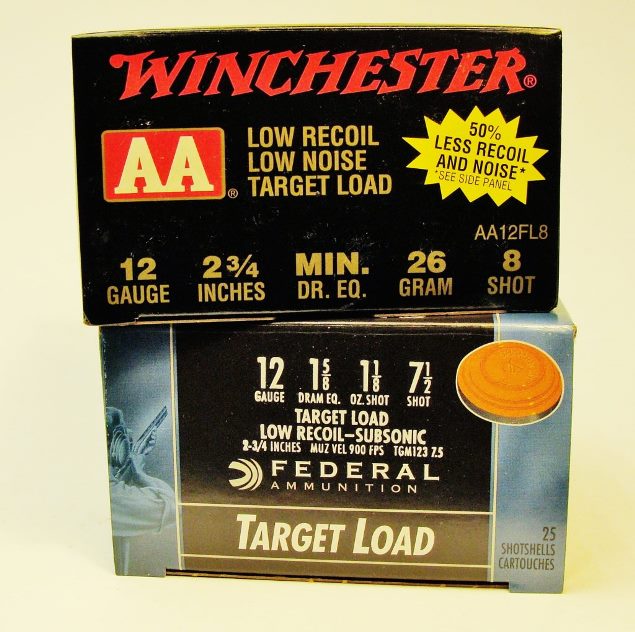
The first time I set mine up, I almost poked a hole in a ceiling and knocked over a lamp. But I will say this: on crossing targets you won’t stop your swing! Also, any bystanders will be shocked by the lack of noise, assuming the right shells are fired. The two I use are subsonic offerings intended to reduce noise and recoil. Federal’s 12 gauge 2 ¾” Top Gun Low Recoil-Subsonic Target Load squirts out 1 1/8 ounces of #7 ½ shot at 900 fps, and is designed for this device. Winchester’s 12 Ga. AA Low Recoil/Low Noise #8s are marketed per their label, but work equally as well at around 980 fps despite a lighter 26-gram payload. Both pattern awesomely through the extension with an improved-cylinder choke. The report is sometimes described as a car door shutting at 100 yards; not silent, but pretty darn quiet.
Subsonic Metro barrel fodder.
My Metro barrel is threaded to fit Beretta’s Mobile-choke system. Even when installed on the shorter 24-inch barrel of my AL-390 auto, it’s way too long for a vehicle. No problem. I just assemble it on site and get to shooting, which goes surprisingly well – in more open spaces. I achieved reliable function with the very light loads by installing a lighter gas-valve spring but, for many, a pump-gun could be the better bet. Within 35 yards or so, it’s downright deadly on clay birds or crows, etc. These barrels are still available on a semi-custom basis in several popular choke patterns. Classified by BATF simply as extensions – no federal stamp is required.
And, even without this extension, the above factory loads have value. They do indeed cut down on noise and recoil, offering smaller-gauge performance perhaps similar to a 28 Ga., but without the need for a separate gun.
Chamber Adapters
Do an online search and you’ll see several versions, most of which function as chamber sleeves. Those designed for shotguns permit the use of smaller-gauge shells, although short rifled barrel inserts are another option. A perfect candidate for either is a break-barrel shotgun. I used a 12/.410 insert in an H&R single-shot with great results. A similar gun would be the best choice for metallic cartridge adapters.
Some survivalists pack an easy-to-carry 9mm converter for use as a backup rifle of sorts, however, the report will still be clearly audible, and accuracy will be iffy sans an aiming system. Other caliber-reducing adapters function similarly, one example being a .223/.22 LR chamber insert. These designs accomplish rimfire ignition either via an eccentric bore, or through use of separate offset firing pin plug. Other simple inserts permit use of .32 ACP pistol cartridges in centerfire .30-caliber chambers like .30/06, etc. The report is fairly quiet and the host-rifle’s sighting system can improve accuracy, but point of impact will deviate. Surf the Web for further details.
Airguns as Alternatives
You can still buy a Red Ryder BB gun, but today’s choices have matured by quantum leaps. Many gun people are now familiar with quiet barrel-cocking air rifles, many of which claim optimistic .22-caliber pellet velocities exceeding 800 fps. But, the recent genre of pre-charged pneumatic (PCP) guns now imperil even hogs via .35-caliber (or larger) “pellets,” expelled by blasts of high-pressure air. Some can even launch arrows! This topic warrants stand-alone coverage, meaning it’ll wait for an upcoming post.
Crossbows
Here’s another technology that’s grown by leaps and bounds. Driven largely by an explosion of whitetail deer herds in many regions, crossbows have now gone mainstream due to liberalized hunting regulations. They work, too. Although, there’s more going on than meets the eye. I’ve hunted with horizontal bows (as well as conventional vertical types) long enough to gain some practical experience including their plusses – and minuses. So, crossbows also warrant dedicated coverage.
Suppressor Alternatives – Closing Thoughts
The above alternatives might not be perfect, but for the most part, they’re legal options. None are federally regulated, meaning they can even be ordered by mail, short of any local restrictions. That’s one beauty of airguns and crossbows. If nothing else, a nation-scaled emergency presents opportunities for learning.
The recent coronavirus outbreak has brought with it an economic crash the likes we haven’t seen in more than a decade. But don’t panic. There are 10 simple tips to follow for survival.
RELATED STORY
Should You Seek Shelter or Bug Out During a Crisis?
Tip No. 1
Be patient during an economic crash. Although your undoing may seem to have occurred almost overnight, it was, in reality, a lot longer than that in the making. Likewise, months and years of effort may be required for you to come out on top. As you practice patience, be somehow employed so you have money coming in to live on in the interim, and live frugally so you have funds for your project. Your diligence in both areas will pay off.
Tip No. 2
Be willing to let go. Our possessions can become so numerous that they own us instead of our owning them. They take time, effort and funds to maintain, they require costly space in our home, and they burden our minds. Letting go of all but the necessary is freeing. What you have left will fit nicely in your small home without cluttering it.
Tip No. 3
Keep building costs down. Try to gather as many of the building materials you can find at little or no cost before you start sketching. Choose materials with the most value per dollar when you have to buy at or near full price. The shape and style of your small house may depend on making the best use of available materials during an economic crash.
Tip No. 4
Always have a plan for tomorrow. You’ve found yourself in a difficult situation, but look beyond today. As you design your new small home, plan to incorporate features that will keep your month-by-month living expenses low once you do move in.
Tip No. 5
Think small, but plan long term. You may at first be willing to live in an 8-foot-wide, 12-foot-long crate, but shortly after you’ve invested in its construction and electrical, plumbing and mechanical systems, its romanticism will have worn off. Just how small of a house will you really be willing to live in over the long haul?
Tip No. 6
Plan big, but build small. You’ll want to incorporate all the basic amenities in your home so that life isn’t burdensome, even if you aren’t able to afford all of them initially. Plan places for eating, relaxing and sleeping, along with bathroom facilities and laundering.
Tip No. 7
Design it for DIY. This may mean the difference between going ahead with the project or not.
Tip No. 8
Be reasonable during an economic crash. Although the initial years of getting back on your feet in your small, off-grid home may be a little like roughing it, plan improvements so that life gets easier and, actually, quite enjoyable as trial and error turns into success. Likewise, don’t immediately go hog wild on the most elaborate of alternative energy systems and burden yourself with those high upfront costs.
Tip No. 9
Limit multiple-use features. Converting features in your home from one use to another is fine for the occasional weekend when grown children come home, but setting up and taking down on a daily basis gets old fast.
Tip No. 10
Be committed. Single or married, building—and living in—your small, off-grid home will require commitment on the part of all who dwell within. Soon you’ll wish it hadn’t taken a crisis to move you into a lifestyle that’s better than before.
This article was originally published in The NEW PIONEER. Subscription is available in print and digital editions here.
When it comes to your food supply, you just can’t risk not having enough. These no cook meals will be a great addition to your food supply planning. Check out the recipes below!
No Cook Meals to Help You Through the Pandemic
As of the writing of this article, there are 20 meat processing plants that have been shut down due to COVID-19 infections. We have been worrying about these types of effects on our food supply for months now, and this is the first real sign of how infections can affect the food supply.
When you walk into a supermarket, you might not see all the choices you had in the past. An empty meat case is a humbling thing for your eyes to fall upon. It’s the shocking realization that the seemingly infinite supply of chickens, pigs, and cows that are butchered for us has begun to run dry!
To deal with this issue, we are going to present four no cook meals that will help you create dinners at home that will feed your family without worrying so much about what’s available, or unavailable, in the meat case.
1. Smashed White Bean, Avocado and Salted Pork Sandwiches
As preppers we get beans. There are a bunch of ways to use beans and this a great example of how you can pack a sandwich with great nutrition and protein.
Serving: Makes 4 sandwiches
Ingredients:
Can of White Beans
Olive Oil
1 Avocado
8 Slices of Whole Grain Bread
8 Slices of Salted Pork (Prosciutto, Ham, Virginia Ham)
Instructions:
Begin by draining your beans in a colander then smashing them up in a bowl add a few glugs of olive oil, salt, pepper. This little mix is delicious. If you add some minced rosemary, you can even turn this into a delicious dip.
Pit your avocado and cut it in half and then quarters lengthwise. Leave the skin on.
Lay the bread out on a clean work surface for assembling the sandwiches.
Spread your mashed bean mix onto one side of the bread.
Peel your avocados and slice 1 quarter for each sandwich. Spread slices over the bean spread.
Add a few slices of your pork to over the top of the avocado.
You can finish this sandwich with some lettuces, fresh sprouts, or just eat it as is.
2. Delicious Crab Salad
Canned crab is a protein option that will likely be around through much of this meat crisis. It does have to be kept in refrigeration, but it’s delicious and this chipotle mayo salad is great in the spring and summer.
Ingredients:
1 Can of Crab Meat
1 Bunch of Asparagus
Chipotle Mayo
1 Bunch of Green Onions
1 Bunch of Cilantro
Instructions:
Drain your crab in a colander and set it in the sink.
Slice your asparagus into 1-inch pieces. Throw them into a bowl.
Thinly slice your onions and your cilantro and throw that into the bowl, as well.
Gently toss in the crab meat.
Squirt on enough Chipotle mayo to coat everything and toss gently not to break up the crab meat.
Chill in the fridge and serve.
3. Simple Greek Salad
The combination of simple summer ingredients makes for an incredible quick salad that you could add other proteins, too, if you wanted. These could be canned meats.
Ingredients:
2 Large Tomatoes
1 Cucumber
1 Red Onion
¼ Cup of Feta Cheese
A Few Sprigs of Fresh Mint
½ Cup of Kalamata Olives
Balsamic Dressing
Instructions:
I like to cut the tomatoes in large chunks and have them kind of be the main course in this salad. Peel and slice your cucumber in half. Remove the seeds and either dice or slice in half-moons.
Peel and slice your red onion in half. Julienne your, or thinly slice, your half onion.
Add all these ingredients to a bowl. Finely slice your mint.
Add your olives, crumbled feta, and mint to the bowl and add enough dressing to coat everything.
Stir it up and allow this to chill for at least an hour for the flavors to really blend.
4. Mediterranean Tuna Lettuce Wraps
Using some similar ingredients and adding a protein like tuna, you can create some delicious lettuce wraps. The key to a good lettuce wrap is to have most of the items around the same size. So, consider that when you are preparing this dish.
Ingredients:
Iceberg or Butter Lettuce
Canned Artichokes
Canned roasted Red peppers
Fresh Cucumber
Feta Cheese
Minced Olives ¼ Cup
2 Cans of Tuna
Green Onions
Basil
Instructions:
Start by peeling all the full leaves from your lettuce. Set them on a plate either cover them with a wet paper towel or put them back into the fridge.
Dice the peppers, artichokes, and cucumbers into cubes. Go no larger than ½ an inch.
Thinly slice your green onions and basil and add them to a bowl with your diced vegetables. Add your loves to this bowl and mix them thoroughly.
Crumble your feta cheese over the mixture.
Drain your tuna thoroughly and then add that to the bowl, as well.
Gently toss this mixture. Try not to break up the tuna and the cheese too much but incorporate it thoroughly.
If you want, you can add some olive oil to the mix or a few glugs of balsamic vinegar. It’s also delicious just how it is.
Scoop a few tablespoons into a lettuce leaf, wrap it up and eat up!
These no cook meals should help lessen the stress you feel when thinking of what to feed your family. If you don’t have the specific ingredients, use your creativity, and use what you have. You might discover a new recipe while you’re at it!
What’s your favorite no cook meal recipe? Please share it with us in the comments section!













 Sometimes that is true, but not always.