Survival Gear is the most unused product until a natural disaster happens, then it’s the most desired products, but usually too late to help those that really need the help.

We sell around the World, and pride ourselves on offering a level of customer service that we would want to see ourselves if we were shopping online.
Our product ranges change regularly, so we hope that you come back to our sites to see some of the fantastic offers that we regularly have.

Get In Touch

Bank of America Warning: The “Big Top Is Coming Down”

Bank of America strategist is warning that we should enjoy 2019 right now, while we still can.  A note led by top strategist Michael Hartnett, says investors will have to grapple with the long-running bull market as it limps into 2020 because the “big top is coming down.”

“We are bullish on risk assets in 2019 as bearish investor sentiment and the irrationality of central banks and bond markets allow an ‘overshoot’ in credit and equity prices,” he wrote. “We are bearish on risk assets in 2020 as recession/policy impotence/bond bubble risks induce Big Top in credit and equities.”

“The 2020s are likely to witness a more forceful attempt to create inflation,” he said. “Even the slightest sign of success will lead to dramatic rotation… away from the deflationary winners of the 2010s to the inflationary losers.” But Hartnett says stocks could still rise too.

Bank of America issued a similar ominous warning back in July.  Back then, Hartnett and chief economist, Ethan Harris wrote a piece on the law of large numbers, arguing that an ever-expanding list of uncertainties would likely undercut the markets going into year-end. At the time, the main concerns were the trade war, a hawkish Fed, Brexit, Quitaly, and Iran oil sanctions.  Bank of America once again warns a similar set of concerns could come to a head and halt the current rally in global equity markets.

https://www.zerohedge.com/news/2019-07-21/bank-america-enjoy-it-while-it-lasts

BofA economists are becoming concerned that the tariffs are permanent, and that there will be no de-escalation of the trade war.  That means higher prices for a majority of goods and services are here to stay at a time when many Americans struggle to make ends meet. According to ZeroHedge, the deadline for avoiding auto tariffs is mid-November. Additionally, there is a steady drift toward some kind of currency war: in the form of either countervailing duties or outright intervention. Countries that benefit from production shifting out of China, including Vietnam and other ASEAN countries, could face at least a serious threat of US tariffs.

Economic expert Michael Snyder of The Economic Collapse Blog and Barbara Fix, author of Survival: Prepare Before Disaster Strikes, address the whys and the hows of getting prepared for the coming crisis in their new book.  Topics include looming economic collapse, Ebola, drought and increasing weather-related disasters, our extremely vulnerable power grid, civil unrest, and practical steps for storing food and supplies that you will need.  Get Prepared Now! walks readers through survival in a short-term or protracted crisis whether in the city or the country with budget-friendly advice

Egg Carton Seedlings

Welcome the spring with newly germinated seedlings using only egg cartons and shells!

RELATED: How To Raise Quail For Eggs And Meat

In this article:

  1. Using Eggshells to Start Your Seeds
  2. Using Egg Cartons to Start Your Seeds

Learn How to Use Egg Carton and Shells to Grow Seeds

Using Eggshells to Start Your Seeds

Seed in eggshells | Egg Carton Seedlings

If you have an empty egg carton material lying around, you can use it to begin growing your garden. Now is the right time to do so as spring is just around the corner.

In this blog post, you will learn two methods on how to do it.

Let’s begin with eggshells. The great thing about this project is nothing ever goes to waste.

The eggshells will hold the healthy plant while the empty egg carton box can keep the shells in place and safe.

Once the seed starts to germinate and grow, you can plant the entire shell into the soil. The shell may also help provide additional nutrients to the plant.

Directions:

  1. Save your eggshells. Rinse them, so they won’t become sticky or smelly.
  2. Add soil to the eggshells. You want to be sure to use seed-starting soil. This is a lighter soil that allows the root system to grow freely through the plant so it becomes strong and healthy.
  3. Add the seeds to the soil and slightly push down just until it covers fully the seeds. Make sure you don’t push them too deep. Otherwise, it will take longer for your seedlings to germinate.
  4. Water your seeds preferably with a spritzer bottle, especially for very small ones, so it doesn’t push the seeds too deep into the soil. Keep the soil moist but not soaked. Carefully poke a tiny hole perhaps with a nail at the bottom of the eggshell for water drainage.
  5. If you really want to give your seeds a jump start, place the eggshells in plastic egg cartons, which act as mini-greenhouses, and put the lid on. Once your seeds sprout, remove the lid so mold does not develop.
  6. Put them in a sunny window and enjoy watching them grow.

What Is a Greenhouse? It is a structure that can help protect the plants from environmental elements and regulate warm temperature.

If your weather is ready for planting, then put the plant into the soil, eggshell and all!

RELATED: 10 Gardening Tips And Tricks You Can Use Right Now!

Using Egg Cartons to Start Your Seeds

Tomato seedlings in mini-greenhouse | Egg Carton Seedlings

If you find using eggshells a hassle or you don’t have them, go straight with egg cartons. They will still help you germinate seeds inside your home.

Materials:

  • Paper egg carton
  • Potting soil
  • Seeds
  • Toothpicks
  • Plastic wrap

Note: You can use the dimples within the egg cartons as individual seed-starter pots.

Directions:

  1. Take an empty cardboard egg carton and poke a small hole in the bottom of each dimple to allow for water drainage.
  2. Fill each individual dimple with seed-starting soil.
  3. Plant seeds according to the planting-depth instructions (found on the back of the packet) in each individual dimple.
  4. Mist with water regularly keeping the soil moist (but not soaked). You may want to keep the carton on a plate so the water doesn’t go everywhere.
  5. To give extra warmth and humidity (if needed), cover the top of the egg carton with plastic wrap, which can work as a little tent. To prop it up, position toothpicks in the middle of the clear egg carton.
  6. Place the carton in a sunny spot and watch the plants grow!
  7. Once the seeds start to sprout, cut apart the individual dimples and plant the seedlings straight into your prepared garden or pot. There is no need to remove the sprouting seed from the carton—just plant the whole thing!

Check out this video from eHow Garden to learn more about how to plant seeds in egg cartons:

There you have it — two easy, earth-friendly, and cheap egg cartons crafts you can do today. All you need to do is save some of the eggshells from cooking.

Once the weather is right, start planting and let the shells supply the nutrients.

Have you tried growing seeds from egg cartons? Tell us about it in the comments section below!

UP NEXT: 

Editor’s Note: This post was originally published on January 20, 2016, and has been updated for quality and relevancy.

28 Signs Of Economic Doom As The Pivotal Month Of September Begins

Since the end of the last recession, the outlook for the U.S. economy has never been as dire as it is right now.  Everywhere you look, economic red flags are popping up, and the mainstream media is suddenly full of stories about “the coming recession”.  After several years of relative economic stability, things appear to be changing dramatically for the U.S. economy and the global economy as a whole.  Over and over again, we are seeing things happen that we have not witnessed since the last recession, and many analysts expect our troubles to accelerate as we head into the final months of 2019.

We should certainly hope that things will soon turn around, but at this point that does not appear likely.  The following are 28 signs of economic doom as the pivotal month of September begins…

#1 The U.S. and China just slapped painful new tariffs on one another, thus escalating the trade war to an entirely new level.

#2 JPMorgan Chase is projecting that the trade war will cost “the average U.S. household” $1,000 per year.

#3 Yield curve inversions have preceded every single U.S. recession since the 1950s, and the fact that it has happened again is one of the big reasons why Wall Street is freaking out so much lately.

#4 We just witnessed the largest decline in U.S. consumer sentiment in 7 years.

#5 Mortgage defaults are rising at the fastest pace that we have seen since the last financial crisis.

#6 Sales of luxury homes valued at $1.5 million or higher were down five percent during the second quarter of 2019.

#7 The U.S. manufacturing sector has contracted for the very first time since September 2009.

#8 The Cass Freight Index has been falling for a number of months.  According to CNBC, it fell “5.9% in July, following a 5.3% decline in June and a 6% drop in May.”

#9 Gross private domestic investment in the United States was down 5.5 percent during the second quarter of 2019.

#10 Crude oil processing at U.S. refiners has fallen by the most that we have seen since the last recession.

#11 The price of copper often gives us a clear indication of where the economy is heading, and it is now down 13 percent over the last six months.

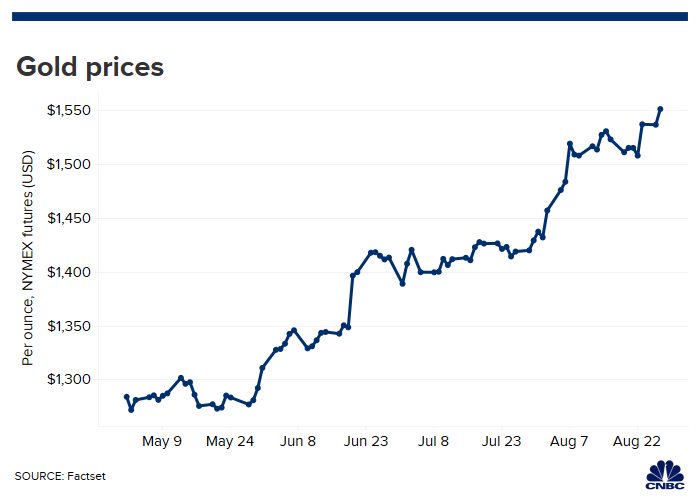
#12 When it looks like an economic crisis is coming, investors often flock to precious metals.  So it is very interesting to note that the price of gold is up more than 20 percent since May.

#13 Women’s clothing retailer Forever 21 “is reportedly close to filing for bankruptcy protection”.

#14 We just learned that Sears and Kmart will close “nearly 100 additional stores” by the end of this year.

#15 Domestic shipments of RVs have fallen an astounding 20 percent so far in 2019.

#16 The Labor Department has admitted that the U.S. economy actually has 501,000 less jobs than they previously thought.

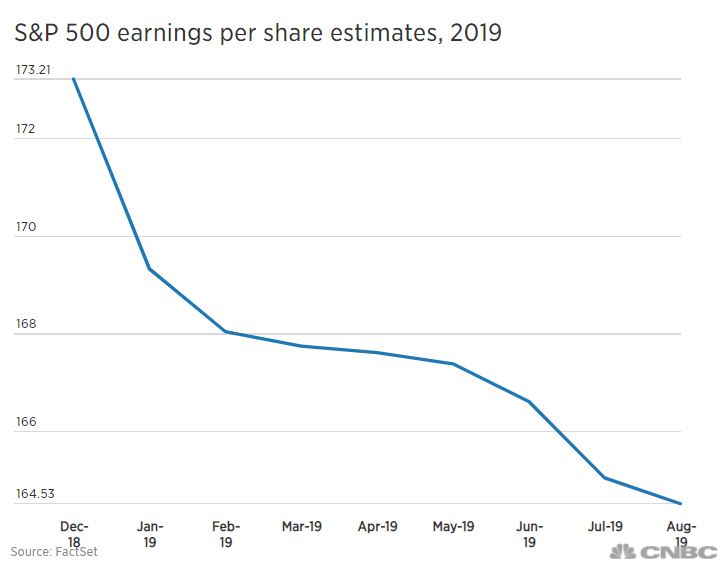
#17 S&P 500 earnings per share estimates have been steadily falling all year long.

#18 Morgan Stanley says that the possibility that we will see a global recession “is high and rising”.

#19 Global trade fell 1.4 percent in June from a year earlier, and that was the biggest drop that we have seen since the last recession.

#20 The German economy contracted during the second quarter, and the German central bank “is predicting the third quarter will also post a decline”.

#21 According to CNBC, the S&P 500 “just sent a screaming sell signal” to U.S. investors.

#22 Masanari Takada is warning that we could soon see a “Lehman-like” plunge in the stock market.

#23 Corporate insiders are dumping stocks at a pace that we haven’t seen in more than a decade.

#24 Apple CEO Tim Cook has been dumping millions of dollars worth of Apple stock.

#25 Instead of pumping his company’s funds into the stock market, Warren Buffett has decided to hoard 122 billion dollars in cash.  This appears to be a clear indication that he believes that a crisis is coming.

#26 Investors are selling their shares in emerging markets funds at a pace that we have never seen before.

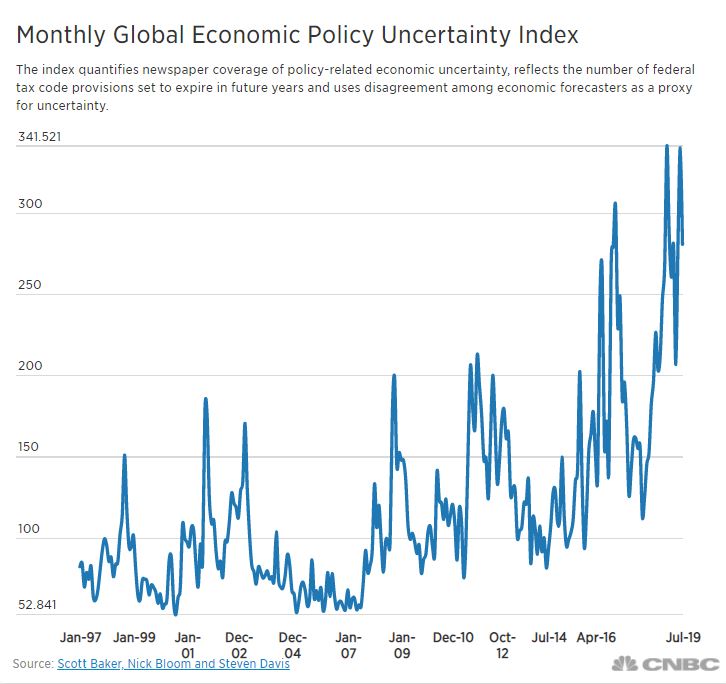
#27 The Economic Policy Uncertainty Index hit the highest level that we have ever seen in the month of June.

#28 Americans are searching Google for the term “recession” more frequently than we have seen at any time since 2009.

The signs are very clear, but unfortunately we live at a time when “normalcy bias” is rampant in our society.

If you are not familiar with “normalcy bias”, the following is how Wikipedia defines it…

The normalcy bias, or normality bias, is a belief people hold when considering the possibility of a disaster. It causes people to underestimate both the likelihood of a disaster and its possible effects, because people believe that things will always function the way things normally have functioned. This may result in situations where people fail to adequately prepare themselves for disasters, and on a larger scale, the failure of governments to include the populace in its disaster preparations. About 70% of people reportedly display normalcy bias in disasters.[1]

For most Americans, the crisis of 2008 and 2009 is now a distant memory, and the vast majority of the population seems confident that brighter days are ahead even if we must weather a short-term economic recession first.  As a result, most people are not preparing for a major economic crisis, and that makes us extremely vulnerable.

In 2008 and 2009, the horrible financial crisis and the bitter recession that followed took most Americans completely by surprise.

It will be the same this time around, even though the warning signs are there for all to see.

About the author: Michael Snyder is a nationally-syndicated writer, media personality and political activist. He is the author of four books including Get Prepared Now, The Beginning Of The End and Living A Life That Really Matters. His articles are originally published on The Economic Collapse Blog, End Of The American Dream and The Most Important News. From there, his articles are republished on dozens of other prominent websites. If you would like to republish his articles, please feel free to do so. The more people that see this information the better, and we need to wake more people up while there is still time.

The post 28 Signs Of Economic Doom As The Pivotal Month Of September Begins appeared first on The Economic Collapse.

If The Debt Machine Was Turned Off, The U.S. Would Immediately Plunge Into A Horrifying Depression

This article was originally published by Michael Snyder at The Economic Collapse Blog.

A new study has discovered that we are far more dependent on America’s great debt creation machine than most of us would have ever dared to imagine.  Today, debt is involved in most of our major transactions.

In order to purchase a home, most of us go into debt.  The same thing is true when most of us buy a vehicle.  Total credit card debt is well over a trillion dollars, and total student loan debt is now over a trillion and a half dollars.  Corporate debt has more than doubled since the last financial crisis, state and local governments are absolutely drowning in debt and unfunded pension liabilities, and the federal government is more than 22 trillion dollars in debt.  The Federal Reserve and the “too big to fail” banks are at the core of this insidious debt-based system, and it has been systematically destroying the bright future that our children and our grandchildren were supposed to have.  But if we suddenly turned off America’s great debt creation machine at this point, our entire economic system would totally collapse because we have become so dependent on it.  In fact, a study that was just conducted by Bloomberg discovered that “gross domestic product per capita would plunge into negative territory” if the ability to borrow was suddenly removed…

The nation’s health as measured by gross domestic product per capita would plunge into negative territory without its dependence on borrowed money, according to data compiled by Bloomberg.

In fact, the U.S. would fall almost to the bottom of a ranking of 114 economies by GDP per capita. Only Italy, Greece and Japan would fare worse. That’s a seismic shift from America’s comfortable No. 5 spot on a list based on conventional measures.

Our massively inflated debt-fueled standard of living is completely and utterly dependent on the continual creation of more debt.

In essence, this study found that without debt we wouldn’t have much of an economy at all.  In fact, Bloomberg says that U.S. per capita income would collapse from $66,900 a year to “negative $4,857”

To get this somewhat dystopian measure, Bloomberg took each economy’s 2020 GDP as projected by the International Monetary Fund as a starting point. We then adjusted the number by removing the ability to borrow, while adding reserves to create an alternative wealth measure.

U.S. per capita income of $66,900 would be slashed to a negative $4,857 using this measure. That’s a total loss of almost $72,000 for every man, woman and child.

So the only thing keeping us from complete and total economic collapse is the fact that debt is flowing like wine.

But what would happen if some sort of major national crisis erupted someday and all of a sudden everyone was afraid to lend money?

That is something to think about, because such a scenario may be a whole lot closer than many people might think.

As it stands, we appear to be on the precipice of the worst economic downturn since the last financial crisis, and our trade war with China just went to an entirely new level as the month of September began

The biggest reason for last week’s torrid stock market rally was rekindled “optimism” that the escalating trade war between the US and China may be on the verge of another ceasefire following phone conversations, fake as they may have been, between the US and Chinese side. This translated into speculation that a new round of tariffs increases slated for this weekend may not take place or be delayed.

However, that did not happen, and with no trade deal in sight, at 12:00am on Sunday, the Trump administration slapped tariffs on $112 billion in Chinese imports, the latest escalation in a trade war that’s ground the global economy to a halt, sent Germany into a recession, and given the market an alibi to keep rising because, wait for it, “a trade deal is imminent.”

Only, it isn’t, and 1 minute later, at 12:01am EDT, China retaliated with higher tariffs being rolled out in stages on a total of about $75 billion of U.S. goods. The target list strikes at the heart of Trump’s political support – factories and farms across the Midwest and South at a time when the U.S. economy is showing signs of slowing down.

The Chinese knew that these tariffs were about to go into effect, and so they were ready and waiting to retaliate just one minute later.

Of course, many U.S. companies will be hit extremely hard by these tariffs that the Trump administration just implemented.  The following comes from CNBC

That means that when an electronics company imports a TV, or a smart speaker, or a drone from China starting September 1, it will have to pay a 15% tax to the U.S. government.

Eventually, this will end up raising prices on gadgets and other products for people in the United States, said Bronwyn Flores, a spokeswoman for the Consumer Tech Association (CTA), a trade group that represents 2,000 different companies in the electronics industry, including brands like Apple and LG and retailers like Walmart and Best Buy.

Basically, people are not going to be able to buy as much stuff during the holiday shopping season, and overall economic activity will be slower than it otherwise would have been.

Meanwhile, President Trump continues to sound hopeful that trade talks with China will bear fruit

President Donald Trump said trade talks with Beijing are still planned for September after a new round of tariffs went into effect on Sunday.

“We are talking to China, the meetings in September, that hasn’t changed,” Trump told reporters Sunday on the White House South Lawn after returning from Camp David.

These sorts of comments helped stabilize the financial markets last week, but if there was any hope that a trade agreement was imminent we would not have seen both sides impose new tariffs on Sunday.

And now we are moving into the month that is traditionally the worst for Wall Street.  The following comes from Fox Business

Investors may breathe a sigh of relief that August, typically a volatile month for stocks, is over, but history shows that September could be even worse for Wall Street.

Since 1950, September has been the worst month for the S&P 500 Index, which has dropped, on average, 0.5% during the month, a phenomenon referred to as the September effect. According to Dow Jones market data, the average decline of the Dow Jones Industrial Average in September is 1%, while the Nasdaq Composite generally sees an average fall of 0.5%.

We shall see what this September brings.  Certainly things are really shaky on Wall Street right now, and any piece of really bad news is likely to set off another wave of panic.

Without a doubt, the market is more primed for a crash than it has been at any point since 2008, and it definitely will not take much to make this a “September to remember”…

Homemade Bug Spray is Easy to Make and Very Effective

mosquito, skin, biting

vodka, bottle

There is more benefits to creating homemade bug spray than just removing harmful chemicals from your life. Sure, DIY cleaning and pesticides are way better than those mixed up in large vats but what if that bug spray finds its way into our survival kits?

What Your Kit is Missing

There are two common sense items that many people overlook when preparing a kit. This kit could be a bugout bag or even a simple survival kit.

While you might have the high speed water filter, multiple methods for starting fire, a simple and effective shelter and maybe you even have something like a frog gig for procuring food, what are you missing?

Many people don’t think about bug spray. In fact, sunscreen and homemade bug spray are often overlooked because they don’t sell them in “tacticool” containers that attach to MOLLE or slip onto a gun rail. We get a little full of ourselves in the survival and prepping world.

That high powered AR15 cannot protect you from the effects of sleep deprivation, if you are up swatting mosquitoes all night.

Dealing with bugs is not a joke and it can go way beyond discomfort and sleep loss. Still, many people build bugout bags that are void of a means to keep the bugs away.

Disease and Discomfort of Dealing with Bugs

While ticks, chiggers and mosquitoes might seem like a nuisance and nothing more, they can carry disease. These diseases can range in severity but some of the worst can really wreak havoc on the human body.

Ever heard of malaria? While not a problem in the US, this mosquito borne disease infected 220 million people last year and killed 435,000. We have our own problems in the US with things like Lyme’s Disease and a growing list of mosquito borne illnesses.

The scariest thing about Lyme’s Disease is that its misdiagnosed regularly. People can go decades without understanding their affliction.

Keep these little monsters at bay, and the diseases they carry, with this homemade bug spray recipe.

Homemade Bug Spray Recipe

When it comes to homemade bug spray, it doesn’t get much easier than this. Honestly, this is a mix up and spray recipe. The base is vodka and that goes a long way with deterring bugs. The addition of the essential oils also helps with that.

Whether you decide to use the coconut oil, olive oil or vegetable glycerin is up to you. Just understand that you need something to smooth this out. You will have problems if you spend all day spraying alcohol on your skin or your kids’ skin.

INGREDIENTS

  • ¼ Cup of vodka
  • ¼ Cup of water
  • 1 TBSP of fractionated coconut oil, olive oil or vegetable glycerin
  • 50 Drops of lavender essential oil
  • 1 TSP of pure vanilla extract

PROCESS

This mix all goes into a spray bottle or a mason jar and can be shook to combine. That is literally the entire process!

Interesting fact about vanilla: Gnats, flies and mosquitoes among many other bugs, hate the smell of vanilla.

How to Store or Pack your DIY Homemade Bug Spray

When we are talking about long term storage for this spray you could keep it in that mason jar. The alcohol base will hold this mix for a long time. However, you should keep it out of direct sunlight. The oils will not last forever and direct sun will only shorten shelf life.

Now, you do not want to carry around a big spray bottle in your backpack. There are a couple ways to put this mix to use.

  1. You could find a small vile with a spray top. Something like a little cologne bottle would work well. Some hand sanitizers work this way as well. The smaller and more compact the better. Just be sure you have some sort of safety or lid to avoid spraying it all into your bag.
  2. You could take small squares of cloth (old shirt or shemagh cut up) and place them into a Ziploc. Pour some of your homemade bug spray into the Ziploc bag to coat the cloth. Don’t add a bunch of extra liquid to the bag but use enough to get them wet. Now these can be used as wipes to apply.

Pack up your homemade bug spray and take it on your next adventure. Or add it to your bugout bags, get home bags and anywhere else you might need it. You’ll be prepared to keep those buzzing and biting creatures at bay.

For the most recent copy of Survivor’s Edge or American Frontiersman or to subscribe, go to OutdoorGroupStore.com.