Survival Gear is the most unused product until a natural disaster happens, then it’s the most desired products, but usually too late to help those that really need the help.

We sell around the World, and pride ourselves on offering a level of customer service that we would want to see ourselves if we were shopping online.
Our product ranges change regularly, so we hope that you come back to our sites to see some of the fantastic offers that we regularly have.

Get In Touch

WATCH: Heating a Tent With a Swedish Fire Log

This is an interesting video in that it is impractical for traditional camping methods but certainly possible for a survival situation. Heating a tent with a Swedish fire log is an easy concept. The long pipe goes through the fire log and collects fresh air from the bottom. The fresh air is heated by the fire. The chimney effect forces the warm air out of the pipe and into the tent. The temperature of the pipe as it enters the tent is low enough to not cause any damage.

Heating a Tent With a Swedish Fire Log

On the YouTube channel Advoko Makes, Advoko is a lawyer living in St. Petersburg, Russia. He is an avid Bushcrafter with a huge following. He films creative how-to videos and DIY projects, mostly relating to outdoor survival. This particular one tackles a common problem: heating a tent. Providing a safe and reliable heat source in a lightweight tent can be a challenge. Open-flame sources are dangerous, and other methods could damage the tent.

If your situation is being trapped in the forest during the winter and you lack a reliable heat source, this method could work for you. By providing an easy-to-build heat source, according to the video, the temperatures inside the tent, could easily be as high as 60 degrees.

For the most recent copy of Survivor’s Edge or American Frontiersman or to subscribe, go to OutdoorGroupStore.com


According To The Federal Government, 19 Million Acres Of Farmland Were Not Planted With Crops This Year

If that headline sounds really bad to you, that is because the situation that we are facing is really bad.  Over the past few months, I have written article after article about the unprecedented crisis that U.S. farmers are facing this year.  In those articles, I have always said that “millions” of acres of farmland did not get planted this year, because I knew that we did not have a final number yet.  Well, now we do, and it is extremely troubling.  Of course there are some people out there that do not even believe that we are facing a crisis, and a few have even accused me of overstating the severity of the problems that U.S. farmers are currently dealing with.  Sadly, things are not as bad as I thought – the truth is that they are even worse.  According to the U.S. Department of Agriculture, crops were not planted on 19.4 million acres of U.S. farmland this year.  The following comes directly from the official website of the USDA

Agricultural producers reported they were not able to plant crops on more than 19.4 million acres in 2019, according to a new report released by the U.S. Department of Agriculture (USDA). This marks the most prevented plant acres reported since USDA’s Farm Service Agency (FSA) began releasing the report in 2007 and 17.49 million acres more than reported at this time last year.

So this is the largest number that the USDA has ever reported for a single year, and it is nearly 17.5 million acres greater than last year’s final tally of less than 2 million acres.

If you have been following my articles on a regular basis, then you know exactly why this has happened.  The middle of the nation was absolutely pummeled by endless rain and unprecedented flooding throughout the first half of 2019, and this new USDA report shows that the vast majority of the acres that were not planted come from that area of the country

Of those prevented plant acres, more than 73 percent were in 12 Midwestern states, where heavy rainfall and flooding this year has prevented many producers from planting mostly corn, soybeans and wheat.

“Agricultural producers across the country are facing significant challenges and tough decisions on their farms and ranches,” USDA Under Secretary for Farm Production and Conservation Bill Northey said. “We know these are challenging times for farmers, and we have worked to improve flexibility of our programs to assist producers prevented from planting.”

Of course the 19.4 million acres that were not planted are only part of the story.

Most farmers were able to get seeds in the ground despite the challenging conditions, but in much of the country the crops are not in good shape.

In fact, according to the latest crop progress report only 57 percent of the corn is considered to be in “good” or “excellent” shape.

Unfortunately, the nation’s soybean crop is in even worse shape.  At this point, only 54 percent of the soybeans are in “good” or “excellent” shape.

In addition, only 8 percent of the U.S. spring wheat crop has been harvested so far.  That is “sharply below the 30% five-year average”.

So what does all of this mean?

Well, it means that we have a real crisis on our hands.  A lot less crops are being grown, and a substantial percentage of the crops that are being grown are not in good shape.  Yields are going to be way down across the board, and that means that U.S. agricultural production is going to be way, way below initial expectations.

In other words, we are going to grow a lot less food than usual.

One bad year is not going to be the end of the world, but what if things don’t bounce back next year?  As I keep telling my readers, our planet is becoming increasingly unstable in a whole bunch of different ways, and global weather patterns have been shifting dramatically.  Many experts are issuing very ominous warnings about what is ahead as weather patterns continue to shift, and some believe that what we have witnessed so far is just the very beginning of this crisis.

Almost every day, there are new headlines about extreme weather and records being broken.  For example, one community in Colorado just got pummeled by hail the size of softballs

Monster hail fell from the sky and hammered areas of the central United States on Tuesday, shattering a state record. Earlier on Tuesday before the storms developed, AccuWeather Extreme Meteorologist Reed Timmer warned that Colorado’s state hail record could be in jeopardy given the intensity of the storms that he saw developing.

His prediction came to fruition on Tuesday afternoon when a hailstone with a maximum diameter of 4.83″ fell in Bethune, Colorado, on Tuesday afternoon. The record was confirmed on Wednesday evening by the Colorado Climate Center and the National Weather Service office in Goodland, Kansas.

For some of my readers, this freakish incident is going to set off major alarm bells.

We are regularly seeing things happen that we have never seen before.  In other words, the seemingly impossible is happening so frequently that it has become mundane.

Despite all of our advanced technology, we are still completely and utterly dependent on the weather.  If the weather does not cooperate, farmers cannot grow our food, and we will not eat.

Hopefully harvest season will go smoothly, but even if that happens, food supplies will be a lot tighter in the months ahead and that means that prices will continue to rise steadily.

This is a crisis that is going to affect all of us.  I wish that I could get everyone to understand this, but unfortunately there are still a lot of people out there that are not taking this seriously.

Get Prepared NowAbout the author: Michael Snyder is a nationally-syndicated writer, media personality and political activist. He is the author of four books including Get Prepared Now, The Beginning Of The End and Living A Life That Really Matters. His articles are originally published on The Economic Collapse Blog, End Of The American Dream and The Most Important News. From there, his articles are republished on dozens of other prominent websites. If you would like to republish his articles, please feel free to do so. The more people that see this information the better, and we need to wake more people up while there is still time.


Guards Were Sleeping During Epstein’s Alleged Suicide, Then Falsified Records To Cover It Up

This article was originally published by Tyler Durden at ZeroHedge.

In the latest blockbuster report about how the chronic understaffing and mandatory overtime at MCC helped contribute to Jeffrey Epstein’s “suicide” (or at least that’s the official narrative that certain parties are trying to push), the New York Times reported on Wednesday that the two guards tasked with monitoring Epstein’s unit were asleep when the pedophile-financier tied a bedsheet around his neck and the other end to a top bunk, before pitching himself forward.

When the guards awakened after not checking on Epstein for three hours to discover, to their horror, that Epstein had apparently committed suicide, they decided to falsify records to cover their tracks, something that could draw criminal charges, per the NYT.

Ladies and gentlemen, have we found our patsies?

The two staff members in the special housing unit where Mr. Epstein was held – 9 South – falsely recorded in a log that they had checked on the financier, who was facing sex trafficking charges, every 30 minutes, as was required, the officials said. Such false entries in an official log could constitute a federal crime.

In fact, the two people guarding Mr. Epstein had been asleep for some or all of the three hours, three of the officials said.

The two employees were placed on administrative leave on Tuesday, while Warden of the jail was temporarily reassigned pending the outcome of the investigation, while the Warden of the federal prison in Otisville has been named acting warden of the Manhattan jail.

Those disclosures came on Tuesday as the two employees were placed on administrative leave and the warden of the jail, the Metropolitan Correctional Center in Manhattan, was temporarily reassigned, pending the outcome of the investigation into Mr. Epstein’s death, the Justice Department announced.

One of the staff members who was working to guard Epstein that night was a former corrections officer who had recently taken a desk job inside the prison. But he had recently volunteered to cover some shifts as a corrections officer once again for the extra overtime pay. The second officer, a woman who was assigned to that wing, had been forced to work overtime because of staffing shortages.

Prison staff found Epstein, 66, dead in his cell at the Metropolitan Correctional Center at 6:30 a.m. on Saturday, officials said. Earlier reports said staff heard shrieking coming from his cell around the time of his death. He was awaiting trial on charges of sexually abusing dozens of underage girls. Just days before, thousands of pages of documents were released by the US Attorney of the Southern District of New York’s office revealing at least half a dozen new names who had never been associated with Epstein and his sex ring before, including former New Mexico Governor Bill Richardson and Marvin Minsky, to name a few.

It’s this particularly curious timing that has prompted some to speculate that conspiracy theories that Epstein was murdered or switched with a body double might be real, since, without Epstein, there won’t be a trial (though AG William Barr has vowed to bring his co-conspirators to justice, his most prominent associate, Ghislaine Maxwell, is nowhere to be found).

Survival Cache Podcast Episode 12: Bug Out Trial Run

Did you ever want to try to test your Bug Out Bag or your Bug Out Plan but did not know where to start or how to do it? Join us on this exciting podcast as Drew and guest Jarhead Survivor from SHTFBlog share with Doc the lessons they learned during a trial run of a bug out scenario. Spoiler Alert: Let’s just say it didn’t go as planned.

Want to comment about this podcast? Sound off below in the comments.

A fun episode with lots of opinions, click on one of the links below to listen now or download to your phone and listen later. Also, if you love the podcast, please leave us a review on iTunes, Stitcher, or Podbeam. It really helps!!!

SHTF podcast for preppers

Best Survival Podcast

The post Survival Cache Podcast Episode 12: Bug Out Trial Run appeared first on Survival Cache.

A One Day Stock Market Plunge Of 48%! A Major Financial Crisis In Argentina Is Happening Right Now

We are watching a complete and utter financial meltdown unfold in Argentina, and many are concerned that the panic could start spreading elsewhere.  When you go into way too much debt and you just keep devaluing your currency, this sort of thing is inevitably going to happen, and this is why I am endlessly criticizing the path that the United States is currently on.  If we do not reverse course, we will end up just like them.  On Monday, we witnessed the second largest one day stock market decline that we have seen anywhere in the world since 1950.  It is hard to believe, but the most important stock market index in Argentina actually plummeted 48 percent in a single trading session…

The S&P Merval Index plummeted 48% Monday, the second-largest single-day drop in any global stock market since 1950, according to Bloomberg. The Argentine peso also declined, losing 15% of its value against the US dollar Monday and falling further Tuesday to a new low.

This is what a financial implosion looks like, and it wasn’t supposed to happen.  In fact, we are being told that there was only a .006% chance that such a sell-off would take place

There was a 99.994% probability that an event like Monday’s sell-off in Argentina wouldn’t happen.

But it did. And it served to underscore the need for investors to protect against extreme events that look very unlikely but can have outsize impact if they do occur.

As I keep reminding my readers, stocks tend to fall a lot faster than they rise, and when some sort of trigger event causes panic things can escalate rather quickly.

In this case, the trigger event was an election result

So much for the polls. Forgetting the electoral shocks of Donald Trump and Brexit, investors displayed herd-like faith in surveys showing that reform-minded Argentine President Mauricio Macri would run close in an Aug. 11 primary, positioning him for re-election in October. They bid up assets accordingly. The GlobalX MSCI Argentina exchange-traded stock fund (ticker: ARGT) soared 42% in the year to Aug. 9. It lost all that the day after voters behaved the way you’d think voters might in a country afflicted by near-zero growth and near-50% inflation.

Investors had been hoping that Argentine President Mauricio Macri would win re-election, but now that possibility appears to be extremely remote.  In the primary vote, Macri was soundly defeated by Alberto Fernandez…

In the primary over the weekend, Macri took home only 32% of the vote, while Fernandez won 47%. The 15-point lead was much larger than investors had expected, Bloomberg reported.

Investors are now fleeing the country’s assets in hoards, leading industry watchers to question if default is on the horizon.

Argentina is considered to be an “emerging market” and many fear that this sell-off in Argentina could spark a wider emerging market crisis.

And that could definitely be the case.  Many other emerging market countries are also up to their eyeballs in debt, and some investors may start dumping assets just out of fear that a broader sell-off could potentially happen.

When there is fear in the air, a lot of times rational behavior goes out the window.

At the first whiff of panic, many investors want to make sure that they get to the exits before anyone else does.  And some people are already using the word “contagion” to describe what we are potentially facing

Andrea Iannelli, investment director at Fidelity International, told CNBC’s “Squawk Box Europe” on Tuesday that it was hard to see how Argentina’s stock market and currency crash could be completely isolated.

“We are going to get a spill over (or) contagion of some sort.”

Of course all of this could have been avoided if Argentina had not gone into so much debt and had used a stable currency all this time.

Unfortunately, nations all over the planet are making the exact same mistakes.  Here in the United States, we have been adding an average of more than a trillion dollars a year to the national debt since Barack Obama first entered the White House, and we have been systematically destroying the value of the U.S. dollar.

Since the Federal Reserve was created in 1913, our national debt has gotten more than 6000 times larger, and the value of our currency has fallen by more than 98 percent.  Our fate will be even worse than Argentina’s fate if we stay on our current path, and I am one of the few national voices that is continually warning about this.  For the most part, both major political parties have completely given up on fiscal responsibility and financial sanity.  It is absolutely infuriating, but at this point the American people don’t seem to care enough to vote the people that got us into this mess out of office.

All throughout history, we have seen government debt spirals end with episodes of wild money printing.  And no matter which politician ultimately ends up triumphant in Argentina, the choices under the current system are going to remain the same.  The following is what one economist recently told CNBC

He added Argentina’s central bank had been left with a binary choice.

“You have one option which is to print peso’s like there is no tomorrow and you have another option which is to print quite a lot — and it is scary.”

It would be easy to mock Argentina for the giant financial disaster that they have created, but the truth is that we are doing the precise same thing to ourselves.

We are literally in the process of committing national financial suicide, and it deeply frustrates me that more people can’t seem to understand this.

About the author: Michael Snyder is a nationally-syndicated writer, media personality and political activist. He is the author of four books including Get Prepared Now, The Beginning Of The End and Living A Life That Really Matters. His articles are originally published on The Economic Collapse Blog, End Of The American Dream and The Most Important News. From there, his articles are republished on dozens of other prominent websites. If you would like to republish his articles, please feel free to do so. The more people that see this information the better, and we need to wake more people up while there is still time.

The post A One Day Stock Market Plunge Of 48%! A Major Financial Crisis In Argentina Is Happening Right Now appeared first on The Economic Collapse.

20 Best Schools in the US to Learn Survival Skills

We’re never too old to gain more survival-based knowledge. Attending one of these survival schools may be one of the best investments you make in your entire life. Some of the benefits besides learning survival skills are meeting like-minded people, being in nature and making lifelong friends.

1. Earth Skills Self-Reliance School

EarthSkills is the first school in SC with over 3,200 followers in the last 5 years. Founded in 2013, the stated purpose of EarthSkills, LLC. is to help re-acquaint the community with the bounty of nature and to reclaim the skills our culture once depended on to prosper as human beings.
Location: South Carolina
Duration: 1 to 5 day courses available
Types of Survival Classes Offered: Wilderness, foraging and making cordage
Level: Beginner to advanced
Family Friendly: Kids 13 years and up, when accompanied by an adult
Profile: EarthSkills Self-Reliance School

2. Boulder Outdoor Survival School

BOSS will give you a welcomed break from technology. The school focuses on primitive living skills, and you can expect to live at basecamp with just hand-made materials. It is fun, educational, and actually a good vacation spot.
Location: Utah
Duration: Ranges from 4-28 day options
Types of Survival Classes Offered: Primitive survival
Level: Intermediate to advanced
Family Friendly: No
Profile: Boulder Outdoor Survival School

3. Maine Primitive Skills School

This survival school markets itself as the “center for wilderness awareness, survival, self-reliance, and nature connection.” A lot of people will prefer the “earth living” focus over the doomsday mentality which is used at other survival schools.
Location: Maine
Duration: Mostly 1-5 days
Types of Survival Classes Offered: Foraging, earth living, wilderness survival
Level: Beginner to intermediate
Family Friendly: Youth survival camps offered
Profile: Maine Primitive Skills

4. Sigma 3 Survival School

Sigma 3, or “The Institute for Self-Reliance,” is one of the best-known survival schools. They offer a huge variety of courses from weekend wilderness retreats to customized classes. People are generally very pleased with the instructors and information learned.
Location: Primarily in Missouri, Virginia, Colorado, Arkansas, and Florida. Limited international courses.
Duration: From 1-day walks to 7+ days
Types of Survival Classes Offered: SERE, wilderness training, anti-abduction and defense, wild plants, survival fishing, trapping, and more
Level: Complete beginner to advanced classes available
Family Friendly: Some options available
Profile: Sigma 3

5. Ancient Pathways

Based in Arizona, Ancient Pathways is best known for their primitive skills courses such as how to trap, track, and survive with tools that you can make yourself. They are also one of the best places to learn desert survival skills. You don’t have to worry if you aren’t advanced – there are all levels of courses. For more advanced people, there are survival classes like “knife only” and field courses.
Location: Arizona
Duration: 1-day, overnight, and multi-day courses available
Types of Survival Classes Offered: Primitive survival, wilderness survival, bushcraft field courses, desert survival
Level: Beginner to advanced
Family Friendly: For kids 14 years and up
Profile: Ancient Pathways

6. Thomas Coyne Survival Schools (Formerly the Survival Training School of California)

There are some basic wilderness survival courses offered by Thomas Coyne, but this is the survival school you want to go to for EXTREME experiences. In those all-weather survival courses, you won’t be allowed to use a sleeping bag or munch on Snickers bars that you hide in your pockets. The survival school is very affordable for the level of skill taught.
Location: California, yearly courses held in Alaska
Duration: Mostly 1-8 days
Types of Survival Classes Offered: Map reading, navigation, basic survival skills, field courses, bushcraft courses, medical and tactical, private survival
Level: Beginner to high-level advanced
Profile: Thomas Coyne Survival Schools

7. Mountain Scout Survival School

If you live in New York and don’t want to commit to a longer survival course, Mountain Scout Survival School has a lot of 1-day classes to choose from that cover wilderness survival to emergency prepping. The nice thing is that many of the courses focus on specific topics so you can build one specific skill instead of trying to learn everything at once in an intensive field course.
Location: New York
Duration: Mostly 1-day courses
Types of Survival Classes Offered: Level: Wilderness survival, bugging out, tracking, navigation, family emergency preparedness, fire, women’s survival
Family Friendly: Children allowed, but courses designed for adults
Profile: Mountain Scout

8. Wilderness Awareness School

This is a survival school for people who love nature. There are shorter courses on tracking, bird language, edible plants, plant medicine, and other topics that will help you survive while getting closer to nature. There are also intensive survival courses that last several months.
Location: Washington State
Duration: 1-3 days; intensive courses last 9 months but are broken into weekend segments
Types of Survival Classes Offered: Wilderness survival, nature
Level: Beginner to advanced
Family Friendly: Youth programs available
Profile: Wilderness Awareness

9. Aboriginal Living Skills School

Run by Cody Lundin, this is a renowned survival school that will turn anyone into a survivalist. There are specific and intensive skill courses available. Cody focuses on primitive survival skills, which means there will be a lot more on exploring indigenous cultures than surviving SHTF disasters.
Location: Arizona
Duration: Mostly 1-day to 1-week
Types of Survival Classes Offered: Primitive skill-focused courses (fire, trapping, edible plants, desert survival…) and adventure courses
Level: Beginner to advanced
Family Friendly: Yes
Profile: Aboriginal Living Skills

10. Jack Mountain Bushcraft School

If you are looking for a more intense survival school for learning wilderness skills, Jack Mountain Bushcraft school has “semesters” which last 2 months. You can even get college credits for these courses! There are also some “folk school” classes which only last a few days where you can learn skills like knife making.
Location: New Hampshire, Maine, Vermont
Duration: Mostly longer classes from 1 week to 9 weeks
Types of Survival Classes Offered: Bushcraft, folk skills (primitive skills), outdoor skills, self-reliance workshops
Level: Intermediate to advanced
Family Friendly: Yes (see their School of the Forest classes)
Profile: Jack Mountain Bushcraft

11. Mountain Shepherd Wilderness Survival School

If you aren’t quite ready to disappear into the wilderness with nothing but a knife, Mountain Shepherd Wilderness Survival School is a good option for learning basics. You will learn which insects are edible (but won’t be required to eat them) and can even stay in lodges if you wish. It’s also one of the more affordable survival schools.
Location: Virginia and Oregon
Duration: Mostly 1-3 days
Types of Survival Classes Offered: Leadership and team building, outdoor skills, wilderness first aid, bushcraft essentials
Level: Mostly beginner
Family Friendly: Yes
Profile: Mountain Shepherd

12. Alderleaf Wilderness School

This is one of the more comprehensive survival schools where you can get certification and college credits (certificate in Wilderness Skills and Education and Ecology). This is great if you want a career outdoors. For people who just want to improve their skills, there are also weekend courses available.
Location: Washington
Duration: Weekend courses, week-long courses, and a 9-month certification program
Types of Survival Classes Offered: Wilderness survival, traditional ecological knowledge, wild edibles, permaculture, wildlife tracking
Level: Intermediate to advanced
Family Friendly: No – Must be at least 18 to attend
Profile: Alderleaf Wilderness College

Other schools that are highly recommended across the United States:

13. Practical Primitive

Location: New Jersey
Types of Survival Classes Offered: Bushcraft, wilderness survival, self-reliance, primitive skills, traditional living
Profile: Practical Primitive

14. True North Wilderness Survival School

Location: Pennsylvania
Types of Survival Classes Offered: Wilderness survival
Profile: True North Outdoor School

15. Wolf College

Location: Washington
Types of Survival Classes Offered: Mostly kids camps
Profile: Wolf Camp

16. NE Ohio Primitive Living and Wilderness Survival School

Location: Ohio
Types of Survival Classes Offered: Primitive living, earth living, wilderness survival
Website: http://medicinescout.com

17. Hawk Circle

Location: New York State
Types of Survival Classes Offered: Mostly for youth and family retreats
Profile: Hawk Circle

18. Tom Brown Jr’s Tracker School

Location: New Jersey, some online courses
Types of Survival Classes Offered: Wilderness survival, primitive cooking
Profile: Tom Brown Jr’s Tracker School

19. First Earth Wilderness School

Location: Missouri
Types of Survival Classes Offered: Bow and arrow, tanning, hunter-gatherer, other primitive skills
Profile: First Earth Wilderness School

20. Ancestral Knowledge

Location: Maryland, DC area
Types of Survival Classes Offered: Primitive skills, family workshops, youth programs
Profile: Ancestral Knowledge

There are so many survival schools available to us. We hit the ones with the highest ratings and strongest reviews. All have links from which to gain more information about the school. It’s fun to go through each one and look at the various in-depth descriptions and also pictures that help display the type of survival skills the school specializes in. Be it for an individual or family, the young or old, one of these survival schools has something for everyone!

5 Best Rocket Stoves (and Plans) For Survival On The Market

Rocket StoveRocket Stoves Are A Prepared Survivalist’s Dream Tool – Discover The Best One’s Available Today

Air. Water. Food. Warmth. Self Defense.

The 5 fundamental requirements of survival. If you provide those 5 elements, you survive.

It might not be fun, it might not be pretty, but with them, you live.

So today let’s talk about one survival tool that supports both cooking and warmth in a single device – The Mighty Rocket Stove.

Specifically, we’ll deep dive into the following rocket stove topics:

As A Way To Introduce You To Skilled Survival, We’re Giving Away Our Ultimate Survival Gear Checklist. Click Here To Get Your FREE Copy Of It.

What Is A Rocket Stove Anyways


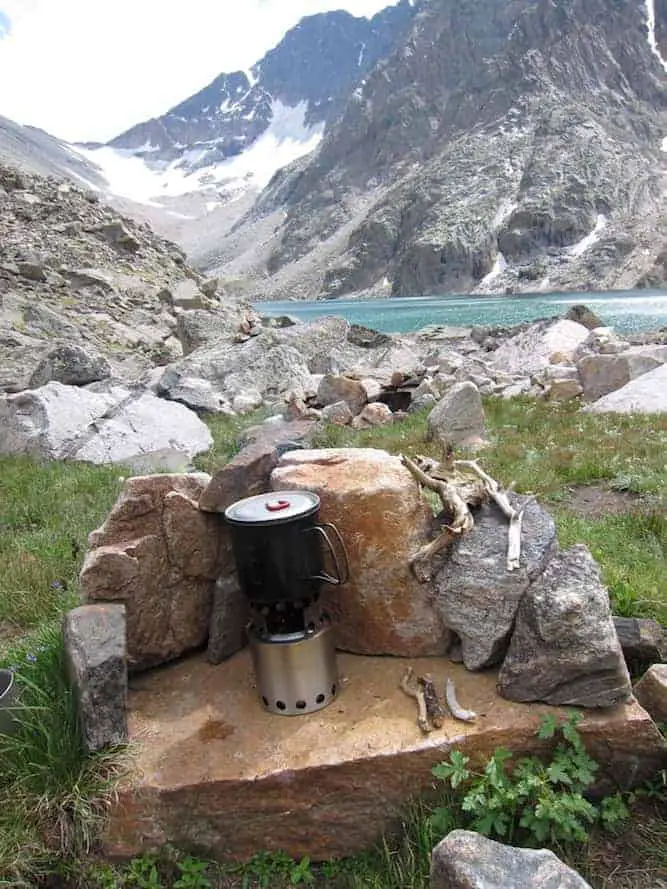
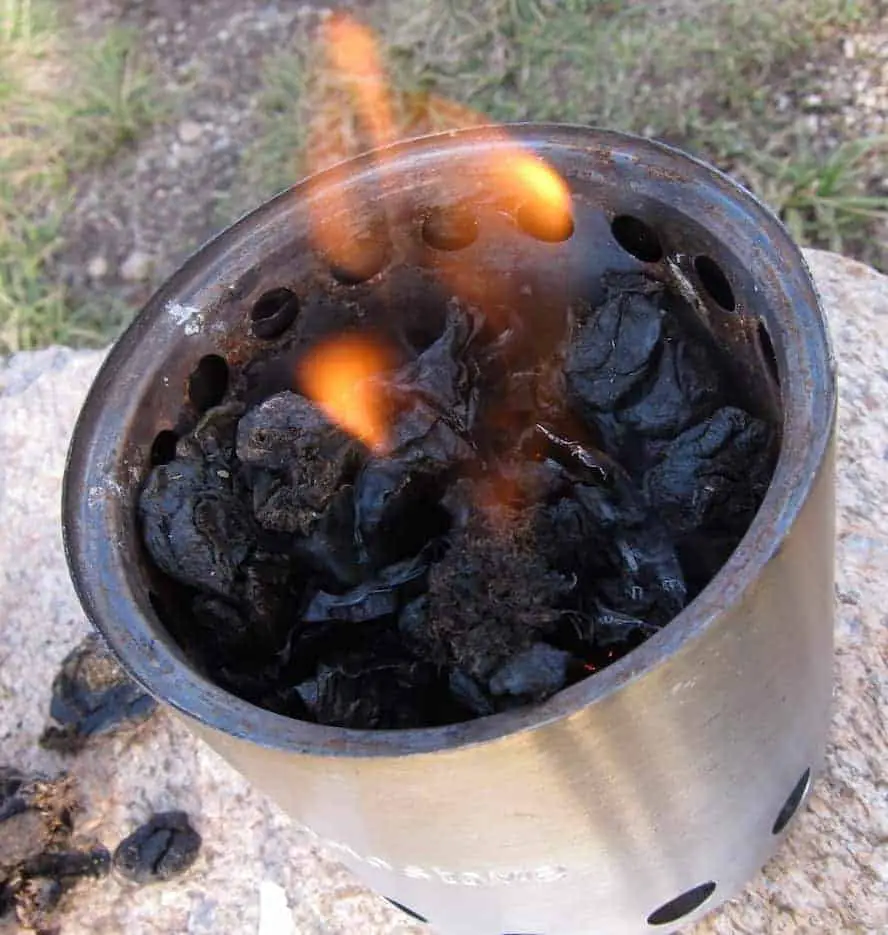
A rocket stove is a super-efficient small combustion stove. Its intelligent design makes use of any small fuel sources such as twigs, small branches, pine cones, and dry grass.

This means a fuel source is:

  1. More readily available
  2. Easy to gather and haul
  3. FREE (who doesn’t love free?)

These small fuel sources are burned in a combustion chamber containing a verticle chimney. The design ensures nearly complete combustion.

This means you’re getting more heat output (for warmth or cooking) than traditional firepits or even wood stoves.

The first ones built were based on an old lamp design that’s been around since at least the 1700s. Since those early years, it’s undergone incremental improvements over the centuries.

The modern-day rocket stove was officially designed in the 1980s. They were originally built to support an improved cooking system for impoverished nations.

Since the simple design of the rocket stove captured the world. Because they are relatively easy and inexpensive to build. Even with scrap materials from the recycling bin or a small amount of concrete!

That’s why they’ve become so popular among those of us who are preparing for future emergencies…

How Rocket Stoves Work – It’s Called Science


The true beauty of a rocket stove can be appreciated until you understand how they work. Why? Because the rocket stove design is so simple.

Unlike a traditional wood stove, a rocket stove has no moving parts. This means no flue damper and no air inlet grate!

rocket stove designThe basic rocket stove has only 4 components:

  1. The “Elbow” – a fire-proof L-shaped pipe with a 90deg bend in the middle. The horizontal portion of the elbow is the fuel chamber and air inlet. The vertical portion is the combustion chamber and chimney.
  2. The Stove Body – an insulated surround for the elbow, capable of withstanding the high heat from the elbow. Large metal food cans (or metal trash cans) work great, as does sheet metal bent to fit the elbow. A hole in the top allows the chimney to exit upwards. And a hole on one side allows access to the fuel chamber and air inlet.
  3. A Fuel Grate – ideally the fuel needs to sit up off the bottom of the fuel chamber. Normally a metal grate provides airflow under and around the fuel. This allows any ash to fall through and be removed.
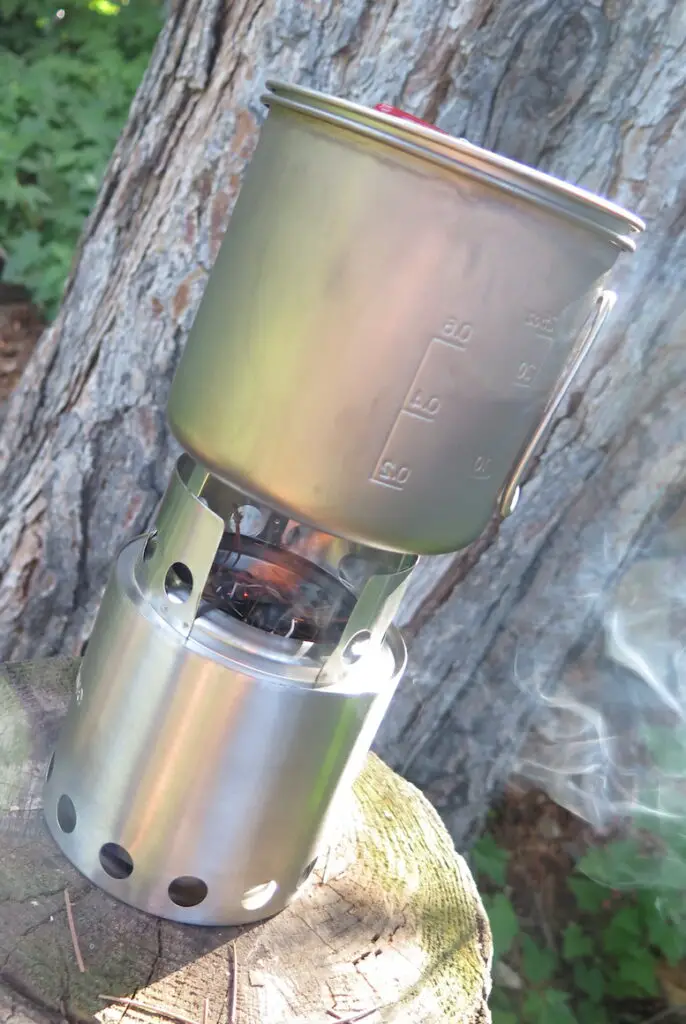
  4. A Pot Skirt – this allows you to place a cooking pot on top of the chimney. It maintains an air gap to allow hot rising gases to escape the elbow. The pot skirt also blocks the wind from the bottom of the pot. This helps provide a better heat transfer for faster cooking.

Once you’ve assembled the rocket stove and loaded it with fuel, it’s easy to see why it’s such an efficient design!

First, the fuel blocks most of the air inlet, providing a limited amount of air for the fire.

This forces the air in a smooth stream under and around the fuel.

As this current passes around the tip of the fuel, it provides a constant stream of fresh air to the fire.

Second, the fire is only burning at the tip of the fuel.

As you slide more fuel into the chamber, it advances the burning material into the air stream from the inlet.

This makes it easier to control the burn rater and keep an even temperature.

Third, with the pot positioned above the chimney, you focus as much heat as possible into your cooking pot (or hands for warmth).

This means little waste and less fuel needed to get dinner on the table!

What you can’t as easily see is the insulated design of the stove body improves cooking efficiency.

It keeps the rocket stove from wasting much heat out into space and away from your cook pot. It also means the fuel chamber preheats the fresh air before reaching the fuel.


Why Rocket Stoves “Rock” For Camping AND Survival


Rocket stoves are a modern-day survivalists (or camping hobbyist) dream device.

No, they won’t win a “cool survival gadget” contest (like a solar charger) but I believe they’re even more important!

I mean what device can make your camping trips better AND save your life in an epic widespread disaster? Not many – that’s why the rocket stove is a device resilient people should invest in.

So here are the top 5 reasons to invest in a rocket stove today.

1 – The design works at different scales – small or large!

A rocket stove can be an extremely portable stove for cooking OR massive “rocket mass heater” for heating a small cabin or hut.

So the design of the rocket stove is extremely versatile. Ideally, if you want to be extremely resilient to the uncertainties of life – you should invest in a small portable rocket stove and a large rocket mass heater as well!

2 – They are insanely efficient – maximizing your fuel.

They run efficiently on very little wood fuel. You can use firewood, twigs or pinecones to generate a lot of heat efficiently.

You can even run many rocket stoves on leaves, grass, and brush! The bottom line is that small portable rocket stoves can use the “free” combustibles found nearly everywhere on the ground.

But what about heating a home? With a well-designed rocket mass heater – you can make your large pile of firewood lasts much longer. How much longer? In the video below, they only used 0.6 cords of wood for an entire Montana winter!


3 – They produce very little smoke. 

If you hate smoke as much as I do, then it’s about time you did something about it.

You could get a smokeless fire pit for your backyard but you should also get a rocket stove for your survival cooking needs. Why don’t they produce much smoke? It’s due to the efficiency of the burn.

The more efficient the combustion process, the less smoke – it’s as simple as that! And if you’ve been paying attention – efficient burning is a rocket stove’s Modus Operandi.

4 – They are a Plan B backup heat source in a long-term grid-down crisis.

What’s your long-term power outage heat plan? Even if you have a backup generator, it will eventually run out of fuel. So, what’s your plan after that?

For some people, a candle heater is worth a try – but it’s not gonna work for large spaces. So for others, it’s to invest in a kerosene or propane heater – but now you’re storing large amounts of liquid fuels

Instead, if you’re serious about being prepared and resilient, then you should look at a rocket stove as a better solution. You’ll need to scale up to a rocket mass heater with a chimney to safely heat a home.

While a small portable rocket stoves produce much less smoke it’s not “smokeless”. So if you burn on inside a home or space without a chimney – you could die from carbon monoxide poisoning. DON’T DUE THAT!

5 – They are a better option than campfires/wood stoves

I’ve always loved cooking over a wood fire. But it’s not always the most convenient means of preparing food and keeping warm.

It can be hard to find enough wood to keep a fire hot enough to cook.

Dry wood can be even more difficult to locate, especially in the rain and snow.

Even if you collect plenty of usable wood, you must constantly feed logs onto the fire to keep up a bed of coals.

Every time you add more logs, you must move the cooking pot out of the way. Thus disturbing the cooking process often, leaving you hungry longer!

A wood stove is an improvement. They help manage the heat and the burn rate of your fuel and providing a more stable cooking surface.

While wood stoves improve efficiency, they still require copious amounts of large firewood.

Splitting logs and sawing branches takes both time and effort! And traditional wood stoves are not exactly portable!

So, what can you do when there’s very little downed wood for fuel? What if you don’t have time to search for dry wood in the rain?

Try a Rocket Stove!

The bottom line is:

My favorite survival gear is gear I can use and enjoy today but is also an ideal backup if things go south. All these reasons in combination make a rocket stove a wise investment.

As A Way To Introduce You To Skilled Survival, We’re Giving Away Our Ultimate Survival Gear Checklist. Click Here To Get Your FREE Copy Of It.


DIY Rocket StoveBest Rocket Stove Plans – DIY Rocket Stove Builds


If your a regular visitor to Skilled Survival – you know we’re big fans of building our own DIY survival gear. Well, would you know it, the rocket stove is an excellent candidate for a DIY project!

Depending on the type of rocket stove you want to build, it can be simple or complex.

  • If you’re not looking for portability, you can build a rocket stove from concrete blocks!
  • Or if portability is a requirement you can build one out of a metal coffee can and a regular-sized food can.
  • If you want indestructible durability – build a gravity-fed carbon steel rocket stove.

So let’s get started – we’re going to cover a wide range of rocket stove plans:

Stacked Brick Rocket Stove Plans

For this super simple rocket stove all you’ll need is a small pile of bricks. Just arrange them in a way to create the rocket stove chambers and there ya go!


Concrete Block Rocket Stove Plans

This version provides a stable place for a cooking pot and can be assembled in minutes. You’ll just need to source a few concrete blocks and properly arrange them. Simple, yet effective.


5 Gallon Bucket & Concrete Rocket Stove Plans

For this version of a rocket stove, you’ll need a 5-gallon bucket, some concrete and some cardboard tubes.


Metal Rocket Stove Plans

There are plenty of simple designs for rocket stoves. But there are also designs that feature welded pipe for durability. If your skills include metalworking, these are best since they’re damn near indestructible!


And you can even build one that has a gravity-fed fuel chamber (watch next video)!


Material Free Rocket Stove – The Dakota Fire Hole

Drawing Of Dakota Fire Pit

Drawing Of Dakota Fire Pit

Now that you’ve taken a look at the DIY rocket stoves, imagine doing the same thing with a hole in the ground!

The Dakota Fire Hole has been a longtime solution for efficient cooking without concrete, bricks, buckets or metal.

It consists of two intersecting holes or tunnels. It has the same fundamental configuration as the elbow of a rocket stove.

Since it’s similar in design, a Dakota fire hole has many of the same benefits as a rocket stove. It’s very low cost, efficient, high heat, clean-burning.

But it adds an element of discretion (the flames are hidden below ground) and wind resistance.

 5 Best Rocket Stoves On The Market Today

If DIY isn’t your thang – there are many commercial versions available online. Ranging from simple tube designs to something with all the bells and whistles of a modern wood stove.

1 – EcoZoom Vera Rocket Stove

The EcoZoom Versa Rocket Stove is a well-built, heavily insulated stove. It includes a separate fuel and air inlet doors and an integrated cooktop and pot skirt.

The EcoZoom Versa doesn’t require a lot of wood or charcoal to cook an entire meal. Making this rocket stove a very eco-friendly outdoor cooking option!

Check Out Today’s Price


2 – Hot Ash Wood Burning Stainless Steel Rocket Stove

The Hot Ash Stove is a 2lb titanium and aluminum rocket stove that folds up for transport and storage.

It even has a fuel ramp that helps feed sticks into the combustion chamber by gravity.

It’s made in the USA and it got a lifetime guarantee (both a rarity nowadays)!

Check Out Today’s Price


3 – Bruntmor Camping Rocket Stove – Self Feeding Stove, Tent Heater

The Bruntmor Camping Rocket Stove is a heavy-duty, portable stove for hunters, fishers, campers, backyard cooks, or survivalists.

Converts box to fully functional stove in minutes. Just add dry wood and light it up.

It also includes a cooking grate that’s wide enough to support large pots.

Check Out Today’s Price

4 – Marsh Kettles Camping Survivalist Prepper Flat Pack Mini Rocket Stove

The Marsh Kettles Rocket Stove’s unique feature is that it packs completely flat for easy storage or transport. It uses a slot assembly system for easy set-up or break-down.

It’s simple to assemble, easy to ignite and has a gravity self-feeding inlet. 

It’s also Made in the U.S.A.

Check Out Today’s Price


5 – SHTFandGO Bullet Proof Rocket Stove Tent Heater Gravity Feed

The SHTFandGO Bullet Proof Rocket Stove is a super heavy duty gravity self-feeding rocket stove.

It includes a well-positioned carry handle for easy transportation. Plus it has a dedicated ashtray and burner damper.

And this rocket stove can be used as a tent stove in a pinch (IF you make sure to use a chimney to aspirate to the outside).

Check Out Today’s Price


Action Plan

Rocket Stove Wrap-Up and Action Plan


With the combo of low cost, fuel efficiency, and ease of use, a rocket stove is an invaluable survival tool. Whether you build your own or buy a commercial version, you should invest in one.

At the end of the day –

It’s pure satisfaction to cook dinner by the power of twigs and pinecones alone. So if you’re still reading this article your action plan is simple:

Get your hands on a rocket stove ASAP – Build or buy? – You get to decide.

Jason K.

P.s. Do you know where the closest nuclear bunker is from your home?

There are a lot of natural nuclear shelters in the US that are absolutely free. And one of them is near your home.

Click on the image above to find out where you need to take shelter.

Top Image Credit

The post 5 Best Rocket Stoves (and Plans) For Survival On The Market appeared first on Skilled Survival.

Years That End In “9” Tend To Be Times Of Great Upheaval

Will 2019 continue the trend?  The other day I was talking with a close friend, and he pointed out to me that all throughout history years that end in 9 have tended to be times of great change and upheaval.  I was intrigued by what he shared with me, and so I went out and did some research, and I discovered that he was right on target.  In particular, over the last 100 years we have seen an unusual number of key historical events take place during years that end in 9, and that seems quite strange.  Could it be possible that the ending of one decade and the imminent start of a new one somehow triggers something inside of us psychologically?  I don’t know, but there does seem to be a pattern.  In this article I will summarize some of the things that I have discovered, and I will let you come to your own conclusions.

Let’s start with 1929.  As I repeatedly remind my readers, most large stock market crashes tend to happen during the fall, and on October 29th, 1929 there was a devastating stock market crash unlike anything that the United States had ever seen before.  That date is generally considered to be the start of the Great Depression, which to this day is the worst economic downturn the western world has ever experienced.  The Great Depression lasted for ten years, and that brings us to the next “9” on our list…

1939 was the year when World War II started.  It was the most catastrophic war that the world has ever seen, and it didn’t end until 1945.  It is estimated that somewhere between 70 million and 85 million people were killed, and the war shocked the planet so much that we haven’t seen a war like it since.

1949 was a year of great change, and it was really when the battle lines of the Cold War between the east and the west definitely solidified.  During this year, the Communist Party of China was able to take full control of mainland China, and the People’s Republic of China was formally established.  In addition, in 1949 the Soviet Union tested their first atomic bomb, it was the year of the Berlin blockade, and NATO was formed on April 4th, 1949.

1959 was the year when Fidel Castro came to power.  Thanks to the success of the Cuban revolution, Cuba became the first communist power in the western hemisphere, and this ultimately led to the Cuban missile crisis of 1963.

1969 was so tumultuous that a number of documentaries have been made about that single year, and author Rob Kirkpatrick wrote an entire book about it entitled “The Year Everything Changed”.  It was the year of the Moon landing, Woodstock and the Manson murders.  During this year Richard Nixon was sworn in as the president of the United States, 250,000 Americans marched on Washington to protest the Vietnam War, and the Palestine Liberation Organization was founded.

1979 was the year of the Iranian Revolution.  Ayatollah Ruhollah Khomeini came to power in February, and the Iranian hostage crisis began in November.  If there had been no Iranian hostage crisis, it is possible that Ronald Reagan may have been defeated by Jimmy Carter in 1980.  1979 was also the year when Margaret Thatcher first became prime minister of the UK, and she served all the way until 1990.

1989 was another year of revolution.  In June of that year the pro-democracy protests in Tiananmen Square in Beijing were brutally crushed by the Chinese government.   On the other side of the world, 1989 was the beginning of the Velvet Revolution in Czechoslovakia which ultimately resulted in a peaceful division of that nation into the Czech Republic and Slovakia.  George H.W. Bush was sworn in as the president of the United States during this year, and huge protests on both sides of the Berlin Wall ultimately resulted in the collapse of the East German government.

1999 was the year when Bill Clinton came very close to being removed from office.  On February 12th, the United States Senate narrowly acquitted Clinton of perjury and obstruction of justice.  1999 was also the year when the euro become the official currency of the European Union, and at the end of the year the Y2K scare was making headlines all over the globe.

2009 was definitely a year of “change”.  On January 20th, Barack Obama became the first African-American to become the president of the United States.  Meanwhile, the nation was greatly suffering from the worst economic downturn since the Great Depression of the 1930s.  It is estimated that 8.8 million jobs were lost during the “Great Recession”, and millions of Americans also lost their homes as a result of the subprime mortgage meltdown.  As 2009 was ending, the Economic Collapse Blog was launched.

So now here we are in another year that ends in 9.  So far in 2019, we have seen mass shootings, crop failures, dramatic escalations in our trade war with China, and a potential war with Iran is looming on the horizon.  Americans are angrier, more frustrated and more divided today than ever before in modern American history, and the mainstream media continues to stir the pot on a daily basis.

The stage is definitely set for things to explode during the second half of this year, and a lot of people that I have been talking to feel like things could really start breaking loose at any moment.

To a large degree, 2019 has already been a year of tremendous upheaval, but many believe that the worst is still yet to come.  So buckle up and hold on, because I think that things are about to get very bumpy.

About the author: Michael Snyder is a nationally-syndicated writer, media personality and political activist. He is the author of four books including Get Prepared Now, The Beginning Of The End and Living A Life That Really Matters. His articles are originally published on The Economic Collapse Blog, End Of The American Dream and The Most Important News. From there, his articles are republished on dozens of other prominent websites. If you would like to republish his articles, please feel free to do so. The more people that see this information the better, and we need to wake more people up while there is still time.

The post Years That End In “9” Tend To Be Times Of Great Upheaval appeared first on The Economic Collapse.

Carbon Express X-Force 350 Crossbow Is The Weapon You Need

crossbow
crossbow, scope
crossbow cocking tool

Daryl Dixon is most everybody’s favorite character on The Walking Dead.  Strong, loyal, capable, and sporting superb fieldcraft borne of a hardscrabble upbringing. His crossbow is an optimized tool for dispatching undead walkers without making much noise. Powerful, accurate, quiet, and reusable, the crossbow brings some remarkable capabilities to the table despite having been introduced by the Chinese some 2,600 years ago. For the same reason that Daryl Dixon gravitates toward a crossbow as the ideal weapon with which to dispatch the undead, normal people out here in the real world may find one useful as well. The attributes that make this weapon such a formidable counter-zombie tool translate readily to survival usage. I bought my Carbon Express X-Force 350 for around $300 on Amazon and have been amazed at its effectiveness.

Carbon Express X-Force 350

I opted for a Carbon Express X-Force 350 compound crossbow along with a dozen spare bolts, a similar number of razor-sharp broadheads, and a broadhead wrench. There are literally dozens of options. This particular bow got solid reviews and was reasonably priced. The X-Force 350 comes with a foot cocking stirrup, a 4×32 optical sight, and a cocking cord. There is a whole new world of technical stuff to learn that orbits around the art of running and maintaining a crossbow. For starters, a proper modern crossbow must be lubricated with some waxy lube that looks like lip balm every five rounds or so. This keeps the bowstring and sliding bits moving freely. Three tubes of the stuff set me back about $5 and will last a lifetime.

The X-Force 350 is a compound crossbow. This means that instead of using a basic unadorned wooden or fiberglass bow for power, the 350 sports eccentric pulleys on the ends of its prods along with cables that multiply its mechanical advantage. This system subsequently allows much more powerful bows to be used than might otherwise be reasonable. This design also magnifies the acceleration of the bolt as it leaves the weapon. This results in better accuracy and more downrange power. The first compound bow of any sort was not developed until 1966.

My X-Force 350 sports a draw weight of 165 pounds. This pushes a carbon fiber bolt to between 275 and 300 feet per second according to my Caldwell chronograph. While 165 pounds may seem intimidating, modern crossbows take advantage of some of the most remarkable physical laws to make this number more manageable.

The Immutable Dicta of Physics

Think back to 7th Grade science class. There are basically three simple machines: the inclined plane, the wedge, and the lever. However, these three basic contrivances can be radically applied to produce the aforementioned eccentric pulleys. As well, the brilliant cocking tool that allows a normal person to cock such a powerful weapon as the X-Force 350. The X-Force 350 simply maximizes its mechanical advantage.

The cocking tool that comes with the X-Force 350 is a length of heavy nylon rope with a pair of sliding hooks in the middle and substantial handles on each end. To utilize the device you lay the center of the cord over a rigid fulcrum on the back of the crossbow tiller. You then affix the two polymer hooks to the bowstring and secure the bow muzzle down by slipping your foot through the handy stirrup on the far end of the tiller. Now by pulling back on the two handles the rope enables compound leverage to be applied to retract the string and cock the bow. The entire process is not particularly laborious. The cocking rope will ride comfortably in your pocket.

Moving with a purpose I can get my crossbow back in action after a shot in maybe twenty seconds. Others might be faster. This still offers a sustained rate of fire of three rounds per minute. Additionally, as Darryl Dixon can attest the ammo is fully reusable. The safety resets itself with each shot. There is a healthy groove that runs the length of the tiller to keep the bolt positioned for firing. A piece of spring steel holds the bolt in place against vigorous movement.

Practical Tactical

The Carbon Express X-Force 350 crossbow is surprisingly quiet in action. With everything appropriately lubricated this weapon fires with less audible sound than even the most expensive sound suppressed firearms. This crossbow carries enormous downrange energy as well. I have a heavy Styrofoam archery target I have used for years to practice with my more conventional bows. The X-Force 350 will push a bolt all the way through. The only downside is that such vigorous performance can eventually damage the fletching on the bolts. The trigger is heavy and thick but entirely adequate.

Out to 75 meters, the X-Force 350 is both accurate and devastating. The device remains dangerous well past that. The bow comes with a decent 4X optical sight that is easy to zero. Its broad reticle allows easy range estimation with a spot of practice. Once the weapon is zeroed it really is everything Daryl Dixon makes it out to be. With a dozen inexpensive bolts I don’t have to stroll downrange to retrieve them too frequently. The experience is refreshing and enjoyable even for a seasoned gun nerd like me.

I have owned a decent compound bow for decades and have shot most every sort of firearm there is for both fun and money. The X-Force 350, however, added a refreshing new facet to my shooting experience at half the price. While the chances are small that I might actually encounter a real zombie intent on masticating on my grey matter, I do indeed have the proper tool should the need arise.

Ruminations

My first choice for a bugout weapon during a genuine collapse of social order would be an M134 minigun in an armored cupola atop an MRAP vehicle. However, reality dictates that I will instead be rolling in my old high-mileage Toyota SUV. In that case a decent compound crossbow really might have a place for those dark times when dialing 911 gives you nothing more than a friendly recording.

A modern crossbow ships through the mail without any ancillary government paperwork and hits like a fifty caliber at modest ranges. Such a tool would easily drop white tail deer or feral pigs. Additionally, rare is the hooligan who might press home an attack when confronted by a determined survivor sporting a crossbow. Spare bolts are cheap, and threading a field point off in favor of a vicious-looking broadhead takes less time to do than to describe. I would suggest you invest in a cheap plastic broadhead wrench to assist with this task. I have sewed some fearsome broadhead injuries.

The modern crossbow is an effective survival tool that offers certain capabilities not found in conventional firearms at three times the price. A crossbow of your own is but a click away, and accessories are dirt cheap when compared to those available for conventional firearms. If you still have a little space left over in your bugout vehicle after your food, medical gear, and shelter, you might want to think about adding a crossbow.

For the most recent copy of Survivor’s Edge or American Frontiersman or to subscribe, go to OutdoorGroupStore.com.

8 Tips for Surviving the Heat

There is no debate that much of the country has been facing some extreme heat this summer. With extreme heat, caution for overheating really needs to be considered when spending extra time outdoors. So what are you to do when camping in the heat with no electricity? One of the biggest things you can attempt to do is try to book or change around plans if possible to camp when temperatures are a little more compliant. The last thing you want is to face heat exhaustion or any heat-related illnesses while being in the middle of nowhere. (TAG previous heat related articles) However, if you do find yourself roughing it through a heat wave, here are our tip tips for staying cool as best you can.

1. Set Up in the Shade

Yes, seems like a pretty obvious thing to do but remember, based on where the sun sets and rises, the shade can move around leaving smack dab in the middle of scorching sun rays for the majority of the day. Find a very shady area where lots of trees can protect you regardless of the time of day. This will help drop a few degrees.

2. Use a Hammock for Sleeping

Not only is it heavenly to sleep in a hammock, but it’s also much cooler. Without a mattress and sheets underneath you (or even the ground), trapping in warm air is not an issue in a hammock. You should get a nice breeze. No hammock? Ditch the cotton and thick sheets and sleep bags and opt for a silk sheet that is cooler and lighter.

3. Stay Hydrated

Keep your electrolytes and water intake high. You will need more water than usual to keep yourself replenished when in extreme heat. Pack some sports drinks also. They are designed to help balance your electrolytes which plain water does not do. Sip on it slowly or add a little into your water.

4. Set Up a Tarp

Look for a good spot to help block those daytime sun rays from your camping site and set up a tarp. Be mindful that you don’t want to block any good wind or breeze that you could be getting so pay attention to the angle and placement of the tarp.

5. Set Up Near a Water Source

Water typically means cooler temperatures but even if it doesn’t cool things down much, staying cool by taking a swim or soaking in the water as needed will help keep your body temperature down. No water nearby? An inflatable pool is good to have on hand. Pack extra jugs of water for filling it and use as a cooling spot when needed.

6. Use Your Tent Wisely

When tent camping, consider lightweight and light colored tents for the summer months. You will want to detract as much heat as possible. Look for a tent that has several mesh windows so that you can let the breeze in if you will be sleeping in it. You can also invest in a battery operated fan for the tent to give you some extra air flo. Do not overcrowd the tent. Take anything out that isn’t necessary, especially sleeping bags and such. If you are not expected rain, take the rain fly off the top of the tent. This is by far, the best way to cool down the tent and get you a little breeze at night.

7. Utilize Cooler Times of the Day

When camping in extreme heat, use the cooler parts of the day for your more active adventures. Take a hike early in the morning and beat the heat. Enjoy evenings for exploring. Take it easy during the day and just focus on staying cool and keeping healthy and hydrated to avoid the entire trip being cut short because of heat illness.

8. Ditch the Big Campfire

I know this might be disappointing but for obvious reasons, you should probably forgo the big fire. Keep the fire as short and sweet as needed for cooking only.

The most important takeaway is that staying cool during the extreme temperatures is the most important thing you can do for your health and to enjoy camping all together. This is not something you want to try and duke out with mother nature.