
No products in the cart.

At a Glance: Best Emergency Food Storage Kits for a Family of 4 (2026)
-
Most “30-day” emergency food kits only feed a family of four for 6–8 days when calories are calculated correctly.
-
A family of four typically needs 7,000–8,000 calories per day during severe weather to maintain energy and body heat.
-
Counting servings instead of calories is the most common mistake families make when buying food storage kits.
-
The most reliable kits balance calorie density, nutrition, shelf life, and honest labeling, not marketing claims.
-
Building a true 14–30 day supply usually requires multiple buckets or a modular system, not a single kit.
The old “3-day emergency supply” advice is outdated. Winter storms now shut down highways for a week. Supply chain disruptions can empty grocery store shelves in hours. The new baseline for family preparedness is 14 to 30 days of food storage.
Most families often buy a kit labeled “30-Day Supply” and assume they’re covered. Then they do the math and realize that bucket only feeds their family for 7 days.
A family of four needs approximately 8,000 calories per day to maintain energy and body heat during severe weather. Commonly, emergency food kits count “servings” instead of calories, which leads to serious underestimation of what your family actually needs.
THE 15-MINUTE FOOD KIT AUDIT
Before buying anything new, run these four checks on what you already have:
TASK 1: Stop Counting Servings, Start Counting Calories
Calculate your Daily Target: (Number of adults x 2,000) plus (Number of children x 1,500). For 2 adults and 2 children, that’s 7,000 to 8,000 calories per day.
TASK 2: Do the Bucket Math
Find the Total Calories on your bucket label. Divide by your Daily Target. A bucket with 56,000 calories only feeds a family of four for 7 days, not 30.
TASK 3: Check for the Survival Six
Healthy fats, high protein (40g per person), fiber, electrolytes, Vitamin C, and complex carbs. If your kit is missing three or more, it’s just a calorie bucket.
TASK 4: Verify Brand Claims
Look for clear calorie counts per container, transparent ingredient lists, and real emergency reviews, not just manufacturer marketing.
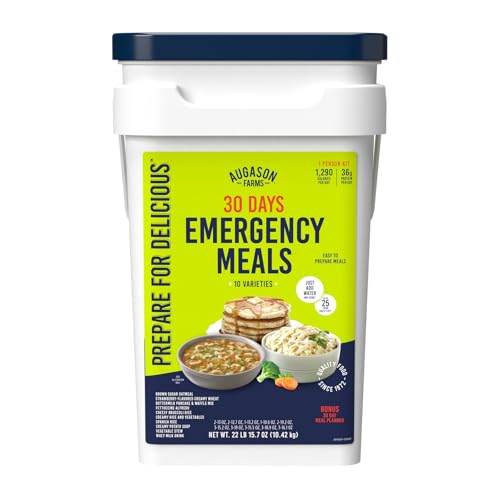
Augason Farms 30 Day Emergency Food Supply Kit, Dehydrated Meal Survival Food Bucket for 1 Person -…
- LONG SHELF LIFE FOOD – Designed to sustain 1 adult for 30 days or a small group for shorter duration, this dehydrated food…
- LOTS OF VARIETY AND NUTRIENTS – Spanning 11 meal varieties and providing approximately 1,290 calories and 36 grams of protein…
Last update on 2026-01-25 / Affiliate links / Images from Amazon Product Advertising API
(As an Amazon Associate, we earn from qualifying purchases.)
Top 5 Emergency Food Kits 2026
We tested these kits for real calorie density, nutritional completeness, and honest labeling. Here’s what actually works for a family of four.
BEST OVERALL EMERGENCY FOOD KIT: ReadyWise 240-Serving Bucket

Total Calories: Approximately 54,000
Actual Days for Family of 4: 6 to 7 days
Shelf Life: 25 years
Price Per Day: Around $12
ReadyWise delivers solid calorie density with decent variety. The serving sizes are more realistic than most competitors. The nutrition is basic but covers the essentials. This is the best all-around choice if you’re building a 30-day supply and plan to buy multiple buckets.
BEST BUDGET EMERGENCY FOOD KIT: Augason Farms 30-Day Supply

Total Calories: Approximately 52,000
Actual Days for Family of 4: 6 to 7 days
Shelf Life: 20 years
Price Per Day: Around $9
Augason Farms focuses on calorie-dense staples like oats, rice, and beans. The taste is bland but functional. If you’re stacking buckets on a budget and plan to supplement with your own seasonings and canned goods, this is your best value.
BEST IN NUTRITION EMERGENCY FOOD KIT: Nutrient Survival Family Pack

Total Calories: Varies by pack size
Actual Days for Family of 4: 10 to 14 days (depending on configuration)
Shelf Life: 25 years
Price Per Day: Around $18
Nutrient Survival is designed by nutritionists, not just food manufacturers. High protein, healthy fats, and bioavailable vitamins. This is the only kit on the market that genuinely covers the Survival Six. If you have young children or elderly family members, the nutritional density justifies the higher price.
BEST IN TASTE EMERGENCY FOOD KIT: Mountain House Just in Case Kit

Total Calories: Approximately 64,000
Actual Days for Family of 4: 8 days
Shelf Life: 30 years
Price Per Day: Around $15
Mountain House is the gold standard for freeze-dried quality. The meals actually taste good. The shelf life is the longest in the industry. If morale matters to your family during a grid-down event, this is worth the premium. The downside is lower calorie density per dollar compared to dehydrated options.
BEST TO BUY IN BULK EMERGENCY FOOD KIT: Ready Hour Number 10 Can Mega Pack

Total Calories: Varies (modular system)
Actual Days for Family of 4: Build your own duration
Shelf Life: 25 years
Price Per Day: Around $10 (when buying in bulk)
Ready Hour sells individual Number 10 cans of staples like wheat, oats, powdered milk, and freeze-dried vegetables. This system lets you customize your nutrition and avoid paying for entrees you won’t eat. Best for experienced preppers who want full control over their macros and meal planning.
Emergency Food Kits: How to Choose Product Type
Freeze-Dried: Best for taste and nutrition. Water rehydrates in minutes. Shelf life is 25 to 30 years. Higher cost per calorie. (Mountain House, Nutrient Survival)
Dehydrated: Best for budget calorie density. Requires longer cooking. Shelf life is 20 to 25 years. Blander taste. (Augason Farms, ReadyWise, Ready Hour)
MREs: Best for grab-and-go when no water is available. Shelf life is 5 to 10 years. Useful for vehicle kits but too expensive for primary storage.
Sale
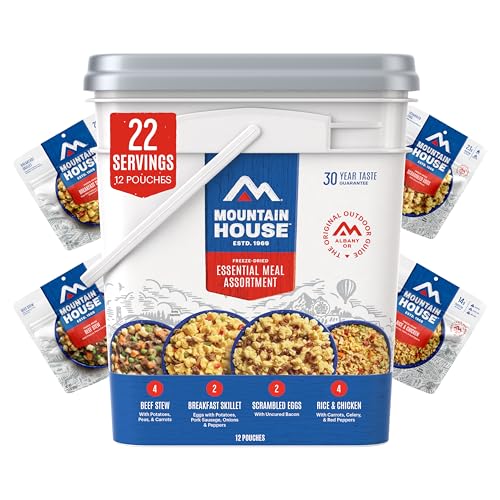
Mountain House Essential Meal Assortment Bucket | Freeze Dried Backpacking & Camping Food | 22…
- BEST-TASTING COMFORT FOOD – Made in the USA since 1969, we have been cooking up your favorite comfort food meals and…
- EASY TO STORE & QUICK PREP – Just add water and eat straight from the pouch in less than 10 minutes, with no cleanup….
Last update on 2026-01-25 / Affiliate links / Images from Amazon Product Advertising API
Food Kits 2026: Storage and Maintenance
Store kits in a cool, dry location. Basements work better than garages. Avoid attics where summer heat degrades nutrition.
Rotate your stock by eating one kit meal per month and replacing it immediately. This keeps your family familiar with preparation methods.
Must-Have Gear: Manual can openers, water filtration (Sawyer or LifeStraw), portable cooking fuel (Jetboil or Kelly Kettle).
Final Verdict
If you need calorie density and long shelf life for winter storms, go with Augason Farms or Ready Hour bulk systems.
If you have young children or need to maintain morale, prioritize taste and nutrition with Mountain House or Nutrient Survival.
If you’re on a tight budget but need 30 days for a family of four, buy multiple ReadyWise buckets and supplement with canned goods and rice.
Secure your family’s food supply today.
DOWNLOAD THE FREE 15-MIN FOOD KIT AUDIT CHECKLIST
Frequently Asked Questions
How much emergency food does a family of four actually need?
A family of four generally needs 7,000–8,000 calories per day, depending on age, activity level, and cold exposure. For a 14-day emergency, that’s roughly 100,000+ total calories, far more than most single “30-day” kits provide.
Why do emergency food kits say “30 days” but last much less?
Most kits calculate days based on serving counts, not calories. When you divide the total calories by what a family actually needs per day, many “30-day” kits only last 6–7 days for a family of four.
Is freeze-dried or dehydrated food better for emergency storage?
Freeze-dried food offers better taste, nutrition, and faster prep, but costs more per calorie. Dehydrated food is more affordable and calorie-dense, but usually blander and slower to cook. Many families use a mix of both.
What nutrients should an emergency food kit include?
A well-rounded kit should provide adequate protein, healthy fats, complex carbohydrates, fiber, electrolytes, and vitamin C. Kits missing several of these are best treated as calorie backups, not complete nutrition.
Should families buy one large kit or multiple smaller ones?
For most families, multiple kits or modular systems work better. This allows you to spread food across locations, rotate supplies more easily, and scale up to a true 14–30 day reserve without relying on a single bucket.