Survival Gear is the most unused product until a natural disaster happens, then it’s the most desired products, but usually too late to help those that really need the help.

We sell around the World, and pride ourselves on offering a level of customer service that we would want to see ourselves if we were shopping online.
Our product ranges change regularly, so we hope that you come back to our sites to see some of the fantastic offers that we regularly have.

Get In Touch

3 Military-Approved Techniques That Will Make You A Better Shooter

3 Military-Approved Techniques That Will Make You A Better Shooter

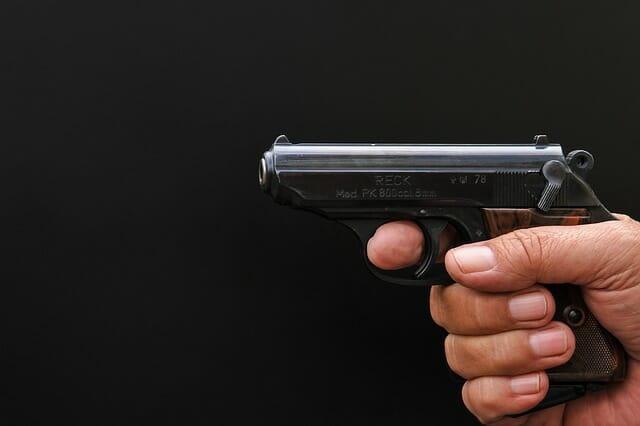
A good trigger squeeze will save you tons of heartache at the range. (Image source: Pixabay.com)

Editor’s note: the writer is an active duty officer in the military.

If you are new to shooting or are unhappy with your shooting abilities, here you will find some basic shooting techniques to become a better shot.

Becoming a better shooter takes more than simply going to the range and shooting. While that will probably help a little bit, the only way to improve is by changing your techniques – techniques I learned early during my military service.

Since I’m directing this article at both skilled shooters and beginners alike, I should say something very important at the outset. Please ensure that you have zeroed your weapon and know how to properly and safely operate it.

One can break proper shooting technique down into three main categories: shooting position, breathing and trigger squeeze.


Shooting Position

Shooting position refers to how you position your body and your weapon while you are shooting. With a long gun, there are a few key things to keep in mind. The weapon should be firmly positioned against your body, in the pocket between your shoulder and your chest. Your head should be pressed against the stock of the weapon in a comfortable spot that you can easily return to each time you shoot. Aiming down the sights becomes much easier and more natural when you position your head in the exact same way each time. Your non-firing hand should have a light grip, but also should be slightly pulling the weapon into your shoulder.

With a handgun, your grip should be the exact same each time you shoot. There are many different ways to hold a handgun. My recommendation would be to practice with all of them until you find what works best for you. Personally, I like to have both of my thumbs on the side of my pistol, pointing downrange. I also like to put a little tension on the weapon by pulling a little with my forward hand against my locked elbow. For me, this limits recoil and makes it easier to reacquire a target.

As far as your body position, you want to have your elbows locked, and you should be in a slightly crouched position so that the weapon is at eye level. Similar to what was mentioned above, get used to shooting in the same body position every time, as it will make aiming come much easier. Usually, when someone has trouble aiming down the sights, it’s because of their body position. Regardless of weapon, get comfortable shooting in the same position. You’ll be surprised how easy it becomes to aim.


Breathing

The next step is breathing. While you are breathing and your arms are in your shooting position, they will naturally move up and down slightly. This causes your weapon to move up and down slightly, which throws off your aiming ability. There are two easy ways to fix this problem. Either hold your breath momentarily to steady your aim or shoot in between exhaling and inhaling. In a controlled situation, shooting between breaths is preferable, but in a high-stress situation, holding your breath will work, as well.

Black Ops Shooting Skills Leaked To Civilians For The First Time — Click Here To Learn More


Trigger Squeeze

The final tip may be the most important. A good trigger squeeze will save you tons of heartache at the range. The fundamentals of a good trigger squeeze are a slow, controlled pull followed by a slow, controlled release. Jerking the trigger back will cause you to twitch the weapon slightly, which results in inaccuracy. Many people teach you to “pull the slack” out of the trigger, which means pulling the trigger back to the final positive block before the firing pin goes home. Practice on your unloaded weapon.

Most weapons have a slight stop in the trigger, right before it engages. After “pulling the slack” out of the trigger and then firing the weapon, keep the trigger held back momentarily. This prevents a jerky release, which once again moves the weapon slightly and interferes with your ability to continue looking down the sights to reacquire your target. Then, slowly release the trigger back to that positive block, ready to shoot again. One last tip on pulling the trigger – try not to anticipate the shot. If you are anticipating the recoil, you will jerk the weapon and have an inaccurate shot.

These three simple tips will almost certainly improve your shooting ability. When I just want to practice shooting, I usually shoot four rounds at a time and judge each iteration to see what I need to improve. You will find that it gets easier and you improve each iteration that you shoot. Practicing shooting using these tips will allow you to develop muscle memory so that in the event the unpredictable does happen, you will be ready to accurately engage the threat.

What advice would you add? Share your tips in the comments section below:

The post 3 Military-Approved Techniques That Will Make You A Better Shooter appeared first on Off The Grid News.

7 Best Pepper Sprays For Self-Defense, Emergencies, And Survival

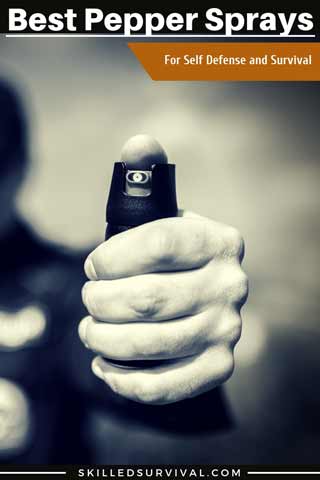
Pepper SprayPepper spray is becoming one of the most popular self-defense weapons available today.

But there’s a lot of confusion and misunderstandings around peppers spray, such as:

  • Can pepper spray REALLY neutralize a dangerous threat?
  • What’s the difference between pepper sprays and heat ratings?
  • What factors matter MOST when choosing a pepper spray for self-defense?

That’s why today, I want to clear the air.

By the time you’re finished reading this article, you’ll know everything you need to know about pepper spray, specifically:

As A Way To Introduce You To Skilled Survival, We’re Giving Away Our Ultimate Survival Gear Checklist. Click Here To Get Your FREE Copy Of It.

PEPPER SPRAY VS FIREARMS


No question about it, firearms are a more powerful form of self-defense than pepper spray if someone is properly trained.

But that’s the issue with firearms, many folks don’t want to take the time to properly train. And some people don’t believe in an armed society.

Plus, firearms are a lethal form of self-defense. This can also make someone hesitant to concealed carry a handgun – even if they own one.

The bottom line is this: firearms come with some extra baggage that doesn’t come with pepper spray.

No, we’re NOT saying YOU should carry pepper spray instead of a gun. You do you.

But there are plenty of people who are more comfortable carrying pepper spray.

Plus, there are situations where pepper spray is the most logical deterrent. Pulling a gun on an unarmed threat might unnecessarily aggravate or elevate the situation.

Many (including military and law enforcement) choose pepper spray as a first option. Then back that up by a more lethal defense (such as a firearm).

This prevents premature escalation in certain circumstances. For example: if the threat is unarmed and/or there are lots of innocent bystanders.

And for some people, carrying a firearm just isn’t an option for moral reasons. Making pepper spray the perfect addition to your nonlethal self-defense arsenal.

Watching the video below provides an excellent example of why EVERYONE can benefit from carrying a professional grade pepper spray:


PROS OF USING PEPPER SPRAY FOR SELF DEFENSE


Affordable Cost

Clearly, even the most expensive pepper sprays are far cheaper than a handgun.

If you want a cost-effective self-defense weapon it’s hard to beat pepper spray.

Fewer Regulations

Yes, pepper spray does have some legal restrictions (based on strength and delivery). But still far fewer than most firearms.

Many locations prohibit firearms (college campuses, national parks, shopping centers, etc.). But these “safe zones” don’t have the same bans on pepper spray.

Plus, pepper spray is simpler to travel with across city or state boundaries.

Where firearm laws (and even knife laws) frequently change from locale to locale.

Easy Concealment

Pepper sprays are generally smaller and lighter than firearms. Even lighter than the smallest and lightest handguns (such as S&W Airweight and Kel-Tec).

Making them easier to carry while working out, running, or even walking the dog.

And some of the most compact pepper sprays are small enough to hang on a keychain.

Note: These mini pepper sprays tend to have very short spray durations…

A Non-Lethal Weapon

Pepper spray is extremely irritating and painful – but not fatal.

It also has a much lower chance of injuring a bystander, which makes it safer to use in a crowd.
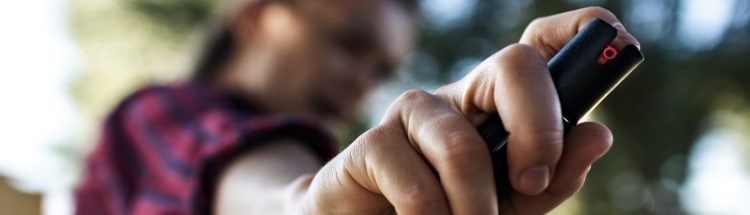
Best Pepper Spray

CONS OF USING PEPPER SPRAY FOR SELF DEFENSE


A Non-Lethal Weapon

While “non-lethal” made the list of pros for pepper spray, it’s also one of the main “cons”.

In some situations, pepper spray may not be enough to stop the most vicious attacker. Especially if they are on drugs that numb their senses or are extremely intoxicated.

If a situation gets out of hand, a perpetrator with firepower is no match for someone with pepper spray.

Reloading (one time shot)

Unlike a handgun, reloading isn’t an option with pepper spray.

Most sprays have a short duration, which means knowing exactly when to use it!

Availability

While pepper spray is becoming more common, it’s still not as easy to find in every sporting good store.

Unlike common handguns and ammo rounds – like the 9mm – which can be found dang near anywhere.

Effectiveness

Not all people will respond to pepper spray – nor will all animals.

With people, this can be due to mental illness, drug abuse, or training.

Plus, face shields, masks, and sunglasses can reduce direct contact with the eyes. Lowering its overall effectiveness ing stopping a threat.

As A Way To Introduce You To Skilled Survival, We’re Giving Away Our Ultimate Survival Gear Checklist. Click Here To Get Your FREE Copy Of It.
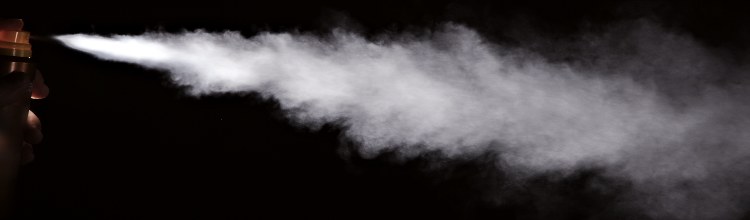
Pepper Gas Spray

KEY FACTORS TO CONSIDER WHEN BUYING PEPPER SPRAY


When choosing pepper spray, there are a few factors you’ll need to be sure to consider.

The Formula

The first, and most important, factor in choosing a pepper spray is the formulation.

There are three major formulas on the market when it comes to self-defense sprays: CN, CS, and OC.

OC (Oleoresin Capsicum)

OC is one of the most common and popular forms of pepper spray. OC stands for Oleoresin Capsicum.

The active ingredient is capsaicin, the same chemical which gives peppers their heat.

Capsaicin acts as an inflammatory agent.

It not only causes pain but also causes instant inflammation of the mucous membranes. This makes it difficult and painful to breathe or even open your eyes.

The remaining ingredients form an oily liquid to help with the delivery of the capsaicin.

The oily liquid means the solution is not soluble in water. So you can’t easily wash it off.

Victims are encouraged to blink excessively to produce tears to help to flush the eyes. They are also told not to touch any other body parts to avoid spreading the substance.

There are wipes available to help remove pepper spray. But your attacker is unlikely to have them on hand fast enough to be useful!

But not all peppers are the same…

Scoville Heat Rating

People who like spicy foods know there are regular peppers, HOT peppers, and INSANELY HOT peppers! And there’s a way to measure these differences, it’s called the Scoville Heat Scale.

You can see from the image below – a bell pepper is essentially harmless, while a Habanero Chili is a very HOT Pepper and a Dragon’s Breath is an INSANELY HOT.
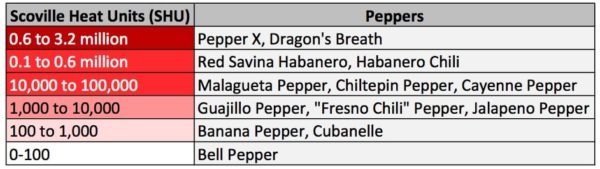
Scoville Heat Unit Scale

Ever heard of the “Scoville Heat Challenge”? – Yeah, it’s as brutal as it sounds:

CS

CS isn’t technically a “pepper spray”, but rather a military tear gas. It can be used alone or in combination with OC spray for added effectiveness.

CS is the most popular since it induces a range of nasty symptoms – from mild tearing to immediate vomiting.

It’s often used for riot control or to force people out of an area. CS can be found in aerosol canisters or can be deployed by grenades.

CN Gas

CN is an older form of tear gas, which has similar effects to CS gas and also includes temporary loss of balance.

The effects of CN tear gas last longer than that of CS. But it can also cause permanent skin and lung damage, so it’s much less common than it was in years past.

Dye Additions

In some pepper sprays, the manufacturers add either a visible or UV dye.

This dye can serve as a marker for your attacker, making ID easier if they run.

This can be helpful for law enforcement, but the visible dyes can also help you avoid them if they try to come back.

Spray Pattern and Range

Another critical factor in choosing a pepper spray is to find the right spray pattern.

The most typical patterns used are spray or mist.

If you have respiratory issues, spray patterns help avoid the risk of accidental user inhalation.

Stream Spray

For accuracy and longer range, some pepper sprays shoot streams of fluid.

This allows you to hit a single attacker without spraying bystanders.

Of course, stream pattern sprays require more training and practice. If you miss, you may have lost your only chance at self-defense.

Mist Spray

A mist spray pattern produces a large cloud of gas which is more easily inhaled. But it comes at the price of a far shorter range.

Since they form a cloud, mist spray patterns do not allow you to target your attacker directly.

This means there is a risk of spraying people other than your attacker. Including yourself, if the mist cloud blows back on you.

Foam Spray

The least common spray pattern is foam.

Foam sprays are difficult to aim and have a shorter range than stream pattern sprayers.

It’s also slower to take effect, so it’s not as useful in most situations. Avoid foam spray patterns unless they’re the only option.

Canister Size Options

Finally, you’ll want to consider the sheer volume of spray you might need.

Stopping a petty thief in the city may require far less spray than a charging grizzly bear in the backcountry.

Think about how you intend to use your spray and pick the right size for your needs.

Small Canisters

Keychain pepper sprays are marketed to runners and college students. These small bottles contain less than a half-ounce of usable spray.

This only gives you a couple of seconds of spray at close range.

Better than nothing, but you can also run out before an attacker has been properly neutralized.

Medium Canisters

Larger sizes tend to come with belt holsters for easy retrieval. Most purses can fit a medium-sized 2oz canister.

These include many backcountry bear sprays and personal defense sprays.

Two ounces of fluid are good for up to 30 seconds of spray and many can achieve accurate patterns up to about 15 feet.

Sure, 15 feet doesn’t feel nearly far enough during an attack. But its good enough as a close-in self-defense weapon.

Remember, you’re aiming at a small target like the eyes and nose, so long-range shots are risky either way.

Large Canisters

There are much larger sprays on the market, but they’re only good for home defense.

Anything larger than 2 ounces is generally too bulky for everyday carry.

Now that we’ve covered all the key features, let’s take a look at some of the best ones on the market today.

7 BEST PEPPER SPRAYS ON THE MARKET TODAY


First off, A lot of people don’t know where to buy peppers spray.

And in the past, this was a problem since many sporting good stores don’t carry it. But nowadays, it’s not difficult to find – you CAN buy it online.

That’s the easiest place to buy pepper spray. And the good news is some of The Very Best Pepper Sprays you can only find online.

For example, the first pepper spray on this list is the one we recommend and can only be purchased online.

1 – Devil Juice Pepper Spray
deviljuiceThis pepper spray claims to be banned in 12 states. That’s why when it comes to nonlethal self-defense, nothing beats Devil Juice Pepper Spray!

Why? Due to it’s insanely powerful 3 million Scoville Heat Rating!

This is the highest legal pepper spray strength and packs a punch so hard your attacker will be begging you to leave them alone!

Note: Possession of this product is regulated or prohibited in some jurisdictions – click here to see if it’s legal where you live.

Check Out Today’s Price


2 – Sabre 3-in-1 Pepper Spray

Just about any list of preferred pepper sprays is going to contain something from Sabre.

They’re a well-known manufacturer trusted by police departments and other law enforcement agencies nationwide.

The 3-in-1 Pepper Spray is one of their most popular offerings, with OC pepper spray, CS tear gas, and a UV dye.

They have a tight stream spray pattern. And they offer an inert practice spray canister so you can train without the risk.

This practice can ensure that in the heat of the moment you don’t fumble with the twist-lock safety or accidentally spray backward!

The included training documents have links to instructional videos and other training tips. These can help you get the most out of your new pepper spray.

The Sabre 3-in-1 also has a good shelf life (4 years) and a low price, so it’s easy to outfit your entire family.

Check Out Today’s Price


3 – Sabre Frontiersman

Sabre is also in the bear spray market.

These sprays are generally larger canisters, have longer ranges, and include higher concentrations.

The Frontiersman delivers on all those fronts.

The 9.2oz canister is huge and hard to conceal. But the 35ft range is amazing compared to the 10-15ft max ranges of most personal pepper sprays.

If you’re in the backcountry a lot or want a good option for home or vehicle defense, this is your best bet!

Check Out Today’s Price


4 – Fox Labs Mean Green

Fox Labs Mean Green trades the UV dye for a highly concentrated, bright green dye.

This immediately colors the skin and clothing of your attacker.

The 3 oz size is available in both stream and spray patterns. Depending on the spray pattern, you can expect a range of 12 to 15 feet.

The Mean Green has metered half-second burst sprays. This provides you with over thirty “shots” without the risk of holding down the trigger until you run out.

Check Out Today’s Price


5 – POM Pepper Spray

This one is for those looking for something a bit more discrete and pocket-friendly.

This POM Pepper Spray is compact and designed to look a little less intimidating.

This makes it a good option for those looking to carry without making it obvious.

It’s a small canister and a closer range than other sprays. But that’s a decent trade-off for being able to carry it in more situations.

Check Out Today’s Price


6 – Wrist Saver Pepper Spray

This pepper spray is made for athletes.

The Wrist Saver is a convenient padded wrist band that contains:

  • a small pepper spray in a holster
  • a built-in LED flashlight
  • some space for ID and other information (or cash)

Of course, it’s a small canister made to fit in a wrist holster. But it’s still capable and worth checking out if you need a portable option for your runs.

Check Out Today’s Price


7 – 3 Pack POLICE MAGNUM OC Pepper Spray Keychain

This 3 Pack Police Magnum Pepper Spray is a great bundle offer for those who want to protect multi-family members.

This is a pepper spray keychainwhich is an ideal size for pockets and purses.

But don’t let the small size fool you, it can deliver over 10ft range in a powerful stream.

It also has added UV Perpetrator marking dye to identify a suspect.

This professional-grade Prepper Spray Keychain Spray is HPLC lab tested before being used in production and sales.

Check Out Today’s Price


HOW TO PROPERLY USE PEPPER SPRAY


No matter how “non-lethal” pepper spray may be, it’s still a dangerous weapon. It can cause serious injury if not handled or stored correctly.

Each model comes with instructions for safe use and handling. Take the time to read through it before heading out into a situation where you may need to use your pepper spray.

One of the first things to learn is how to draw, aim, and release the safety mechanism on your spray canister.

If your model offers a practice canister, this is the best way to learn.

Practice with the inert spray until you can:

  1. Smoothly pull the pepper spray out of your holster or bag
  2. Turn off the safety without fumbling

Proper body position is key to aiming any weapon.

For pepper spray, you’ll want a solid defensive posture. That means your knees are slightly bent and the pepper spray held out in front of your face. This helps with your line of sight during aiming.

This balanced, athletic posture will help your accuracy.

When you press the trigger, resist the urge to close your eyes. This only serves to interrupt your aim at the worst possible time.

Spray in a slight “back and forth” pattern, as if spray painting a surface.

This helps ensure that you don’t miss smaller targets like the eyes and nose.


Always remember, pepper spray isn’t an absolute.

Be sure to keep your eyes on your target. But be ready to elevate the fight or flee if your attacker doesn’t back down.

Finally, here’s a good video on the DO’s and DON’Ts of pepper spray:


HOW TO MAKE PEPPER SPRAY


Yes, you CAN make your own pepper spray. But it’s highly unlikely you’ll make it as powerful or as good at delivery as commercial brands.

But if you still want to pursue making your own – read our step by step article.

As A Way To Introduce You To Skilled Survival, We’re Giving Away Our Ultimate Survival Gear Checklist. Click Here To Get Your FREE Copy Of It.

FINAL THOUGHTS


Pepper spray might not have the reputation that other self-defense weapons enjoy. But they should!

The best ones have powerful high concentration formulas. And ease of use makes them an attractive option for anyone.

From backcountry defense against bears to people intent on doing you harm. There are plenty of options on size and range to suit any situation.

It’s a smart move to add pepper spray to your EDC bag, get home bag, bug out bag, your vehicle’s glove box, and even your home.

Jason K.

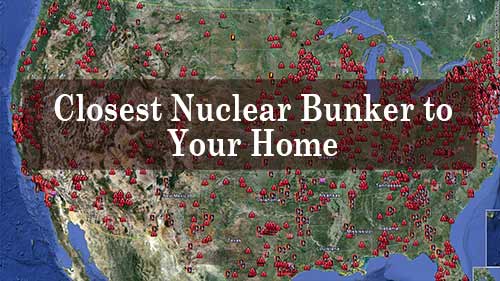
P.s. Do you know where the closest nuclear bunker is from your home?

There are a lot of natural nuclear shelters in the US that are absolutely free. And one of them is near your home.

Click on the image above to find out where you need to take shelter.

The post 7 Best Pepper Sprays For Self-Defense, Emergencies, And Survival appeared first on Skilled Survival.

National Geographic Admits Billions Of People Will “Face Shortages Of Food And Clean Water” Over The Next 30 Years

A lot of people out there don’t like when I write these kinds of articles, because they directly contradict the false narrative that humanity has an extremely bright future ahead.  Sadly, the truth is that our planet and everything that lives on it is rapidly deteriorating.  And I am not talking about the false environmentalism being pushed by the mainstream media, Greta Thunberg and countless well-funded NGOs.  What I am talking about is the stuff that is happening right in our face.  We are systematically poisoning our planet, thousands upon thousands of species are going extinct, and we are literally running out of all of our most important natural resources.  There isn’t going to be enough of anything in the not too distant future.  In fact, even National Geographic is admitting that up to five billion people could soon be facing “shortages of food and clean water”…

As many as five billion people, particularly in Africa and South Asia, are likely to face shortages of food and clean water in the coming decades as nature declines. Hundreds of millions more could be vulnerable to increased risks of severe coastal storms, according to the first-ever model examining how nature and humans can survive together.

“I hope no one is shocked that billions of people could be impacted by 2050,” says Rebecca Chaplin-Kramer a landscape ecologist at Stanford University. “We know we are dependent on nature for many things,” says Chaplin-Kramer, lead author of the paper “Global Modeling Of Nature’s Contributions To People” published in Science.

The clock is literally ticking for humanity, but meanwhile we spend immense amounts of energy on relatively meaningless political squabbles.

Look, the reality of the matter is that this is going to happen no matter which political party is in control of the White House.  We are in very big trouble, and nobody really has any idea how we can possibly turn things around.

At this point, we are running out of topsoil at a staggering rate.  In fact, we have already lost “nearly half of the most productive soil” within the last 150 years

The world grows 95% of its food in the uppermost layer of soil, making topsoil one of the most important components of our food system. But thanks to conventional farming practices, nearly half of the most productive soil has disappeared in the world in the last 150 years, threatening crop yields and contributing to nutrient pollution, dead zones and erosion. In the US alone, soil on cropland is eroding 10 times faster than it can be replenished.

If we continue to degrade the soil at the rate we are now, the world could run out of topsoil in about 60 years, according to Maria-Helena Semedo of the UN’s Food and Agriculture Organization.

So do any of you have a viable plan for how we can stop losing our topsoil?

Because if nobody has a plan, mass starvation is an absolute certainty.  Even if we found a way to save our topsoil, we aren’t going to have anyone to pollinate our crops because all of the insects are dying.  I covered this phenomenon in a previous article entitled “Insect Species Are Rapidly Going Extinct Across The Globe – All Insects Could Be Gone ‘In 100 Years’”.

And without enough insects to eat, the bird population is rapidly declining as well.  This is something that I wrote about in a previous article entitled “North America’s Bird Population Is Collapsing – Nearly 3 Billion Birds Have Been Wiped Out Since 1970”.

Despite all of our advanced technology, we can’t seem to do much of anything to stop the death and decay that we see all over the globe.

Even the human race is steadily deteriorating.  Scientists tell us that humans are now smaller, shorter, weaker and dumber than our ancestors were thousands of years ago.  Today, our genes contain tens of thousands of mistakes (mutations), and those mistakes are passed on to the next generation.  And each new generation adds additional mistakes (mutations) to the gene pool, and so over time the number of mutations being passed on continues to grow.  In virtually every case those mutations are harmful, and we have absolutely no way to stop this systematic decay of the human genome.

Literally, our planet and everything in it is falling apart.

Here in the western world, things may seem okay for the moment because our debt-fueled lifestyles and our advanced technology allow us to live fairly comfortable lives.

But things are already starting to change, and global events are accelerating at a pace that is very alarming.  As the fabric of our society unravels, it is going to be imperative to have others that you can lean on for support.

Unfortunately, making friends is not something that most of us are very good at doing.  In fact, one recent study discovered that the average American adult “hasn’t made a new friend in the last five years”

Spending time in the company of good friends regularly has been shown to have a positive impact on health. But for many Americans, socializing in adulthood gets harder with age. A recent survey reveals that 45% of adults admit they find it hard to make new friends. In fact, the average adult hasn’t made a new friend in the last five years, according to the survey.

In this day and age, our screens have become our friends.  We spend countless hours with our televisions, our phones and our computers.  Meanwhile, many of us don’t have any idea how the people living right next door are doing.

One of the reasons why I write so many articles is because that is how I can reach the most people.

If the most effective way of waking people up was traveling the country and holding meetings, I would do it.

But these days it is exceedingly difficult to get people to leave their homes and go to a meeting.  But once I publish this article on the Internet, it will be seen by enough people to easily fill a sports stadium.

The Internet is where the battle for hearts and minds is being won or lost, and we need to do all that we can to wake more people up.

Because the clock is ticking for humanity, and the destiny of billions hangs in the balance.

About the author: Michael Snyder is a nationally-syndicated writer, media personality and political activist. He is the author of four books including Get Prepared Now, The Beginning Of The End and Living A Life That Really Matters. His articles are originally published on The Economic Collapse Blog, End Of The American Dream and The Most Important News. From there, his articles are republished on dozens of other prominent websites. If you would like to republish his articles, please feel free to do so. The more people that see this information the better, and we need to wake more people up while there is still time. Of course the most important thing that we can share with people is the gospel of Jesus Christ, and if you would like to learn more about how you can become a Christian I would encourage you to read this article.

The post National Geographic Admits Billions Of People Will “Face Shortages Of Food And Clean Water” Over The Next 30 Years appeared first on The Economic Collapse.

The Shocking Truth About Trump’s “Trade Deal” With China

We have a trade deal with China!  Well, except that nothing has actually been written down, nothing has actually been signed, the potential deal won’t really require any major concessions from China, but it did allow the Chinese to achieve a couple of key goals that they really wanted.  But other than that, the good news is that the Trump administration now has a “trade deal with China” to tout as a “major accomplishment” to voters.  And without a doubt, in the short-term this will calm the financial markets and ease some of the pressures on the global economy.  Certainly it appears that there should be no further escalations in our trade war with China over the next few months, and that is definitely a bit of good news worth celebrating.  Following the announcement of this potential deal, stock prices started surging, and the Dow Jones Industrial Average ended the day up more than 300 points.  We haven’t seen this much optimism on Wall Street in some time, and things certainly seem brighter for investors in the short-term.

But let there be no doubt – this is not even remotely in the neighborhood of being the sort of “comprehensive trade deal” that the Trump administration originally wanted.

Instead, it is a very, very limited potential deal that is still being worked on

President Donald Trump announced a trade deal, in principle, on Friday afternoon with Chinese Vice Premier Liu He the U.S. says will be rolled out in two or three parts.

The agreement postpones a tariff increase scheduled for Oct. 15 and could halt additional penalties scheduled to go into effect just before Christmas.

‘We’ve come to a deal, pretty much. Subject to getting it written,’ said Trump in the Oval Office of what he described as phase one.

Oh, it isn’t actually “written” yet.

Apparently, phase one of this “trade deal” will be written over the next three weeks.

But most Americans don’t pay attention to the details, and all they will hear is that we have a “trade deal with China”, and that will certainly help Donald Trump politically.

So when phase one is eventually put down on paper, what will it actually do?

Well, the truth is that it won’t actually do very much

The initial deal, which Mr. Trump said had been reached “in principle” would involve China buying $40 billion to $50 billion worth of American agricultural products, along with agreeing to guidelines on how it manages its currency. The agreement also includes some provisions on intellectual property, including forced technology transfer and would give American financial services firms more access to China’s market, the president said.

In exchange, the United States will not go ahead with plans to raise tariffs on $250 billion worth of Chinese goods to 30 percent next week.

We’ll see what the “provisions on intellectual property” ultimately look like, and I have to say that I am skeptical, but if China agreed to some substantial changes in this area that could potentially be a positive thing for U.S. companies.

But other than that, this “deal” seems very tilted toward the Chinese.

For China, one of the main goals in these negotiations was to get the Trump administration to roll back the tariffs that were about to be implemented and to get the Trump administration to agree not to impose any additional tariffs.  These tariffs are very damaging for the Chinese economy and are the primary instrument of leverage that the Trump administration possesses in this trade war.

So for China to be able to essentially get a freeze on tariffs was a big win for them.

Without the threat of more tariffs, the Chinese can continue to run out the clock on the Trump administration and wait for a Democrat to be elected in 2020.  The Chinese will continue to do a lot of “talking” and “negotiating”, but they won’t agree to any sort of a comprehensive trade agreement until they can get someone that they consider to be more “reasonable” in the White House.

Oh, but we really stuck it to them by forcing them to purchase “$40 billion to $50 billion worth of American agricultural products”, didn’t we?

Well, no, we didn’t.

Let me tell you a secret.

The Chinese actually want to buy our agricultural products.  In fact, since millions upon millions of their pigs have been dying from African Swine Fever, the truth is that they desperately need U.S. pork products.

So this is essentially a case of throwing the Chinese into “the briar patch”.  The Chinese knew that our farmers desperately need to sell our agricultural products to them, and so they quit buying them temporarily in order to get leverage on the Trump administration.  But this is something that the Chinese were always going to compromise on, because they have a great need for what our farmers are producing.

In the short-term, this is a big win for the Chinese, it is a win for U.S. farmers, and it is a win for the Trump administration because they now have their “trade deal with China” and the stock market is soaring once again

Stocks ended higher Friday after President Donald Trump said China and the U.S. reached the first phase of a substantial trade deal that delays tariff hikes that were set to kick in next week.

The Dow closed 319 points higher, while the S&P 500 rose 1.1% and the Nasdaq gained 1.3%. The gains helped the Dow and S&P 500 snap a three-week losing streak. The Dow and S&P 500 gained 0.9% and 0.6%, respectively, for the week. The Nasdaq ended the week up 0.9%.

But it appears that this trade deal doesn’t really do much of anything to address our long-term problems with China, and we are being told that “expectations for a major breakthrough” are “still low”

Beijing’s vice premier is in Washington leading the 13th round of negotiations with Mnuchin and U.S. Trade Representative Robert Lighthizer. Expectations for a major breakthrough in the 15-month standoff are still low.

The two sides are deadlocked primarily over the Trump administration’s assertions that China steals technology and pressures foreign companies to hand over trade secrets as part of a sharp-elbowed drive to become the global leader in robotics, self-driving cars and other advanced technology.

In the end, this very limited “deal” gives the Chinese what they want in the short-term and it allows them to continue to delay any sort of resolution on the most important trade issues.

The Chinese got just what they wanted, but here in the United States it will be spun as a big win for Trump by the White House.

And Trump certainly needs some good news right now, and so it is hard to blame him for grabbing this deal.

But let’s not lose sight of what is really going on here.  The coming tariffs have been put on hold, and meanwhile no “agreement” has even been drafted yet.  I think that the current state of affairs was summarized very well by Sven Henrich

We have no agreement.
We have nothing in writing.
We have agreed to discuss a process on how to consult during which we will discuss what to agree upon.

Now get ready for phase 2 and meeting #14.

Trade wars are easy, didn’t I tell you?

And nothing that happened this week has changed the long-term outlook even one bit.

The global economy is still slowing down, and our financial system is still the most vulnerable that it has been since the crisis of 2008.

About the author: Michael Snyder is a nationally-syndicated writer, media personality and political activist. He is the author of four books including Get Prepared Now, The Beginning Of The End and Living A Life That Really Matters. His articles are originally published on The Economic Collapse Blog, End Of The American Dream and The Most Important News. From there, his articles are republished on dozens of other prominent websites. If you would like to republish his articles, please feel free to do so. The more people that see this information the better, and we need to wake more people up while there is still time. Of course the most important thing that we can share with people is the gospel of Jesus Christ, and if you would like to learn more about how you can become a Christian I would encourage you to read this article.

The post The Shocking Truth About Trump’s “Trade Deal” With China appeared first on The Economic Collapse.

4 Deadly (And Easy-To-Make) Self-Defense Weapons

melee weapons

Homemade Melee Weapons

Guns have been referred to as “the great equalizer,” and there’s no weapon which can come close to them in that regard. A lot of the popularity of firearms is due to the fact that anyone can use them effectively, not only the strong and agile. The young, the old, men, women and child can take up firearms in defense of home and family and do so effectively.

But what do you do if you can’t use a gun – or if you don’t have a gun — to protect yourself?

It only makes sense to have a backup plan. That way, in the case that a firearm malfunctions, you run out of ammunition or somehow get separated from your weapons, you still have a way of defending yourself and your family.


Common Alternate Weapons

When people think of alternate weapons, they either think of non-lethal weapons or they think of two of the most common weapons in history. Those are the knife and the bow. Both are excellent weapons, but they have one drawback as a secondary weapon: They require extensive training to use effectively. Unless you are willing and able to spend the necessary time to become proficient with them, owning those weapons really isn’t much of a benefit.

The non-lethal weapons, such as a taser and pepper spray, don’t require much in the way of training, but are extremely limited in range. This makes them a poor choice for more than avoiding a mugger or rapist. Even then, I’m not all that sure how effective they would be, unless you were able to catch the assailant off-guard and use them. They would not be effective in a situation where there was a breakdown of society and you had to defend your home.


Introducing Melee Weapons

Melee weapons are weapons created for the purpose of use in a melee. According to Dictionary.com, a melee is “a confused hand-to-hand fight among several people.”

There are two basic problems with being caught in hand-to-hand combat. First of all, the person who has practiced with his or her weapon has a distinct advantage. Second, the advantage always goes to those who are stronger and have a longer reach. That makes hand-to-hand combat a bad place to find yourself, especially if you don’t have an equalizer with you.


Handheld Solar Generator Provides Dependable Backup Power 


Berserker Weapons – a Sub-Category of Melee Weapons

Criminals use their weapons primarily to intimidate. That’s why many use a knife. They aren’t expert knife fighters, nor do they really want to gut you like a fish, regardless of what they say. They want to scare you with that knife. Even so, they aren’t really all that concerned about hurting you. So, the worst thing you can do is meet them without a weapon or with a knife, giving them the advantage.

Okay, so what do you use? That’s where the weapons below come in. These melee weapons could also be referred to as berserker weapons, because they are the type of weapons that you just go berserk with. While training would help, the main idea is to just beat on them with the weapons. Violence, not training, gives you the advantage.


Making Simple Melee Weapons

What’s the advantage of these weapons? Simple: It’s reach. If a criminal is coming at you with a knife in his hand, the reach is limited to the length of his arm. On the other hand, if you are holding a weapon that’s two or three feet long, you’ve got a longer reach than they do, even if your arms are shorter. So, when it comes down to it, you’ve got the advantage.


1. The Quarterstaff

The quarterstaff is just a wood pole. Perhaps it is easiest to think of it as a long walking stick. Originally, they ran from six- to nine-feet long; but in reality, it’s hard to work with one that’s more than six-feet long. You’re likely to spend more time hitting the ground than you are your assailant.

weapon 1 -- rich

Simple Homemade Melee Weapons

In the Middle Ages, when one wanted a quarter staff, they simply cut off an appropriate tree branch or sapling, about two to three inches in diameter. It should be fairly stiff wood, but lightweight. The biggest trick is finding a long-enough branch that is straight. I tried a willow branch and it was too flexible. Then I tried an oak branch and it looked like a crooked finger. The best I did was to improvise one by grabbing a closet rod. This works if you have wood closet rods. The metal ones have built-in hangers on the ends, so they are a bit awkward as a quarterstaff.

In use, the quarterstaff is held in both hands, dividing the staff in three sections. The middle section is used for blocking and both of the ends can be used for striking. A sweeping blow from a quarterstaff carries enough force to cause considerable pain or even knock an opponent unconscious. An assailant with a knife doesn’t stand a chance.


2. The Axe

Although not something you normally make yourself, the axe is a natural berserker-style melee weapon, especially the axes they had in olden times. Modern axes aren’t quite as good, because the blade is extremely short, but axes in olden times had a much longer blade.

A warrior armed with an axe could put fear into the heart of an experienced swordsman. That’s because there is no art or science in swinging an axe. More than anything, the axe is held in two hands and swung with pure wild abandon. This makes the axe-wielding warrior unpredictable; therefore, it’s hard to counter in battle. The longer the handle on the axe and the heavier the head, the more that damage can be inflicted.

If you want to use an axe as a weapon, I’d recommend buying a double-bitted axe. A standard woodcutting axe has two things against it. First of all, the head is off-balance, with almost all the weight to one side. That will tend to make that side turn downward, rather than being naturally pointed at the enemy. Secondly, the handle is curved, which is great when you’re cutting a tree, but horrible when you’re using it as a weapon.

The modern incarnation of the tomahawk really isn’t at all like an axe. First of all, it’s mostly intended to be a throwing weapon. But even when used in the hand, it is a single-handed weapon for striking; you really can’t go crazy with one, like you can with an axe.


3. Spear

The spear is another very simple weapon. Spears have evolved throughout the history of warfare, being one of the first actual manufactured melee weapons. Those early spears were about four to five feet long and hard wood points. American Indians chipped stone points for their spears, and the Europeans made metal points for them, once they learned how to work metal. In the later Middle Ages, spears became much longer, as they were intended to be used against men on horseback.

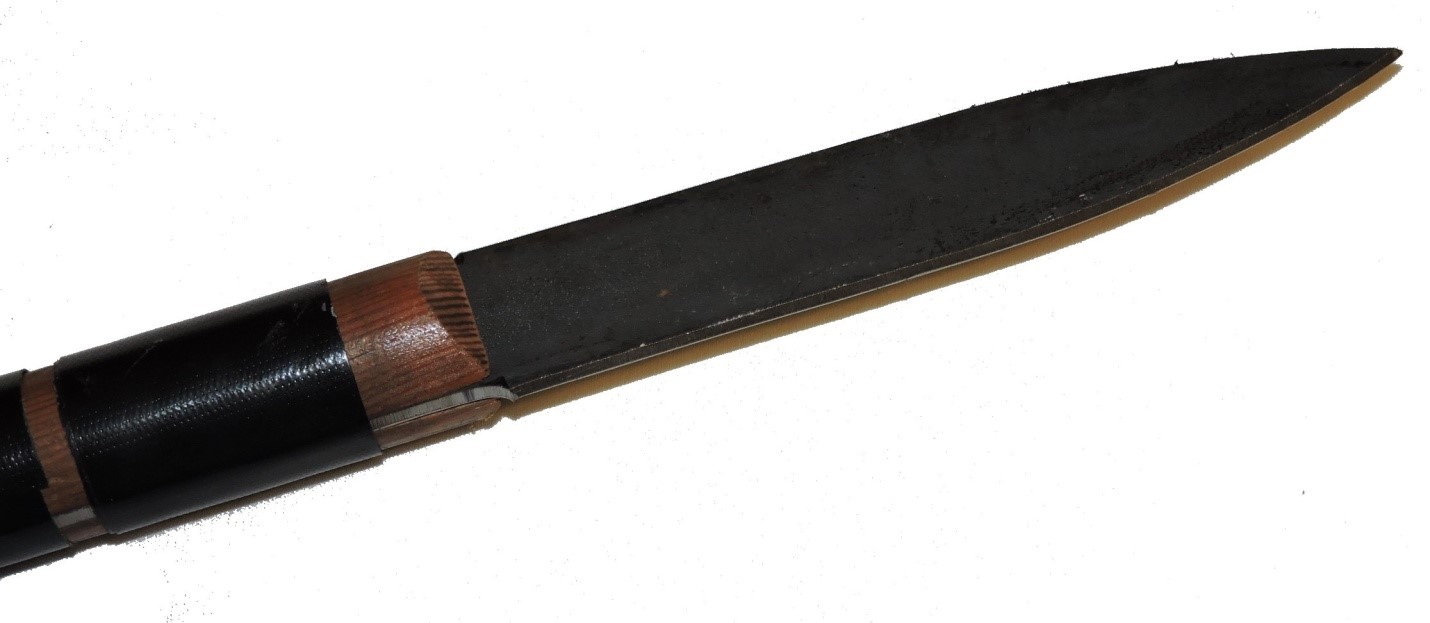
For a melee weapon, a four- to five-foot long spear works well. You can make one easily by taking a knife blade (with the handle removed) and inserting it in a slot cut into the end of your spear shaft. Binding the blade in place with strong cord, strapping or duct tape would finish off the spear. Not fancy, but functional.

It is easy to make your own spear point by grinding a piece of metal, much as I explained in the article on how to make your own knives. As an alternate plan, you could grind a spear point from a piece of 1/8-inch thick steel strap. The edges don’t have to be as sharp as they are for a knife, since spear is mostly a piercing weapon.


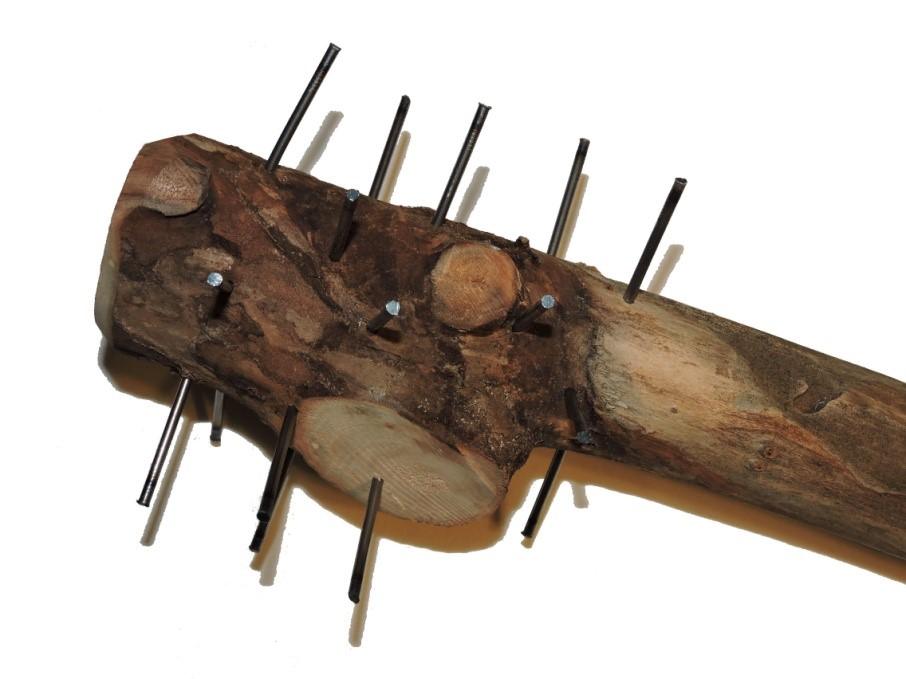
4. Spiked Club

Man’s oldest melee weapons were the rock and the stick. The stick gave the advantage of reach over the rock held in the hand, but in turn the rock could be thrown, giving an even greater reach. Many of our weapons can trace their roots all the way back to those two basic weapons — none more obviously than the club.

A club is merely a heavy stick. Weight is important, especially at the striking end of the stick. The weight improves the velocity and force of the impact. Another thing that helps a lot is to put spikes on the business end of the club. Then, not only does the club provide blunt-force trauma, but also piercing trauma when it strikes.

All you have to do to make a spiked club is find an appropriate piece of tree branch for the club itself. This may require a little bit of whittling on the handle end, to make it thin enough to get a good grip on. You can then hammer nails into the striking end of the club for spikes. Cut off the heads of the nails and then grind points on them to complete the spikes.

Don’t worry about making your spiked club pretty; generally speaking, the uglier they are, the better they work. Oh, and, the easiest way to grind points on your spikes is to grind their ends at an angle, rather than trying to grind them to a conical point.

What is your favorite alternative weapon? Share your tips in the section below:


The post 4 Deadly (And Easy-To-Make) Self-Defense Weapons appeared first on Off The Grid News.

The Rumors of My Demise are Overrated

Written by Wild Bill on The Prepper Journal.

Though I can certainly understand how they started.

Due to events in my life The Prepper Journal site needed to take a seat in the back of the bus as I reviewed where all this was going and how best to move forward.

I would like to emphasize that the site is NOT being shut down, so there is no compelling need to cache content.

Running the content treadmill is simply a lot of work and I needed to take a break to re-evaluate how to produce and organize content better.

Please stay tuned for further updates and a return to quality content from The Prepper Journal.

Wild Bill

The post The Rumors of My Demise are Overrated appeared first on The Prepper Journal.

Protecting Your Shelter for Personal and Financial Survival

Oh, a storm is threat’ning
My very life today
If I don’t get some shelter
Oh yeah, I’m gonna fade away – Rolling Stones

Mick Jagger, in Gimme Shelter, sings of the importance of having shelter from external threats. Shelter is a topic that doesn’t get the level of attention in prepper circles that food storage or firearms might get, but that doesn’t make it any less important. In fact, if you look at Maslow’s Hierarchy of Needs, a five-tier psychological theory of human needs, Maslow establishes Physiological Needs (food, water, warmth, and rest) and Safety Needs (security and safety) as the first two most critical human needs. It’s clear how shelter is a key component of these two layers of human survival. Shelter provides warmth, rest, and protection.
By Derrick of Prepper Press

Using Maslow’s theory, shelter is as important as food and firearms (security). So why don’t preppers discuss it with the same level of importance? Perhaps it’s because most people assume it’s a need that’s already covered. We live in our house, for example. That’s where we’ll bug in and ride out the storm, whatever “storm” that might be; or maybe we’ll bug out to that “cabin in the woods” so many people dream about.

Bushcraft Shelter

The bushcraft prepper gives shelter far more attention than other preppers might. They know that surviving in the wild requires constructing a shelter from the materials surrounding you. The bushcraft prepper knows how to construct a lean-to shelter out of evergreen branches in order to stay dry, or how to make a snow cave to escape winter wind and frigid temperatures. Short of the bushcraft circles, preppers generally take shelter for granted.

Also Read: How To Build A “Hurricane Katrina” Rifle

But isn’t taking something for granted contradictory to prepping? Prepping is founded in the very idea of not taking everything for granted. Otherwise, why would we prep in the first place? However, Bushcraft shelters, while important in wilderness survival, is not what this post is about. This post is about your most important shelter, your everyday shelter, your house, apartment, or condominium. This post is about protecting “home,” however you define that. It’s about… sheltering your shelter.

Why Your Primary Shelter Should Not Be Taken for Granted

We often overlook threats to our residence. We might look at how we’ll protect ourselves within our shelter, but not how we protect the shelter itself. This is unfortunate. As preppers, we are doing ourselves a disservice if we are gearing up for an EMP or civil unrest, but ignore the far more common threats facing us: natural and man-made disasters, job loss, and crime. These threats happen far more often and forever will happen far more often.

As an example, according to the U.S. Fire Administration, in 2017, the United States had 1,319,500 fires, which resulted in 3,400 deaths. That means while preppers are stockpiling food for an apocalypse that will hit some day, fires—and the deaths resulting from them—are happening every day.

Thus, if you are prepping in order of most-likely scenario to least-likely scenario, your preps should start with the far more mundane subjects. It’s less exciting, but it’s more practical.

Shelter Your Shelter from Natural and Man-Made Disasters

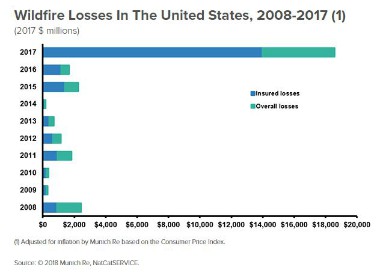
Natural disasters that threaten your shelter include wildfires, hurricanes, earthquakes, etc. You need to examine the threats that are most apt to strike the area in which you live. Let’s take wildfires as an example. See here the financial losses from 2008 to 2017 in the United States:

2017 resulted in a dramatic increase! Is this the new norm? If so, it’s important to take precautions!

The first step toward reducing risk could be examining your shelter itself, where it’s located, how it’s constructed, and what surrounds it. If you live in a wildfire-prone area, you may want to build a fire-resistant house from the outset (you may be required to by code) or you could choose appropriate materials as you update your home’s exterior.

Headwater Economics, and independent research group, has a downloadable .pdf on building a wildfire-resistant home. A building’s roof, as an example, is the most vulnerable area. Building with fire-resistant materials costs more than conventional materials; but on the flipside, those materials are often of higher-quality and don’t need to be replaced as often.
Another step toward reducing risk, and these steps apply to all natural disasters, is looking at your insurance policy. If you own a house or condo, does your home owner’s insurance cover all the threats you could face? If you rent, do you have renter’s insurance that offers enough coverage?

Related: Walking Around Rifle

Note: A standard policy won’t provide coverage if you have water damage from flooding. This is a hard reality many people learn about only after tragedy has struck! If you are in a flood zone, make sure you have a flood damage rider or get a separate flood insurance policy.

The same applies to man-made disasters. Fire isn’t limited to natural causes. Fire detectors and carbon monoxide detectors are snoozer subjects, but they’re critical. Are your detectors hardwired? Do you even have detectors? What about fire extinguishers? Do you heat with wood? Woodstoves are notorious for causing unintended fires. If you do heat with wood, do you have the recommended safe space around the stove where an errant spark won’t cause fire? These are all things to consider as you ponder natural and man-made disasters. Assess your shelter’s weaknesses.
Shelter Your Shelter from Job Loss

Foreclosure rates are very low, but not that long ago, during the Great Recession, it seemed like everyone knew someone that was in foreclosure. According to Bankrate, foreclosure filings for 2018 were reported on one out of every 215 homes. Compare that to 2010, when roughly one in 47 homes was in foreclosure. With rumblings of another recession on the way, those with questionable job security might be wondering how to guard against foreclosure.

First, don’t overextend yourself, whether that’s buying more home than you can afford in the first place, buying more car/truck than you need or can afford, or spending frivolously at the expense of building a financial safety net. Having enough money to cover a job loss or unexpected expenses is Prepping 101.

Second, while interest rates are low right now, and they might go even lower, if you have an adjustable rate mortgage, lock in a fixed rate before they can go up. Predictability is your friend.

Third, don’t go underwater on your home. Don’t spend more than the house/condo is worth, and don’t take out loans against it that don’t increase the home’s value. If real estate prices go down, you could end up owing more than the property is worth. Then, when you must sell, you can’t sell at a profit and face foreclosure.

Shelter Your Shelter from Crime

Home burglaries are not uncommon and are difficult to solve. Burglars are seldom caught, and stolen goods are seldom recovered. This assume that no one is home at the time of the burglary. If you or a loved one is home, the situation can turn out far worse than just stolen goods. Here are some ways to protect your shelter from crime.

  1. Keep your home well-lit. This means motion-activated lights, ideally solar lights as they are cost effective and continue to function when the power goes out. You can also program your home’s lighting inside, to create the illusion that someone is home. Lights can be automated or controlled with a mobile app.
  2. Fortify access points. The saying goes that a lock will only keep out an honest person. While I believe that is true, there is no need to make access easier for criminals. Are your doors fortified with strike plates? Are basement windows easy to open? Are windows locked? Walk around your home and imagine yourself as a thief trying to get in. Where would you enter? What would you use? Is there a ladder stored next to the garage making access to upstairs windows easier? Is there an ax next to your wood pile? Lock up any tools that could be used.
  3. Don’t stash a key. Faux rocks, under doormats, under plant pots, atop door frames – people are not stupid. If you find yourself forgetting your key often, give one to a trusted neighbor, or install a door lock with a keypad.
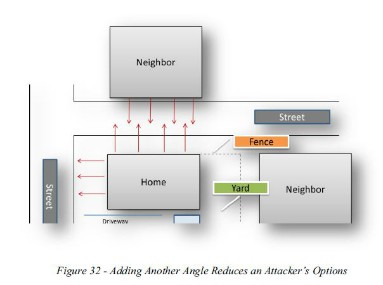
  4. Maintain your shelter’s surroundings. Move large shrubs next to the house where someone could hide. Keep your yard maintained so people know there is ongoing activity at your home. If you own a security system (or even if you don’t), put up a sign indicating the home is protected.
  5. Get home protection. Whether you decide to keep a handgun or shotgun for home defense, pepper spray, or a pack of Dobermans, make sure that you have something.

Shelter Your Shelter from the Apocalypse

Protecting your home from all the threats associated with a serious SHTF or TEOTWAWKI event is a bigger hurdle than those mentioned above. This is the stuff post-apocalyptic movies are made of. If you assume that roaming bands of thugs will go house-to-house looking to rape and pillage, you have an uphill battle. This threat is, of course, far less likely to happen, but it’s the type of threats that many preppers envision.

Also Read: How To Bug Out From Mother Nature

The details of how to protect one’s home in such a situation goes beyond the scope of this post, but it typically involves a lot of firepower, family, friends, and neighbors. You need others in such a situation. You cannot stay awake at all hours guarding your property. The best, single-source of information on this subject can be found in Joe Nobody’s best-selling book, Holding Your Ground.

Shelter Summary

Discussing shelter, homeowners insurance, and outside lighting isn’t as fun as debating the ten best guns for survival, but it’s a necessary one. Preppers that begin their prepping efforts by equipping themselves for an extended TEOTWAWKI event are prepping in the reverse order. Start with the lower hanging fruit, the more likely scenarios, and work your way up to the bigger threats. Not only does this make more sense, but it is more economical. Also, many of those more elementary steps will better situate your shelter for the more advanced threats.

Please Visit Amazon Affiliate Sponsors of SHTFBlog.com

There Is A Lot Of Speculation That John Bolton Is The “Second Whistleblower”

I knew that John Bolton was going to be trouble the moment President Trump hired him.  Nothing good was ever going to come from having John Bolton as National Security Advisor, and fortunately Trump rejected almost every major recommendation that Bolton made during his entire tenure.  If Trump had gone along with Bolton’s agenda, we would probably be at war right now.  Being so close to the levers of power and being unable to move his agenda forward time after time was very frustrating for Bolton, and since he was fired by Trump he has been on a “revenge tour”.  But would Bolton go so far as to completely betray Trump by becoming the “second whistleblower” regarding the controversial phone call with the president of Ukraine?  There is now a lot of speculation among conservatives that this could be the case, and so far Bolton has not publicly denied being the “”second whistleblower”.  That doesn’t mean that Bolton is guilty, but if I was President Trump he would be the number one suspect on my list.

Let’s start with the facts as we have them at this hour.  It is being reported that a “second whistleblower” has come forward, and that he is being represented by the same legal team that is representing the “first whistleblower”.  The following comes from Breitbart

On Sunday’s broadcast of “This Week,” host George Stephanopoulos opened his show with a report proclaiming a second “whistleblower.”

Stephanopoulos said, “Good morning. Welcome to ‘This Week,’ a week of head-snapping developments. The first key witness testimony to Congress. the first release of text messages from administration officials confirming the pressure campaign or Ukraine outlined in the original whistleblower complaint. That public request from President Trump calling on China to investigate Joe Biden. A new request for documents from Vice President Pence. This morning more breaking news. ABC News has learned that the legal team representing the first whistle-blower is now representing a second whistleblower. Attorney Mark Zaid said he is a member of the intelligence community with firsthand information on some of the allegations at issue.”

The original whistleblower hired “a former Schumer and Hillary Clinton staffer” named Andrew Bakaj to represent him, and we also know that Bakaj has given money to Joe Biden’s presidential campaign.

Following the revelation of this “second whistleblower”, Bakaj confirmed on Twitter that his firm is now representing “multiple whistleblowers”.

So let’s summarize what we know so far.

-We know that the second whistleblower is a “he” according to attorney Mark Zaid.

-We know that the second whistleblower has at least some “firsthand knowledge” about the call with the president of Ukraine.

-We know that the second whistleblower has been a member of the intelligence community.

-We know that the second whistleblower is clearly not loyal to Trump.

John Bolton certainly fits that profile.

Can any of you think of another potential suspect?

Of course in Washington there are always more suspects, but it is interesting to note that Trump has apparently been very suspicious of Bolton for quite some time now

One veteran political consultant in Washington tells Cockburn that Trump is afraid Bolton is the mastermind behind all the damaging leaks on his secret dealings with the Ukrainians; the whistleblower’s Deep Throat, if you will. This, he believes, is why Trump’s cheerleader in the Senate, Lindsay Graham, keeps asking who was feeding the CIA whistleblower who came forward with details of a call between Trump and the Ukrainian president (in which Trump asked for dirt on the Democratic frontrunner, Joe Biden). Graham tweeted: ‘It is imperative we find out which White House official talked to the whistleblower and why. Why didn’t they lodge the complaint?’

And thanks to The Hill, we also know that John Bolton “opposed the phone call between President Trump and Ukrainian President Volodymyr Zelensky” while he was still a member of the administration…

Former White House national security adviser John Bolton opposed the phone call between President Trump and Ukrainian President Volodymyr Zelensky at the center of an impeachment inquiry launched by House Democrats, NBC News reported Monday.

Three current and former administration officials told the network that Bolton was opposed to the call because he was concerned Trump wasn’t coordinating with advisers on what to say and might air personal grievances.

John Bolton could put all of this speculation to rest by simply denying that he is the second whistleblower, but he has not done that at this point.

Perhaps Bolton thought that he could make a name for himself by being the man that got Donald Trump out of the White House, and it does seem quite likely that Trump will be impeached by the House of Representatives, but Mitch McConnell is being quite clear about the fact that Trump will be protected by the Senate as long as he is the majority leader

The Senate majority leader released last week a brief video ad on Facebook, which prompts viewers to financially support his reelection campaign, and insisted that the pathway forward for impeachment proceedings to cease is with him maintaining leadership in a Republican-controlled chamber.

‘Nancy Pelosi is in the clutches of a left-wing mob,’ McConnell said in the ad. ‘They’ve finally convinced her to impeach the President. All of you know your Constitution. The way that impeachment stops is a Senate majority, with me as majority leader.’

As long as McConnell refuses to move from that stance, it will be almost impossible for pro-impeachment forces to get enough votes to convict Trump in the Senate, and that means that Trump will almost certainly remain in the Oval Office.

But the endless coverage of this impeachment process by the mainstream media will stir up hatred on the left like never before, and it is setting the stage for utter chaos when the Republicans in the U.S. Senate vote to protect Trump.

It doesn’t take a genius to see how all of this is going to play out.  But the mainstream media will continue to breathlessly cover this process 24 hours a day, and they will put relentless pressure on Republican senators in an all-out effort to get some of them to crack.

No matter how this drama plays out, this is going to be a very ugly chapter in our history, and our political system will never be the same again once it is over.

About the author: Michael Snyder is a nationally-syndicated writer, media personality and political activist. He is the author of four books including Get Prepared Now, The Beginning Of The End and Living A Life That Really Matters. His articles are originally published on The Economic Collapse Blog, End Of The American Dream and The Most Important News. From there, his articles are republished on dozens of other prominent websites. If you would like to republish his articles, please feel free to do so. The more people that see this information the better, and we need to wake more people up while there is still time. Of course the most important thing that we can share with people is the gospel of Jesus Christ, and if you would like to learn more about how you can become a Christian I would encourage you to read this article.

The post There Is A Lot Of Speculation That John Bolton Is The “Second Whistleblower” appeared first on The Economic Collapse.

Deadly Self-Defense When You Don’t Have A Gun

deadly self-defense (OLYMPUS DIGITAL CAMERA)

Kali is a complete martial art. It maximizes both armed and unarmed techniques for deadly self-defense, unlike other disciplines that tend to focus on only one area.

Actor Denzel Washington learned it for several months to do his fight scenes in the movie The Book of Eli. Matt Damon and Tom Cruise learned it, too, for their roles in, respectively, The Bourne Identity and Mission Impossible 3. Comic book superheroes like Nightwing and video game characters in Mortal Kombat also use its combat techniques.

Why all the buzz about kali in American pop culture? And why should anyone who already carries a gun want to learn it as a means of deadly self-defense?

Kali, otherwise known as arnis (from the Spanish word arnes meaning “armor” or “harness” of the hand) or eskrima (from esgrima, Spanish for “fencing”), is an ancient Filipino martial art.  The word KA-LI is a combination of the Cebuano words KA-mot meaning “hand” and LI-hok meaning “movement.”

We can give a lot of the credit for the rise in popularity of kali to the late Chinese martial arts icon Bruce Lee. He used it in his movies in the 1970s. In fact, Lee learned kali from his Filipino friend Dan Inosanto. Inosanto also trained many of the instructors now operating kali schools in the U.S. and Hollywood even hired him to teach their actors.


The Ancient History Of Kali As A Deadly Self-Defense Discipline

Recognition of kali in mainstream martial arts has only spread in the last few decades. Nevertheless, it was used as early as the 12th century in my country, the Philippines. Ethnic tribes and visiting traders from other Asian and Arab regions contributed to its development throughout the ages. So, the art evolved into a fusion of ethnic styles that it is today.

Learn A Dirty Trick To End A Fight In 3 Seconds Flat…

Historical accounts say that when Spanish conquerors landed on Philippine shores in the 16th century, native warriors drove them back merely with sticks, bolos (cutting tools similar to machetes), daggers, and spears. The Spaniards had to retreat to their ships and use firearms to beat the natives. When Filipinos succumbed to Spanish rule, kali came close to extinction. The Spaniards forbade that anyone use it, but my ancestors kept it alive nonetheless. They practiced in secret and incorporated it into their stage plays and religious dances.

When the Americans took over in 1898, they lifted the ban on kali. People then held friendly competitions in town centers on special occasions. In World War II when it was Japan’s turn to invade us, Filipinos worked alongside Americans in guerrilla units to fend them off during close quarter encounters. Many of our men probably owed their lives to their kali skills and trusty bolos.


What The Practice Of Kali Looks Like Today

Kali as an art and a fighting system survived and is now our national sport. In addition, it is an integral part of the training for our SWAT police and military. Its practicality and combat effectiveness have been tested and proven over centuries of common street skirmishes and all-out military wars. It’s no wonder that even the U.S. Army and the Russian Spetsnaz now use kali as well.

Kali is largely known for its use of sticks and bladed weapons. However, it also employs a variety of tactical tools and techniques. Kalistas or eskrimadors train to be resourceful, using common items like pens, car keys, a belt, PVC pipe, broken bottles, or even a handkerchief as weapons. Methods involve kicking, leg sweeping, foot stomping, head butting and thrusting, and lots of empty-hand combat like blocking, weapon disarming, wrist flicking, striking, hooking, joint locks and take-downs.

The first and most remarkable thing you’d probably notice about kali is the dynamic flow. Movements are fast, constant, fluid and rhythmic, almost dance-like. This is to give an enemy no opportunity for ensuing attacks. The moment you stop moving, you become prone to further advances.

Because kali relies heavily on speed, timing, accuracy, and agility, many of the moves require little or no muscle power at all. Much of kali’s strength and efficiency actually comes from the constant motion and the precision of the strikes. Kalistas have a keen sense of movement and can anticipate how an enemy’s arms and body lunge and thrust. They train to block these and quickly decide if, when, and where exactly to strike back. They also have a heightened awareness of their surroundings, so they can think quickly and improvise weapons.


Why Kali?

Kali is said to be a complete martial art. It maximizes both armed and unarmed defense, unlike others that tend to focus on only one. Kalistas become adept at fighting with or without weapons and are comfortable at all combat ranges: long range with feet and weapons, medium range with just hands, and close range using elbows and knees.

Another difference of kali from other martial arts is that students practice sparring right from the beginning, unlike others that prioritize and spend lengths of time on empty hands training, complicated footwork, and stances. One of the advantages of learning weaponry early on is that it quickly develops manual dexterity and coordination of both the right and left sides of the body, and improves overall muscle memory. It also trains the student to psychologically face an armed opponent, and to produce rapid, conditioned responses to different kinds of attacks — including those with multiple adversaries.

Kali is probably the cheapest and easiest martial art to learn and practice. No fancy gears and uniform are necessary. What a beginning student only needs are a couple of broomsticks, and of course, a good instructor or guro. And because there is little need for muscle power, practically anyone can learn kali — even an 11-year-old child or an overweight 50-year-old adult.


Kali Training Can Take Your Workout Routine To The Next Level

An added benefit to taking up the sport is the physical fitness that results from the regular cardio-vascular workout. Many schools, in fact, teach the sport outdoors, with shoes on, to give students a semblance of an actual street-fight environment.

When seen in terms of disaster preparedness in the American setting, kali can complement your security preps for protecting your family and property.

Additionally, since you can’t carry a gun with you everywhere all the time, and gun stores are frequently in short supply of ammunition, kali could be your best alternative for deadly self-defense.

Have you ever learned kali or a different martial art? Do you believe it is a deadly self-defense alternative to firearms? Share your thoughts in the comments section below:

Click Here And Discover The Hand-To-Hand Fighting System That’s So Simple You Can Learn It In Hours

Sources:

https://www.ebmas.com.tr/en/escrima-2/history-of-escrima/history/

https://www.blackbeltwiki.com/eskrima

https://www.black-eagle.org/why.htm

The post Deadly Self-Defense When You Don’t Have A Gun appeared first on Off The Grid News.

3 Benefits of Buying a Homestead

Buying a homestead although challenging, provides security for survival and an extra layer of preparedness.

A homestead is defined as a house and the surrounding land owned, often including a farmhouse.

You usually find self-sufficient homesteads in rural areas where crops, livestock and food sources supplemented through hunting are accessible. This land is often passed down generation after generation.

Homesteads typically have a way to supply their own eggs, meat, dairy products and grain right from their own land. Plus, they may supply their own electric and water.

3 Reasons to Buy a Homestead

1. Unlimited Resources

The food and dairy are fresh. The animals are raised properly. You are saving tons of money by having your own supermarket right in your own yard.

Speaking of eggs, a lot of people think chickens. However, you may want to consider raising quail. Quails are a great addition to your homestead because they offer meat and eggs.

If you do live in the city or have a smaller space, that doesn’t mean that you can’t have your own ‘homestead’. However, if you want to be “off the grid” and on your own, then having your own rural farmland is the way to go.

You want to look for a nice parcel of land away from civilization, but close enough to reach help in an emergency.

2. Financial Survival

Another benefit of having your own homestead is the financial perk-saving on taxes.

Plus, you can set up solar power and your own way of generating water to avoid paying the electric company and other utilities.

The first thing to look into before buying is if your state actually allows it. Some states actually prohibit homestead purchases because you are not using the state’s utilities or paying the typical taxes.

It’s good to start by checking state laws.

The other big benefit to buying a homestead is the low crime rate. Smaller population means less chance for crime. Plus, you can set up simple alarm systems to alert you to people approaching your homestead.

If you are considering this way of life, take some time to learn how to become self reliant to make the change less of a shock.

3. Peace and Privacy

Another great benefit is the peace you’ll find “off the grid.” How many times have we thought that it would be nice to get away or take a break from the rest of the world? Here’s your chance.

The greatest benefit is that you and your loved ones work together to sustain your family. This builds a stronger family unit, and the skills of true survival.

You gain an incredible sense of accomplishment and memories you will never forget as you spend time building your future survival base together.

Whether in a survival situation or a permanent situation, it seems that it is easy to find benefits to buying a homestead. What about you? Comment below and let us know your thoughts on buying a homestead. If you have a homestead, share your advantages…